
In this guide
The Department for Energy Security and Net Zero (DESNZ) is the UK government department that writes home energy policy: the rules of the grant schemes, the standards installers and products must meet, the tariffs paid under legacy incentives, and the legislative framework behind them. It was created in February 2023, when machinery of government changes split the Department for Business, Energy and Industrial Strategy (BEIS) and transferred the energy schemes to the new department1. BEIS itself had absorbed the Department of Energy and Climate Change, which existed until 20162.
The clearest way to understand the department is by what it does not do. It does not administer most of the schemes it owns. Ofgem's own guidance puts the division in five words: "DESNZ sets policy & rules"3. Ofgem then runs the scheme, checks applications and pays the money. For the Energy Company Obligation, Ofgem is the appointed administrator but the department "sets the overall policy for the scheme"4. The same split applies to the Boiler Upgrade Scheme, the Great British Insulation Scheme and the Renewable Heat Incentive.
Its headline household commitments are a minimum market capacity of 600,000 heat pump installations a year by 20285, a strategic decision on the role of hydrogen for heating in 20266, and total departmental group spending of £13,381m in 2025-267. The Public Accounts Committee has recorded that installation rates reported by the Climate Change Committee are around one tenth of the 600,000 figure8, and the department has accepted that its consumer protection system was "too layered, fragmented and complicated"9.
What the department is responsible for
The department's responsibilities are defined scheme by scheme rather than by a single statutory list. For the Boiler Upgrade Scheme, Ofgem sets them out as: the scheme policy and legislation; approving and publishing the standards, including consumer codes, that installers and products must adhere to; setting the scheme budget and publishing budget allocations for vouchers annually and quarterly, if required; and determining, publishing and reviewing the grant categories and the value of grants, and altering those values if required11. That last power matters to a household directly: the size of a heat pump grant is a ministerial decision, not a regulator's.
For the Renewable Heat Incentive the department is responsible for developing the underpinning policy, including setting tariffs, establishing the legislative framework and introducing amendments to the scheme12. Note the geography: it is responsible for RHI policy in Great Britain, not the United Kingdom13. For the Great British Insulation Scheme it is again responsible for setting the overall policy14.
Beyond the grant schemes, the department publishes the Warm Home Discount statistics15, publishes the Social Housing Decarbonisation Fund16, commissioned the 2025 Energy Innovation Needs Assessment on heating and buildings, delivered by a consortium led by the Carbon Trust17, and backs the Energy Technology List, a scheme of independently verified and accredited energy efficient products covering 62 sub-technology groups, updated monthly with an annual review of which technologies and products qualify18. It ran the heat networks consumer protections consultation jointly with Ofgem, published in November 202419. Looking forward, it has stated it will future-proof technical specifications for interoperability in 2027 so they can be expanded to incorporate vehicle-to-everything charging and home energy management systems20.
For a household, the practical effect is that the terms of almost every subsidy, standard and certification route that touches a home upgrade are set in Whitehall and delivered by someone else. Dependence on the department is therefore indirect but total: a change of policy can move a grant value, a product standard or a scheme deadline without any regulator's involvement.
Powers of the Secretary of State

Ed Miliband was appointed Secretary of State for Energy Security and Net Zero in July 2024, with Sarah Jones appointed Minister of State in the department as well as in the Department for Business and Trade10. Martin McCluskey holds the post of Minister for Energy Consumers21.
The office carries specific statutory powers rather than general discretion. Under the Housing Act 2004, the Secretary of State may give financial assistance to a scheme administrator, may make payments to a scheme administrator otherwise than as financial assistance in pursuance of arrangements under section 212(1), may guarantee the discharge of any financial obligation incurred by a scheme administrator in connection with those arrangements, and may make regulations conferring or imposing specified powers or duties on scheme administrators22. That combination of funding, guarantee and rule-making is how a government department controls a body it does not itself run.
Other powers are procedural and time-bound. Under the 2015 planning order, a direction is subject to a disallowance period of 28 days beginning with the date on which the direction is made, and where the Secretary of State is considering exercising the section 77(1) call-in power, written notice, the pause notice, must be given to the relevant local planning authority23. Under the domestic minimum energy efficiency standards regulations, the Secretary of State must establish and maintain a system, the PRS Exemptions Register24, which is the mechanism behind landlord exemptions from the privately rented sector energy standards.
Deadlines also bind the office. Regulations made in 2026 require the aggregate core spending estimate on or before the fifth working day after the commencement day in scheme year 16, then on or before 10 February preceding the start of each scheme year, updated by 10 August in the scheme year25. These are the unglamorous mechanics that determine whether a scheme has a published budget in time for installers to plan against it.
Heat pumps: the 600,000-a-year target and installer capacity
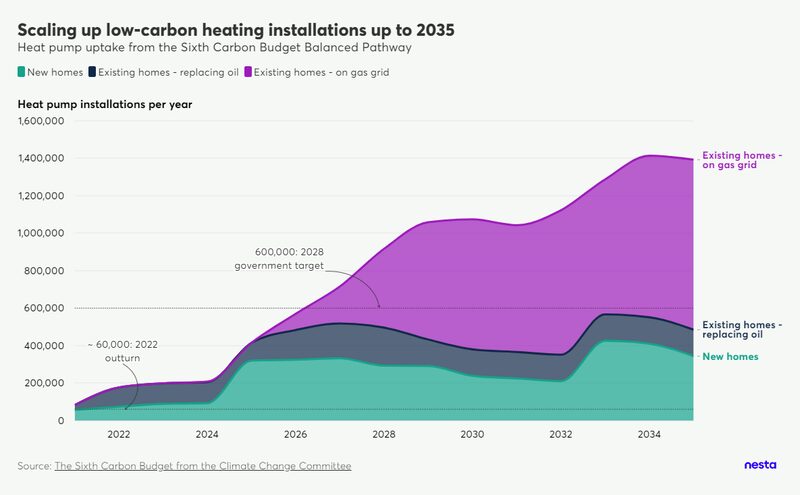
The 600,000 figure originates in the October 2021 Heat and Buildings Strategy, which committed to growing the supply chain for heat pumps to a minimum market capacity of 600,000 installations per year by 20285. It has been restated repeatedly: in the British Energy Security Strategy26, as a Net Zero Strategy metric27, in the strategy's equality impact assessment as scaling up installation to 600,000 per annum by 202828, in the heat pump net zero investment roadmap as annual deployment reaching at least 600,000 a year29, and by the Public Accounts Committee as the department's aim6.
Beyond 2028 the figures in circulation differ. The Environmental Audit Committee records the previous government's target as 600,000 per year by 2028 and up to 1.9 million per year by 20358, while the department projected that annual deployment would need to reach up to 1.6 million installations per year by 203513. More recently, the Carbon Budget and Growth Delivery Plan factsheet states an aim of 450,000 annual installations per year by 2030, 70 per cent of which are targeted to be manufactured in the UK by 203530. These are different framings from different documents and different dates, and they do not reconcile into a single trajectory.
| Milestone | Figure | Source date |
|---|---|---|
| Annual installations by 2028 | 600,0005 | 2021-10 |
| Annual installations by 2030 | 450,00030 | CBGDP factsheet |
| Annual installations by 2035 | up to 1.6 million13 | 2024-07 |
| Annual installations by 2035 | up to 1.9 million8 | 2025-05 |
Delivery is constrained by installers. The Public Accounts Committee found the department faces a substantial challenge to increase the number of trained heat pump installers to support an elevenfold increase in installations6, and the department is aware it will need to significantly increase the number of trained installers to deliver the 2028 target31. It reported a target of 12,000 trained heat pump installers by 2025, against 7,000 trained so far including 3,000 through the Heat Training Grant, and investment of £29 million from 2021-22 to 2024-25 to train installers in the heat sector32. To reach the target, official guidance has said a more mass-market approach will be needed33. Further detail sits on the page dealing with the heat pump installation target.
For households the practical reading is blunt: the grant exists, the standards exist, but the workforce to install at scale does not yet, and the department has still to work out how it will support households to decarbonise where heat pumps are not a practical solution6. The Boiler Upgrade Scheme underspent by £100 million in its first year5.
Hydrogen for heating: a decision promised for 2026
The government committed in its October 2021 Heat and Buildings Strategy to decide on the role of hydrogen for heating in 20266, and the strategy itself states an intention to take strategic decisions on the role of hydrogen in heating buildings in 202634. As of the 2024 committee evidence the department said it remained the case that a decision should be taken in 2026, and that it was still working towards being able to make that strategic decision32.
The evidence base has been weakened. The Public Accounts Committee found the department's work to test hydrogen for heating "beset by problems, with key trials cancelled"6, and recorded that there could not have been a live trial of hydrogen supply to non-domestic properties5. In their place the department said it was drawing on other sources of evidence, including a trial to use hydrogen for home heating across a neighbourhood in Fife, alongside trials in other countries such as the Netherlands and Germany, and was working with the Health and Safety Executive to develop an evidence base around the safety and appropriateness of hydrogen to inform the 2026 decision32.
The department's stated position in the meantime is that heat pumps and heat networks will be the main low-carbon heating technologies over the next decade, with "the potential for hydrogen to play a role in slower time in some locations"5. Its advice to households, as recorded in committee evidence, was that anyone looking to install a heat pump should do so, irrespective of where they live32. The wider policy position is set out on the hydrogen for home heating page.
Consumer protection reform: three principles and a single overseer

The current consumer protection architecture was designed by the department in response to the 2016 Each Home Counts review, which introduced a single quality mark delivered by TrustMark9. The department has since accepted the system's failure in its own words.
Ministers set out three principles for future reform: the system must be simpler and clearer; there must be stronger central oversight with appropriate sanctions; and there must be real accountability with clear redress and remediation9. The 2026 consultation proposes a new integrated consumer protection service for government-supported home upgrades, covering advice, quality assurance and redress, with central oversight held by the department and the intention to delegate that responsibility to the Warm Homes Agency subject to final approvals35. Under the proposal the department would act as the service integrator to ensure operations are efficient, effective and provide a consistent, high-quality experience for consumers, installers and retrofit professionals35.
The reform follows failures in insulation quality under ECO. The National Audit Office recorded that when the department and Ofgem became aware of these issues they responded quickly, and that the two challenges the department now faces are to ensure the relevant businesses meet their obligations to remediate all the affected homes as quickly as possible and to reform the system so that this cannot happen again36. The Public Accounts Committee noted the department had written to say it had no evidence it was notified of problems earlier than October 2024, and that concerns were escalated to its Net Zero Buildings Portfolio Board only in January 2025, once they had materialised9. One concrete change already made: as of March 2025 it is a requirement for retrofit coordinators, who manage the design and installation of measures, to physically visit each project site9. The department also confirmed it had not completed a full fraud risk assessment before ECO4 was implemented in 2022, and that the assessment has since been completed and was being actively managed, with all risks allocated to owners, as of October 20259.
Related routes are covered under installer schemes and consumer codes and energy complaints and redress.
Budget and spending: from £1.4bn resource to £13,381m total
Departmental spending is published in two streams. Spring Budget 2023 set resource departmental expenditure limits for the new department at £1.4 billion in 2022-23, £1.6 billion in 2023-24 and £1.5 billion in 2024-25, with capital limits of £5.9 billion in 2023-24 and £8.2 billion in 2024-25, all in current prices as plans37. The department's 2025-26 annual report gives total departmental expenditure limit spending for the departmental group of £13,381m7.
| Measure | Year | Figure |
|---|---|---|
| Resource DEL | 2022-23 | £1.4bn37 |
| Resource DEL | 2023-24 | £1.6bn37 |
| Resource DEL | 2024-25 | £1.5bn37 |
| Capital DEL | 2023-24 | £5.9bn37 |
| Capital DEL | 2024-25 | £8.2bn37 |
| Total DEL, departmental group | 2025-26 | £13,381m7 |
Programme funding for homes sits inside these envelopes. The Net Zero Strategy announced £3.9 billion of new funding for decarbonising heat and buildings38, and the Heat and Buildings Strategy described a record level of investment of £6.6 billion on clean heat and energy efficiency over that Parliament28. Separately the department reported investing some £868 million in heat networks up to 2028, comprising £338 million to 2025 and £530 million between 2025 and 20285.
Spending announced is not spending delivered. The Boiler Upgrade Scheme underspent by £100 million in its first year5, and the department's plans to rebalance the cost of electricity and gas by moving levies from electricity to gas bills were delayed by nearly two years, with an approach to be set out during 20245. Levy rebalancing bears directly on the running cost of a heat pump against a gas boiler, so the delay has a household consequence rather than only an accounting one.
Schemes DESNZ runs or inherited from BEIS
Every scheme the department owns carries its predecessor's fingerprints. The Assignment of Rights mechanism under the Renewable Heat Incentive was introduced by the former Department for Business, Energy and Industrial Strategy, now the Department for Energy Security and Net Zero39. RHI annual reporting records that from February 2023 the new department became responsible for RHI policy in Great Britain, having been BEIS until 2023 and the Department of Energy and Climate Change until 20162.
| Scheme or function | Department's role | Administrator or deliverer |
|---|---|---|
| Boiler Upgrade Scheme | Policy, legislation, standards, budget, grant values11 | Ofgem |
| Renewable Heat Incentive (GB) | Policy, tariffs, legislative framework, amendments12 | Ofgem |
| Energy Company Obligation | Sets overall policy4 | Ofgem (appointed administrator) |
| Great British Insulation Scheme | Sets overall policy14 | Ofgem |
| Warm Home Discount | Publishes the statistics15 | Suppliers |
| Social Housing Decarbonisation Fund | Publishing department16 | Grant recipients |
| Energy Technology List | Backs the list, annual criteria review18 | Listed products, monthly update |
The department also publishes the consultations that change these schemes: the ECO4 and Great British Insulation Scheme mid-scheme changes consultation was published by the department, with Ofgem responding40, and the minimum energy performance standards for heat pumps options assessment is a departmental consultation41. How that machinery works is set out under energy consultations.
Consumer-facing contact points differ by scheme. Boiler Upgrade Scheme policy complaints go to the department by email42; Feed-in Tariff policy complaints go to the Complaints Manager, Enquiry Unit, Department for Energy Security and Net Zero, 1 Victoria Street, London, SW1H 0ET, telephone 0207 215 500043; Green Deal consumers have a separate departmental email address44. Citizens Advice Scotland states that the department will not talk about an individual case and that points must be put in writing, that it can take a few months to reply, and that possible outcomes are to write off the Green Deal, reduce it, award compensation, offer a settlement figure, or reject the complaint45.
The accountability gap: carbon budgets without all the levers
The department holds a legal duty it cannot discharge alone. The Heat and Buildings Strategy commits to meeting "our legally binding carbon budget contributions, including carbon budgets and net zero commitment"28, but the levers sit across building regulations, devolved administrations, distribution network operators and private installers.
The Climate Change Committee's assessments have repeatedly identified gaps. Its independent assessment of the Clean Growth Strategy found that "Gaps to meeting the fourth and fifth carbon budgets remain. These gaps must be closed."46. Its progress reporting assesses performance at the level of the economy, the non-traded and traded sectors, the key emitting sectors and the devolved administrations47, which is a reminder that a single UK department is not the only unit of account. On Scotland, the committee notes that negative emissions technologies in the draft climate change plan pathway are responsible for around a quarter of the required emissions reduction in the Third Carbon Budget48, an exposure that sits outside the reach of household heating policy entirely. Its sixth carbon budget call for evidence drew just shy of 180 responses, a third more than for its Net Zero report the previous year49.
Programme delivery has slipped in ways committees have recorded. The department delayed its target for pulling together the different plans for decarbonising power from December 2023 to mid-2024, despite the Public Accounts Committee calling for one by autumn 2023 at the latest, against an ambition to decarbonise the power sector by 20355. Its interim evaluation of Boiler Upgrade Scheme uptake among different socio-economic groups was due in the second half of 20245. It has shifted emphasis towards spatial planning, considering overall energy demand at a local level and how to connect low-carbon generation to individual homes, and reported work with the National Infrastructure Commission on building capacity in the distribution network operators to manage increased demand nationally and at street level32.
Where policy is devolved, the department's writ stops. Building standards, and much of heat policy, sit with the Scottish, Welsh and Northern Irish administrations, and Northern Ireland energy regulation sits with the Utility Regulator. RHI policy responsibility is expressly Great Britain only13. The wider framework is mapped on the carbon budgets and net zero targets page and across UK home energy regulation and policy.
What this means for household energy independence
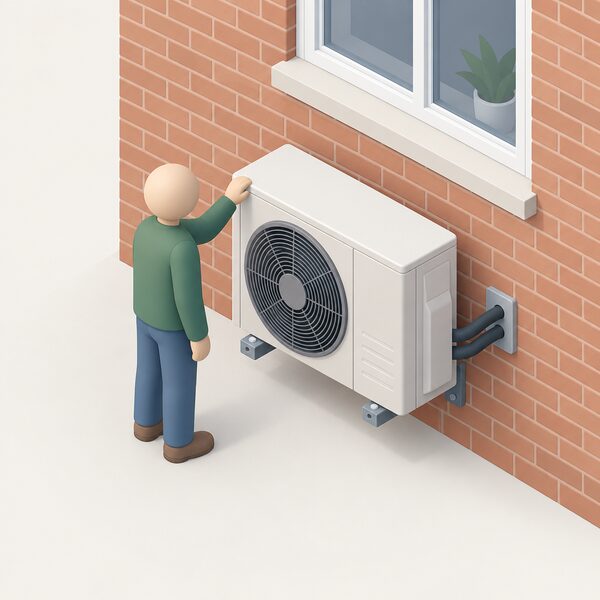
A household that installs a heat pump, insulates a loft or joins a heat network is operating inside a framework this department writes. The grant value, the product standards, the installer certification requirements and the redress route are all policy choices, revisable by ministers, and the evidence above shows they are revised: grant values can be altered11, levy rebalancing has been delayed by nearly two years5, and the consumer protection system is being rebuilt around a proposed Warm Homes Agency35.
Independence from a supplier is therefore not independence from policy. The cost of running an electric heating system relative to gas depends on levy decisions taken here. The availability of an installer depends on a training programme measured at 7,000 installers trained against a target of 12,000 by 202532. The recourse available if an installation fails depends on a protection system the department itself calls fragmented9. The one measurable thing a household controls is the physical asset on the wall; everything around it, including whether the grant that part-funded it still exists next year, is a departmental decision.
The Public Attitudes Tracker, the department's nationally representative annual survey of UK adults aged 16 and over, tracks public awareness, attitudes and behaviours relating to its policies, such as energy and climate change50, covering the remit of the department and formerly BEIS across energy, climate change and net zero51, with dedicated reporting on heat and energy use in the home52. It is the clearest published measure of how far these policies have reached the households they are aimed at.
Sources52 cited
- Energy bills support: an update, National Audit Office, 2023-02
- Domestic RHI Annual Report, Scheme Year 11, Ofgem, 2025-07
- Summary of updates for BUS guidance for property owners v5.1, Ofgem, 2026-07
- Energy Company Obligation: homeowners and tenants, Ofgem, 2026-09-17
- Decarbonising home heating: PAC report, UK Parliament, 2024-05-26
- Decarbonising home heating: PAC summary, UK Parliament, 2024-05-26
- DESNZ Annual Report and Accounts 2025 to 2026: performance report, DESNZ, 2026-08-19
- Retrofitting homes for net zero: committee report, UK Parliament, 2025-05-09
- Energy efficiency installations under ECO: PAC report, UK Parliament, 2026-01-23
- IGEM policy brief: policy asks of our new government, IGEM, 2024-07
- Boiler Upgrade Scheme, Ofgem, 2026-09-17
- Domestic Renewable Heat Incentive, Ofgem, 2026-09-17
- Domestic RHI Annual Report 2023-24, Ofgem, 2024-07
- Great British Insulation Scheme delivery guidance, Ofgem, 2023-08-31
- Warm Home Discount statistics 2025 to 2026, DESNZ, 2026-06-18
- Social Housing Decarbonisation Fund, DESNZ, 2024-05-13
- Energy Innovation Needs Assessment: heating and buildings, DESNZ, 2025-06
- Energy Technology List, GOV.UK, 2015-05-15
- Heat networks regulation: fair pricing protection guidance, Ofgem, 2025-09-29
- Clean Flexibility Roadmap: July 2026 update, DESNZ, 2026
- One million consumers helped by Energy Ombudsman, Energy Ombudsman, 2026-07-07
- Housing Act 2004, Part 6, Chapter 4, legislation.gov.uk
- The Town and Country Planning (Development Management Procedure) Order 2015, legislation.gov.uk
- Energy Efficiency (Private Rented Property) Regulations 2015, regulation 36, legislation.gov.uk
- SI 2026/488, legislation.gov.uk, 2026-04-30
- British Energy Security Strategy, UK Government
- Net Zero Strategy metrics, committee publication, UK Parliament, 2022-05-17
- Equality impact assessment for the Heat and Buildings Strategy, DESNZ, 2023-03-01
- Heat pump net zero investment roadmap, UK Government
- Carbon Budget and Growth Delivery Plan: heat and buildings factsheet, DESNZ
- Environmental Audit Committee report on heat pump deployment, UK Parliament
- Committee evidence on decarbonising home heating, UK Parliament, 2024-05-23
- What impact can heat pumps have in domestic heating today, DESNZ, 2023-11-21
- Heat and Buildings Strategy, UK Government
- Reforming consumer protection for home upgrade schemes, DESNZ, 2026-06-17
- Energy efficiency installations under the Energy Company Obligation, National Audit Office, 2025-10-14
- Spring Budget 2023, HM Treasury, 2023
- UK's path to net zero set out in landmark strategy, UK Government, 2021-10-19
- Domestic RHI guide to assignment of rights, Ofgem, 2022-03-07
- Ofgem's response to the DESNZ ECO4 and GBIS mid-scheme changes consultation, Ofgem, 2025-02-04
- Raising minimum energy performance standards for heat pumps: options assessment, DESNZ, 2024-11-27
- BUS guidance for property owners v5, Ofgem, 2026-03-25
- Feed-in Tariffs dispute resolution, Ofgem, 2026-09-17
- Green Deal energy saving measures, GOV.UK, 2026-09-17
- How to complain about your Green Deal home improvements, Citizens Advice Scotland, 2026-09-17
- Independent assessment of the UK's Clean Growth Strategy, Climate Change Committee, 2018-01
- Meeting Carbon Budgets: 2013 progress report to Parliament, Climate Change Committee, 2013-06
- Progress in reducing emissions in Scotland 2025, Climate Change Committee, 2026-02-25
- The path to net zero: CCC's homework in the year of climate action, Climate Change Committee, 2020-03-05
- DESNZ Public Attitudes Tracker: winter 2025, DESNZ, 2026-03-12
- DESNZ Public Attitudes Tracker technical report, winter 2024 to summer 2025, DESNZ, 2025-12-15
- DESNZ Public Attitudes Tracker: heat and energy use in the home, summer 2025, DESNZ, 2025-10-28
 Grants and Energy IndependenceCan you get a grant for solar panels or a battery?
 Energy Policy in ScotlandWho decides how your home in Scotland is heated and improved?
 The Full Rules and Regulation GuideConfused about who actually decides what you pay for gas and electricity, or why rules differ in Scotland and Wales?
 Energy Independence RulesExamines how the regulatory framework helps or hinders a household trying to generate, store and use its own energy, from connection rules to export arrangements and metering obligations.
 Energy Policy in WalesWhat help can you get in Wales to make your home warmer and cheaper to run?
 Devolved vs Reserved PowersWho decides what you pay for gas and electricity, and who decides how your home is insulated or improved?