

In this answer
Short answer
Northern Ireland does not publish a single headline figure for the share of its homes at EPC band C or above, and the reason is structural rather than statistical laziness. The province has no minimum energy efficiency standard for its housing stock, so there is no compliance threshold forcing a count. The Energy Saving Trust's solar panel calculator states plainly that EPC data for Northern Ireland is not included in its database, so users must select "my address isn't listed" and enter their details by hand1. Band C itself is a score of 69 to 80 on the EPC scale, with band G running from 1 to 20 as the least efficient2.
What is known points in an unexpected direction. The latest comparable data shows that homes in Northern Ireland had the highest average energy efficiency rating across the UK3. That sits alongside a housing stock that is heavily oil heated and largely off the gas grid, which is the central tension this page works through.
Northern Ireland's EPC position: no minimum energy efficiency standards
Northern Ireland stands apart from the rest of the UK in having no minimum energy efficiency standard for domestic private rented property. In England and Wales, landlords must comply with the 2018 Minimum Level of Energy Efficiency standard, which sets EPC band E as the floor for domestic private rented property9. The UK Government has proposed raising that minimum to band C by 2030 for domestic private rented properties, but the proposal is not yet in force10.
Scotland has moved further still. The draft Energy Efficiency (Domestic Private Rented Property) (Scotland) Regulations were consulted on in 2025, and the National Insulation Association's response notes that 48% of households in properties within EPC bands F or G are fuel poor, compared with 32% in properties rated band C or better11. That is the kind of evidence base a minimum standard rests on, and Northern Ireland has not built the equivalent.
For a household, the practical consequence is that an EPC in Northern Ireland is a disclosure document rather than a compliance lever. It must be made available to buyers and new tenants, and advice on EPCs, or on an EPC that has not been provided, comes from the local district council building control service12. Nothing in that process requires a home to reach any particular band.
Why so many homes sit in lower bands: oil heating and the building stock
The dominant reason Northern Ireland homes cluster in lower bands is heating fuel. More than two-thirds of Northern Ireland households use oil boilers as their main source of heating4. Census 2021 estimates for the number of households by type of central heating give the household-based picture, and the classification shows how far oil reaches into the stock13.
Oil heating drags an EPC down for reasons that have nothing to do with the boiler's efficiency. An EPC scores the cost of running the home, and oil is priced per litre delivered by tanker, with no equivalent of the gas network's standing arrangements. A dwelling with a modern condensing oil boiler can still score poorly if the fabric is thin. The pattern is visible in the Scottish house condition data, where dwellings in the lowest energy efficiency bands (F and G) are more likely to be older pre-1919 dwellings (9%), non-gas fuelled (12% for electric, 9% for oil, 11% for other fuels), detached (5%), off the gas grid (14%) and in rural areas (10%)14. Northern Ireland shares most of those characteristics.
The building stock compounds it. Northern Ireland has a large rural housing component and a substantial pre-1919 stock, both of which correlate with solid walls and limited cavity insulation. The Climate Change Committee's advice for Northern Ireland's fourth carbon budget sets out an aim that by 2040 more than two-thirds of homes are heated by low-carbon electric heating, predominantly heat pumps8. That is a modelled pathway rather than a forecast, and it implies a retrofit programme on a scale the current grant landscape does not fund.

Fuel poverty and the 10% indicator

Northern Ireland measures fuel poverty differently from England. The 10% indicator defines a household as fuel poor if it is required to spend in excess of 10% of its household income on all fuel use, to maintain 21°C in the main living room and 18°C in other occupied rooms15. The Chartered Institute of Plumbing and Heating Engineering states the same threshold in simpler terms: any household that needs to spend more than 10% of its income on energy costs5.
The band a home sits in tracks fuel poverty closely. In Scotland, the fuel poverty rate by EPC band runs at 32% for households in band D, with an extreme fuel poverty rate of 16% for dwellings in band D and 27% for dwellings in band E14. In Wales, households living in dwellings rated bands A to C are the least likely to be fuel poor, at 15%15. Those are not Northern Ireland figures, but they show the gradient that any Northern Ireland strategy has to work against.
The relationship runs in both directions. A home in band F or G costs more to heat, so its occupants are more likely to cross the 10% threshold; a household on a low income is less able to fund the insulation that would lift the band. The Northern Ireland energy bill reduction scheme, paid for through £81 million in funding, is one response to that16.
"Any household that needs to spend more than 10% of its income on energy costs."
Grants and support: what is and isn't available
The grant landscape in Northern Ireland is narrower than in England, Wales or Scotland, and several schemes that households elsewhere take for granted do not operate. The Warm Home Discount Scheme does not run in Northern Ireland; it covers England, Wales and Scotland only17. An Affordable Warmth Scheme operates instead17. The Energy Company Obligation, which funds efficiency measures across Great Britain, does not extend to Northern Ireland either.
What does exist is delivered through NISEP and through NI Energy Advice. For heat pumps specifically, there is no specific grant currently available in Northern Ireland, though households can still prepare for one and apply for funding for insulation via NI Energy Advice18. That is the honest position: the fabric measures are fundable, the heating appliance is not.
| Scheme | What it covers | Northern Ireland status |
|---|---|---|
| Warm Home Discount | Electricity bill rebate | Does not run in Northern Ireland17 |
| NISEP | Fully or part-funded efficiency improvements | Operates across Northern Ireland19 |
| NI Energy Advice insulation funding | Insulation measures | Available18 |
| Heat pump grant | Heat pump installation | No specific grant currently available18 |
| Home Heating Oil Support Scheme | £100 voucher for oil users | Around 340,000 eligible households7 |
The Warm Homes: Local Grant, which targets band C for properties in England, is not a Northern Ireland scheme, and its rules illustrate how differently the funding is structured elsewhere: privately rented properties with an EPC rating of band D or E are eligible, and landlords must not have exceeded £315,000 in minimum financial assistance under government rules20. The Warm Homes: Social Housing Fund supports social landlords upgrading homes below EPC band C, and funding for measures taking a home from EPC C to band B or beyond must be entirely funded by the grant recipient22.
NISEP and the schemes funding efficiency work
The Northern Ireland Sustainable Energy Programme is the main funding route for domestic efficiency work in the province. It is an £8 million fund collected from both domestic and non-domestic electricity customers6. It operates as a collection of energy saving schemes across Northern Ireland offering fully funded or part-funded energy efficient home improvements, varying by location, tenure and income19. Work under NISEP is either fully funded or requires a contribution depending on the level of household income25.
The programme has a defined life. The Utility Regulator extended it for two years, running from 1 April 2027 to 31 March 2029, with a break clause allowing it to close after the first year if the Department for the Economy's successor scheme is fully developed26. That break clause matters for any household planning work beyond 2028: the funding route is not guaranteed to the end of the extension.
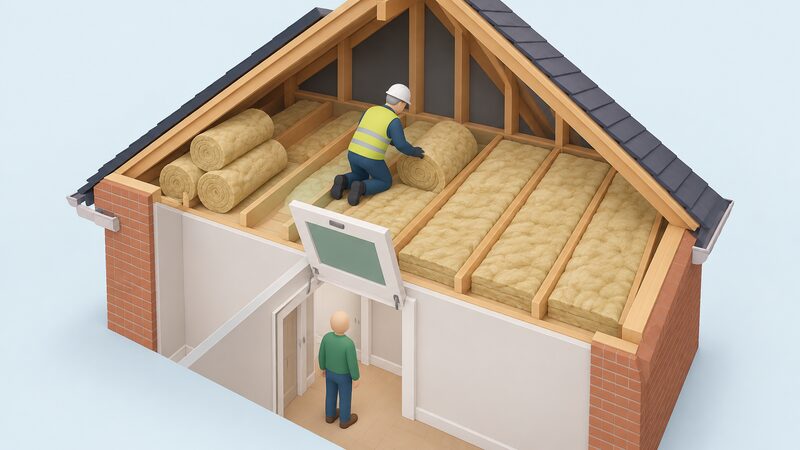
For a household, NISEP's value is that it reaches measures the market does not fund on its own, particularly insulation for lower income homes. Its limit is scale. An £8 million annual fund spread across the province's housing stock will not lift a significant share of homes from band E or F to band C, and it does not fund heat pumps. The programme is a fabric-first intervention, which is the correct order of operations but a slow one.
How Northern Ireland compares with the rest of the UK
The comparison is genuinely mixed, and it does not resolve into a simple story of Northern Ireland lagging. On average energy efficiency rating, the latest comparable data shows Northern Ireland homes had the highest average rating across the UK3. On minimum standards, Northern Ireland has none for private rented property, while England and Wales enforce band E and Scotland has consulted on its own regulations9.
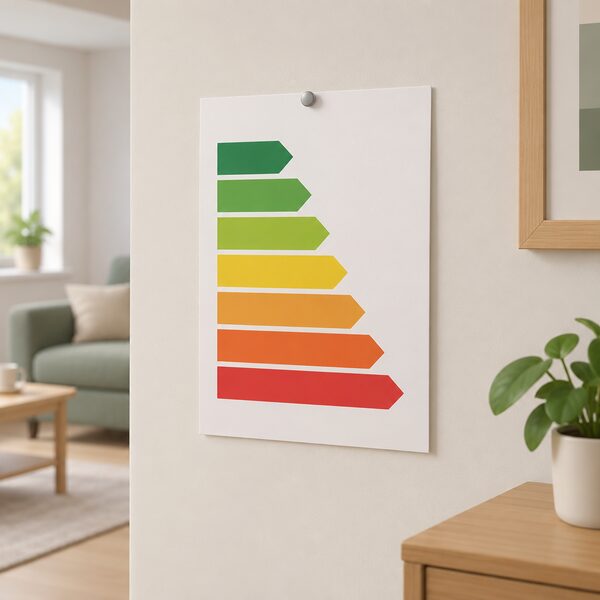
The EPC scale itself is common across the UK: band C is 69 to 80, band G is 1 to 202. What differs is the distribution. In England and Wales, Tower Hamlets in London stands out as the local authority with the highest percentage of housing in band C or above, at 82% of dwellings with a valid EPC registering a score of 69 or above2. No Northern Ireland district has a published equivalent.
The electricity carbon intensity also differs, which affects how a heat pump performs on paper. Northern Ireland's electricity standard rate carries a carbon dioxide equivalent factor of 0.163 kgCO2e/kWh, the same figure applying to on-peak Economy 7 electricity27. That is a lower carbon intensity than the Great Britain average, which strengthens the case for electrified heating in Northern Ireland on carbon grounds even where the grant funding is absent.
For household energy independence, the picture is this: a Northern Ireland home with insulation and a heat pump plus solar would be substantially independent of delivered fuel, but the funding to get there is thinner than elsewhere, the grid connection remains, and the smart meter rollout that would let a household manage an electrified home intelligently does not begin until 2028. Until then, oil dependence is the default for more than two-thirds of households4.
Sources27 cited
- New calculator shines a light on solar panels, Energy Saving Trust, 2026-08-17
- Energy efficiency of housing in England and Wales, Office for National Statistics, 2025-10-28
- Energy efficiency of housing in England and Wales, House of Commons Library, 2026-09-17
- Central heating, nidirect, 2026-09-17
- Fuel poverty, Chartered Institute of Plumbing and Heating Engineering, 2026-09-17
- Northern Ireland Sustainable Energy Programme, House of Commons Library, 2026-05-13
- Lyons announces opening date for Home Heating Oil Support Scheme, Department for Communities, 2026-08-26
- Northern Ireland's fourth carbon budget, Climate Change Committee, 2025-03-19
- Minimum Energy Efficiency Standards, Carmarthenshire County Council, 2026-09-20
- Trading standards guidance, Isle of Anglesey County Council, 2026-05
- Consultation on draft Energy Efficiency (Domestic Private Rented Property) (Scotland) Regulations, National Insulation Association, 2025-09-03
- Energy Performance Certificates, nidirect, 2026-02-26
- CT0082 Central heating, Northern Ireland Statistics and Research Agency, 2024-02-12
- Scottish House Condition Survey 2024: Key Findings, Scottish Government, 2026-02
- Fuel poverty modelled estimates for Wales, Welsh Government, 2024-10
- Fuel poverty, House of Commons Library, 2026-08-06
- Warm Home Discount Scheme, Ofgem, 2026-09-17
- Ground source heat pumps, Energy Saving Trust, 2026-07-16
- NISEP, Energy Saving Trust, 2026-09-14
- Warm Homes Local Grant, Greater Manchester Combined Authority, 2026-09-17
- Warm Homes Local Grant 2025 to 2028, Birmingham City Council, 2026-09-20
- Warm Homes: Social Housing Fund Wave 3 scheme guidance, Department for Energy Security and Net Zero, 2026-06
- ECO scheme to end after March 2026, Elmhurst Energy, 2025-11-27
- Loan standard terms and conditions: Green Homes Wales, Development Bank of Wales, 2026-09-17
- Financial support for home energy, Energy Saving Trust, 2026-09-07
- Extension announced for Northern Ireland Sustainable Energy Programme, Utility Regulator, 2026-04-02
- Our data, Energy Saving Trust, 2025-11-01
 Housing Stock and EPCsNorthern Ireland's homes score best in the UK for energy efficiency, yet most run on heating oil.
 Housing Stock Data for NIMost homes in Northern Ireland heat with oil, so why are the grants and help different from the rest of the UK?
 New Build Energy PerformanceHow energy efficient are new build homes compared with older ones?
 EPC StatisticsHow energy efficient are UK homes, and is it getting better?
 Housing Stock Data for ScotlandScotland's housing is measured differently from England's, so the numbers you see may not compare directly.
 Setting a TargetWhat should you aim for when improving your home: a better EPC band, lower bills, or a low-carbon heating system?