
In this answer
Short answer
Northern Ireland's housing stock is often described as the most efficient in the UK by average rating, and the comparable data supports that: homes in Northern Ireland had the highest average energy efficiency rating of the four nations1. That headline sits awkwardly beside the other numbers a householder will meet. More than two-thirds of Northern Ireland households use oil boilers as their main source of heating2, and 24% of all households were in fuel poverty in the latest estimates, for 20213.
The reason both things can be true at once is that an EPC score measures a property, not a household's bills. An EPC score typically ranges from 1 to 1004, and it is generated from the building's fabric, heating system and controls rather than from what the occupant actually spends. A well-insulated house with an old oil boiler can rate respectably while still costing a great deal to run, particularly where there is no gas grid to fall back on.
For a household thinking about independence, the average rating is a benchmark rather than a target. It tells you where the stock sits, not where your home sits, and it says nothing about the two dependencies that shape Northern Ireland energy most: imported heating oil and a grid with a renewable electricity target still ahead of it.
What the average EPC rating in Northern Ireland tells you
The average rating is a stock measure. It is calculated across the whole housing stock, so it blends new-build homes that meet current building regulations with older rural properties that predate any thermal standard at all. A single average therefore hides a wide spread, and the spread is where the practical information lives.
The scale itself is straightforward. An EPC score typically ranges from 1 to 1004, and that score is banded from A at the top down to G. The band matters more than the number for most purposes, because grant eligibility, lending criteria and social housing standards are all written in bands rather than points.
Northern Ireland's position at the top of the four-nation comparison is a genuine finding, but it needs care. The comparison is of average ratings, and averages are sensitive to the mix of properties in each nation. Northern Ireland has a relatively large rural housing stock and a different tenure mix from England, and both affect what the average looks like.
What the average does not tell you is how any individual home performs, what it costs to run, or whether it is eligible for anything. For that, a household needs its own certificate. The certificate is also the document a buyer or tenant is entitled to see, and where one has not been made available, official guidance is to contact the local district council building control for advice1.
For energy independence, the average is a starting point rather than an answer. A high average rating across the stock does not reduce any individual household's exposure to oil price movements, and it does not by itself lower a bill. It indicates that the fabric of Northern Ireland homes is, on average, reasonably sound, which means the remaining gains are more likely to come from the heating system and its controls than from the walls.
Why Northern Ireland homes rate lower: oil heating and no efficiency standards
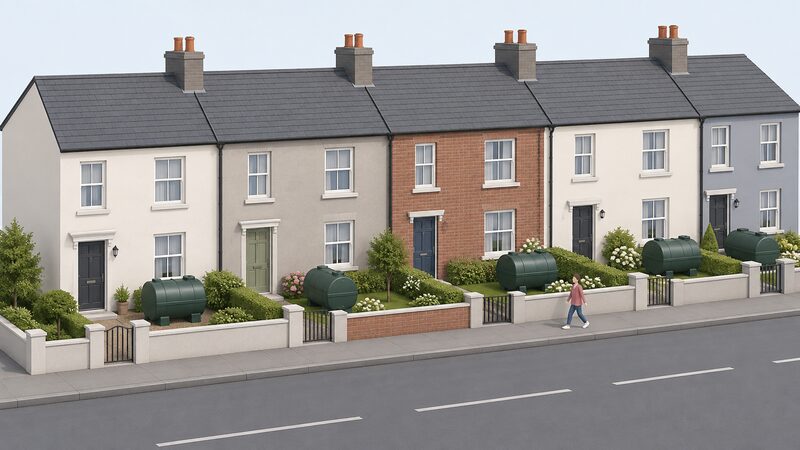
The central fact is heating fuel. More than two-thirds of Northern Ireland households use oil boilers as their main source of heating2, and oil central heating is much more common for households in Northern Ireland, many of which are not connected to a gas grid network7. Where there is no mains gas, the practical alternatives have historically been oil, solid fuel or electricity, and oil has dominated.
That dependence has a direct effect on ratings. An EPC reflects the cost and carbon of the heating system as well as the insulation, so a home heated by oil carries a penalty relative to an equivalent home on mains gas, even where the fabric is identical. The result is that two similar houses on either side of the Irish Sea can hold different bands for reasons that have nothing to do with how well they are built.
There is a second factor: the absence of a legal floor. Northern Ireland currently has no statutory fuel poverty targets and no minimum energy efficiency standards5. Without a minimum standard, there is no point at which a low-rated home must be improved before it is let or sold, and no compliance mechanism pulling the bottom of the stock upwards. In Great Britain, by contrast, minimum standards in the private rented sector have acted as a floor for years.
The rating methodology itself is under review. The Climate Change Committee has told both the UK government and the Scottish government that the current EPC rating metrics do not accurately incentivise the energy efficiency and heating solutions required to deliver Net Zero homes8. That criticism applies to the metric, not to Northern Ireland specifically, but it matters here because a stock dominated by oil heating is exactly the case a fabric-weighted metric handles poorly.
"The current EPC rating metrics do not accurately incentivise the energy efficiency and heating solutions required to deliver Net Zero homes"
The practical consequence for a household is that the band on a certificate is a guide to the building, not a verdict on its running costs. A home can be pushed up a band by insulation alone while its oil boiler remains the dominant cost and the dominant source of emissions. Independence, in the sense of not being exposed to a delivered fuel price, requires changing the system, not just the fabric.
Fuel poverty and what it means for ratings
Fuel poverty in Northern Ireland is measured on the 10% indicator: a household is fuel poor if it needs to spend more than 10% of its income on energy costs10. The official formulation is more precise, defining the household as one required to spend in excess of 10% of its household income on all fuel use to maintain 21°C in the main living room and 18°C in other occupied rooms3. The same 10% threshold appears in the consultation on the Warm Healthy Homes Fund, which describes fuel poor households as those needing to pay more than 10% of full household income to maintain a satisfactory heating regime at an affordable cost11.
The rate is high. The latest fuel poverty estimates for Northern Ireland are for 2021, when an estimated 24% of all households were defined as fuel poor3. Independent guidance puts the figure at 22% of Northern Ireland's population in fuel poverty6. The two figures come from different bases, one counting households and the other counting people, and they are not directly comparable.
The lived experience behind those numbers is stark. In a survey cited by the National Energy Action Northern Ireland manifesto, 19% of households said they went without heating (oil or gas) or electricity because of not being able to afford the cost5. That is a measure of self-disconnection and rationing rather than of arrears, and it points to the same underlying issue: a stock that is reasonably efficient on average but heated by a fuel whose price a household cannot control.
Fuel poverty and EPC ratings are related but distinct. A home can be in band D and still be affordable if the occupants are on a high income and heat it modestly; a home in band C can be in fuel poverty if the occupants are on a low income and the fuel is expensive. The 10% indicator captures the second case, which is why Northern Ireland's fuel poverty rate is not simply a mirror of its average EPC band.
For independence, the fuel poverty measure is the more honest indicator of household exposure. It counts what a household must spend to stay warm, which is the number that changes when oil prices move. The EPC band changes only when the property changes.
Grants and support: what is and isn't available
Support in Northern Ireland is narrower than in Great Britain, and the differences are structural rather than temporary. The Warm Home Discount Scheme does not run in Northern Ireland, official guidance confirms, though an Affordable Warmth Scheme is available12. The scheme's territorial extent is England, Wales and Scotland, and it is not available in Northern Ireland13.
The main energy efficiency funding route is the Northern Ireland Sustainable Energy Programme, administered by the Utility Regulator. At least 80% of the funding is available to vulnerable or priority customers14. The programme's schemes for 2026/2027 have been approved and published15, and the 2024/2025 annual report sets out outturns for spend, savings and properties treated14.
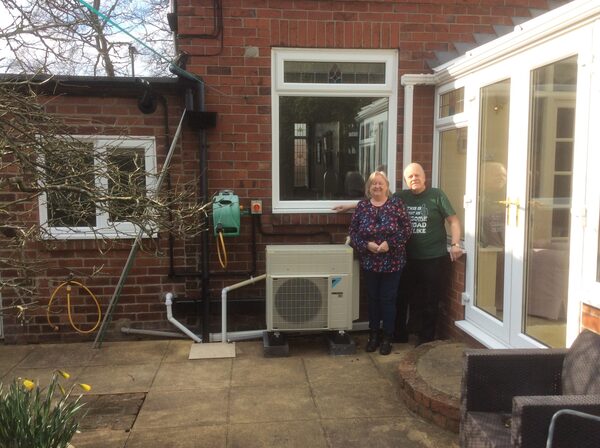
For heat pumps specifically, the position is limited. Independent guidance states that if you live in Northern Ireland there isn't a specific grant currently available, but that a household can still get heat pump ready16. That is a meaningful distinction: fabric measures and emitter upgrades can be done ahead of any future grant, and they are the same measures that improve an EPC band.
Other routes exist but are not energy-specific. Disabled Facilities Grants in Northern Ireland provide up to £25,00017. The Warm Homes: Local Grant in England is restricted to owner occupied properties with an EPC rating of band D, E, F or G18, and it does not extend to Northern Ireland; it is included here only to show how eligibility is written elsewhere.
During the energy price guarantee period, Northern Ireland received per-unit support of up to 13.6 p/kWh for electricity and 3.9 p/kWh for gas in Q1 202319. A separate official statistics release gives a lower figure of up to 3.8 p/kWh for electricity and 2.6 p/kWh for gas for the same period19. The two figures are not reconciled in the documents, and the difference is material for anyone comparing support levels across nations.
The pattern for a household is that Northern Ireland's support is targeted at vulnerability rather than at decarbonisation. That keeps help flowing to those least able to pay, but it leaves the general householder with fewer routes to fund a heating system change, which is the measure that would most reduce exposure to oil.
Smart meters and the rollout timetable
Northern Ireland has not yet begun domestic smart meter installation. As of early 2026 no smart electricity meters had been installed in homes in Northern Ireland6. The Department for the Economy has announced plans for the rollout of smart meters for all homes in Northern Ireland, starting in 20286.
The framework that governs Great Britain does not apply here. Ofgem's supplier smart metering installation targets ran between 1 January 2022 and 31 December 202520, and that obligation covers Great Britain rather than Northern Ireland. Northern Ireland's electricity metering sits with a different regulator and a different network operator.
When the rollout does arrive, the mechanics are described by the Consumer Council. Smart meters record electricity usage in much the same way as a traditional meter but can automatically send consumption information to NIE Networks at regular intervals6. The stated benefits are reducing electricity costs, more accurate bills, supporting a more reliable electricity network, and helping Northern Ireland meet its net zero emissions targets6.
For a household, the delay has a direct consequence for independence. Without a smart meter, there is no half-hourly consumption data, no time-of-use tariff structure of the kind available in Great Britain, and no easy way to match a heat pump or an electric vehicle to cheap overnight electricity. A household can still install solar and a battery, but the metering arrangements limit how much value can be extracted from them.
The connection rules for generation are also distinct. In Northern Ireland, connection requirements are governed by the Electricity Safety, Quality and Continuity Regulations (Northern Ireland) 2012 and Engineering Recommendation G98/NI21. That is the technical framework a household meets when it connects a generating installation, and it is separate from the Great Britain equivalent.
How ratings connect to Northern Ireland's net zero target
Northern Ireland has a legislated 2050 Net Zero target22, and the Climate Change Committee's advice is that targets consistent with that legislated goal can be built using a speculative option based on direct air capture22. The same advice is blunt about the arithmetic: even with radical actions, Northern Ireland does not reach Net Zero in 205022.
The scale of the task is set out in the Committee's pathway work. Northern Ireland's contribution rises to 5% of that needed to meet the 2050 Net Zero target23. That is a small share of the UK total, reflecting the size of the nation, but it is a large share of Northern Ireland's own emissions, which are concentrated in buildings and in agriculture.
Housing is central to closing the gap because of the heating fuel. A stock where more than two-thirds of households heat with oil2 cannot reach a net zero trajectory without changing those systems, and the EPC metric as currently constructed does not reward the right changes8. That is the tension at the heart of the ratings question: the average rating looks good, but the average rating is not the measure that tracks decarbonisation.
On electricity, the Northern Ireland Executive has a target for at least 80% of electricity consumption to come from renewable sources by 203024. That is a consumption target, and it addresses the grid side of the equation rather than the household side. A household that electrifies its heating benefits from a cleaner grid, but only if the grid reaches that share.
For a household, the connection between ratings and the net zero target is indirect but real. A higher band reduces the energy a home needs; a changed heating system reduces the carbon it emits. The first is achievable with insulation and controls, and the second requires a heat pump or another low carbon system, for which there is currently no specific grant in Northern Ireland16. That gap between the target and the support is the practical constraint a household faces.
Sources24 cited
- Energy Performance Certificates, nidirect, 2026-02-26
- Central heating, nidirect, 2026-09-17
- Fuel poverty in Northern Ireland, House of Commons Library, 2026-08-06
- Energy efficiency of housing in England and Wales, Office for National Statistics, 2025-10-28
- NEA NI Manifesto for Homes 2024, National Energy Action, 2024
- Smart meters, Consumer Council for Northern Ireland, 2026
- Oil central heating, Which?, 2026-06-01
- Letter: reform of domestic EPC rating metrics to Lee Rowley MP, Climate Change Committee, 2026-09-19
- Letter: reform of domestic EPC rating metrics to Patrick Harvie MSP, Climate Change Committee, 2026-09-19
- Fuel poverty, Chartered Institute of Plumbing and Heating Engineering, 2026-09-17
- Warm Healthy Homes Fund consultation, Department for Communities, 2026-05
- Warm Home Discount, Ofgem, 2026-09-17
- The Warm Home Discount scheme, House of Commons Library, 2026-02-26
- NISEP 2024/2025 annual report, Utility Regulator, 2026-07-03
- NISEP list of schemes 2026/2027, Utility Regulator, 2026-04-01
- Ground source heat pumps, Energy Saving Trust, 2026-07-16
- Disabled Facilities Grants: what you'll get, GOV.UK, 2026-09-17
- Warm Homes: Local Grant, Greater Manchester Combined Authority, 2026-09-17
- Energy price guarantee support, House of Commons Library, 2026-08-28
- Supplier smart metering installation targets, Ofgem, 2026-09-17
- Plug-in solar consultation, Department for Energy Security and Net Zero, 2026-06-16
- Advice report: the path to a net zero Northern Ireland, Climate Change Committee, 2026-09-19
- Northern Ireland's fourth carbon budget, Climate Change Committee, 2025-03-19
- UK Solar Roadmap, Department for Energy Security and Net Zero, 2030
 Housing Stock and EPCsNorthern Ireland's homes score best in the UK for energy efficiency, yet most run on heating oil.
 Housing Stock Data for NIMost homes in Northern Ireland heat with oil, so why are the grants and help different from the rest of the UK?
 New Build Energy PerformanceHow energy efficient are new build homes compared with older ones?
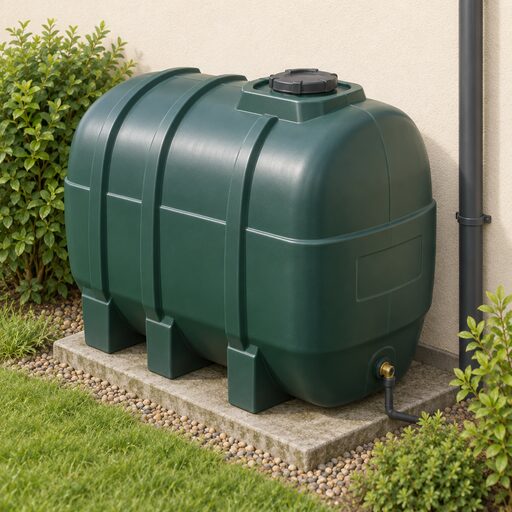 Fuel PovertyWhy does Northern Ireland have such a high rate of fuel poverty, and how many households are affected?
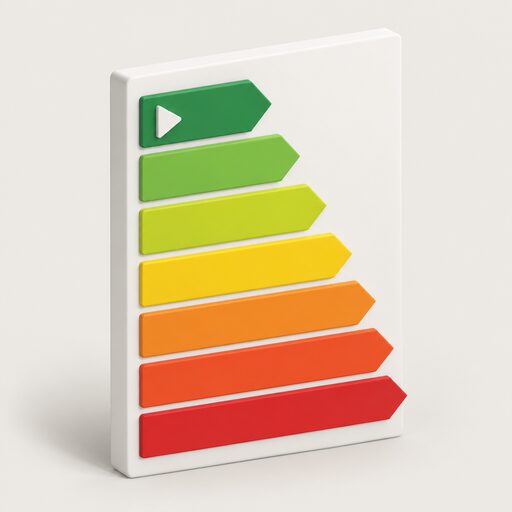 Energy Performance CertificatesAn Energy Performance Certificate rates how energy efficient your home is, from A down to G.
 Home HeatingWhy do so many homes in Northern Ireland run on heating oil, and will that ever change?