

In this answer
Short answer
Yes, a heat pump can lower an EPC rating. The reason is not the heat pump's efficiency but the way the certificate is scored: EPC ratings are based on the costs of home heating, rather than its carbon footprint, which means that cheaper heating scores better1. Replacing a gas boiler with a heat pump can, in fact, reduce a property's EPC score, which can negatively impact the property's value1.
The same certificate carries a second figure. All EPCs also have an environmental rating, and this rating will always improve dramatically if you switch from gas to a heat pump, while the main EPC rating is likely to stay roughly the same and could end up slightly lower or higher2. So the answer depends on which number is being read, and on which number the rule in front of you refers to.
For a household, this matters most where an EPC band is a legal threshold rather than a piece of information: the private rented minimum standard, grant eligibility, and the tariff a solar installation attracts. The sections below set out the mechanism, the scale, the landlord rules, the exemptions, and the reform that may change the calculation.
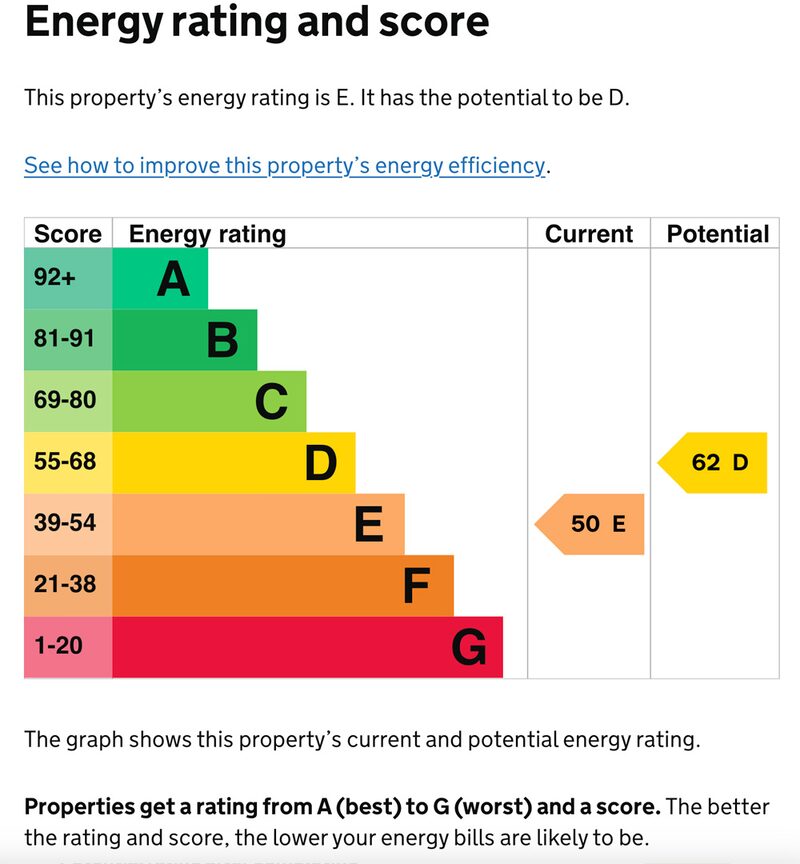
How EPC ratings work: the A to G scale and what the score measures
An EPC rates how energy efficient a building is, with ratings from band A (very efficient) to band G (inefficient)7. The same scale is described in Scottish guidance as ranging from "A" (very efficient) to "G" (very inefficient)8, and in local authority guidance as an A to G scale with G being the least energy efficient9. The band is a summary of a modelled score, not a measurement taken in the home.
What sits underneath that score is the crux of the heat pump question. EPC ratings are based on the costs of home heating, rather than its carbon footprint, which means that cheaper heating scores better1. A fuel that costs less per unit of delivered heat will therefore flatter the rating, regardless of the emissions it produces. That is why the certificate can reward a gas boiler over an electrically driven heat pump even where the heat pump delivers more heat per unit of energy input.
The certificate is not only a band. Each EPC comes with a report setting out cost effective measures to improve energy efficiency and the energy rating, such as low energy bulbs or upgrading insulation10. The recommendations report provides more detailed information about improvement measures11. Those recommendations are modelled from the same cost assumptions as the band itself, so a recommendation to switch heating fuel will be judged on running cost as well as on carbon.
Scotland has consulted on replacing the single headline figure. Its proposed domestic rating would use a Heat Retention Rating on an A to G scale, showing a current and potential rating, alongside a Heating System Rating and an Energy Cost Rating12. That structure separates the fabric of the building from the heating equipment and from the running cost, which is precisely the separation the current single band does not make.
Why the cost-based calculation penalises heat pumps
The mechanism is straightforward once the cost basis is accepted. The price of electricity is inflated by environmental and social levies, with the result that a heat pump can be more expensive to run than a gas or oil boiler13. The Public Accounts Committee put the same point plainly: electricity prices mean that heat pumps can be more expensive to run14. Where the rating follows running cost, a more expensive fuel loses.
Independent analysis has been blunt about the consequence. EPCs continue to favour intensive gas heating over low carbon technologies such as air source heat pumps, owing to the focus on energy costs within the current Energy Efficiency rating15. The Energy Systems Catapult's finding is that the certificate is working against the direction of travel rather than with it.
The penalty is not automatic, and it is not the same in every home. Croydon Council's retrofit guidance notes that if a home is not well insulated, installing a heat pump may increase energy bills instead, because electricity is more expensive than gas16. In a poorly insulated home the coefficient of performance can drop to around 2 or even lower units of heat per unit of electricity17, which narrows or reverses the running cost advantage a well-installed system would have.
Cold weather compounds it. During winter, the air temperature can drop by 5°C or more overnight, which reduces the heat pump's efficiency because it is heating water to a high temperature18. Lowering the flow temperature reduces the reaction time of the heating system and has a big impact on running costs18, so the way the system is set up and run feeds directly back into the modelled cost and therefore into the band.
"EPCs continue to favour intensive gas heating over low carbon technologies such as air source heat pumps (ASHPs)"
What this means for landlords and the minimum E rating
For landlords, the band is not advisory. Guidance for landlords of domestic, private rented property covers compliance with the 2018 "Minimum Level of Energy Efficiency" standard, EPC band E4. In England and Wales the minimum standard of energy efficiency of certain domestic rented property is a rating of E or above19. Since April 2020, landlords can no longer let or continue to let properties covered by the MEES Regulations if those properties fall below that threshold, unless a valid exemption applies20.
The practical risk is a property sitting at band E on a gas boiler. If a heat pump installation moves the modelled running cost the wrong way, the band can slip to F, and a letting that was lawful becomes unlawful without any change to the fabric of the building. Properties let with an EPC rating of F or G must be improved to a minimum rating of E or an exemption registered where applicable4.
The direction of future regulation raises the stakes further. Under the Clean Flexibility Roadmap, landlords will be required to ensure their properties meet a minimum score of EPC C against the fabric performance metric and either the heating system or smart readiness metric, from 1 October 203020. That is a different test from the current single band, and it is built on the fabric and the heating system rather than on running cost alone.
| Rule | Threshold | Applies to | Date |
|---|---|---|---|
| Minimum Level of Energy Efficiency standard | EPC band E | Domestic private rented property | 2018 standard4 |
| MEES Regulations letting restriction | Band E or above | Private rented sector, England and Wales | Since April 202020 |
| Clean Flexibility Roadmap landlord requirement | EPC C on fabric metric plus heating system or smart readiness metric | Private rented homes | From 1 October 203020 |
When you need an EPC and how much one costs

An EPC is required at the point of sale, at the point of a new tenancy, and in various other circumstances set out in official guidance21. In Northern Ireland the certificate is administered under its own arrangements22, and Scotland publishes separate guidance for buildings for let23. The trigger points differ by nation, so the requirement should be checked against the nation the property sits in.
The certificate cannot be produced remotely. An EPC can only be produced by an accredited energy assessor who will visit the property to carry out an assessment10. Qualified assessors can be found on the EPC register21. Online services may handle the booking or store the finished document, but the assessment itself is a visit.
On price, the cost of the EPC will vary from one company to another and you will have to shop around for the best price3. One published figure puts a new EPC at around £60 to £120, depending on the size and location of the home4. Size, location and age of the building all bear on what an assessor quotes3.
The band also reaches into other schemes. For solar PV installations wired to provide electricity to a building, the higher tariff rate requires an EPC with a rating of level D or higher at the time of the commissioning date, otherwise the lower rate applies24. The Nest scheme in Wales requires a home to have an EPC rating of 54 (E) or less to qualify5. In both cases the band is a gate, and a heat pump that moves it can move eligibility with it.
Could EPC reform fix the heat pump problem?
The case for reform is now made by official bodies rather than by campaigners. The Climate Change Committee has stated that the current EPC rating metrics do not accurately incentivise the energy efficiency and heating solutions required to deliver Net Zero homes25. It has repeated the finding in correspondence on the reform of domestic EPC rating metrics26. The Scottish Government's own review found that EPC ratings do not always capture the true efficiency of a retrofit, noting that measures like PV panels or air source heat pumps may improve an EPC score but fail to address fundamental building issues such as poor insulation or moisture risks27.
The proposed replacement separates the components. Scotland's consultation response sets out a Heat Retention Rating reflecting fabric energy efficiency, a Heating System Rating covering type, emissions and efficiency, and an Energy Cost Rating6. Under that structure a heat pump would be judged on the heating system metric for its emissions and efficiency, while the running cost consequence would sit in its own figure rather than dragging the headline band down.
The Committee's conditions for reform are specific. Reforms to EPC rating metrics should be applied alongside wider improvements to the EPC system to improve the quality of assessments and use of data25. Separately, the Parliamentary Office of Science and Technology has noted that reducing the price of electricity relative to gas would make heat pumps more competitive28, which addresses the running cost at source rather than through the metric.
None of this is yet in force for the headline band in England, Wales or Northern Ireland. Until it is, the cost basis stands, and a household or landlord weighing a heat pump against an EPC threshold is working with a rating that measures running cost rather than carbon. For the wider picture of how a heat pump changes a home's exposure to fuel markets and the grid, see heat pumps and household energy independence, and for the equipment itself, air source heat pumps.
Sources28 cited
- Energy Security and Net Zero Committee report, UK Parliament, 9 May 2025
- Heat pump questions answered, Energy Saving Trust, 27 May 2026
- Trading standards guidance: Energy Performance Certificates, Isle of Anglesey County Council, September 2025
- Minimum energy efficiency standards, Carmarthenshire County Council, 20 September 2026
- Nest eligibility, Welsh Government, 17 September 2026
- Energy Performance of Buildings (Scotland) Regulations 2025 update, Scottish Government, October 2025
- Energy Performance Certificates, House of Commons Library, 20 September 2026
- Edinburgh Local Heat and Energy Efficiency Strategy, City of Edinburgh Council, December 2023
- Energy Company Obligation ECO4 scheme, Derbyshire County Council, 17 September 2026
- Energy Performance Certificates, nidirect, 26 February 2026
- How does solar PV affect property value?, EPVS, 27 March 2026
- EPC reform consultation: government response, Scottish Government, January 2025
- Beyond affordability: why heat pumps feel like a gamble, Which?, 16 June 2026
- Public Accounts Committee summary, UK Parliament, 26 May 2024
- EPCs undermining decarbonisation efforts, Energy Systems Catapult, 13 December 2023
- Air and ground source heat pumps, London Borough of Croydon, 17 September 2026
- The role of insulation in the Warm Homes Plan, National Insulation Association, 2 March 2026
- How to ensure a heat pump runs efficiently, Energy Saving Trust, 19 May 2026
- Trading standards guidance: minimum energy efficiency standards, Isle of Anglesey County Council, May 2026
- Clean Flexibility Roadmap, Department for Energy Security and Net Zero, July 2026
- When is an Energy Performance Certificate required?, Planning Portal, 2026
- Energy Performance Certificates guide: buildings for let, Scottish Government, 2026
- Energy Performance Certificates guide, Scottish Government, 24 August 2026
- Guidance for FIT generators, Ofgem, 1 April 2026
- Letter on reform of domestic EPC rating metrics to Patrick Harvie MSP, Climate Change Committee, 19 September 2026
- Letter on reform of domestic EPC rating metrics to Lee Rowley MP, Climate Change Committee, 19 September 2026
- Review of retrofit assessment in Scotland, Scottish Government, 6 June 2025
- Reducing the price of electricity relative to gas, Parliamentary Office of Science and Technology, 19 September 2026
 Heat Pump Electricity TariffsA heat pump tariff gives you cheaper electricity for part of the day, so running your heating costs less than on a standard rate.
 Heat Pump Running CostsWhat does a heat pump cost to run each year, and is it cheaper than a gas boiler?
 Energy in Student HousingWhat does the EPC rating mean when you are renting a student house, and can a landlord legally let one below band E?
 Energy Performance CertificatesAn Energy Performance Certificate rates how energy efficient your home is, from A down to G.
 Energy IndependenceA heat pump runs your heating on electricity instead of gas or oil, so how much does that really cut what you pay and how exposed you are when fuel prices jump?
 Heating Controls and EPC RatingsWill fitting a smart thermostat improve my EPC score, or does only the basic heating controls count?