

In this guide
The Minimum Energy Efficiency Standards (MEES) are the rules that stop a landlord letting a privately rented home in England and Wales with a poor energy performance certificate rating. Since April 2020, landlords can no longer let or continue to let properties covered by the MEES Regulations if those properties fall below the minimum standard, which is EPC band E1. A property rated F or G must be improved to at least an E before it can be rented out, or a valid exemption registered2.
The mechanism is a cost cap rather than an absolute duty. A landlord is never required to spend more than £3,500 on improvements, inclusive of VAT, and where that sum will not lift the property to band E, the "all improvements made" exemption can be registered instead2. The cap figure of £3,500 also appears in the government's Great British Insulation Scheme response, which describes in-scope landlords in England and Wales improving homes to an EPC band E up to that spend cap4.
For a household, MEES is the point where the condition of a rented home and its running costs meet the law. A better EPC band generally means a warmer, cheaper-to-heat property, but the standard is a floor, not a guarantee of low bills, and the tenant still depends on the grid, on a supplier and on whatever heating system the landlord has installed. The sections below set out the current minimum, the cost cap and exemptions, how exemptions are registered, the proposed EPC C standard, the Scottish position and what compliance involves in practice.
MEES at a glance: what the rules require
The legal basis is the Energy Efficiency (Private Rented Property) (England and Wales) Regulations 2015, which establish a Minimum Level of Energy Efficiency Standard for private rented sector properties in England and Wales7. The standard itself is described in official guidance as the 2018 "Minimum Level of Energy Efficiency" standard, EPC band E8. In practice, a domestic private rented property must be at band E or above, or have a valid exemption registered for it5.
The prohibition has two limbs. Landlords of domestic private rented properties, including public sector landlords, may not grant a tenancy to new or existing tenants if the property has an EPC rating of band F or G, unless an exemption applies10. Separately, landlords must not continue letting a domestic property that is already let if that property has an EPC rating of band F or G10. The first limb catches new lettings; the second catches the tenancy that is already running.
The rules bite on the EPC, so the certificate has to exist and be valid. An EPC is required for buildings advertised for sale or for let to a new tenant, and must be provided when a building is advertised for sale or for let to a new tenant11. In Northern Ireland, the equivalent duty is set out in the Energy Performance of Buildings Regulations, under which the relevant person must make available free of charge a valid energy performance certificate to any prospective buyer or tenant at the earliest opportunity and before contract13. A prospective buyer or renter can ask to see the EPC when they first enquire about a property14.
What this does for a household's independence is indirect but real. A property at band E or better has had some work done on its fabric or its heating, which reduces the heat it loses and the fuel it burns. It does not remove the home's dependence on the gas grid, on electricity from a supplier, or on a landlord's decisions about the heating system. The standard sets a floor for the worst-performing rented stock; it does not make a rented home self-sustaining.
The current minimum: EPC band E for privately rented homes
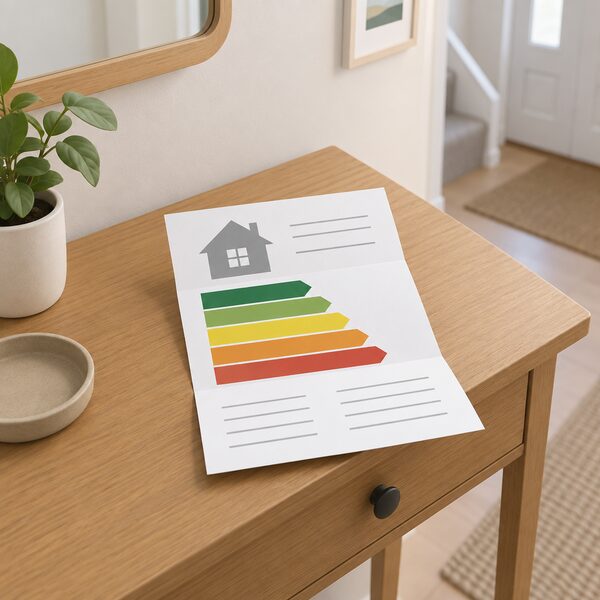
Band E is the operative threshold. Official guidance for landlords of domestic private rented property states that the minimum standard of energy efficiency of certain domestic rented property is a rating of E or above10. The same figure appears in the exemptions guidance, which describes a private rented sector property requiring an EPC as needing an EPC rating of E or above, or a valid exemption5. The Planning Portal's summary is blunter: if the property's rating is F or G, then it must be improved to at least an E2.
The date matters. Since April 2020, landlords can no longer let or continue to let properties covered by the MEES Regulations if those properties fall below the required standard1. That is the point at which the current minimum moved from a proposal to an enforceable duty, and it is why the F and G prohibitions are framed as continuing obligations rather than one-off conditions at the start of a tenancy.
For listed buildings and properties in conservation areas, the position is qualified. Complying means either being at a minimum of EPC band E, or having a valid exemption registered for it, and that formulation is used for listed domestic private rented properties and properties within conservation areas in England and Wales9. Changes are not required on listed buildings or in conservation areas where they would affect the character of the dwelling's appearance2. That is a genuine limit on the standard, not a loophole: the property still needs either the rating or the registered exemption.
In practice, a landlord with an F or G property faces a choice between improving the fabric or the heating to reach E, or documenting why that cannot be done within the cost cap. The EPC recommendation report is the starting point, because it lists the measures that would move the rating. The household living in the property sees the result as either a warmer home or a registered exemption that leaves the property as it was.
The £3,500 cost cap and the 'all improvements made' exemption
The cost cap is the central protection for landlords and the central limit for tenants. The prohibition on letting property below an EPC rating of E does not apply if the cost of making even the cheapest recommended improvement exceeds £3,500 including VAT3. Official guidance states the same cap in plain terms: a landlord will never be made to spend more than £3,500 on the improvements2.
The cap interacts with third-party funding. A recommended measure counts as a relevant energy efficiency improvement only where third-party funding covers the full cost, or the cost is £3,500 or less inclusive of VAT, or a combination of landlord self-funding and third-party funding totals £3,500 or less inclusive of VAT10. Where third-party funding is unavailable but the improvement can be made for £3,500 or less using the landlord's own money, the same cap applies10.
Where the cap is reached without reaching band E, the all improvements made exemption is available. The requirement to meet the minimum level of energy efficiency does not apply where a landlord has made all the relevant energy efficiency improvements for the property, or there are none that can be made, and the property remains below EPC E3. The practical instruction is to make as many improvements as possible up to the cap, then register for the exemption2.
The evidence standard is specific. For the high cost exemption, the landlord must upload copies of three quotations from different installers, each showing that the cost of purchasing and installing the cheapest recommended improvement exceeds £3,500 including VAT3. Local authority guidance repeats the requirement for three separate quotes showing the cost to be over £3,500 where the cost exemption is claimed10.
Exemptions and the PRS Exemptions Register

The PRS Exemptions Register is for properties which are legally required to have an EPC, are let on a relevant tenancy type, and cannot be improved to meet the minimum standard of EPC band E for one of the listed reasons3. Registration is not optional paperwork: where an exemption applies, it must be registered by the landlord, or an agent for the landlord, before it can be relied on3. Registration is made on a self-certification basis and the exemption applies from the point at which it is registered3.
The register is a public record in part. There is public access to some information, including addresses of properties where exemptions have been registered, names of landlords where the landlord is not an individual, the nature of the exemptions and valid EPCs10. The legislation sets out the published fields: the address of the property, the name of the landlord where the landlord is not an individual, the exemption relied on, a copy of the valid energy performance certificate for the property, and the date on which the information was registered5. The Secretary of State and enforcement authorities can access information registered on it, and held on it, as necessary to carry out their functions under the regulations5.
The register also carries enforcement consequences. A local authority may impose a publication penalty, meaning details of the landlord's non-compliance may be published on the PRS Exemptions Register10. The public search covers properties that have registered exemptions and properties that have been issued penalties for failing to comply with these standards6.
The exemptions themselves are listed by regulation. A landlord of a sub-standard domestic or non-domestic private rented property may rely on regulation 24(2), regulation 25, regulation 28(2), regulation 29, regulation 31(1) or (1A), regulation 32(1), or regulation 33(1) or (3), and must register the information set out in the Schedule on the PRS Exemptions Register5. In plain terms, the categories cover the high cost case, the all improvements made case, wall insulation specifically, third-party consent, property devaluation, and the temporary exemption for a landlord who has recently become a landlord.
How long an exemption lasts, and what happens on sale
Duration varies by exemption, and the differences matter for planning. A property devaluation exemption generally lasts five years once registered3. A third-party consent exemption lasts five years or until the end of the tenancy if it relates to obtaining tenants' consent10. The temporary exemption for a landlord who bought a property already let on an existing tenancy lasts six months10.
The six-month exemption has a hard follow-on. After six months the exemption expires and the landlord must either have improved the energy efficiency of the property to at least EPC band E, or have registered another valid exemption should one apply, if they intend to continue letting3. The high cost exemption works differently: after it expires the landlord must try again to improve the property's EPC rating to meet the minimum level, and if this still cannot be achieved, a further exemption may be registered3.
Sale is the point where exemptions and EPCs part company. Any registered exemptions will not be transferred and will cease to apply once the property is sold, though the EPC can transfer10. The exemptions guidance is explicit that exemptions registered on the Register may not pass over to a new owner or landlord upon sale or other transfer, that the exemption ceases to be effective, and that the new owner must improve the property or register a new exemption3.
"any exemptions from the prohibition on letting F or G rated property which are registered on the Private Rented Sector ("
For a buyer, that means an F or G property bought with a registered exemption is not bought with the problem solved. The exemption dies with the transfer, and the new owner inherits the duty to improve or to register afresh. For a tenant, it means the condition of the property can change hands without the exemption following it.
Proposed EPC C minimum for England and Wales: status and timeline

The current standard is band E. The proposed standard is band C, and it is not yet in force. The UK Government has proposed raising the minimum EPC standard for domestic private rented properties to band C by 203010. The government's preferred option in consultation is to require landlords to ensure that domestic properties for rental meet EPC C standards, at a minimum for new tenancies from 1 April 2025 and for all tenancies by 1 April 20281.
Those two dates do not agree, and the documents differ. The 2025 and 2028 dates come from the consultation proposal recorded in a parliamentary committee report1. The 2030 date comes from official guidance describing the proposal as band C by 203010, and from a parliamentary report stating that the Government has proposed to raise minimum energy efficiency standards required of privately rented homes in England and Wales to the equivalent of EPC C by 203011. The Clean Flexibility Roadmap sets out a later framework again: landlords will be required to ensure their properties meet a minimum score of EPC C against the fabric performance metric and either the heating system or smart readiness metric, with a date of 1 October 203010.
The Welsh position is stated in a Welsh Government housing decarbonisation document, which describes MEES at EPC C for private rented housing as a short term UK energy efficiency target that needs to go further12. That is a Welsh Government view of the target rather than a separate Welsh standard in force.
The non-domestic proposals are separate and also not in force. Consulted proposals for EPC C by 1 April 2027 and EPC B by 1 April 2030 for non-domestic rental properties are not yet in force13. A landlord reading the current rules should treat band E as the enforceable minimum and band C as a proposal with competing dates attached to it.
Scotland: the Private Rented Sector Landlord Loan
Scotland runs its own regime, and its trajectory has been set for longer. The Energy Efficient Scotland Route Map confirmed the intention to bring forward regulations based on Energy Performance Certificates, requiring landlords of privately rented homes to meet minimum EPC standards from April 202014. A 2017 consultation set out that from 1 April 2019 private rented properties would need to have an EPC rating of at least E at the point of rental, or have had an assessment done before rental and be improved within six months, with a backstop date of 31 March 2022 by which all private rented properties would need to meet the standard15.
The forward target is EPC C. The Scottish Government has committed to introduce regulations requiring private rented sector properties to meet a minimum standard equivalent to EPC C, where technically feasible and cost-effective, by 20286. The same commitment appears in the tackling fuel poverty periodic report17 and in the heat in buildings strategy, which states that private rented sector properties should achieve an equivalent of EPC C by 203018. The 2028 and 2030 dates are both in Scottish Government documents and they disagree.
The reformed EPC changes the metric. A scoping consultation states that the regulations would mean all privately rented properties, as far as possible, achieving a Heat Retention Rating of Band C on the reformed EPC19. The 2025 progress report repeats the aim of all privately rented properties, as far as possible, reaching the equivalent of EPC C under the new, reformed EPC20. The Energy Performance of Buildings (Scotland) Regulations 2025 update covers EPC reform and the government response to consultation21, and a business regulatory impact assessment covers the 2026 amendment regulations22.
Funding is where Scotland differs most from England and Wales. The Private Rented Sector Landlord Loan is available in addition to Area Based Schemes grants, to support landlords who are ineligible for ABS to install energy efficiency and renewable energy measures to reduce the EPC rating of the property in line with Scottish Government Regulations23. Home Energy Scotland grant and loan funding and the Private Rented Sector Landlord Loan Scheme provide grant and loan funding directly to owner occupiers, as well as private registered landlords for their rented properties24. The loan is available to registered private landlords for improvements to domestic dwellings listed on the Scottish Landlord Register, not a holiday or second home, registered with the Scottish Assessors Association as paying domestic council tax rates, not under construction, and currently occupied by at least one tenant or with a tenant in place within 30 days of payment18.
The maximum loan amount is not settled in the available documents: one figure of £100,000 and another of £250,000 appear for the same scheme, and the conflict is unresolved. Landlords should treat the loan terms as scheme rules to be checked at the point of application rather than a fixed published ceiling.
What MEES means for tenants' bills and home conditions

The tenant-facing effect of MEES runs through the EPC and the information duties around it. An EPC must be provided when a building is advertised for sale or for let to a new tenant11. In Scotland, an EPC is required for every individual dwelling that is rented out, must be provided to a new tenant free of charge, must be available for issue to all prospective tenants, and the EPC rating must be included in property adverts in commercial media19. Where a building is rented, it is the responsibility of the landlord to provide the EPC to the potential tenant25.
That matters because the EPC is the document that tells a prospective tenant what the home will cost to heat and how it performs. A property at band E or above has cleared the legal floor; a property at band C or above performs considerably better. The gap between the floor and the proposed future standard is the gap between a home that is legally lettable and a home that is cheap to run.
The limits are worth stating plainly. MEES regulates the rating, not the bill. A band E property can still be expensive to heat if it is large, poorly used or heated by an expensive fuel, and the tenant remains dependent on the grid, on a supplier and on the landlord's choice of heating system. The standard also does not require a heat pump, solar panels or any measure that would reduce dependence on imported gas; it requires a rating. The proposed EPC C standard would raise the floor, and the Clean Flexibility Roadmap's fabric performance metric would tie the rating more closely to the building's actual thermal performance10, but neither is in force.
For a household, the practical reading is that MEES sets a minimum condition for the worst rented homes and gives a tenant a document to check before signing. It does not make a rented home energy independent, and it does not transfer control of the heating system, the tariff or the fabric to the tenant.
How a landlord prepares a property for compliance
Compliance starts with the certificate. The owner or landlord must have an EPC, make it available to potential buyers or tenants, and give a copy to the new owner when selling26. In Northern Ireland, before a building is made available for sale or rent, the relevant person must ensure that an energy performance certificate is issued for the building27, and the earlier regulations place the duty to make a valid EPC available free of charge to any prospective buyer or tenant at the earliest opportunity and before contract28.
The sequence that follows from the rules is straightforward:
- Obtain a valid EPC and read the recommendation report.
- Identify the cheapest recommended improvements and obtain quotations.
- Compare the quoted cost against the £3,500 cap including VAT.
- Commission the improvements that fit within the cap, or all of them where the total is at or below it.
- Re-certify to confirm the new rating.
- Where band E is still not reached, register the all improvements made exemption with three quotations as evidence.
- Where a different exemption applies, register that exemption type with the required evidence before relying on it.
The evidence requirements differ by exemption. For the all improvements made exemption, a landlord may rely on information contained within the property's EPC, and if relying on a separate report, a copy of that report must also be uploaded3. For the third-party consent exemption, the landlord must upload a copy of any correspondence or relevant documentation demonstrating that consent was required and sought and refused, or granted subject to an unreasonably onerous condition3.
Where a building is leased to an agency which then rents it on to its own tenants, responsibility for the EPC depends on the contract between the building owner and the agency19. That is a reminder that the duty sits with a person, not with the property, and that the contract determines who that person is.
For the fabric measures themselves, the practical choices are the ones covered elsewhere on this site: loft insulation, cavity wall insulation and solid wall insulation are the measures most often recommended for a low-rated property, with floor insulation and draught-proofing filling the remaining gaps. What an EPC measures, and how a rating is built up, is set out in Energy Performance Certificates, and the measures that move a rating most are covered in How to Improve an EPC Rating. Landlords weighing the wider picture can read Insulation in Rented and Social Housing, and the funding landscape is covered in Insulation and Glazing Grants in England and Insulation and Glazing Grants in Scotland.
Sources28 cited
- Energy efficiency and the private rented sector, House of Commons Environmental Audit Committee, 2026-09-20
- Minimum Energy Efficiency Standards, Planning Portal, 2026
- Guidance on PRS exemptions and exemptions register evidence requirements, GOV.UK, 2026-05-05
- Great British Insulation Scheme: government response, Department for Energy Security and Net Zero, 2023-03
- The Energy Efficiency (Private Rented Property) (England and Wales) Regulations 2015, regulation 36, legislation.gov.uk, 2026-09-17
- View private rented sector energy standards exemptions, GOV.UK, 2026-05-05
- ECO4 Delivery Guidance v1.1, Ofgem, 2023-02-03
- Minimum Energy Efficiency Standards, Carmarthenshire County Council, 2026-09-20
- Adapting historic homes for energy efficiency: a review of the barriers, GOV.UK, 2024-01-03
- Minimum Energy Efficiency Standards guidance, Isle of Anglesey County Council, 2026-05
- Minimum energy efficiency standards for privately rented homes, House of Commons Energy Security and Net Zero Committee, 2025-05-09
- Homes of today for tomorrow: decarbonising Welsh housing 2020 to 2050, Welsh Government, 2024-02
- Clean Flexibility Roadmap: July 2026 update, GOV.UK, 2026-07
- Tackling fuel poverty in Scotland: strategic approach, Scottish Government, 2021-12-23
- Minimum standards of energy efficiency in private rented sector housing consultation, Scottish Government, 2017-04
- Tackling fuel poverty in Scotland: strategic approach, Scottish Government, 2021-12-23
- Tackling fuel poverty in Scotland: periodic report 2021 to 2024, Scottish Government, 2025-04
- Heat in buildings strategy, Scottish Government, 2021-10-07
- Energy performance certificates: buildings for let, Scottish Government, 2023-11-29
- Heat in buildings progress report 2025, Scottish Government, 2025-10-02
- Energy Performance of Buildings (Scotland) Regulations 2025 update, Scottish Government, 2025-10
- Energy Performance of Buildings (Scotland) Amendment Regulations 2026: BRIA, Scottish Government, 2025-10
- Home energy efficiency, Argyll and Bute Council, 2026-09-17
- Home Energy Scotland grant and loan funding, Scottish Government, 2025-02-20
- Scoping consultation: HEETSA partial BRIA, Scottish Government, 2025-06-06
- Energy performance certificates, nidirect, 2026-02-26
- Energy Performance of Buildings Regulations 2013, Building Control Northern Ireland, 2013-01-21
- Energy Performance of Buildings Regulations 2008, Building Control Northern Ireland, 2008-04-10
 Insulation in Rented HousingWho pays for insulation when you rent, and who has to agree to it?
 Welsh Housing Quality StandardWhat does the Welsh Housing Quality Standard mean for your home if you rent from a council or housing association in Wales?
 New Build Energy PerformanceHow energy efficient are new build homes compared with older ones?
 Energy Performance CertificatesAn Energy Performance Certificate rates how energy efficient your home is, from A down to G.
 Renting and Home EnergyThe position of a tenant in a privately rented home: which measures need no permission, which are fixtures the landlord controls, and what the law says about heating, insulation, certificates and bills across the four UK nations.
 Housing Stock and EPCsNorthern Ireland's homes score best in the UK for energy efficiency, yet most run on heating oil.