
In this guide
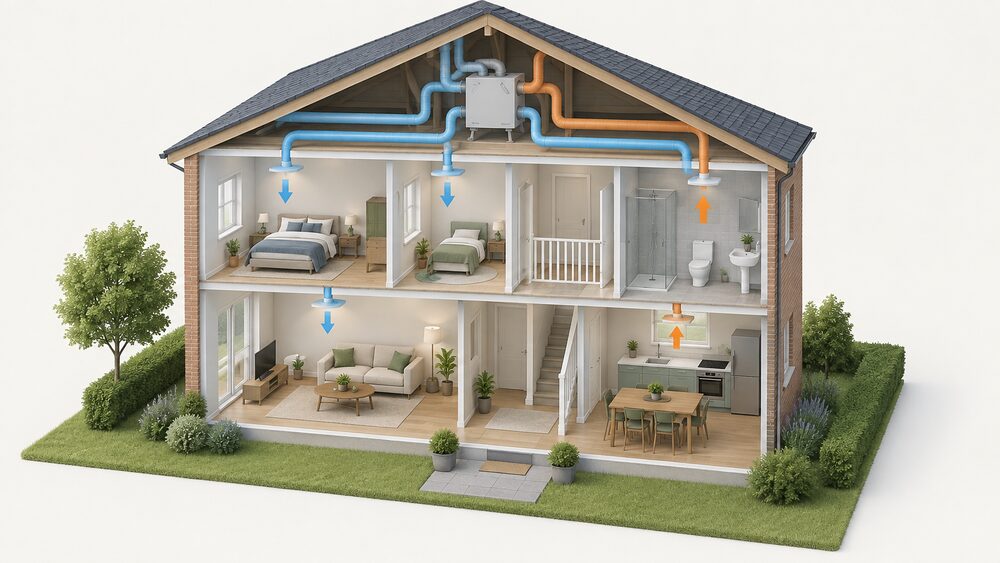
MVHR, mechanical ventilation with heat recovery, is a whole-house ventilation system that extracts stale air from kitchens and bathrooms, passes it through a heat exchanger, and uses the recovered heat to warm fresh filtered air supplied to living rooms and bedrooms1. It is the ventilation route that airtight homes are built around, and it is the one that most directly ties a household's air quality to a piece of mechanical equipment it owns and maintains.
The case for it rests on two numbers. Independent guidance puts typical heat recovery efficiency at 80 to 90%, with systems inaudible during normal use, and estimates that this reduces household heating costs by 10 to 30%2. Welsh Government guidance for systems providing both supply and extract ventilation sets a minimum efficiency of 73%3. The gap between the two figures is not a contradiction: 73% is a regulatory floor, while 80 to 90% is what well-specified units achieve in practice.
The case against complacency is equally clear. A ventilation industry figure reported that thousands of MVHR units had been fitted into heavily insulated and sealed homes, that many were never commissioned, and that few are checked or maintained, with many switched off by users because of noise4. MVHR is not a fit-and-forget product, and its performance depends on design, ducting and commissioning as much as on the box on the wall.
What MVHR is and how it works
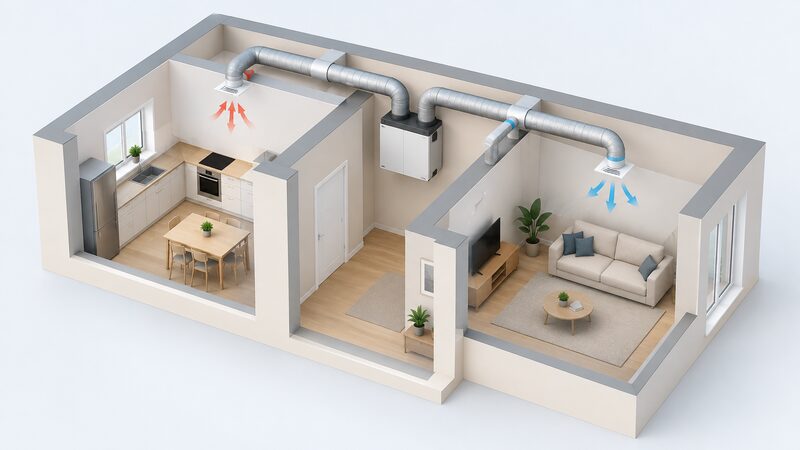
The mechanics are straightforward. Northern Ireland's official guidance describes a system that draws air out of warm, moist rooms such as kitchens and bathrooms, transfers heat from that exhaust air to incoming fresh, filtered air in a heat exchanger, and blows the pre-warmed air into habitable rooms such as living rooms and bedrooms1. The same source describes the result as a constant supply of clean, fresh air contributing to a healthy, comfortable living environment, with additional benefits and efficiencies from combining heat recovery with ventilation1.
Two things distinguish MVHR from simpler mechanical extract systems. The first is balance: MVHR simultaneously extracts stale air and provides a supply of filtered air, so the air path is controlled rather than left to leaks and vents6. The second is filtration. Air filtration is commonly built into MVHR systems to prevent pollen and other particles entering the home, and some units can be equipped with carbon filters to remove a portion of gas-phase pollutants such as nitrogen oxides2. The BESA, the trade body for building engineering services, notes that MVHR units can also include filtration of pollutants such as NOx and particulate matter to improve indoor air quality7.
The system is not a heater. It recovers heat that would otherwise leave with the exhaust air and returns it to the incoming stream, which reduces ventilation heat loss rather than adding heat. That distinction matters when sizing and when explaining the system to a household: MVHR lowers the ventilation penalty of an airtight home, it does not warm the rooms.
Heat recovery efficiency: 73% to over 90% in practice
Efficiency is the figure most often quoted and the one most often misunderstood. Independent guidance states that systems typically have between 80 and 90% heat recovery efficiency2. Welsh Government guidance, in its consultation version of Approved Document L Volume 1, specifies a heat recovery system with a minimum efficiency of 73% for systems providing both supply and extract ventilation3. The BESA describes the units as simultaneously recovering valuable heat energy for maximum efficiency7.
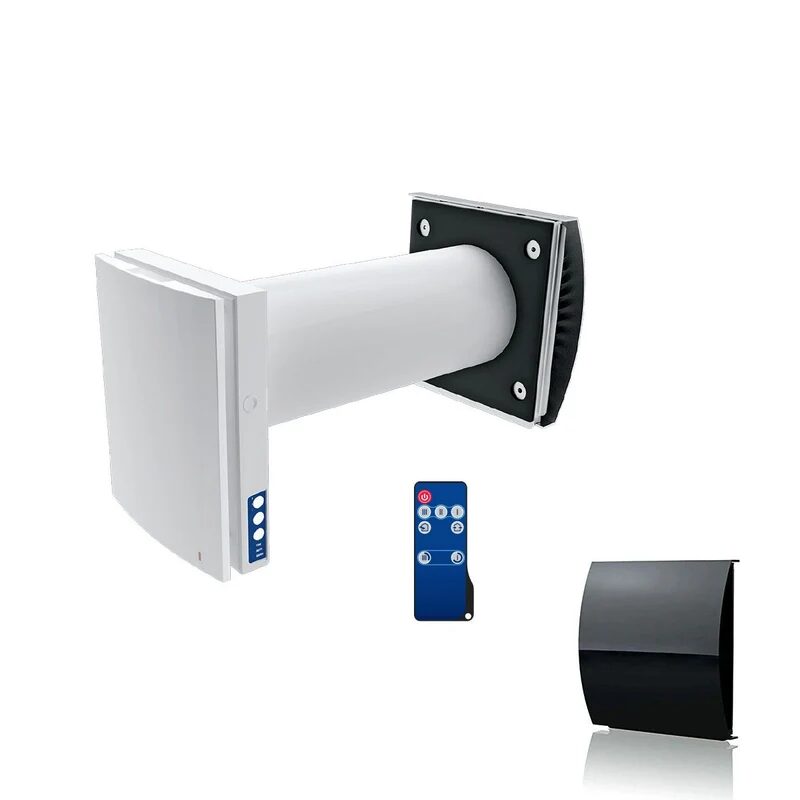
The range across sources reflects different things being measured. A regulatory minimum is a compliance threshold that a system must meet to be accepted under building rules. A typical range describes what installed, well-commissioned systems deliver. A maker's figure describes a specific product under test conditions. The Wolf CWL-D-70 Excellent, a decentralised ventilation unit with heat recovery, is stated by its maker to have a maximum heat provision efficiency of 87%8. That sits inside the independent 80 to 90% band rather than above it.
What drives the figure in a real house is less the heat exchanger than the installation. Duct runs that are long, cramped or uninsulated lose heat before it reaches the supply terminals. A unit placed outside the insulation layer loses heat from the casing. Poor commissioning leaves the system running at a rate that does not match the dwelling. The independent case studies show what good looks like: at the Chippenham Passivhaus scheme, the MVHR was reported to be inaudible in normal operation and to maintain excellent indoor air quality for both carbon dioxide and relative humidity9.
For a household, the practical implication is that the efficiency figure on a datasheet is a ceiling, not a prediction. The number that matters is the one measured after commissioning, in the dwelling, at the design flow rate.
What MVHR costs to install and run
Costs divide into capital, consumables and running. Independent guidance puts decentralised MVHR systems at prices starting from £600 per fan, and whole-house MVHR systems at starting from around £3,000 but potentially well over £10,0002. A Passivhaus-certified system is described as costing a few thousand pounds5.
Retrofit cost data from a feasibility study of a salary sacrifice scheme gives a narrower picture for one specific installation: a capital cost band of £5,000 to £10,000, with a cost of measure of £5,000, a total lower rate cost of £3337.50 and a total higher rate cost of £2837.5010. Those two totals are lower than the £5,000 cost of measure because they reflect the net position under the scheme modelled, not the gross installation price.
Running costs are dominated by filter replacement and electricity for the fans. Replacement paper filters might cost £10 to £155. Filters need checking every few months and cleaning or replacing as necessary, with a more thorough servicing and cleaning of the heat exchanger and fans every few years5. Servicing is not optional: MVHR systems require servicing because all equipment such as filters and fans must be kept clean to ensure effective operation2.
| Item | Figure | Source |
|---|---|---|
| Decentralised MVHR | from £600 per fan | 2 |
| Whole-house MVHR | from around £3,000, potentially over £10,000 | 2 |
| Passivhaus-certified system | a few thousand pounds | 5 |
| Retrofit cost of measure | £5,000 (band £5,000 to £10,000) | 10 |
| Replacement paper filters | £10 to £15 | 5 |
Against those costs sits the heating saving. Independent guidance estimates a reduction in household heating costs of 10 to 30%2. A maker states that by recovering heat from the exhaust air, MVHR systems can lead to significant savings on heating bills11. The independent figure is the one to plan against, and it applies to the ventilation component of heat loss, not to the whole bill.
Where MVHR fits: airtight homes, new builds and deep retrofits
MVHR works best in buildings that are relatively airtight, such as new-build homes or older properties that are being fully refurbished2. The reason is that a leaky building ventilates itself, however inefficiently, and a mechanical system added to it competes with uncontrolled air paths rather than replacing them. Northern Ireland's official guidance describes mechanical heat recovery ventilation as an efficient way to provide ventilation in a well insulated and air tight building1.
Modern energy efficient homes are more airtight than older buildings because they have to follow specifications for air-tightness set out in the Building Regulations, and MVHR is one of the systems fitted to meet that requirement2. The Passivhaus standard specifies mechanical ventilation with a heat recovery system attached12. The UK Green Building Council has recommended capitalising on the benefits of MVHR to improve air quality, comfort and heating efficiencies13.
The fit is not limited to new build. Whole-house systems such as mechanical extract ventilation or MVHR offer more consistent results, especially in newer, more airtight homes14. For existing housing, the Centre for Sustainable Energy advises that if a very deep retrofit is being considered, stripping the house back to the basic structure before improving its thermal performance, it may be worth considering a mechanical ventilation heat recovery system15. The qualification is doing real work in that sentence: MVHR belongs to the deep end of retrofit, not to a piecemeal programme of draught-proofing.
Public sector retrofit has followed the same logic. Edinburgh's High Rise Retrofit and Upgrade Programme Phase 1 used decentralised ventilation and MVHR systems to design out damp and mould risk in each block's ventilation strategy16. The AECB's CarbonLite new build standard lists MVHR as the ventilation approach for Taylor House17.
Retrofitting MVHR into an existing home
Retrofit is possible and is being done, but it is a design exercise rather than a product purchase. Independent guidance notes that mechanical ventilation systems can be more easily retrofitted to existing buildings7. The constraint is that retrofitting MVHR needs to follow a comprehensive airtightness strategy, including a series of airtightness tests2. Without that, the system is fighting the building.
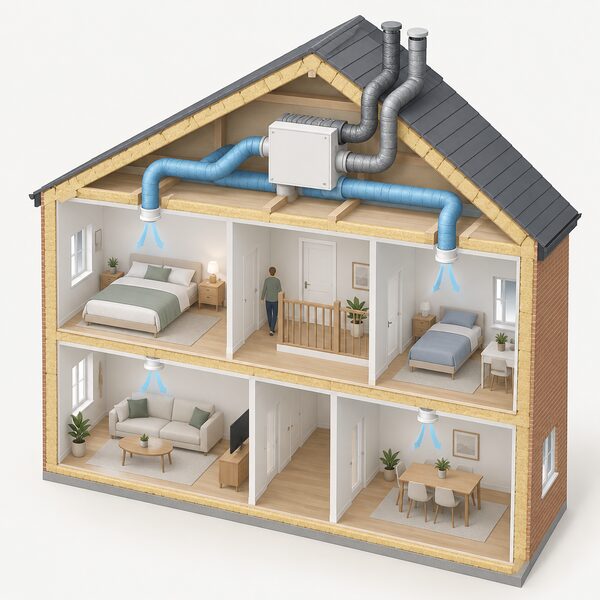
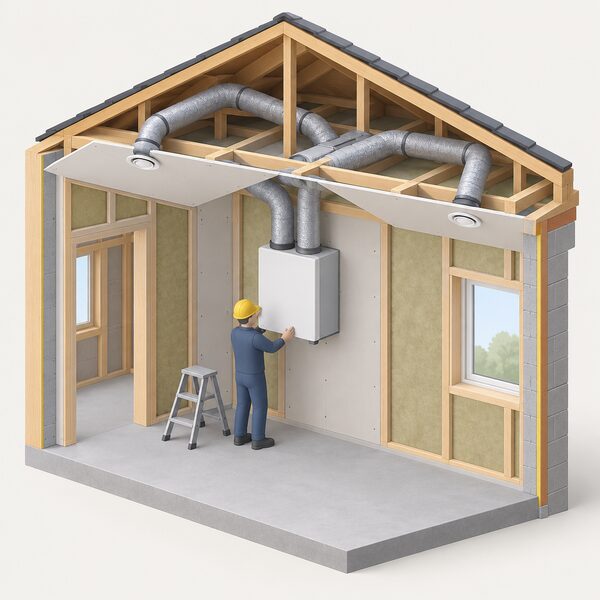
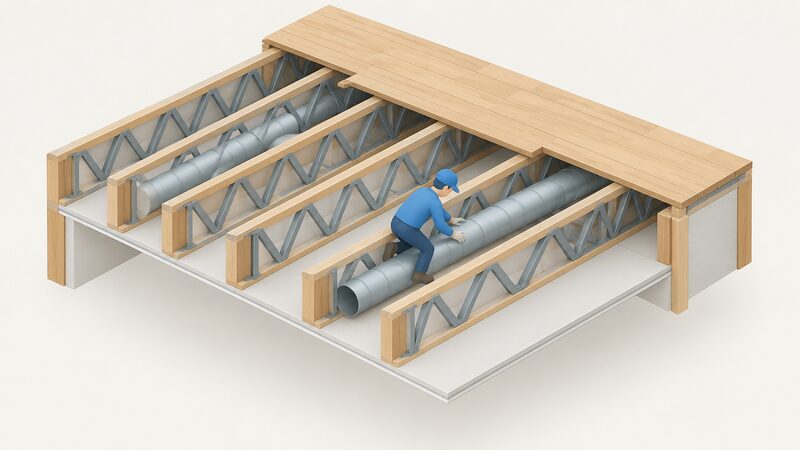
The practical difficulties are duct routes and unit siting. Independent guidance describes systems made up of concealed ducting in ceiling cavities leading to the heat exchanger unit in a cupboard, utility room or sometimes a loft2. In a retrofit, those routes have to be found in a finished building. The case studies show the techniques: at Project 80, the MVHR unit was placed in the loft and the duct work ran through the I-joists18. At Barton Quarter, one house has MVHR and uses Posi-Joists to aid ducting, while the rest use dMEV19. At Tomorrow Home, MVHR was installed in one unit as a kitchen extraction unit, which compared to a conventional MVHR system minimises the space requirement20.
Those three examples illustrate the range of retrofit answers: use the structural voids, use engineered joists designed for the purpose, or reduce the system to a single-room unit. The last option trades whole-house balance for installability.
Filtration, air quality and summer bypass
Filtration is where MVHR earns part of its keep in urban and polluted locations. Air filtration is commonly built into MVHR systems to prevent pollen and other particles entering the home2. Some units can be equipped with carbon filters to remove a portion of gas-phase pollutants such as nitrogen oxides, and MVHR units can also include filtration of pollutants such as NOx and particulate matter to improve indoor air quality7.
The Wolf CWL-D-70 Excellent illustrates how filtration is specified on a real product. Its maker states a filter category of two ISO coarse 60% filters for extract air and one ISO coarse 60% for supply air, with ISO coarse 60% and ISO ePM1 50% available as an optional accessory for supply air, and a filter change requirement indicated on the appliance8. The distinction between the standard and optional supply filter matters: the finer grade is the one that captures the smaller particles, and it is an accessory rather than a default.
Summer bypass addresses the opposite problem. Modern MVHR systems have summer by-passes which reduce or switch off the recovery of heat from the air21. In a well-insulated home, recovering heat from exhaust air in July is a liability, and the bypass allows the system to bring in cooler night air without warming it first. The Wolf unit lists bypass as standard8. Overheating guidance from BRE treats this as part of the overheating toolkit for insulated homes rather than an optional extra.
The BESA has argued that indoor air quality deserves political attention, with its indoor air quality group chair calling for the issue to be debated at the 2024 General Election and citing MVHR failures alongside mould linked to cavity wall insulation4. That framing is useful: filtration and bypass are the features that make MVHR an air quality measure as well as an energy measure, and they only work if the system is running and maintained.
Installation, ducting and where the unit goes
The unit's location determines how much of the recovered heat survives. For heat recovery to work efficiently, the MVHR unit and ducting need to be within the insulation layer, not in an uninsulated loft5. Where a cold loft is the only option, independent guidance is specific: install the unit on a raised platform, insulate ducts and the condensate pipe and keep duct runs as short as possible2.
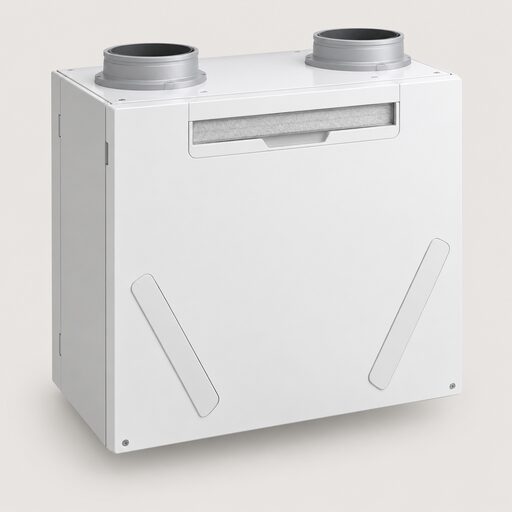
The standard arrangement is concealed ducting in ceiling cavities leading to the heat exchanger unit in a cupboard, utility room or sometimes a loft2. Each of those locations has consequences. A cupboard or utility room keeps the unit inside the thermal envelope and accessible for filter changes. A loft keeps it out of living space but puts it in the coldest part of the building unless the loft itself is insulated at the rafters.
Duct design is where retrofit schemes concentrate their effort. Running ductwork through I-joists or Posi-Joists uses voids that already exist in the structure18. Where no such route exists, a decentralised unit avoids long duct runs altogether: the Wolf CWL-D-70 Excellent is a decentralised ventilation unit with heat recovery, suitable for retrofitting or in new builds, with a unit diameter of 250 mm and a core hole bore of Ø 260 mm with a 3° fall towards the outside, for wall thicknesses of 500 to 600 mm including accessories, or 300 to 500 mm8. It is fully wired, has a white internal panel, an indoor unit rating of IP 20 with a front cover of IP X4, and a 230 V / 50 Hz electrical connection8.
Servicing, filters and commissioning
Commissioning is the difference between a system that works and one that is switched off. A ventilation industry figure reported that thousands of MVHR units have been fitted into heavily insulated and sealed homes, that many were never commissioned, that they were simply wired up and connected to flexible ducting crammed into the available space without any allowance for air flow, that few are being checked or maintained, and that many have been switched off by users because of noise4. Every one of those failures is a commissioning and design failure rather than a limitation of heat recovery.
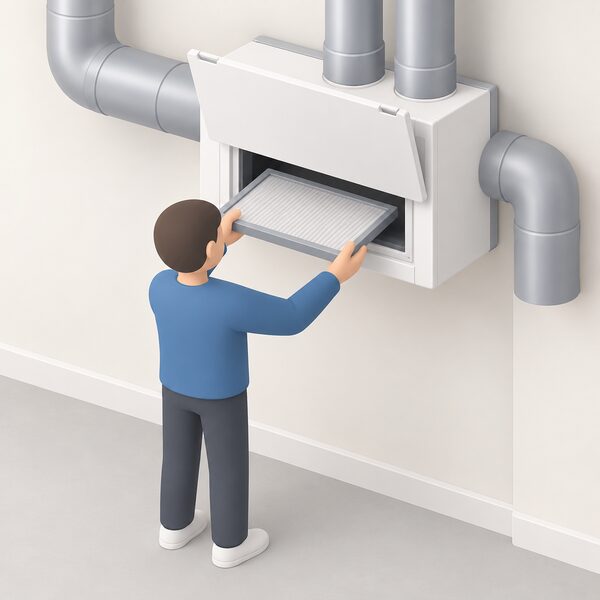
Routine maintenance is modest but real. Filters need checking every few months and cleaning or replacing as necessary, and a more thorough servicing and cleaning of the heat exchanger and fans is needed every few years5. MVHR systems require servicing because all equipment such as filters and fans must be kept clean to ensure effective operation2. Replacement paper filters might cost £10 to £155. On the Wolf CWL-D-70 Excellent, the filter change requirement is indicated on the appliance itself, which removes the guesswork8.
Noise is the symptom that most often leads to a system being turned off. Independent guidance describes systems as inaudible during normal use2, and the Chippenham Passivhaus scheme reported that its MVHR is inaudible in normal operation9. Where noise is a problem, it points to undersized ducts, tight bends, or a unit mounted without isolation.
Boost settings exist for the moments when moisture generation spikes. Some units have an automatic or manual boost setting which can be used when generating excessive moisture, such as when cooking or washing2. Guidance notes that this may only be an increase of 25 to 50% over the background ventilation rate21, so boost is a moisture control function rather than a way to clear a room quickly.
What MVHR means for household energy independence
MVHR's contribution to energy independence is indirect but real. It reduces the ventilation heat loss that an airtight home would otherwise suffer, and independent guidance puts that at a 10 to 30% reduction in household heating costs2. A maker states that by recovering heat from the exhaust air, MVHR systems can lead to significant savings on heating bills11. In a dwelling that has been insulated and draught-proofed, ventilation becomes a larger share of the remaining heat loss, so recovering it matters more, not less.
What it does not do is remove dependence. The system runs on mains electricity, draws its supply air from outside, and depends on a manufacturer for filters, spare parts and, in some cases, controls. It is a piece of mechanical equipment with moving parts, and it needs servicing every few years5. Where a unit is controlled through an app or a proprietary controller, that is a further dependency on the maker's systems remaining available.
The dependence on the building itself is the more important point. MVHR works best in buildings that are relatively airtight2, and retrofitting it needs a comprehensive airtightness strategy including a series of airtightness tests2. A household that installs MVHR without addressing airtightness gets the maintenance burden without the heat recovery benefit. A household that addresses airtightness without providing mechanical ventilation gets a different problem: a sealed building with no controlled air path.
There is no dedicated national funding stream for MVHR. Government incentive payments are available in some regions to offset the high upfront cost of installing renewables technologies, with acceptance criteria to satisfy and possible MCS registration for the installer and equipment22. The Boiler Upgrade Scheme provides upfront grants to help reduce the cost of installing heat pumps and biomass boilers in homes and non-domestic buildings, and does not cover ventilation23. Cold loft insulation is the only type of roof insulation for which grant funding is available24.
For a household weighing it up, the honest position is that MVHR is a ventilation system with an energy benefit, not an energy system with a ventilation benefit. It belongs with airtightness and air leakage and home ventilation as part of a whole-house approach, and it makes most sense alongside a whole-house retrofit plan rather than as a standalone purchase. Households comparing it with simpler options can read the wider guide to home ventilation, and those considering it as part of a fabric-first programme will find the context in insulation and energy independence.
Sources24 cited
- Ventilation systems, nidirect, 2026-09-17
- Mechanical ventilation with heat recovery, Centre for Sustainable Energy, 2026-07
- Approved Document L Volume 1 consultation version, Welsh Government, 2026-09-17
- The election must get people talking about IAQ again, BESA, 2024-06-03
- Airtightness and ventilation, CAT, 2025-06-27
- Ventilation advice, Centre for Sustainable Energy, 2025-07
- BESA focus areas: ventilation, BESA, 2026-09-20
- Ventilation unit CWL-D-70, Wolf, 2026-09-17
- Chippenham, Future Homes, 2025-03-04
- Catalysing net zero retrofit: feasibility of an innovative salary sacrifice scheme, CREDS, 2023-11-22
- What makes MVHR a superior ventilation solution, Nilan UK, 2024-07-18
- Passivhaus: what you need to know, Energy Saving Trust, 2026-02-16
- Future Homes and Buildings Standard consultation response, UKGBC, 2024-05-09
- Home ventilation guide: stop condensation, damp and mould, IAQ, 2026-09-20
- Home energy efficiency, Centre for Sustainable Energy, 2025-11
- High Rise Retrofit and Upgrade Programme Phase 1, City of Edinburgh Council, 2026-04-20
- AECB CarbonLite new build standard, AECB, 2026-09-04
- Project 80, Future Homes, 2023-11-10
- Barton Quarter, Future Homes, 2023-10-11
- Tomorrow Home, Future Homes, 2024-08-16
- Overheating guidance, BRE, 2026-09-17
- Your home guide to heat pumps, OFTEC, 2026-09-17
- Boiler Upgrade Scheme, Ofgem, 2026-09-17
- Roof insulation, Which?, 2026-05-05
 Ventilation and Cooling TechYour home is being made more airtight, so how do you stop stale air and damp building up without wasting heat?
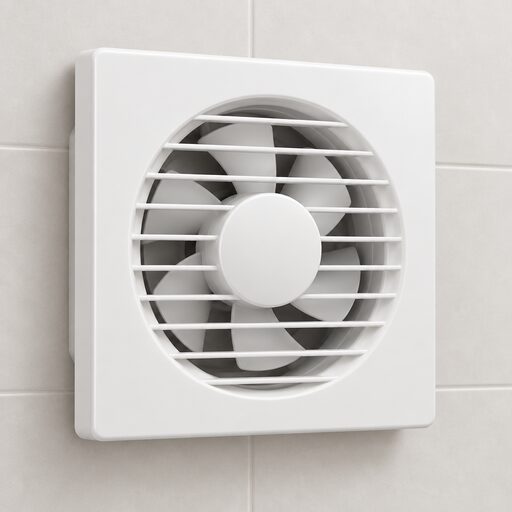 Ventilation ManufacturersWhich brands make home ventilation equipment, what does each type cost, and is a quiet one genuinely quiet?
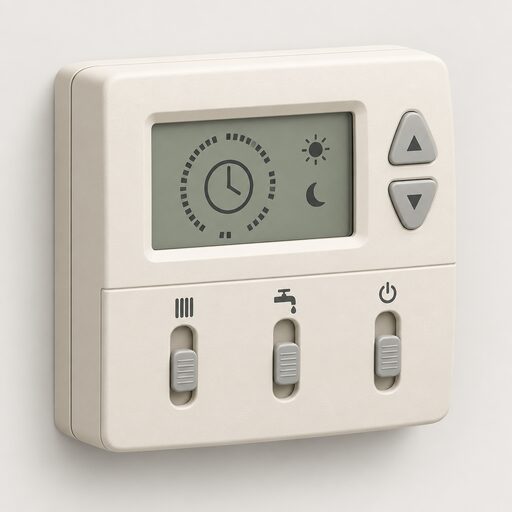 Controls, Thermostats and TRVsWhich heating controls actually cut your bills, and what does each one do?
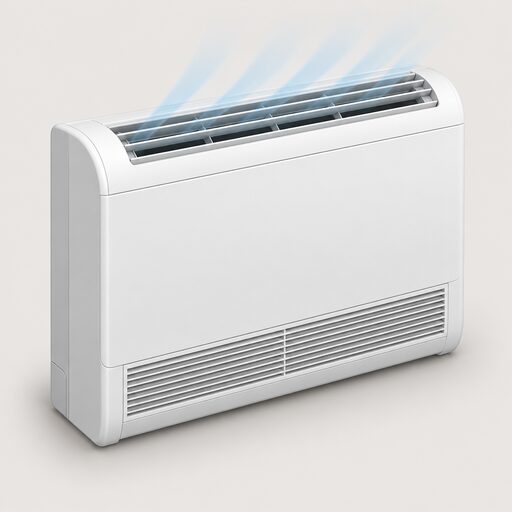 Split Air ConditioningA split air conditioning system cools or heats one room using an indoor unit and an outdoor unit linked by pipes.
 Do Smart Controls Save Money?Do smart heating controls really cut your bills, and by how much?
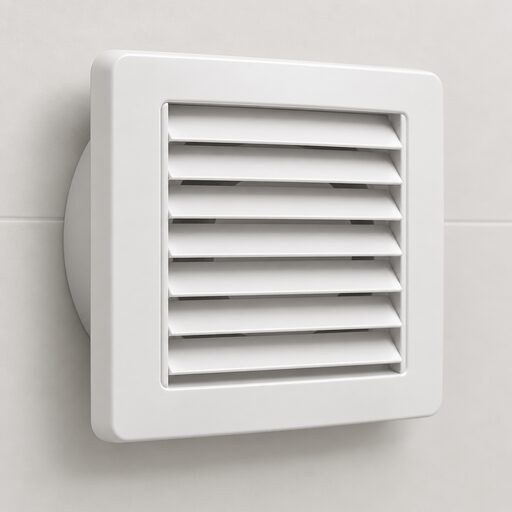 Home Ventilation SystemsWhy do modern insulated homes need extra ventilation, and what happens if they do not get it?