In this guide
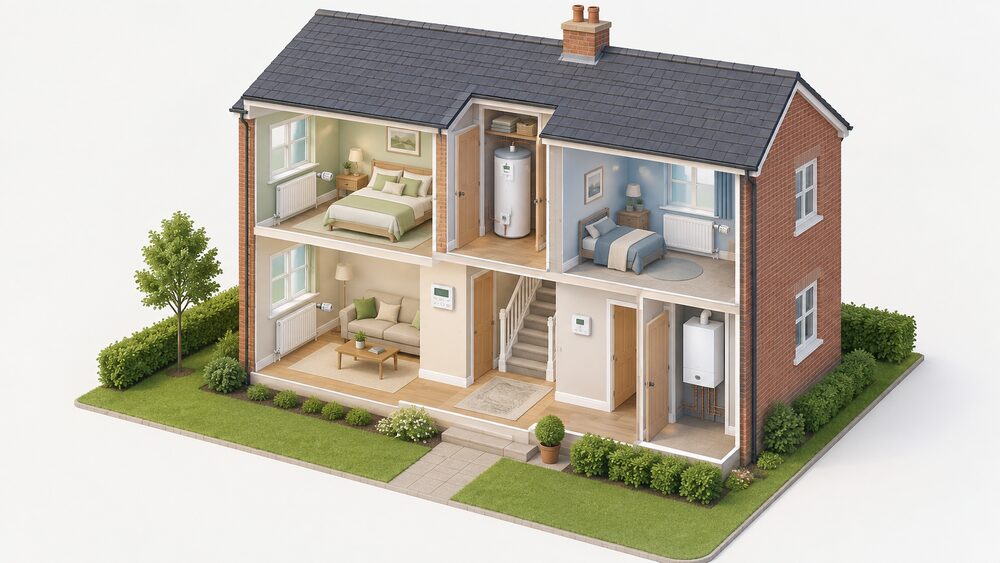
Heating controls decide when a boiler fires and how hot each room becomes. A full set is a time-controlled programmer, at least one room thermostat, thermostatic radiator valves (TRVs) on the radiators, and a cylinder thermostat where the system has a hot water cylinder1. Independent guidance puts the saving from installing heating controls at £100 a year in Great Britain, and £110 in Northern Ireland2.
The controls are also the cheapest way to change how a home uses energy, because they can be fitted without touching the boiler. Heating controls can be upgraded or installed independently of the boiler1. For a household working towards energy independence, that matters: controls reduce the amount of gas, oil or electricity bought from a supplier, and they are the layer a household can change without a registered gas engineer, a new appliance or a grant application.
What they cannot do is remove the dependence underneath. A programmer, thermostat and TRV set still relies on the grid or a delivered fuel, on a boiler that needs servicing, and, where smart controls are used, on an internet connection and a manufacturer's app. Controls manage demand; they do not generate supply.
What heating controls do, and the set every system should have
Heating controls help control when the heating system operates and the temperature in each room1. That single sentence covers two different jobs. Time control decides whether the system runs at all; temperature control decides how much heat each space receives. A system with one but not the other either heats an empty house or heats every room to the same level.
The recommended set is a time-controlled programmer, at least one room thermostat, TRVs if there are radiators, and a cylinder thermostat if the system has a hot water cylinder1. Independent guidance gives the minimum core as a programmer, at least one room thermostat and TRVs on central heating systems such as boilers2. The two lists agree on the essentials and differ only on the cylinder thermostat, which applies to systems with stored hot water.
Building regulations push the same direction. For heating systems in new dwellings, or when a heat generator such as a boiler is replaced in an existing dwelling, each room should be provided with thermostatic room controls able to separately adapt the heating output in each room served5. Approved Document L Volume 1 sets that rule for new dwellings and boiler replacements6. Electric panel heaters in new systems or replacement components need time and temperature control for separate control of each room or each appliance7. Heat pump systems must have adequate controls5.
In practice, a household with a boiler, a programmer and one thermostat in a hallway has the minimum. Adding TRVs to the bedrooms and living room is what turns a single-zone system into room-by-room control, and it is the step that most often pays back first.
The main types: programmer, room thermostat, TRVs and smart controls
The four control types do different jobs and are not substitutes for one another.
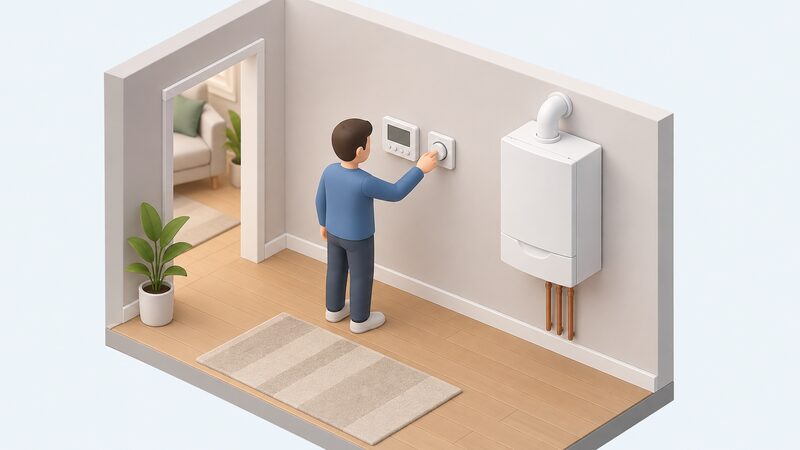
- Programmer (time control). Sets the periods when the heating runs. Independent guidance lists it as the first element of the minimum core2.
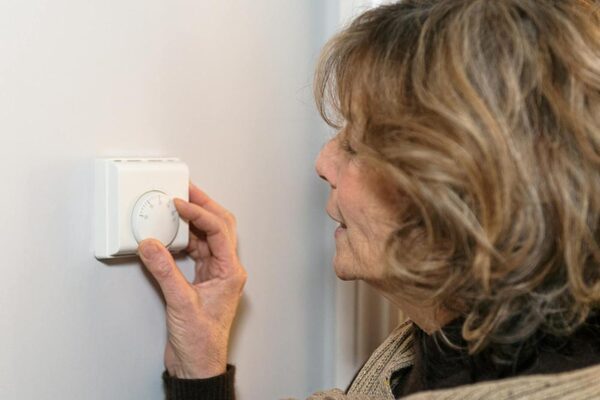
- Room thermostat. Measures air temperature in one place and calls for heat when the room falls below the set point.
- TRVs. Fit to individual radiators and control each room separately8.
- Smart controls. Connected to the internet and offering more functionality than conventional controls2.
Two hybrids sit between these. A programmable room thermostat combines time and temperature controls in a single unit and can set different temperatures for different times of the day2. Programmable TRVs are TRVs with timing control as well, letting each radiator come on at different times and heat each room separately2. Both reduce the number of separate boxes on the wall, and both are more complex to set up than the basic versions.
Smart controls are the category that has grown fastest. A smart thermostat controls heating and helps manage how the central heating is set and adjusted9. The main difference from conventional controls is the internet connection and the extra functionality that comes with it2. That functionality is also the dependence: a smart control system typically needs a working home network, a manufacturer's account and an app that continues to be supported.
Room thermostats: how they work and the temperature to set
A room thermostat is a switch that responds to air temperature. When the room falls below the set point it calls for heat; when the room reaches it, the call stops. It does not control how hot the radiator gets, only whether the system is running.
Independent guidance puts the lowest comfortable temperature for most people at between 18°C and 21°C2. A separate independent source suggests starting at 21°C and reducing by one degree at a time3. The two are not in conflict so much as different starting points: one gives a band, the other a method for finding the bottom of it. Where a system has a hot water cylinder, the cylinder thermostat should be set between 60°C and 65°C2.
The saving from a single degree is the figure most often quoted. Turning the thermostat down by one degree Celsius is estimated to save as much as 10 per cent on heating bills10. In cash terms, that is around £120 a year in Great Britain or £80 in Northern Ireland3. The two figures differ because Northern Ireland's housing stock, fuel mix and prices differ from Great Britain's, not because the physics changes.
Placement matters as much as the number. A thermostat in a hallway next to a draughty front door reads lower than the living room and keeps the boiler running longer than needed. A thermostat in a room with a TRV on the radiator fights the valve, which is why the regulations separate them.
Thermostatic radiator valves: room-by-room control, settings and limits
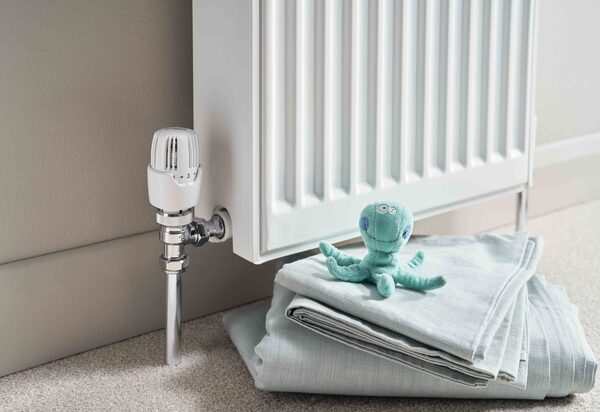
TRVs control the temperature of each room by opening and closing automatically to control the flow of hot water through the radiator they are fitted to11. They can be manually adjusted to different settings11. A TRV gives better control over individual room temperatures8.
The regulatory position is clear on where they go and where they do not. Approved Document L Volume 1 states that thermostatic radiator valves should not be used in the same room as the thermostat, and that heat emitters in the same room as the thermostat should have manual controls6. The reason is straightforward: a TRV closing in the thermostat's room would stop the flow before the thermostat was satisfied, and the two would cycle against each other.
TRVs are also written into the energy efficiency rules for extensions. Any new radiator installed will require a thermostatic radiator valve to be installed12. It is also encouraged to place TRVs on existing radiators8. In Scotland, any conservatory with heating installed should have controls that regulate it from the rest of the dwelling, for example a TRV to each radiator13.
TRVs are treated as energy-saving materials in legislation, listed alongside central heating system controls14. That classification matters for the tax treatment of installation, and it confirms that the valve is regarded as a control rather than an accessory.
How much controls can save: £100 a year for a full set, £120 for one degree
The savings figures come from independent guidance and are given separately for Great Britain and Northern Ireland.
| Measure | Great Britain | Northern Ireland |
|---|---|---|
| Full set of heating controls, average semi-detached house | £100 a year | £110 a year |
| Turning the thermostat down one degree | around £120 a year | £80 a year |
The full set figure of £100 a year in Great Britain and £110 in Northern Ireland comes from independent guidance for the average semi-detached house3. The one-degree figure of around £120 in GB and £80 in NI comes from the same source3. A separate independent source gives the full set saving as £100 a year in Great Britain and £110 in Northern Ireland2.
The two measures overlap. A household that installs a full set of controls and then turns the thermostat down is not adding £100 and £120 together; the controls make the lower temperature easier to live with, and the saving is measured against the same baseline. The figures are estimates for an average semi-detached house, and a flat, a large detached house or a home with unusual occupancy will differ.
What drives the saving is not the hardware but the hours of running avoided. A programmer that switches the heating off overnight and during the working day removes the largest block of waste. A room thermostat that stops the boiler at the set point removes the second. TRVs that keep unused bedrooms cooler remove the third. None of the three requires a new boiler.
Boiler Plus: what the rules require when a boiler is installed in England
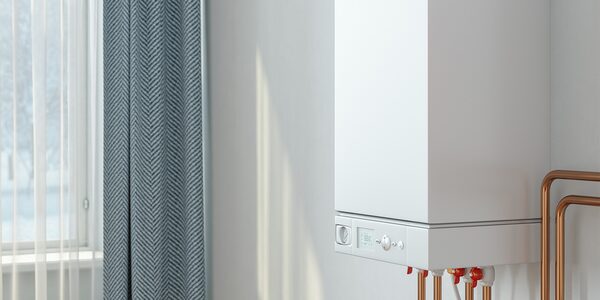
Boiler Plus standards were introduced in England in 20184. The requirement is for existing households in England to install an additional energy saving measure from a choice list at the point of installing a new or replacement combi gas boiler in an existing dwelling16. The measures are thermostatic control measures, and they typically require both room thermostats and thermostatic radiator valve controls4.
The scope is narrower than it is sometimes described. Boiler Plus applies to combi gas boiler replacements in existing dwellings in England. It does not apply to new build, and it does not apply in Scotland, Wales or Northern Ireland, which set their own building standards. Thermostatic control measures apply when a heating appliance is installed, and the appliance may be a boiler, electric heating or a heat pump4.
Separately, the Energy Company Obligation rules changed. The requirement for a full set of heating controls in the property following a boiler installation was removed from ECO4 delivery guidance17. That is a change to a grant scheme's conditions, not to the building regulations, and it means a household receiving ECO4 funding for a boiler should not assume controls are included.
OpenTherm: the protocol that lets controls modulate the boiler
Most controls are on/off. They call for heat, the boiler fires at a fixed flow temperature, and the call stops when the room is satisfied. OpenTherm is different: it is a communication protocol between heating controls and the boiler which modulates the temperature flow through the heating system19. The protocol is primarily designed to control modulating heating appliances20.
The practical difference is that a modulating boiler can run at a lower flow temperature for longer rather than cycling on and off at full output. That suits condensing boilers, which recover more heat from the flue when the return water is cooler. It also suits heat pumps, which run most efficiently at low flow temperatures.
OpenTherm is a multi point to point communication protocol for use in HVAC systems20. Future expansion possibilities include connecting OpenTherm controllers to other smart energy systems such as home energy management systems, grid control or other related systems20. That last point is where controls touch energy independence most directly: a control system that can respond to a grid signal or a time-of-use tariff can shift when a home draws power, which matters more as heating electrifies.
The limit is compatibility. OpenTherm requires both the control and the boiler to support the protocol, and a boiler without it will fall back to on/off control. The protocol is not a retrofit for an appliance that does not speak it.
Smart controls and a worked example: the Herschel iQ MD2
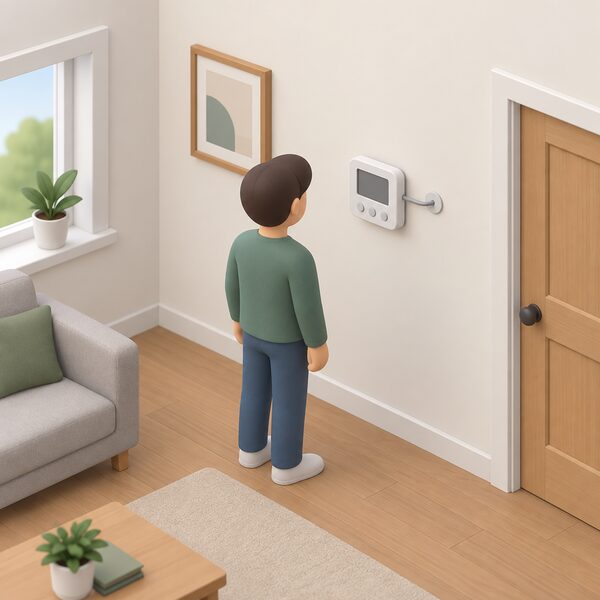
Smart controls are connected to the internet and offer more functionality than conventional controls2. A smart thermostat controls heating and helps manage how the central heating is set and adjusted9. A wireless thermostat usually sends a signal to a receiver connected to the boiler, which then tells the boiler when to turn the heating on or off, without a direct wired connection between thermostat and boiler9.
The Herschel iQ MD2 Wired Thermostat is a maker product that illustrates the category. It is priced at £69.0019. It carries built-in frost protection19. Its certifications are listed as EN60730-1 and 2-9, and separately as EN62479 and EN5066319. The two certification listings are both given by the maker and are not reconciled in the documents.
Two points follow from the example. First, a wired thermostat at this price is a control, not a heating system: it changes when the boiler runs, not how much heat the building needs. Second, the certifications listed are product safety and electromagnetic standards, which is what a household should expect to see for any control wired into a heating circuit.
Costs, installers and help with paying: £600 for a full set, grants and Nest in Wales
Costs are given by independent guidance and are installer-quoted in practice.
| Work | Cost |
|---|---|
| Adding TRVs to all radiators where a programmer and thermostat already exist | around £370 |
| Adding a programmer, thermostat and TRVs on all radiators where no controls exist | around £600 |
| Full installation of programmer, room thermostat and TRVs for all radiators | around £600 |
The £370 and £600 figures come from independent guidance2. The separate full installation figure of around £600 comes from independent guidance3. The two £600 figures describe the same scope from different sources and agree.
In Wales, the Warm Homes Nest scheme provides funding for home energy improvements21. It offers free energy efficiency advice and improvements to low-income Welsh households22. The scheme funds replacement of a boiler or electric storage heaters to ensure a safe and reliable heating system23. Over £30 million has been allocated next year to fund energy efficiency, renewables and clean heat measures24. Since 2011, the Welsh Government has invested more than £251 million to improve home energy efficiency through the Warm Homes Nest scheme25. A network of Wales-based installers provided the installation services under the management of the Nest team26.
Eligibility is set out in official guidance. Households must own or privately rent their home, receive a means-tested benefit or live in a low-income household, and live in a home with an EPC rating of 54 (E) or less, or 68 (D) or less where a household member has an eligible health condition27. The scheme supports people in Wales living on a lower income who receive a means-tested benefit or live with a respiratory, circulatory or mental health condition28. It is aimed at houses with a poor EPC rating29. All households in Wales also have access to free, impartial advice21. Eligibility can be checked by calling Nest free on 0808 808 224423.
For England, Scotland and Northern Ireland, the grant position differs and is covered on the boiler and heating grants in England, Scotland, Wales and Northern Ireland pages.
How controls fit into the move away from gas boilers
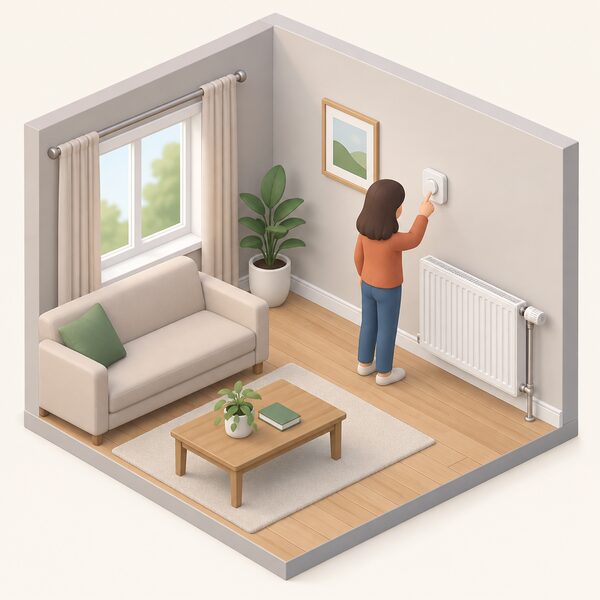
Controls are the part of a heating system that carries over when the heat source changes. Thermostatic control measures apply when a heating appliance is installed, and the appliance may be a boiler, electric heating or a heat pump4. The same room thermostat and TRV set that manages a gas boiler also manages a heat pump, which is why the controls are worth getting right before the appliance is replaced.
The order matters. It is important to get the heating controls right before trying to change the flow temperature30. If the heating controls are not set correctly when the boiler thermostat is adjusted, the expected results may not follow30. A household that lowers flow temperature with a thermostat fighting a TRV in the same room will not see the efficiency gain that a condensing boiler can deliver.
The direction of travel is set out in government strategy. The UK Government has proposed phasing out the sale of most new fossil fuel boilers from 2035, with exemptions for unsuitable homes31. The strategy intends to phase out the installation of new and replacement natural gas boilers from 203532. In Scotland, the assessment states that over 1 million households and around 50,000 non-domestic buildings need to convert by 2030 to remain within the published buildings sector emissions envelopes33. The strategy proposes converting around 50% of homes and an estimated 50,000 non-domestic properties to zero or low emissions heating by 2030, alongside a 68% reduction in combined building emissions compared with 202034. A backstop date of 2045 is proposed for low or zero emissions heating in existing buildings33.
For a household, the controls are the part of that transition that can be done now, at a known cost, without committing to a fuel or an appliance. The dependence that remains is the same as before: the grid or a delivered fuel, a supplier, and, for smart controls, a manufacturer's platform. Controls reduce the bill and the waste; they do not make a home self-sustaining on their own. The wider picture is set out on home heating and energy independence, and the appliance side on boilers and home heating.
Sources34 cited
- Thermostats and heating controls, Home Energy Scotland, 2026-09-20
- Thermostats and heating controls, Energy Saving Trust, 2026-02-10
- Tips to improve the EPC rating of your home, Energy Saving Trust, 2026-08-03
- Building Regulations Discussion Document 2023, Northern Ireland Department of Finance, 2023-10-11
- Approved Document L Volume 1: Dwellings, UK Government, 2026
- Building Regulations Approved Document L Volume 1 2026, Welsh Government, 2026-04
- Approved Document L: Conservation of Fuel and Power, Volume 1 Dwellings, 2021 edition incorporating 2023 amendments, UK Government, 2023
- Building Regulations: Extensions, Energy Efficiency, Welsh Government, 2026-09-17
- What is a smart thermostat, Smart Energy GB, 2026-08-19
- Thermostat advice, nidirect, 2026-09-02
- ECO4 New Measures and Products Guidance v3.0, Ofgem, 2026-03-26
- Building Regulations: Energy Efficiency for Extensions, Planning Portal, 2026
- Building Standards Technical Handbook 2020: Domestic, 6.3 Heating System, Scottish Government, 2020-12-02
- Value Added Tax Act 1994, Schedule 8, Part II, Chapter 23, legislation.gov.uk, 2026-09-17
- The Value Added Tax (Installation of Energy-Saving Materials) Order 2022, legislation.gov.uk, 2022-03-23
- Carbon Budget Delivery Plan, UK Government, 2023-03-30
- Summary of updates to ECO4 delivery guidance and measures table, Ofgem, 2026-03
- ECO4 Delivery Guidance v3.2 and measures table: summary of updates, Ofgem, 2025-12
- Wireless thermostats: all you need to know, Ideal Heating, 2026
- What is OpenTherm, OpenTherm Association, 2026-01-26
- Home Energy Efficiency, Bridgend County Borough Council, 2026-09-17
- Minimum Energy Efficiency Standards, Carmarthenshire County Council, 2026-09-20
- Get help with unexpected costs such as food and heating, Welsh Government, 2026-04-15
- Written statement: support available to help with the cost of living, Welsh Government, 2026-03-18
- Tackling fuel poverty: priority actions, Welsh Government, 2025-06-23
- Warm Homes Nest Scheme Annual Report 2024 to 2025, Welsh Government, 2026-03-26
- Research briefing CBP-9585, House of Commons Library, 2026-05-13
- Nest: a scheme to make your home warmer and more energy efficient, Isle of Anglesey County Council, 2026-09-17
- POST note 0771, Parliamentary Office of Science and Technology, 2026-06-25
- Should I turn my boiler's flow temperature down, Energy Saving Trust, 2026-05-20
- Boilers and heating, Planning Portal, 2026-09-17
- Boilers and heating: building regulations, Planning Portal, 2026
- Heat in Buildings Strategy: Business and Regulatory Impact Assessment, Scottish Government, 2021-11
- Draft Heat in Buildings Strategy consultation, Scottish Government, 2021-02
 The Full Heating Controls GuideA room thermostat, a programmer and valves on your radiators are the basics.
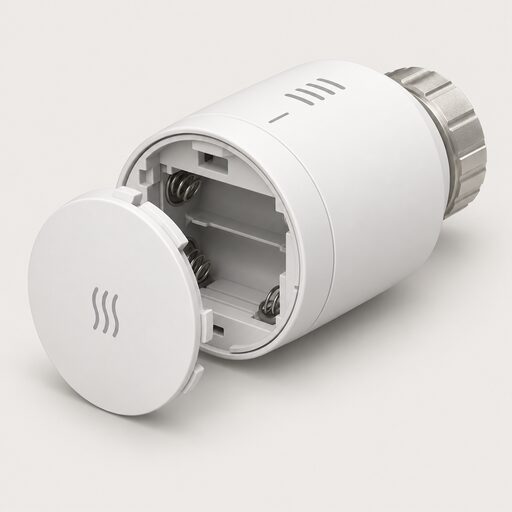 Smart TRVs ExplainedSmart radiator valves let you heat one room without heating the rest, on a schedule you set from your phone.
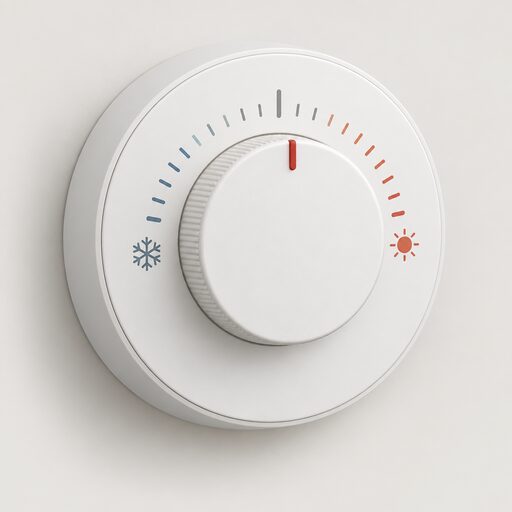 Controls and Smart OperationWhy does a heat pump need different controls from a boiler, and what does weather compensation actually do?
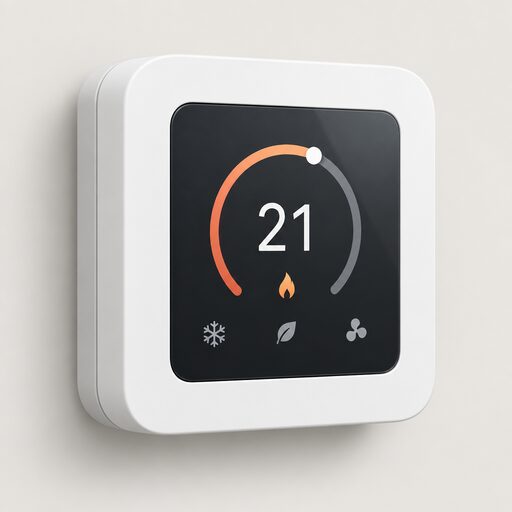 Heating Controls CostA smart thermostat usually costs between about a hundred and two hundred and fifty pounds, but fitting can push that higher.
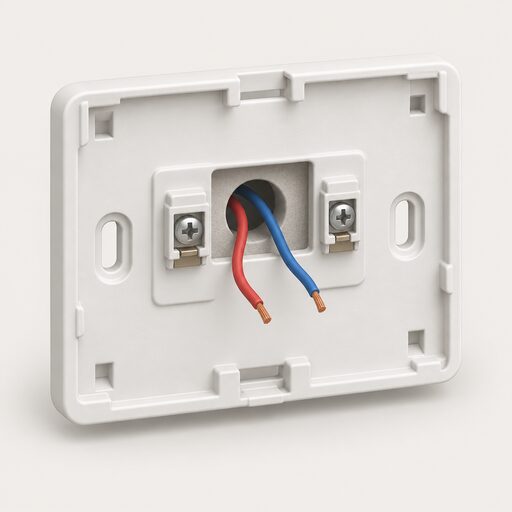 Installing Heating ControlsSwapping a thermostat or programmer looks simple, but which jobs can you safely do yourself and which need a registered installer?
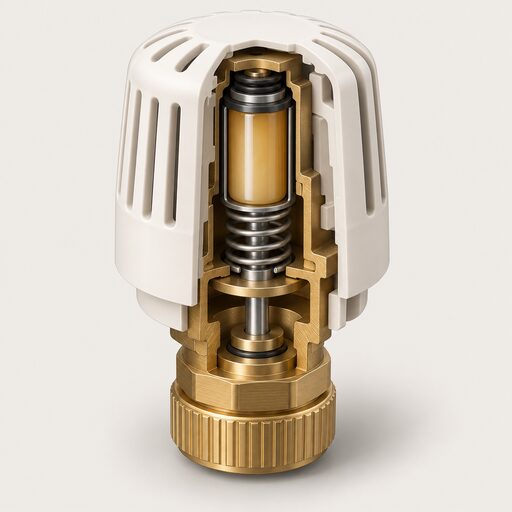 Thermostatic Radiator ValvesHow a thermostatic radiator valve senses room air temperature and throttles flow to a single radiator, what the numbered settings mean, where TRVs should and should not be fitted, and what the Building Regulations require across the UK.