In this guide
A boiler fault code is the appliance telling you which of its own safety or sensor conditions has been tripped. It is not a standard: the letter and number belong to the manufacturer, so the same characters mean different things on different makes. Vaillant's F28 covers ignition problems, gas supply problems or a frozen condensate pipe1. Worcester Bosch uses EA229 for a blocked condensate pipe, and E5218, E5332, E9219 or E9224 for overheating that may come from a faulty central heating pump, a blocked condensate pipe or heat exchanger problems2. ATAG uses 118, 108 or 1P4 for low water pressure, and 133 or 501, described as no flame after five attempts, when the condensate pipe has frozen3.
Behind most household lockouts sit a small number of causes. Pressure that has drifted outside the normal cold range of 1 to 1.5 bar, a condensate pipe iced over in freezing weather, trapped air, sludge, a failing thermostat, or scale slowing flow across the heat exchanger so that water boils in the boiler and kettles4. Two of those, topping up pressure through the filling loop and thawing an external condensate pipe with warm water, are routinely described in manufacturer and network guidance as householder tasks. Almost everything else is not. Vaillant states plainly that householders should not gain access inside the boiler, and Cadent's position on gas appliances is blunter still6.
A gas boiler is the part of a home's heating that is least independent: it depends on a gas supply, a mains electricity supply for its controls and pump, mains water pressure to refill, and a registered engineer for any repair beyond the external checks below. Understanding the fault codes shortens the outage; it does not remove those dependencies.
What a fault code actually tells you, and what it does not
A code narrows the field. It rarely names the failed part. Vaillant's F28 is the clearest example of why: three unrelated conditions, ignition failure, a gas supply problem and a frozen condensate pipe, all produce the same display1. A householder who thaws a condensate pipe on the strength of an F28 may be addressing the right cause in January and the wrong one in July.
The codes are also brand property. Vaillant states that "The official list of Vaillant boiler fault codes is available only from us", on its overview page, kept constantly updated1. That is worth taking at face value: numbering is reused between ranges and revised between model generations, so a list found against a different make, or a different series of the same make, can send a household down the wrong path. The boiler's user manual and the manufacturer's current fault code page for that exact model are the two places a code should be looked up. Some ranges are marketed on the clarity of this: the Vaillant ecoFIT sustain combi range is described as using recognisable Vaillant fault codes, making faults easy to diagnose11.
Codes fall into rough families, and knowing the family is often enough to decide whether the next step is a householder one:
| Fault family | Example codes | What it points to |
|---|---|---|
| Low water pressure | ATAG 118, 108, 1P43 | System pressure below normal; 108 is below 0.5 bar3 |
| High water pressure | Model-specific; not all boilers have one12 | Overfilling, filling loop left open, expansion vessel12 |
| Condensate blockage | Worcester Bosch EA2292; ATAG 133, 5013 | Frozen or blocked condensate pipe |
| Ignition / no flame | Vaillant F281; ATAG 5013 | Ignition, gas supply, or frozen condensate |
| Overheating | Worcester Bosch E5218, E5332, E9219, E92242 | Pump fault, blocked condensate, heat exchanger2 |
The pressure and condensate families cover the bulk of what households meet. The ignition and overheat families are engineer territory, because the possible causes reach inside the case.
Pressure: the 1 to 1.5 bar range and what the gauge is telling you
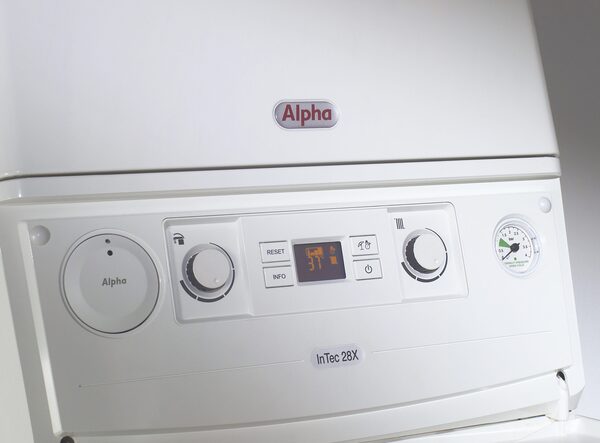
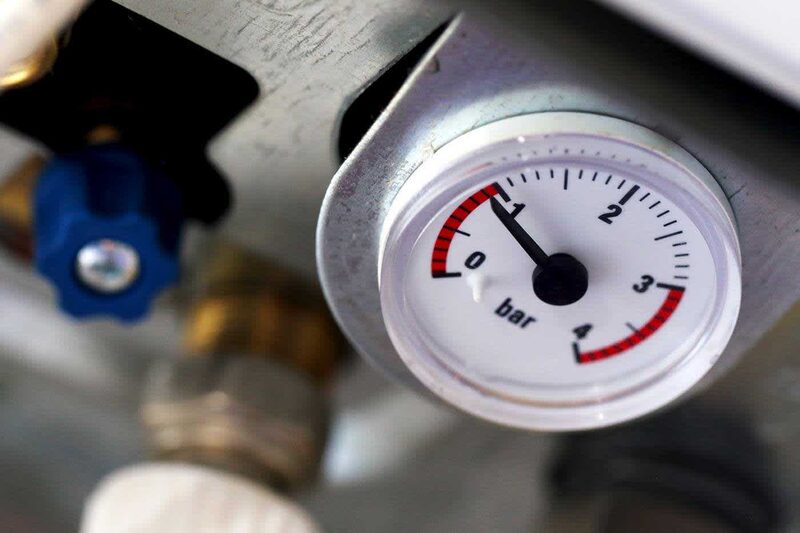
Sources converge tightly on the cold range. Ideal states that with the heating off the gauge should read between 1 and 1.5 bar, and that action may be needed below 1 bar when the system is cold5. Cadent gives the same aim of 1 to 1.5 bar13. Citizens Advice tells households below 1 bar to repressurise following the manufacturer's guide, setting the pressure between 1 and 1.5 bar14. Vaillant describes the normal range as 1 to 1.5 bar and instructs slow increase into it6. EDF's own re-pressurising procedure shuts both valves at about 1.2 bar, which sits inside that band15. Vaillant elsewhere gives an ideal of around 1.5 bar while noting it can vary slightly by make and model, and that variation is why the manual outranks any general figure4.
Running pressure is higher and should be. Ideal describes an increase of around 0.5 bar when the heating is active, so a system resting at 1.5 bar might sit closer to 2 bar5. ATAG states that a system filled to the correct cold pressure may rise to around 1.8 to 2.4 bar when hot, and that this is normal, because water system pressure increases with heat3. A reading taken mid-cycle therefore proves very little. The cold reading is the diagnostic one.
Low pressure is uncomfortable rather than destructive. Ideal states that low pressure makes the boiler work harder, using more energy and potentially increasing bills, but that it will not damage the boiler or reduce its lifespan5. What it does do is trip the safety cut: if pressure gets too low, a modern boiler will typically shut down as a safety measure5. Typical symptoms are no heating or hot water, radiators not warming properly, and a fallen gauge15. Navien lists the gauge dropping below 1 bar among the signs a boiler is in trouble in cold weather16.
High pressure carries more risk. Uswitch states that too much pressure brings an increased chance of leaks, overheating and damage to pipes and radiators17. The visible signs are the dial rising or entering the red zone and the system shutting down15. Baxi notes that some boilers show an error code for high pressure and some do not, so the manual has to be checked for that model12. Uswitch also lists a noisy boiler, radiators taking too long to heat and inconsistent hot water among the warning signs worth acting on17.
Why pressure drifts: leaks, valves, vessels and bleeding
Pressure does not fall without water or air leaving the system. EDF states that boilers lose pressure when water escapes, often through small leaks in pipes, radiators or valves, and names a faulty expansion vessel or pressure relief valve and recent radiator bleeding among the causes15. Uswitch gives the same two headline causes, leaks in pipes or valves, and bleeding radiators releasing air17. Ideal adds two more: air in the water of a newly filled system, released over time, and component failure within the boiler itself18.
Two specific components account for a large share of stubborn cases. Ideal describes the pressure relief valve as a safety device that releases water when pressure rises too high, notes that like any tap it can wear out and start leaking, and states that the outlet pipe should be dry in normal operation, with a Gas Safe registered engineer called if it is wet5. Puddles or excessive water around the boiler suggest a leak in the system, most commonly at joints and radiator pipework5. Vaillant lists excessive boiler pressure, corroded pipes or tanks, a faulty component and leaks from seals as causes of boiler leaks4.
High pressure has a different root. Intergas attributes it to overfilling, a faulty filling loop or a problem with the expansion vessel8. EDF describes too much water being added, often from the filling loop being left open, and an expansion vessel failing to absorb the extra pressure as water heats15. Baxi's first check is that the filling loop is completely closed and not letting more water in, and it notes the simple case of pressure having been topped up too far after a low reading12. Uswitch describes the same two homeowner errors: overfilling when correcting low pressure, and leaving filling valves open by accident17.
Winter confuses the picture. EDF states that cold weather does not directly cause pressure loss, but exposes weaknesses such as frozen pipes, leaks and faulty components15. Frequency is the useful signal. Intergas pairs the symptom of needing to repressurise every few weeks with a slow leak or deteriorating component, and observes that frequent repressurising, recurring faults or an age over 10 to 15 years point towards replacement8. Ideal's position on repeat loss is that most causes are professional jobs not to be attempted by homeowners, and that a Gas Safe registered engineer should diagnose it5. Uswitch lists pressure that keeps falling or rising among the signs a breakdown is coming19. More on the gauge itself is set out on the page covering boiler pressure.
Bringing the gauge back into range
Ideal's sequence for topping up is: turn the boiler off and let it cool completely, check the filling loop attachments, open both valves, watch the gauge until it reaches the operating range, close both valves, and switch the boiler back on5. EDF's version closes both valves at about 1.2 bar15. Uswitch describes closing the valve once the gauge reaches between 1 and 1.5 bar17. Vaillant's instruction is to increase the pressure slowly to between 1 and 1.5 bar6.
Reducing high pressure is the mirror operation, carried out by releasing water from the system rather than adding it, after confirming the filling loop is shut12. Where the cause is a failing expansion vessel or a worn pressure relief valve, topping up or bleeding down only postpones the next shutdown8.
The frozen condensate pipe: the classic winter shutdown
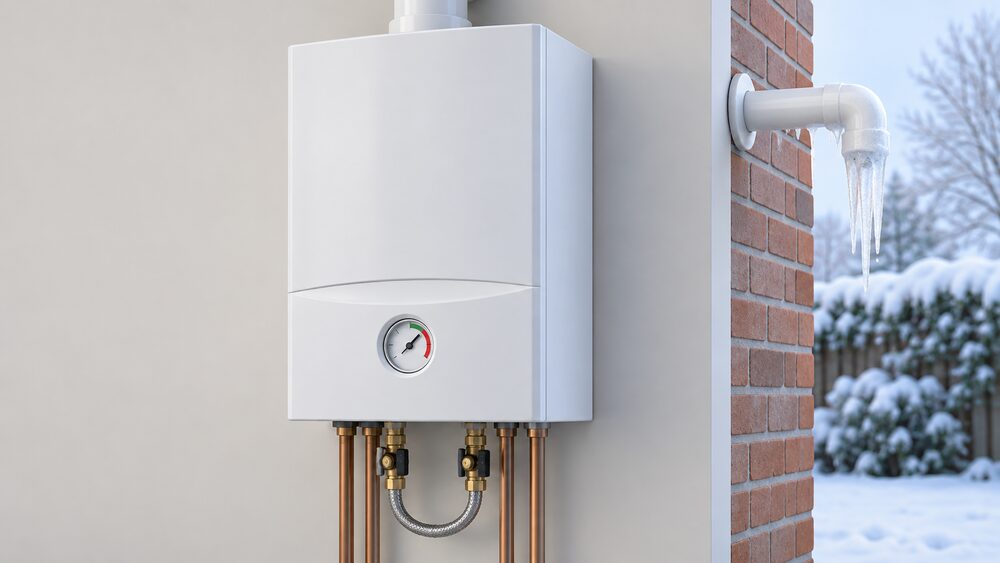
Every condensing boiler produces waste water. Worcester Bosch describes the condensate pipe as an additional pipe fitted to carry away the waste water formed by the normal condensing process, normally plastic, running from the boiler to a household drainage system or soakaway outside, or to a suitable existing waste pipe or external drain20. SGN describes it as a small pipe carrying away the water the boiler produces, usually found on the wall outside the home or underneath the boiler, made of plastic9. Alpha describes its function as draining that liquid away so the boiler can operate at its optimal level21. Northern Gas Networks notes that the condensate contains contaminants that make it slightly acidic, which is why it must go to a suitable drain22.
Because the run is often external, it freezes. Baxi states that external pipes are outside, exposed to the elements and more prone to freezing than internal ones, and notes that the route varies by model, with wall-mounted boilers often taking the pipe through the wall behind them and floor-standing models running it down to a drain23. Alpha makes the same point about the far higher risk when the pipe is external and the weather turns cold10. Home Energy Scotland puts the consequence simply: if the pipe gets blocked with a build-up of ice, the boiler will stop working24. Navien states that the boiler will usually shut itself down as a safety precaution, which is a designed response rather than a breakdown16. Alpha's condensate guidance says the same: frozen condensate discharge pipes will cause a boiler to shut down21.
Wales & West Utilities states that if a boiler has stopped working in the cold, the chances are the condensate pipes are frozen25. The symptom set is consistent:
- No heating or hot water, and the boiler having switched itself off16
- A gurgling, banging or otherwise unusual noise from the boiler or near the outside pipe20
- An error or fault code on the display16
- Visible frost or ice on the pipe, or the pipe feeling very cold10
- No water coming out of the pipe9
- Water pooling around the boiler or near where the pipe exits the wall23
- Repeated shutdowns over a cold spell23
CIPHE's broader list of frozen-pipe warning signs extends to a lack of water at taps and showers, gurgling from the central heating, heating systems in lockout or shutdown, the boiler not switching on, and the toilet failing to flush26. Northern Gas Networks sets out the stakes: a frozen condensate pipe can stop the boiler working and potentially leave a household without heating, without cold water and unable to cook27.
Thawing the pipe, and the one method ruled out everywhere
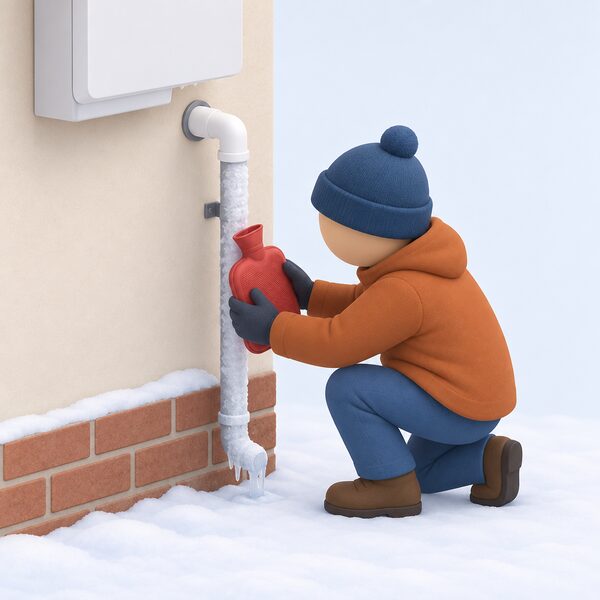
The permitted methods are warm, not hot enough to shock the plastic, and applied to the outside of the pipe. SGN distinguishes by location: for an external pipe, pour hot but not boiling water on it; for internal pipes, hold a hot water bottle against the pipe9. Northern Gas Networks gives the same pair, a hot water bottle or heat wrap held around the pipe, or hot, not boiling, water poured over the frozen end22. Uswitch adds a warm cloth or microwaveable heat pack, and notes the boiler may then need resetting28. ATAG's instruction covers a hot water bottle, a microwaveable heating pack of the sort used for muscular aches, or cloths soaked in warm water applied to the exterior3. Ideal describes a hot water bottle or warm water poured over the pipe18.
The prohibition is unanimous and the reason is physical. Vaillant states that boiling water from a kettle can damage or crack the pipe, causing damage that will be costly to repair1. Alpha states it is crucial not to use boiling water, which can crack the pipe10. Citizens Advice warns that boiling water might melt the pipe29. CIPHE rules out both boiling water and naked flames, because there may be unnoticeable splits in the pipe or flammable material nearby26.
"Avoid using boiling water or naked flames for thawing as there could be unnoticeable splits in the pipe or flammable materials nearby."
Thawing is a repair of a symptom. Alpha states that if the pipe has been thawed several times and the boiler is still underperforming, a Gas Safe registered engineer should be called10. SGN's winter guidance says that if the boiler still does not fire up after an attempt at thawing, the household should contact its gas supplier where it holds home or boiler care cover, or a Gas Safe registered engineer31. Cover arrangements are covered on the page about boiler cover and service plans.
Keeping the condensate pipe from freezing again
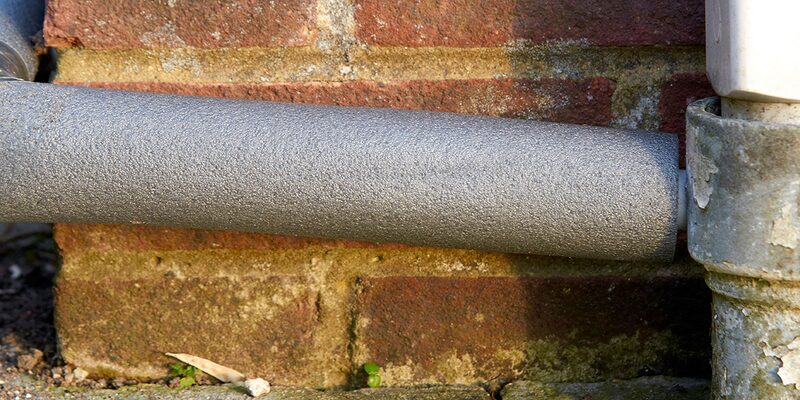
Insulation is the standard preventive measure and the one households can arrange. Home Energy Scotland advises insulating the plastic pipe with foam pipe insulation to keep it warmer and prevent the condensate water from freezing24. Uswitch calls wrapping the condensate pipe in foam pipe insulation the most energy-efficient way to protect it28. SGN notes insulation can be bought from any DIY store, and that a plumber can install a heat wrap9. Baxi advises foam sleeves or insulating tape, focusing on exposed sections in unheated areas such as garages or lofts, and suggests pipe heating solutions giving gentle warmth in areas prone to severe cold23.
Alpha specifies what the insulation itself should be: class "O" grade PVC coated material, water- and weather-proof21. That grade matters because the material sits outdoors through repeated freeze and thaw cycles.
Routing is not a retrofit decision for a householder, but it is decided at installation and it determines how much insulation has to do. Alpha also flags a consequence that outlives the winter: not following the condensate pipe regulations can inadvertently invalidate a boiler warranty21. That applies to alterations as well as to the original installation, and it is a reason to have any change to the pipe run made by the installer rather than improvised. The rules that govern the pipe run are set out on the building regulations for heating page, and the effect on cover on the boiler warranties page.
Kettling: when the boiler sounds like a kettle
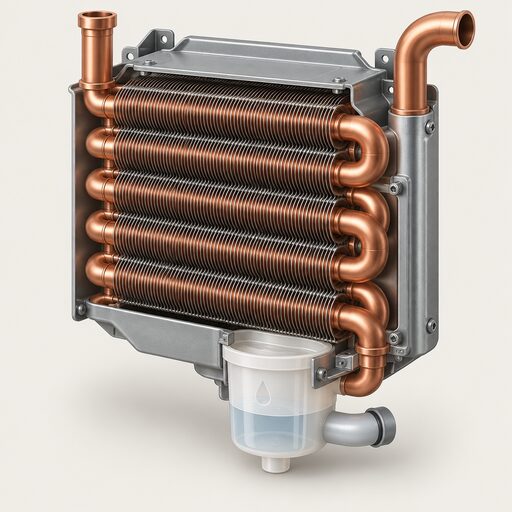
Ideal's definition is literal. Kettling is where the water is being boiled just like inside a kettle, in the boiler loop, when flow slows over the burner32. Vaillant describes the mechanism from the other side: water heated too quickly reaches boiling point, steam is generated and air becomes trapped4.
The causes fall into two groups. Vaillant names limescale build-up, which slows the flow of water through the system and causes it to heat too fast, and a faulty component on the appliance4. Ideal adds a control cause: a damaged or wrongly set up thermostat could give the wrong reading to the boiler, which could cause it to overheat32. Hard-water areas see the scale route more often, and the flow temperature the boiler is asked to reach bears on how quickly water crosses the heat exchanger, which is covered on the boiler flow temperature page.
On risk, the sources are measured rather than alarmed. Ideal states that kettling has the potential to be dangerous, as theoretically the high pressure could burst internal pipework and cause steam emission and electrical hazards32. Vaillant's framing is that strange boiler noises do not usually mean there is an immediate danger with the system, but that an engineer should nonetheless be called as soon as possible to investigate4. Both point the same way: not an evacuate-the-house event, not something to live with either.
The remedy is a system one. Vaillant states that an engineer will inspect the system, that the noisy component can sometimes be cleaned using different methods, and that alternatively replacing the parts may be required4. Ideal is explicit that none of the remedies are DIY jobs and that a Gas Safe engineer should always be used32. Water treatment and system cleanliness sit behind most scale and sludge problems, and are dealt with under heating system design and balancing.
Noise is also one of the general warning signs. Uswitch lists unusual sounds like hissing and clunking, along with a pilot light turning yellow or orange, pressure that keeps falling or rising, and a boiler that stops working when the temperature falls below zero for a prolonged period, as indications that a breakdown is approaching19.
Other common lockouts and what sits behind them
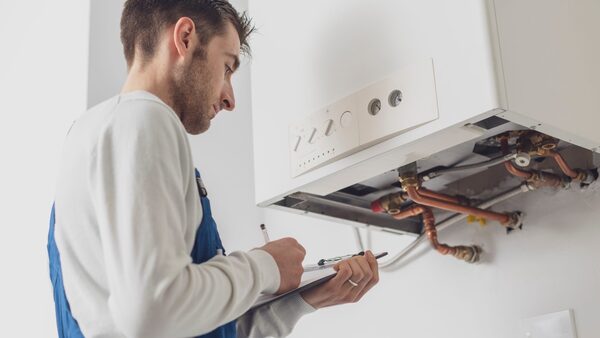
Vaillant lists the causes of a boiler that keeps switching off: trapped air in the system, low boiler pressure, high boiler pressure, a faulty thermostat, and debris and sludge building up in the pipes4. Three of those overlap with the pressure and kettling sections above, which is why a single code can point in several directions at once.
| Symptom | Causes given | Who resolves it |
|---|---|---|
| No heating or hot water, gauge low | Leaks, bled radiators, faulty expansion vessel or relief valve15 | Householder may top up; repeat loss to an engineer5 |
| Boiler off in freezing weather, gurgling | Frozen condensate pipe25 | Householder may thaw externally9 |
| Kettling or knocking noises | Limescale, faulty component, thermostat4 | Gas Safe engineer only32 |
| Overheat codes on Worcester Bosch | Pump fault, blocked condensate, heat exchanger2 | Gas Safe engineer |
| Repeated pressure top-ups, boiler over 10 to 15 years | Slow leak or deteriorating component8 | Engineer; replacement may be discussed8 |
A boiler that has stopped during a power cut is a separate case from one that has failed on its own. SGN states that if the boiler is not working and it is unrelated to a power cut, a Gas Safe registered engineer is needed to investigate33. Age is the other background variable: Intergas's threshold of over 10 to 15 years, alongside recurring faults, is the point at which replacement enters the conversation8, a subject taken further on the boiler lifespan page.
Where the householder's line is drawn
The rule across gas networks, makers and consumer bodies is the same and it is not hedged. Cadent states that households should never DIY on a gas appliance, and should call a Gas Safe registered engineer if they suspect something is wrong or the appliance is not working correctly7. Cadent also states that when it comes to repairing faulty appliances, work must be carried out by a registered Gas Safe engineer34. SGN directs householders to a Gas Safe registered engineer for boiler issues beyond a frozen condensate pipe9, and Wales & West Utilities says to call a Gas Safe registered engineer or the gas supplier for any gas boiler or appliance issue25. Servicing follows the same rule: Confused.com describes maintenance checks on the key parts of a boiler being carried out by a Gas Safe registered engineer during a service35.
What that leaves a household is a short, defined list: reading the gauge, reading the code and looking it up in the manual for that model, topping up through the filling loop to the range the maker specifies, checking whether the condensate pipe is iced, thawing it from the outside with warm water or a heat pack, insulating it before winter, and resetting the boiler. Everything inside the case, every gas component, every replacement of a pressure relief valve or expansion vessel, and every diagnosis of kettling belongs to a registered engineer6.
Read against energy independence, that boundary is the honest measure of what a gas boiler is. It is efficient and, when working, invisible. But the household depends on a gas supply, on mains water to refill the system, on an electricity supply to run the controls and pump, on the manufacturer for the meaning of its own fault codes, and on a registered engineer for the repair. The two faults a household can act on alone, low pressure and a frozen condensate pipe, are real ones and are worth knowing. They are also the exceptions. Broader comparisons of heating that changes those dependencies are set out on heating and energy independence and across the main heating guide.
Sources35 cited
- Understanding an F28 fault code on a Vaillant boiler, Vaillant, 2026
- Worcester Bosch boilers and fault codes, E.ON Next, 2026-09-17
- ATAG boiler troubleshooting and fault codes, ATAG Heating, 2026-09-17
- Most common boiler problems, Vaillant, 2026-09-17
- Why is my boiler losing pressure?, Ideal Heating, 2026-09-17
- Vaillant boiler fault codes, Vaillant, 2026-09-17
- Gas Safety Week guidance, Cadent Gas, 2026-09-20
- Why does my boiler keep losing pressure?, Intergas Heating, 2026-06-11
- Boiler isn't working: frozen condensate, SGN, 2026
- Frozen condensate pipes, Alpha Innovation, 2025-11-06
- Vaillant ecoFIT sustain combi boilers, Quiet Mark, 2026-09-17
- How to fix high boiler pressure, Baxi, 2026-09-17
- Boiler not working, Cadent Gas, 2026-09-20
- Getting your broken boiler repaired or replaced, Citizens Advice, 2024-08-16
- Boiler pressure: everything you need to know, EDF Energy, 2026-09-17
- Why boilers break down in cold weather, Navien, 2026-03-03
- What pressure should your boiler be?, Uswitch, 2024-11-13
- Boiler fault FAQs, Ideal Heating, 2026-09-17
- Boiler insurance and breakdown warning signs, Uswitch, 2022-09-25
- Frozen condensate pipe advice, Worcester Bosch, 2026-09-20
- What does the boiler condensate do?, Alpha Innovation, 2026-09-17
- My boiler isn't working, Northern Gas Networks, 2026-07-24
- Why is my condensate pipe freezing?, Baxi, 2026-09-17
- Protect your pipes in winter, Home Energy Scotland, 2025-12
- Winter safety advice, Wales & West Utilities, 2026-09-20
- Don't be frozen out, CIPHE, 2024-01-11
- Staying safe and warm this winter, Northern Gas Networks, 2025-11-03
- Boiler maintenance guide, Uswitch, 2026-09-03
- Getting your broken boiler repaired or replaced, Citizens Advice, 2024-08-16
- Frozen pipes, CIPHE, 2022-12-12
- Be winter ready, SGN, 2026
- What is kettling in a boiler and is it dangerous?, Ideal Heating, 2026-09-17
- Gas supply updates, SGN, 2026
- How to detect a gas leak, Cadent Gas, 2026-09-20
- Boiler servicing guide, Confused.com, 2025-07-23
 Gas Boilers GuideMains gas boilers heat around 23 million UK homes.
 Who to Call for Energy HelpA single reference to the right contact for each situation: gas escapes, power cuts, water leaks, meter faults, billing disputes, scams and free advice.
 Faults and TroubleshootingWhat to check when a heat pump stops working, how to read fault logs and error codes, why short cycling happens, what servicing and warranty cover, and which refrigerant and F-gas rules apply.
 Boiler Manufacturers in the UKCovers the manufacturers supplying gas, oil, LPG and electric boilers to UK homes, their main ranges and where they are made.
 Thaw a Frozen Condensate PipeHow to identify a frozen condensate as the cause of a boiler lockout, the safe way to thaw the external pipe and how to restart the boiler afterwards.
 The Full Boilers and Heating GuideWhich boiler suits your home, and when is it worth swapping the old one?