In this guide
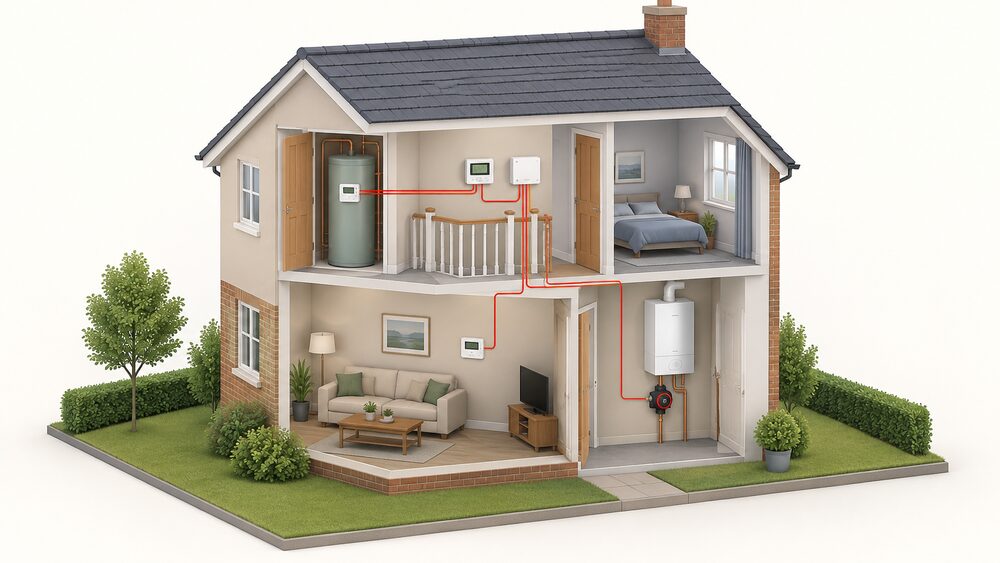
A boiler interlock is not a component you can buy. It is a wiring arrangement: the controls are wired so that when there is no demand for space heating or hot water, the boiler and the pump are switched off. The use of thermostatic radiator valves alone does not provide interlock1. In practice that means a room thermostat, a programmable room thermostat or a cylinder thermostat, wired through the programmer or wiring centre so that the appliance cannot fire once every call for heat has been satisfied2.
The requirement is a building regulations one. Approved Document L states that if work is carried out on a system that includes a boiler, a boiler interlock should be installed, and building regulations require all new and replacement systems to be interlocked4. Worcester Bosch states that the operating efficiency of a condensing boiler can be enhanced by up to 13% when installed with the correct controls5.
For a household, an interlock is the difference between a boiler that heats the house and a boiler that heats itself. Without one, the appliance fires and the pump circulates whenever the programmer says "on", regardless of whether the rooms are already warm, burning gas or oil that buys nothing. The interlock is the single cheapest piece of independence from wasted fuel in a wet heating system, and it is the reason every other control on this site, from a room thermostat to a smart thermostat, has to be wired correctly rather than merely fitted.
An interlock is a wiring arrangement, not a box on the wall
The clearest description comes from BEAMA's Part L heating controls guidance: boiler interlock means that controls are wired so that when there is no demand for space heating or hot water the boiler and pump are switched off, and the use of TRVs alone does not provide interlock1. Scottish draft guidance for wet central heating systems uses almost identical words: system controls should be wired so that when there is no demand for space heating or hot water, the boiler and pump are switched off2.
Viessmann describes it in plain terms as a wiring arrangement that prevents the boiler from heating the home when there is no need for it, and notes that interlock switches, in their general engineering sense, interrupt the electrical current running around a circuit and act as a safety device on machinery and industrial equipment such as lifts8. The heating version borrows the principle: break the circuit to the appliance when the conditions for running it are no longer met.
Two things must be switched off, not one. The burner in a gas boiler is switched on and off by a heating control, triggered either manually or by a thermostat when the temperature drops below a set level9. The pump matters too, because circulating hot water through radiators that are already up to temperature costs electricity and moves heat into rooms that do not want it.
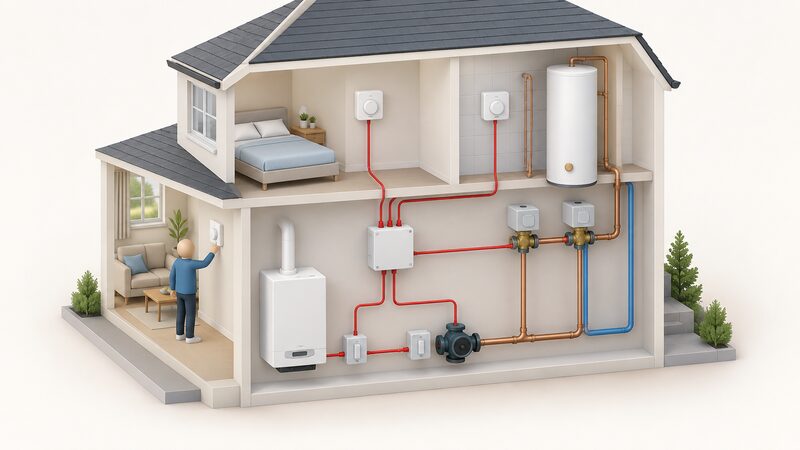
Drayton puts the minimum in one sentence: as a minimum, you need both time and temperature controls which have the ability to turn off the boiler when there is no demand, with TRVs recommended in each room10. That pairing, time control plus temperature control, is what the regulations are after. The wiring arrangements that deliver it, S-plan and Y-plan among them, are covered separately.
How the interlock behaves in operation
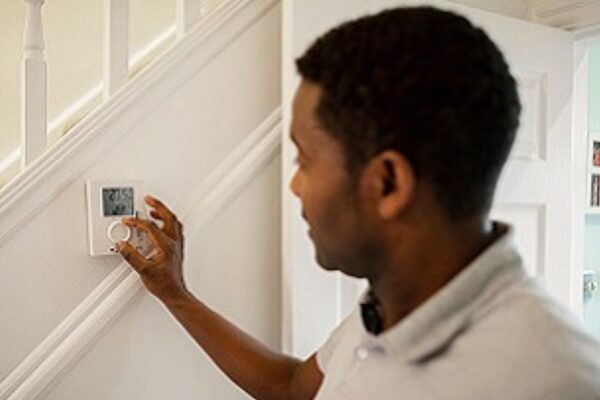
Once the controls are wired correctly, the sequence is simple. The boiler switches off if the heating and hot water thermostats have reached their set temperatures3. A room thermostat turns the boiler on and off automatically when the room temperature reaches the level chosen11. A cylinder thermostat stops the cylinder becoming hotter than it needs to be: once the water reaches the set temperature, the heat supply from the boiler is turned off3.
The Heating and Hotwater Industry Council states the behavioural test precisely:
"When this demand is met, the boiler should switch off again, it should not be able to fire until a new demand is created"
That last clause is the whole point. A boiler that switches off and then re-fires on its own internal thermostat, with no new call from the room or the cylinder, is short cycling: heating up, losing heat, and heating up again to no purpose. Myson makes the same connection from the cylinder side, stating that when a cylinder thermostat is used with a thermostatic control for the heating circuit it will give boiler interlock, providing a safety feature13.
It is worth keeping two thermostats distinct. The boiler's own thermostat controls the temperature of the water flowing through the heating system; it does not control the temperature inside rooms14. The boiler thermostat changes the temperature of the water in the system, and the boiler controls are separate from the central heating controls such as the room thermostat, programmer and radiator valves15. A boiler thermostat alone, therefore, cannot provide interlock: it regulates flow temperature, not demand. A related question, whether room controls are needed at all when a boiler has its own thermostat, follows directly from this distinction.
Underfloor heating is subject to the same rule. BEAMA's underfloor guidance states that when there is no demand for heat from the underfloor system, the heat source and the circulating pump should be switched off, known as boiler interlock, and that this is typically enabled via a main heating system wiring centre16. Homes mixing radiators and underfloor circuits need the demand signals from both to be combined, which is covered under underfloor heating controls.
Why the regulations require it on new and replacement systems
Approved Document L Volume 1 is explicit: if work is carried out on a system that includes a boiler, a boiler interlock should be installed4. The Energy Saving Trust states the same requirement in householder terms, that building regulations require all new and replacement systems to be interlocked3. Worcester Bosch confirms that Part L of the Building Regulations directs boiler interlocks17, and Navien notes that all new gas and oil boiler installations must include boiler interlock, time and temperature controls, meaning a programmable timer and a thermostat18.
Installing a new boiler needs building regulations approval because of the safety issues and the need for energy efficiency, and where a new system is to be installed the installer should proceed as if the work is being carried out in a new building19. The same requirement applies in Wales, where guidance states that work to install a new boiler, or a cooker that also supplies central heating, needs building regulations approval20. Planning permission is a separate matter and is not normally required for the installation or replacement of a boiler or heating system if all the work is internal19.
The rules do not stop at interlock. Building regulations specify that a replacement boiler must be A-rated for energy efficiency, and as a minimum a room thermostat and a programmer, or a programmable room thermostat, should be installed21. In Wales, the replacement of a gas boiler will probably have to be a condensing boiler unless there is sufficient reason why one cannot be installed20. Baxi records that under the 2022 changes installers must fit all new boilers with an inline magnetic filter, flush and clean out the heating system, and add scale and corrosion inhibitor22.
| Nation | Position on interlock | Source type |
|---|---|---|
| England | Approved Document L: a boiler interlock should be installed where work is carried out on a system that includes a boiler4 | official guidance |
| Wales | Approved Document L Volume 1 (2026) sets the TRV placement rule and the same control framework; new boiler work needs building regulations approval23 | official guidance |
| Scotland | Draft domestic building services compliance guidance: controls wired so that with no demand the boiler and pump are switched off2 | official consultation |
| Northern Ireland | Building regulations discussion document proposes that a gas-fired boiler in an existing dwelling, new or replacement, install a boiler interlock as defined for new systems24 | official consultation |
The presence of an interlock is also recorded formally. Energy assessment regulations list "whether there is a boiler interlock system" as a data item25, and the notional dwelling in Approved Document L is specified with boiler interlock and ErP Class V controls4. What those class numbers mean is set out under ErP control classes, and the wider regulatory picture under building regulations for heating controls.
Which controls actually provide the interlock
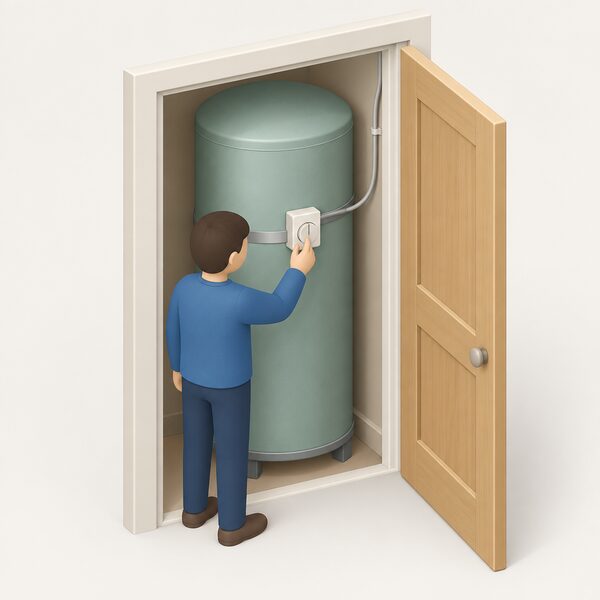
Only a control that can break the boiler's demand signal counts. In practice that is a room thermostat, a programmable room thermostat, or a cylinder thermostat for the hot water circuit, wired through a programmer or wiring centre.
- Programmer or timer. A timer controls when the boiler switches on and off, while a thermostat controls the temperature the boiler heats to26. Time control alone is not an interlock, but it is half of the required pair.
- Room thermostat. Turns the boiler on and off automatically when the room temperature reaches the level chosen11. This is the component that makes the system interlocked in most homes.
- Programmable room thermostat. Combines time and temperature controls in a single unit, and can set different temperatures for different times of day3. Worcester Bosch describes its Greenstar Comfort II as combining a programmer, usually plugged into the boiler, and a room thermostat, so all control functions sit in a single accessible location27.
- Cylinder thermostat. Needed where the system has a hot water cylinder; it turns off the heat supply from the boiler once the stored water reaches its set temperature3. Covered further under hot water controls.
- Thermostatic radiator valves. Recommended in each room10, but never the interlock itself.
The Energy Saving Trust lists the core set for a central heating system as a programmer for time control, at least one room thermostat, and TRVs3. Home Energy Scotland adds a cylinder thermostat where the system has a hot water cylinder28. The Centre for Alternative Technology gives the same list for a boiler home: a room thermostat, timer or programmer, boiler and cylinder thermostats, and TRVs29.
Smart controls satisfy the requirement in the same way, because they occupy the same place in the wiring. Hive states that if a boiler works with a standard room thermostat or programmer, then its system can control it30. Beyond simple on and off, BEAMA notes that load and weather compensation adjust the boiler flow temperature to maximise boiler efficiency, and that a smart thermostat is probably the easiest way to add compensation to an existing system31. Those techniques are set out under load compensation and modulation, weather compensation and OpenTherm. A modulating control interacts with the boiler rather than simply cutting it: with a regular thermostat, the boiler will turn itself on to reach the set temperature and off to stop heating for a while32.
Where TRVs fall short
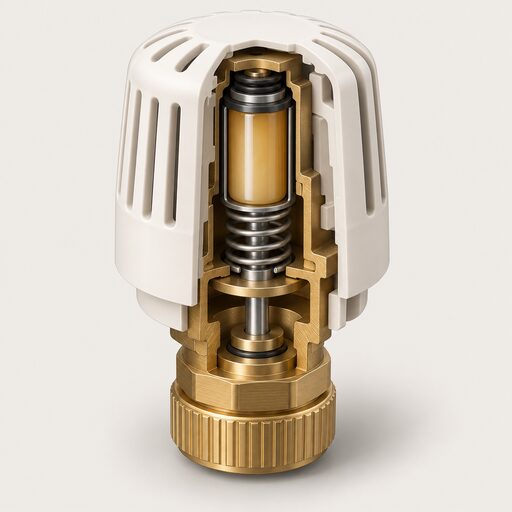
A thermostatic radiator valve controls the temperature of each room by opening and closing automatically to control the flow of hot water through the radiator it is fitted to6. It can be adjusted manually to different settings, and typically carries a scale from 0 to 6, where zero is off and six is fully open6. What it cannot do is stop the boiler. Ofgem's ECO4 guidance is blunt about the reason: TRVs have no communication with the boiler6.
That is why BEAMA's definition ends with the warning that the use of TRVs alone does not provide interlock1. Close every TRV in the house and the radiators stop emitting, but the programmer is still calling, the pump is still running and the boiler is still firing against a nearly closed system. The result is short cycling and, in some cases, noise: Ideal notes that a damaged or wrongly set up thermostat could give the wrong reading to the boiler, which could cause it to overheat34.
TRVs remain worth having alongside a proper interlock. Adding TRVs to a system that already has a programmer and thermostat is estimated to save 30 pounds a year in Great Britain and 40 pounds a year in Northern Ireland33. Manual valves start at around 10 pounds35. Welsh guidance states that a TRV gives better control over the individual room temperatures, that any new radiator installed will require a TRV, and that placing TRVs on existing radiators is encouraged36. Whether they earn that on their own is examined under do TRVs save energy.
The competition is straightforward. If the TRV closes the radiator before the room reaches the thermostat's set point, the thermostat never sees its target, never drops the call for heat, and the interlock never operates. The requirement is covered further under TRV requirements under building regulations and thermostatic radiator valves.
Interlock and condensing operation
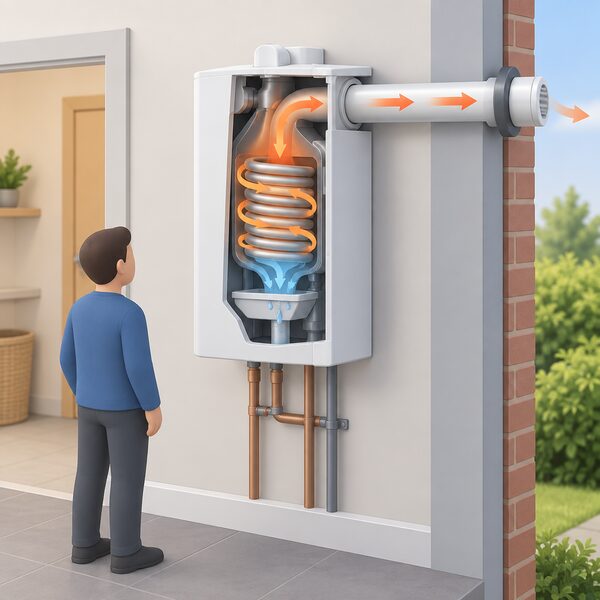
A condensing boiler is defined as one designed to make use of the latent heat released by the condensation of water vapour in the combustion flue products7. The Centre for Sustainable Energy explains the mechanism as extracting heat from the hot exhaust gases, or flue gases, to pre-heat the water fed into the boiler21. Ideal describes the flue as effectively part of the heating system, because it is the heat from the burned gases that warms the returning water38. Modern condensing boilers are capable of using around 90% of their heat39.
Whether that potential is realised depends on return water temperature. The HHIC states that if the return temperature is kept below approximately 55 degrees C (131 degrees F), the boiler will be in condensing mode and working at its most efficient40. Interlock supports this in two ways. First, it prevents dry cycling: a boiler that fires with no heat being taken from the system heats its water quickly, returns it hot, and condenses little. Second, it forces the boiler to run only when the emitters are genuinely absorbing heat and returning cooler water.
Flow temperature is the related lever. Many boilers are set by default to heat water to 75 to 80 degrees C41. Nesta's work with households states that condensing boilers should ideally be set to a flow temperature of 60 degrees C or lower to run as close as possible to condensing42. Which? suggests trying 60 degrees C, which is sufficient for many homes, on a combi43, while cautioning that for a boiler with a hot water tank or cylinder the flow temperature should not be set lower than 65 degrees C without asking an engineer first41. The Energy Saving Trust gives 65 degrees C for a conventional boiler15.
The sources differ on the exact number because they address different systems and different risks: combi boilers, which heat water on demand, tolerate a lower flow setting than systems that must bring a stored cylinder up to temperature. The settings question is treated at length under thermostat and flow temperature settings.
What an interlock is worth
Two figures frame the answer, and they come from different kinds of source.
The regulatory and modelling figure is a penalty rather than a saving. That is a modelled adjustment used in energy assessment, not a metered result in a particular house, and it affects the EPC rating.
The maker figure is larger and broader. Worcester Bosch states that the operating efficiency of a condensing boiler can be significantly enhanced by up to 13% when installed with the correct controls5. That is a manufacturer's claim about controls generally, not about interlock alone, and it should be read as the upper end of what a full, correctly wired control set can add.
| Measure | Estimated annual saving | Coverage |
|---|---|---|
| Full set of heating controls where the system had none | 110 pounds a year44 | Cadent Gas, GB |
| Heating controls, average semi-detached house | 100 pounds a year in GB, 110 pounds in NI45 | Energy Saving Trust |
| G-rated gas boiler with no controls to A-rated with full controls | 420 pounds a year45 | Great Britain |
| Upgrading an oil boiler to A-rated gas condensing with full controls | 440 pounds a year45 | Northern Ireland |
| Adding TRVs to a system with a programmer and thermostat | 30 pounds in GB, 40 pounds in NI33 | Energy Saving Trust |
Not every boiler carries the interlock penalty. Estimated savings also depend on how much other work has already been done: Nesta found that where controls compensate, the gas saved from lowering the boiler flow temperature might fall from 8% to 3.6%, a reminder that efficiency measures overlap rather than stack neatly42. Whether smart controls deliver their headline numbers is examined under do smart heating controls actually save money.
Checking an existing system, and having one added
There is no householder test that proves an interlock exists, because the answer lies in the wiring. There are, however, symptoms worth noticing.
- Watch the boiler with the heating programmed off and no hot water being drawn. E.ON Next advises that if a non-combi boiler turns on for prolonged periods when not running hot water, a professional heating engineer should check the system46.
- Check the thermostat is responding. Vaillant suggests setting the desired temperature to 20 degrees C, above the current temperature in the home, at which point the boiler should turn on47. Viessmann advises checking that settings have not inadvertently been changed and that the heating responds when the thermostat temperature is raised48.
- Check the timer's batteries have not run out and that it is correctly programmed49.
- Have the system inspected professionally. HHIC recommends that the boiler and system are serviced and checked annually to ensure they are running in tip-top condition50, and Alpha advises keeping an eye on individual components so that a fault such as a boiler thermostat not working does not go unnoticed51.
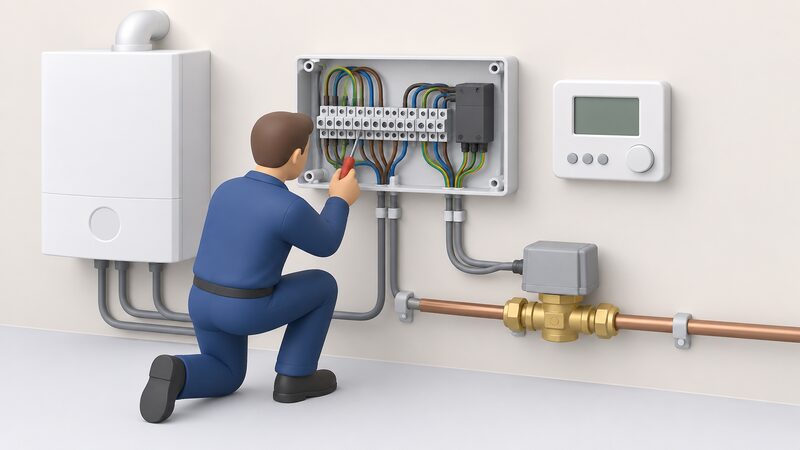
Where an interlock is missing, adding one is installation work on the heating system, not a DIY fitting. Only a Gas Safe registered engineer may install a gas boiler, and doing so otherwise is both dangerous and illegal52. Where the installer is not on a competent persons scheme, they cannot self-certify that the work is compliant, and the firm or the householder must give notice to the local authority of the intention to carry out the boiler work in advance and pay a notification fee19; alternatively, building regulations approval can be obtained from the council or a registered building control approver21. Practical considerations for changing controls are covered under installing and replacing heating controls, and fault diagnosis under heating control faults.
What an interlock does and does not do for independence
An interlock removes one specific form of waste: fuel burned when nobody has asked for heat. On a system with a boiler lifespan of around 10 to 15 years45, that waste accumulates over every winter the boiler runs. Correcting it costs nothing in running terms and is the precondition for everything else, because compensation, zoning and scheduling all assume the boiler stops when demand stops.
It does not reduce dependence on the fuel itself. An interlocked gas or oil boiler is still a mains gas or delivered oil appliance, still exposed to supplier prices, and still subject to the wider transition: regulations to phase out the need to install new or replacement fossil fuel boilers in on-gas areas in Scotland are set to begin in 2030. Nor does an interlock make a house independent of the electricity supply, since the controls, the pump and in most cases the boiler's ignition all need mains power.
There is one forward-looking consideration. A combi boiler does not need a cold water tank or hot water cylinder53, which makes it a good option where space is short and often the least expensive kind of boiler15. But the Energy Saving Trust notes that if a household switches to a combi now, it may need to put a cylinder back in should it want a heat pump in future15. Since a cylinder thermostat is one of the devices that provides interlock, removing the cylinder also changes which control does that job, and changes it back again later. The wider question of local versus cloud control is taken up under heating controls and energy independence, and the full control landscape at the heating controls guide.
Sources53 cited
- Part L 2022 Heating Controls Guidance, BEAMA, 2022
- Draft Guidance: Domestic Building Services Compliance Guide, Scottish Government, July 2021
- Thermostats and heating controls, Energy Saving Trust, 10 February 2026
- Approved Document L, Conservation of fuel and power, Volume 1: Dwellings, GOV.UK
- Do I need a boiler, solar panels or heat pumps to heat my home, Worcester Bosch
- ECO4 New Measures and Products Guidance v3.0, Ofgem, 26 March 2026
- SAP 10.3 full specification, BRE Group, 13 January 2026
- What is boiler interlock, Viessmann, 31 May 2022
- How a boiler works, Viessmann, 5 April 2022
- Homeowner FAQs, Drayton Controls, 20 November 2023
- How to use your heating controls, Age UK, 23 March 2026
- Heating controls guidance, HHIC, 2018
- Cylinder Thermostat, Myson
- Smart heating controls: what they do and why they matter, BEAMA, 7 April 2025
- Boilers, Energy Saving Trust, 20 May 2026
- Underfloor Heating Controls Guide for Domestic Properties, BEAMA, May 2020
- How does Part L of the Building Regulations affect my boiler installation, Worcester Bosch
- Support FAQs, Navien
- Building regulations for boilers and heating, Planning Portal
- Building regulations: boilers and heating, Welsh Government
- Upgrading and replacing your boiler, Centre for Sustainable Energy, June 2026
- What you need to know about sludge, Baxi, 1 March 2023
- Approved Document L Volume 1 (Wales), Welsh Government, April 2026
- Building Regulations Discussion Document and Pre-Consultation, Department of Finance NI, 11 October 2023
- The Energy Performance of Buildings Regulations, regulation 4, legislation.gov.uk, 2017
- Boiler controllers, Ideal Heating
- Greenstar Comfort II, Worcester Bosch
- Thermostats and heating controls, Home Energy Scotland
- Energy saving at home, Centre for Alternative Technology, 27 June 2025
- How does a smart thermostat connect to a boiler, Hive, 17 December 2025
- Smart homes and a lower carbon footprint, Energy Saving Trust, 21 January 2026
- What is OpenTherm, Viessmann, 16 June 2022
- Take control of the heating in your home, Energy Saving Trust, 11 September 2026
- What is kettling in a boiler, Ideal Heating
- No cost and low cost energy saving, Low Carbon Hub, 5 August 2026
- Building regulations for extensions: energy efficiency, Welsh Government
- Best smart radiator valves, Which?, September 2026
- What is a boiler flue and how do they work, Ideal Heating
- Different boiler types, Uswitch, 18 September 2026
- Condensing boilers: do they do what it says on the tin, HHIC, 2 March 2017
- One simple way to adjust your boiler to lower your heating bill, Which?, 29 September 2025
- Testing boiler efficiency advice with households, Nesta
- Make your home more energy efficient in one weekend, Which?, 28 August 2026
- Energy efficiency, Cadent Gas
- Tips to improve the EPC rating of your home, Energy Saving Trust, 3 August 2026
- Set a timer, E.ON Next
- Boiler not igniting: common issues, Vaillant
- How to check and fix boiler fault codes, Viessmann, 5 April 2022
- No hot water: here's what to check, Viessmann, 24 March 2022
- Heating system guidance, HHIC
- Best way to keep my boiler in good working condition, Alpha Innovation, 6 November 2025
- Glow-worm boilers review, Which?, 17 September 2025
- High efficiency condensing boilers: the benefits, Ideal Heating
 Thermostatic Radiator ValvesHow a thermostatic radiator valve senses room air temperature and throttles flow to a single radiator, what the numbered settings mean, where TRVs should and should not be fitted, and what the Building Regulations require across the UK.
 Heating Control FaultsWhy is my heating on when the thermostat says it is off, or why does one radiator stay cold?
 Regular and Heat-Only BoilersGot tanks in the loft and a hot water cylinder in the airing cupboard?
 OpenTherm Protocol ExplainedOpenTherm lets a smart thermostat and a boiler from different makers work together properly, so the boiler can run gently instead of switching on and off.
 Controls, Thermostats and TRVsWhich heating controls actually cut your bills, and what does each one do?
 Load Compensation and ModulationA boiler that only switches on and off wastes money, because it runs too hot to work at its best.