

In this guide
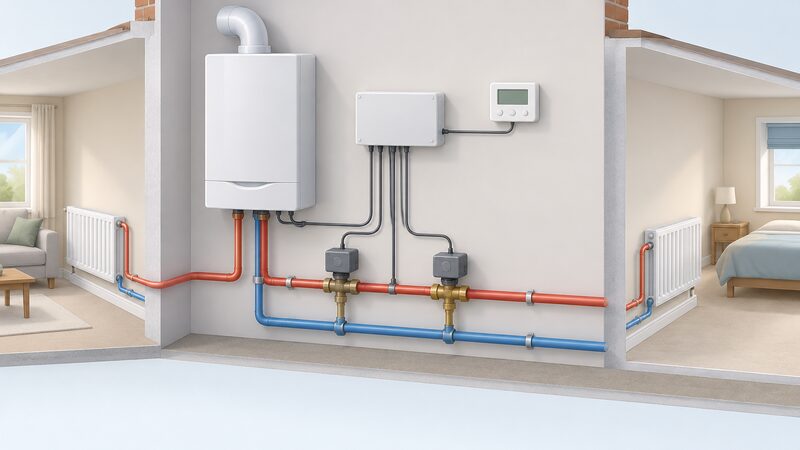
Heating controls are not a matter of taste in UK building law. When a boiler or a heating system is installed or replaced, the Building Regulations require a minimum standard of control, and the person who does the work is responsible for showing that the standard has been met. The baseline is time and temperature control on the heating system, plus a boiler interlock so the boiler and pump stop when there is no demand for space heating or hot water1.
In England there is a further layer. Boiler Plus, introduced in 2018, requires existing households installing a new or replacement combi gas boiler in an existing dwelling to fit an additional energy saving measure from a choice list: weather compensation, smart thermostat, flue gas heat recovery or load compensation3. The same policy raised minimum boiler efficiencies and made time and temperature controls a requirement, which the evidence notes were "surprisingly not present in all installations"4.
The rules are not uniform across the UK. England, Wales, Scotland and Northern Ireland each have their own building control framework, their own approved or guidance documents, and their own pace of change. Wales has been consulting on a revised Approved Document L, Scotland has its own domestic building services compliance guide, and Northern Ireland's discussion document on building regulations remains a pre-consultation5.
What the building regulations require of heating controls
The Building Regulations are not a single rule about thermostats. They are a set of functional requirements, and the approved documents describe one way of meeting them in ordinary circumstances. The Planning Portal states that the approved documents set out what "in ordinary circumstances, may be accepted as one way to comply with the Building Regulations"11. That wording matters: a household or installer is not obliged to follow the approved document route, but any alternative has to be agreed with the building control body at an early stage10.
Heating controls sit inside this framework because they determine how much fuel and power a system consumes in practice. The regulations "include requirements to ensure that fuel and power is conserved"12, and Part 6 of the Building Regulations imposes additional specific requirements for energy efficiency10. A boiler that is efficient on paper but runs whenever the pump is on, or heats rooms nobody is using, does not deliver the conservation the regulations are aimed at.
The scope of building control is wider than boilers. Applications are required for new build, extensions and work of a minor nature, "particularly, installing fittings, new heating appliances and systems"13. Wet underfloor heating will likely require building control approval14. Heat pump installation, whether ground source or air source, must comply with the Building Regulations, and the relevant requirements are the same for both types15. Micro-combined heat and power installations are covered too, and building regulations also apply to the electrical installation and plumbing work that goes with them17.
For a household, the practical consequence is that controls are part of the compliance story, not an optional extra bolted on afterwards. The person who last worked on an altered or replaced system is responsible for its safe running and should issue a certificate showing the necessary checks have been carried out1. That certificate is the household's evidence that the control requirements were addressed.
Part L: Conservation of Fuel and Power, the parent rule
Part L of Schedule 1 to the Building Regulations 2010 is titled "Conservation of fuel and power, and the reduction of greenhouse gas emissions"19. It is the parent requirement from which the control standards flow. Everything else, the efficiency floors, the zoning rules, the flow temperature limits and the Boiler Plus measures, exists to give Part L practical effect in dwellings.
Part L is under active revision. The Welsh Government consulted in 2025 on the impacts of changes to Part L, including changes to Part F on ventilation and Part O on overheating, and associated approved document guidance5. A separate Northern Ireland discussion document covers Part F, Part K on ventilation, overheating risks in dwellings and electric vehicle infrastructure to parking spaces, across dwellings and buildings other than dwellings6. The direction of travel is towards tighter integration between energy, ventilation and overheating requirements, which in turn affects how controls are specified.
"Part 6 of the Building Regulations imposes additional specific requirements for energy efficiency."
The practical reading for a household is that Part L is not static. A control specification that satisfied a building control body a few years ago may not satisfy it now, particularly on flow temperature and on the evidence trail. Where a system is being installed or fully replaced, the current approved document for the relevant nation is the reference point, not the version that applied when the previous boiler went in.
Boiler Plus: the England-specific control standard
Boiler Plus is the clearest example of a control standard layered on top of Part L. It was introduced in England in 2018 and applies to existing households installing a new or replacement combi gas boiler in an existing dwelling3. The requirement is to install an additional energy saving measure from a choice list at the point of installation3.
The policy did three things at once. It increased minimum efficiencies for boilers, required time and temperature controls, and required the additional measure4. The four options are weather compensation, smart thermostat, flue gas heat recovery and load compensation4. Each is a different route to the same end: reducing the fuel a combi burns for the heat it delivers.
Boiler Plus is an England-only standard. Wales, Scotland and Northern Ireland have their own frameworks, and the Welsh Government's own boiler and heating guidance sits alongside a Welsh Approved Document L rather than adopting the English policy by name20. A household in Cardiff or Glasgow should not assume the four-measure choice list applies to them.
The baseline: time and temperature controls on every new boiler installation
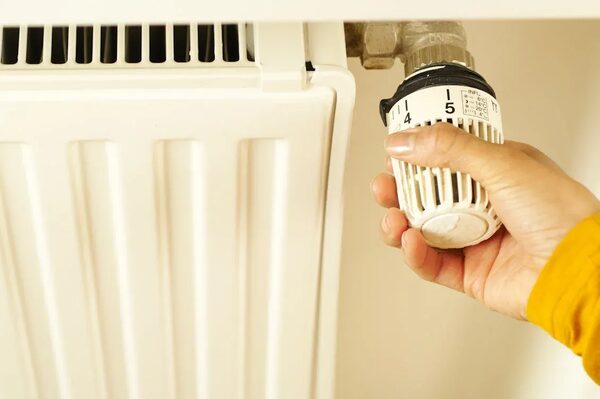
Underneath Boiler Plus sits a simpler and broader duty. Work to install a new boiler, or a cooker that also supplies central heating, needs Building Regulations approval because of the safety issues and the need for energy efficiency1. Time and temperature control should be installed for the heating system3.
Approved Document L Volume 1 goes further on room-by-room control. For heating systems in new dwellings, or when a heat generator such as a boiler is replaced in an existing dwelling, "each room should be provided with thermostatic room controls" able to separately adapt the heating output in each room served8. That is a stronger requirement than a single wall thermostat and a programmer, and it is the regulatory basis for the zoning and TRV guidance that applies to replacement boilers as well as new homes.
The same principle extends to electric heating. For electric panel heaters, time and temperature control should be provided for separate control of each room or each appliance, on new systems or replacement components2. The control duty follows the heat emitter, not the fuel.
| Situation | Control requirement | Source |
|---|---|---|
| New boiler or central heating cooker | Building Regulations approval; time and temperature control | 1 |
| Boiler replaced in an existing dwelling | Thermostatic room controls able to adapt output in each room | 8 |
| Electric panel heaters, new or replacement | Time and temperature control for each room or appliance | 2 |
| Oil boiler replaced | Time and temperature controls as a new additional requirement | 3 |
| System including a boiler worked on | Boiler interlock should be installed | 2 |
The oil position is worth separating out. For oil-fired boilers installed as a replacement of an existing boiler, time and temperature controls are applied as a new additional requirement3. In Northern Ireland, building control regulations cover boilers and stoves and the siting of an oil tank21. Oil households therefore face a control duty on replacement, but the framing differs from the gas combi rule.
Combi boilers: the extra measure, one of four options
A gas combination boiler in an existing dwelling in England triggers the additional measure requirement: "at least one of the following energy efficiency measures should be installed"3. The four are weather compensation, smart thermostat, flue gas heat recovery and load compensation4. The regulations set a choice, not a ranking.
The measures work in different ways. Weather compensation adjusts the flow temperature according to outdoor conditions. Load compensation modulates the boiler output to match demand. Flue gas heat recovery captures heat from the flue gases that would otherwise be lost. A smart thermostat provides time and temperature control with additional functionality. Which one fits depends on the boiler's compatibility, the existing control wiring and how the household uses heat.
There is a separate selection rule that applies to combi boilers in existing dwellings under Approved Document L Volume 1: "the boiler type should be selected to modulate down to the typical mid-season heating load of the dwelling"8. This is about sizing rather than controls, but it interacts with them. A combi that is oversized for the dwelling will cycle rather than modulate, and no control measure fully compensates for that.
Boiler interlock: the wiring rule that stops the boiler firing when there is no demand
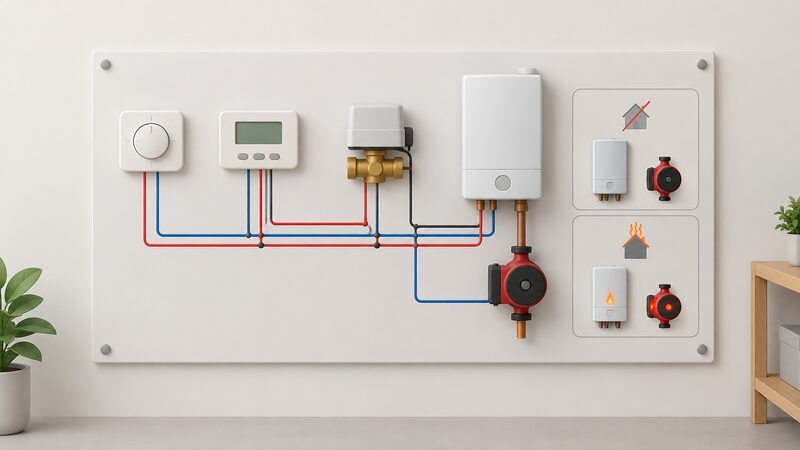
Boiler interlock is the least visible control requirement and one of the most consequential. Approved Document L states that "if work is carried out on a system that includes a boiler, a boiler interlock should be installed"2. The interlock is a wiring arrangement, not a device: it ensures the boiler and pump are switched off when there is no demand for space heating or hot water7.
The Scottish domestic building services compliance guide describes the same principle for oil-fired wet central heating: "System controls should be wired so that when there is no demand for space heating or hot water, the boiler and pump are switched off"7. For wet underfloor heating, the equivalent rule is that when there is no demand for heat, the heat source and pump are switched off7. The wording varies with the system; the outcome does not.
Interlock matters because a boiler that fires without demand burns fuel for nothing. It also matters for the household's independence: an interlocked system responds to local controls rather than running on a timer regardless of temperature. The notional dwelling specification in Approved Document L lists "Boiler interlock, ErP Class V" as the control class for the notional dwelling heating system2, which ties the wiring rule to the ErP control classification framework.
Efficiency and flow temperature: the 92% ErP floor and the 55°C flow rule
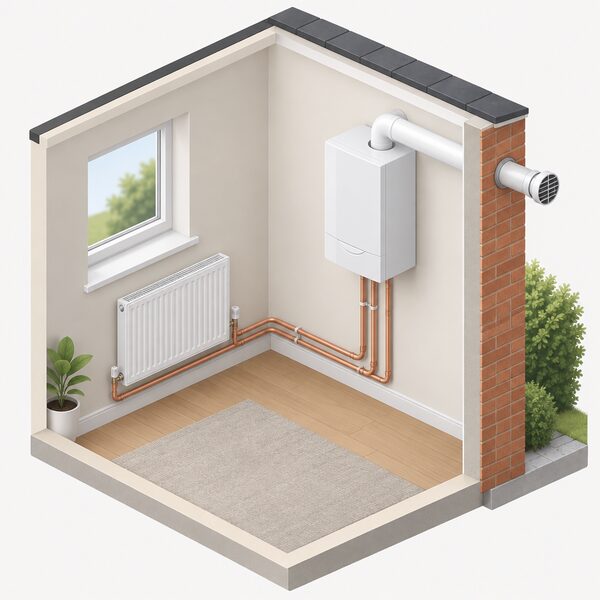
Two numbers dominate the efficiency side of the regulations. The first is 92%. Gas-fired wet heating, for example radiators or underfloor heating, must achieve a minimum efficiency of 92% as defined in ErP, in both existing and new dwellings2. The same figure appears in the Welsh consultation version of Approved Document L10 and in the current Approved Document L Volume 111. Oil-fired wet regular boilers in existing dwellings carry a minimum of 91% as defined in ErP2.
The second number is 55°C. Newly installed or fully replaced wet heating systems must be designed to run at a maximum flow temperature of 55°C or lower10. This is a design requirement on the system, and it has consequences for radiator sizing and for the controls that modulate flow temperature. It also aligns with the SAP default basis: condensing boiler efficiency data in SAP 2012 Table 4b and individual PCDB boiler records are based on a design flow temperature of 55°C or higher9.
For heat pumps, the low temperature thresholds are lower still. The relevant figures are 45°C or 35°C design flow water temperature, stated on the commissioning certificate and rounded to the nearest whole number9. Controls must also prevent simultaneous hot water and space heating where the heat generator provides hot water9.
| System | Minimum efficiency or flow limit | Applies to | Source |
|---|---|---|---|
| Gas wet heating | 92% as defined in ErP | Existing and new dwellings | 2 |
| Oil wet regular boiler | 91% as defined in ErP | Existing dwellings | 2 |
| New or fully replaced wet heating | Maximum flow temperature 55°C or lower | New and existing dwellings | 10 |
| Condensing boiler SAP basis | Design flow temperature 55°C or higher | SAP 2012 Table 4b and PCDB records | 9 |
| Heat pump low temperature | 45°C or 35°C design flow, on commissioning certificate | Heat pumps | 9 |
The flow temperature rule is where controls and efficiency meet. A system designed for 55°C needs controls that can hold it there, which is why weather compensation and load compensation appear both as Boiler Plus measures and as general good practice for low temperature operation.
Where the rules apply: England, Wales and the deviated territories
Building control is devolved, and the control requirements differ by nation. Electrical installation work in England and Wales must comply with the building regulations for electrics22, but the energy standards themselves are set separately.
Wales has its own Approved Document L Volume 1, published in 2026, and its own boiler and heating guidance8. The Welsh Government has also consulted on a 2025 review of Part L, covering changes to Part F and Part O and associated guidance5. Micro-combined heat and power has its own Welsh building regulations page18.
Scotland works from a domestic building services compliance guide, drafted as part of a review of building regulations energy standards7. The Scottish Government's heat in buildings strategy sets out longer term direction, including a phase-out of the need to install new or replacement fossil fuel boilers in on-gas areas from 2030, and a target that households in fuel poverty achieve energy efficiency equivalent to EPC C by 203023. Those are strategy commitments rather than current control rules, but they shape what installers specify.
Northern Ireland's position is at an earlier stage. A 2023 discussion document and pre-consultation covers next steps for building regulations, including Part F, Part K, overheating and electric vehicle infrastructure6. Building control applications in Northern Ireland cover new build, extensions and minor work including new heating appliances and systems13. Domestic oil installation and boiler servicing guidance sits alongside21.
What Boiler Plus means for cost, choice and household savings
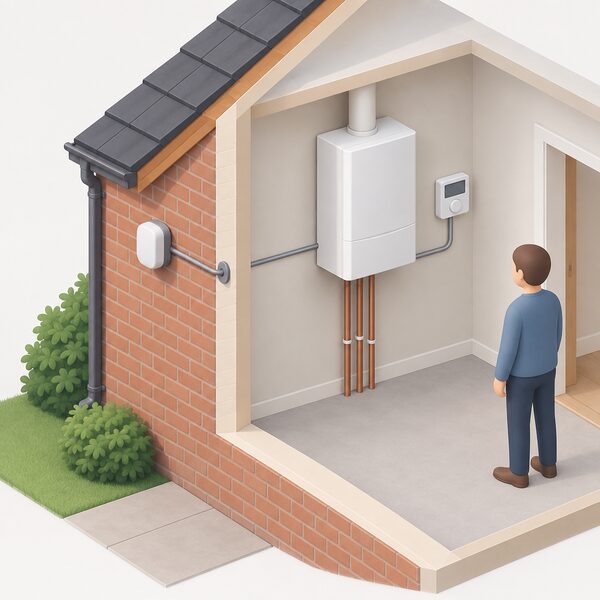
Boiler Plus changes what is installed, and therefore what is paid for. The additional measure is a cost at the point of installation, and the choice of measure affects that cost. Weather compensation and load compensation typically require compatible boiler controls and wiring. A smart thermostat brings its own hardware and, in some cases, app and subscription considerations. Flue gas heat recovery is a physical component fitted to the boiler.
The policy's stated purpose is efficiency: increased minimum efficiencies, required time and temperature controls, and the additional measure4. The savings a household actually sees depend on the measure chosen, the boiler it is paired with, and how the home is run. The regulations do not publish a savings figure per measure, and none should be assumed.
There is a separate interaction with grant-funded work. Ofgem's ECO4 delivery guidance records the "removal of requirement for full set of heating controls in property following a boiler installation"24. The ECO4 measures table sets conditions on heating controls measures, including eligibility where an innovation measure is installed or where the controls are installed as part of the same project as a renewable heating system, first time central heating or a district heating connection, with different conditions for the private rented sector and social housing25.
For a household's energy independence, the control requirement is a modest but real shift. A boiler interlock and proper time and temperature control mean the system responds to the home rather than to a clock. The dependence that remains is on the gas network, the boiler manufacturer's control ecosystem, and in many cases a cloud app for smart thermostat functions. The regulations require control; they do not require that control to be local.
How compliance is demonstrated: Approved Document L and alternative evidence
Compliance is demonstrated through the building control process. A building control application may not be required when replacing a heating or hot water system, and if required it may not be necessary to apply in advance of the work1. Where a new system is installed, the installer should proceed as if the work is being carried out in a new building1.
The approved document route is one option. If a household or installer prefers to meet a relevant requirement in some other way than described in an approved document, agreement should be sought with the relevant building control body at an early stage10. Once the body has decided the work meets all the requirements, it issues a Building Regulations completion certificate if it is a building control authority, or a final certificate if it is a registered building control approver11.
Evidence can include photographic records. Building control bodies are authorised to accept notification as reported in the as-built stage BRWL report together with photographic evidence of compliance8. For heat pump work carried out by a registered competent person, the compliance certificate or a copy of the information on it must be given to the building control authority11.
Emergency work has its own route. Emergency repairs may be carried out straightaway, but they must comply with the requirements, and retrospective approval and a completion certificate must be applied for after the event1.
Sources25 cited
- Boiler and heating building regulations, Planning Portal, 2026
- Approved Document L, Conservation of Fuel and Power, Volume 1: Dwellings, 2021 edition incorporating 2023 amendments, HM Government, 2026-09-17
- Carbon Budget Delivery Plan, HM Government, 2023-03-30
- Written evidence on Boiler Plus, UK Parliament, 2026
- Building Regulations Part L: 2025 review, Welsh Government, 2025-08-26
- Building Regulations discussion document and pre-consultation, Northern Ireland Department of Finance, 2026-09-20
- Draft Guidance: Domestic Building Services Compliance Guide, Scottish Government, 2021-07
- Building Regulations Approved Document L Volume 1 2026, Welsh Government, 2026-04
- Low temperature heating, NCM PCDB, 2026-09-17
- Approved Document L Volume 1 consultation version, Welsh Government, 2026-09-17
- Approved Document L Volume 1: Dwellings, HM Government, 2026
- Difference between building regulations and planning permission, Planning Portal, 2026-09-17
- Building control application forms, Building Control Northern Ireland, 2026
- Do I need building regulations approval to add underfloor heating, Planning Portal, 2026
- Heat pumps: building regulations, Planning Portal, 2026-09-17
- Building regulations renewables guidance, Bedford Borough Council, 2026-09-17
- Micro combined heat and power: building regulations, Planning Portal, 2026
- Building regulations: micro combined heat and power, Welsh Government, 2026
- Building etc. (Amendment) (Wales) Regulations 2026, Welsh Government, 2026-03-06
- Building regulations: boilers and heating, Welsh Government, 2026-09-17
- Domestic oil installation and boiler servicing, nidirect, 2024-08-27
- Building regulations for electrics: general information, Planning Portal, 2026
- Energy Performance of Buildings Directive 2002/91/EC, legislation.gov.uk, 2026-09-17
- Summary of updates to ECO4 delivery guidance and measures table, Ofgem, 2025-08-07
- ECO4 Measures Table v4.0, Ofgem, 2025-07-29
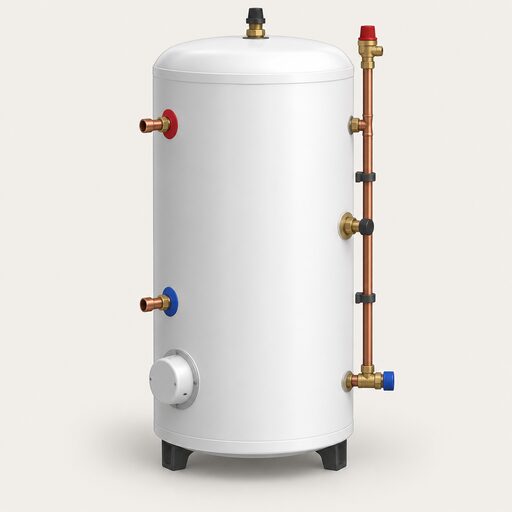 Building RegulationsReplacing a boiler or heating system usually needs building regulations approval, and the rules differ across England, Scotland, Wales and Northern Ireland.
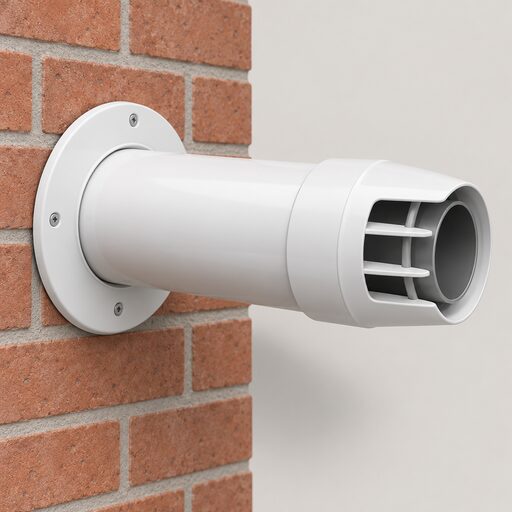 Boiler InstallationGetting a new boiler means following building rules, and the person fitting it must be registered to sign the work off.
 Overheating StandardsScotland and Northern Ireland handle overheating in new homes differently from England and Wales.
 The Full Rules and Regulation GuideConfused about who actually decides what you pay for gas and electricity, or why rules differ in Scotland and Wales?
 The Full Boilers and Heating GuideWhich boiler suits your home, and when is it worth swapping the old one?
 Energy Policy in WalesWhat help can you get in Wales to make your home warmer and cheaper to run?