In this guide
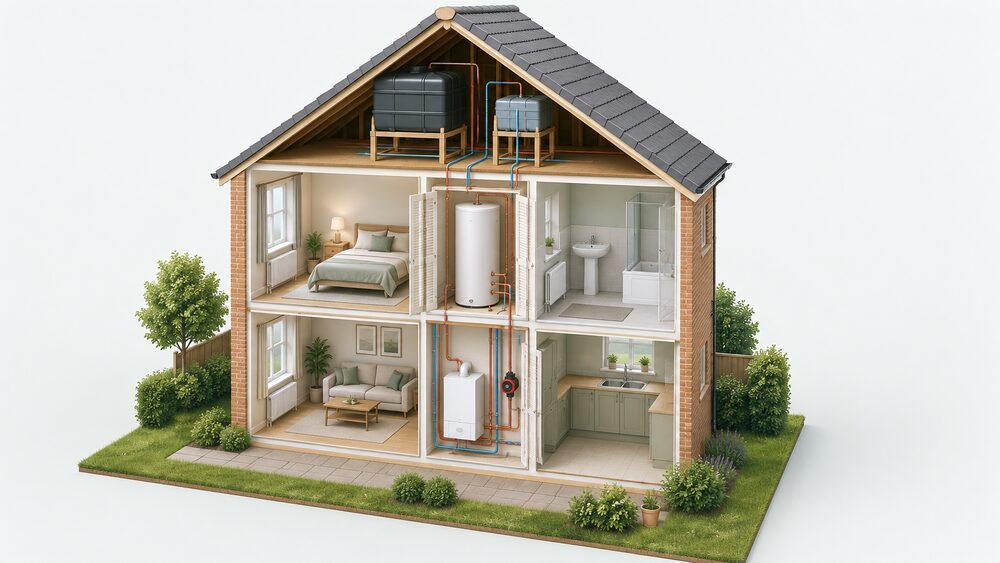
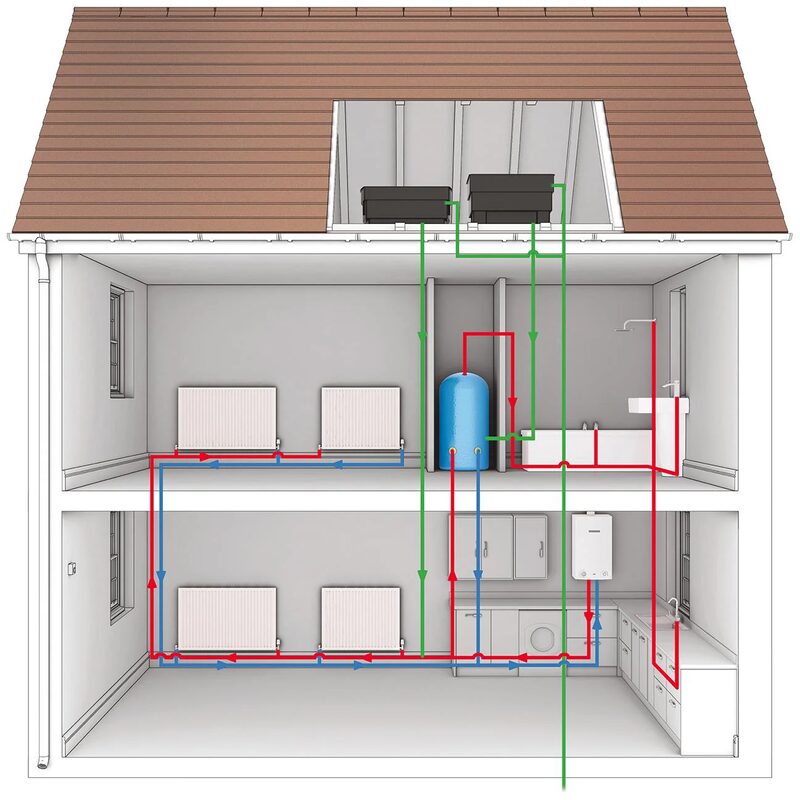
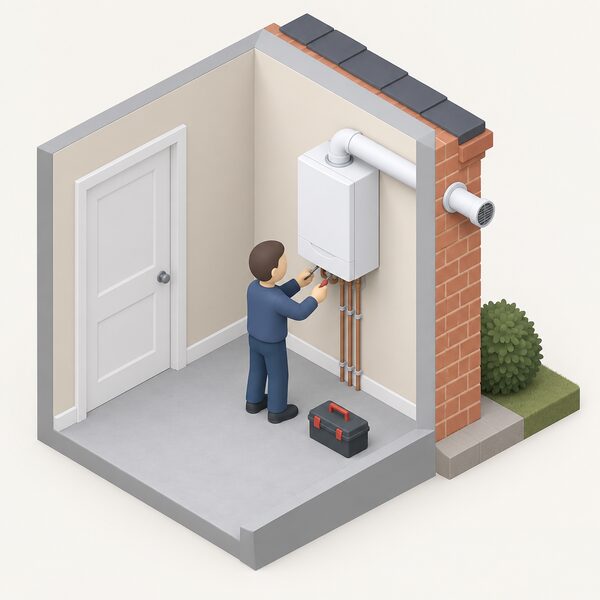
A heat-only boiler, also called a regular or conventional boiler, heats water for the radiators directly and heats the household's hot water indirectly, by warming a stored cylinder. It works alongside two extra tanks, usually in the loft: a cold water storage tank that feeds the cylinder, and a small feed and expansion tank that keeps the heating circuit topped up. The Energy Saving Trust describes these boilers as suiting larger properties or homes with low water pressure, and they are unlikely to suit a flat, because the tanks have to sit higher than the highest hot tap or radiator1. Baxi lists "open vent" and "traditional" among the other names in use2.
The trade-off is plain. Stored hot water can feed several taps and showers at once, but it runs out, it loses heat while it waits in the cylinder, and the tanks take up space3. A conventional boiler costs in the region of £1,500 before installation4, and Uswitch gives £2,500 to £4,100 for a gas heat-only boiler installed (September 2026)5. Older non-condensing boilers of this type typically ran at 60 to 70% efficiency, against up to 97% for a modern condensing boiler6.
For energy independence, a heat-only boiler is a mixed picture. A cylinder is the one part of a gas heating system that can store heat and accept other sources, such as solar water heating. The boiler itself still depends on a gas or oil supply, on mains electricity for its pump and controls, and on the government's timetable for phasing out new fossil fuel boilers.
Regular, heat-only and conventional: one boiler, several names
The same appliance appears under at least five names. The Energy Saving Trust uses "heat-only", "regular" and "conventional" interchangeably1. Baxi adds "traditional", "conditional" and "open vent"2, Worcester Bosch uses "regular" as its main term11, and Ideal Heating calls its range "heat only" while noting the other two names12. Uswitch defines a conventional boiler as one that "requires both a hot and cold water storage tank in order to work"14. The names describe one arrangement: a boiler that makes heat only, with the hot water stored elsewhere.
"Open vent" refers to the heating circuit being open to the air through the loft expansion tank, rather than sealed and pressurised. That is the clearest dividing line from a system boiler, which also heats a cylinder but runs a sealed circuit with no cold water tank4.
Several practical consequences follow from the design:
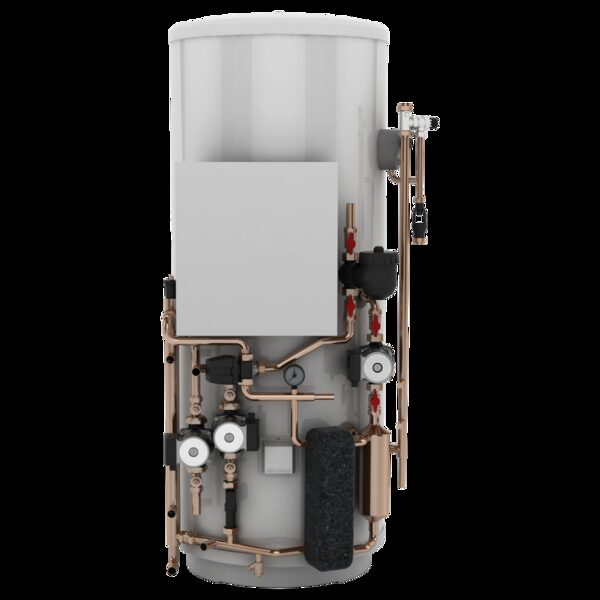
- Separate parts. Heat-only boilers typically have components housed outside the boiler, such as the circulation pump3.
- One energy label. Heat-only and regular boilers carry only the space-heating part of the ErP label, because they do not heat tap water themselves15. The ErP ratings page explains the label.
- Gas or oil. Which? prices heat-only boilers in both gas and oil versions16, so the arrangement is common off the gas grid as well as on it; see oil boilers.
A heat-only boiler heats stored water in a cylinder, fed from loft tanks
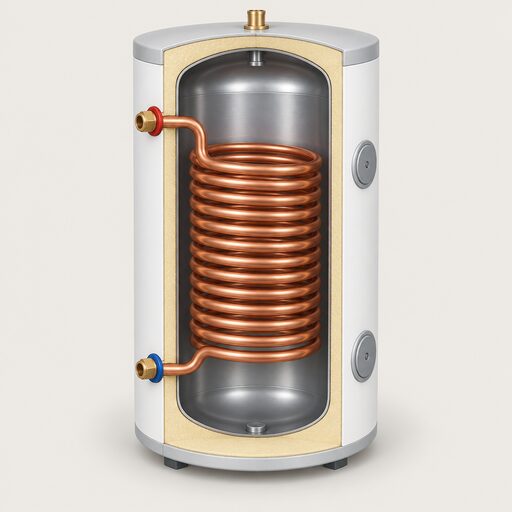
The water path runs in two loops. For hot water, cold water flows by gravity from the loft storage tank into the hot water cylinder, where the boiler heats it; the heated water then goes to taps and showers13. For heating, the boiler sends hot water directly around the radiators3. A pump, separate from the boiler, circulates water round the heating system17.
Ideal Heating describes the loft requirement as "a small expansion tank and larger cold water storage cistern"18. The larger tank supplies the cylinder and cold taps; the small one keeps the heating circuit full and gives the water room to expand as it warms. Because the whole system is fed by gravity, the height of the loft tanks sets the water pressure at the taps, which is why the Energy Saving Trust notes the tanks must sit higher than the highest hot tap or radiator1.
This design is the reverse of a combi boiler, which heats water on demand straight from the mains and has no tanks. With a heat-only boiler, hot water is made in advance and kept until needed. That is the source of its main strength, several outlets at once, and its main weakness, a finite supply that has to be reheated.
The single-dial control follows from the same arrangement. The Energy Saving Trust states that a regular boiler with a separate cylinder has only one control for both the radiators and the hot water [19 is not used; see below].
What comes with the system: cylinder, cold water tank and feed and expansion tank
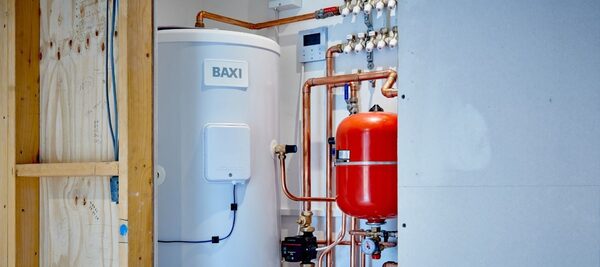
A heat-only installation is really four or five pieces working together. Worcester Bosch describes regular boilers as needing "a cold water storage tank to feed a hot water cylinder, plus a tank that maintains the water level of the central heating system"11. Baxi places the tanks in the loft and the cylinder and separate pump "usually housed in the airing cupboard"2.
| Part | Where it usually sits | What it does |
|---|---|---|
| Heat-only boiler | Kitchen, utility or garage | Heats water for radiators and the cylinder coil |
| Cold water storage tank | Loft | Feeds the hot water cylinder by gravity |
| Feed and expansion tank | Loft | Keeps the heating circuit topped up and takes up expansion |
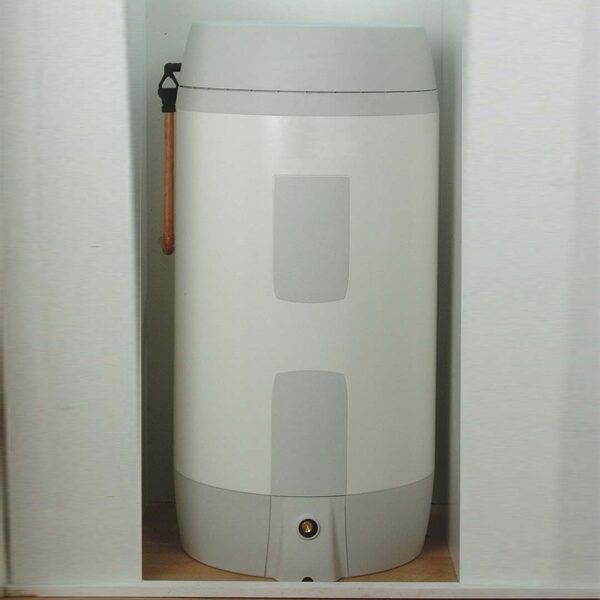
| Hot water cylinder | Airing cupboard | Stores hot water for taps and showers |
| Circulation pump | Airing cupboard or near the boiler | Moves water round the heating circuit |
Ideal Heating gives a simple test: a heating setup with a hot water cylinder and two water tanks, usually in the loft, most likely has a heat-only boiler10. It also notes these boilers are common in many older UK homes, especially those built before the 1970s10, which is why the arrangement persists: replacing like for like keeps the existing pipework, tanks and radiators in use.
Each part is a maintenance point. The loft tanks can freeze in cold weather2, and the cylinder is a heat store that loses some of its warmth over time3. On the other hand, the cylinder is the component that opens the system to other heat sources, covered on the hot water cylinders page.
Who suits one: large homes with high hot water demand or low mains pressure
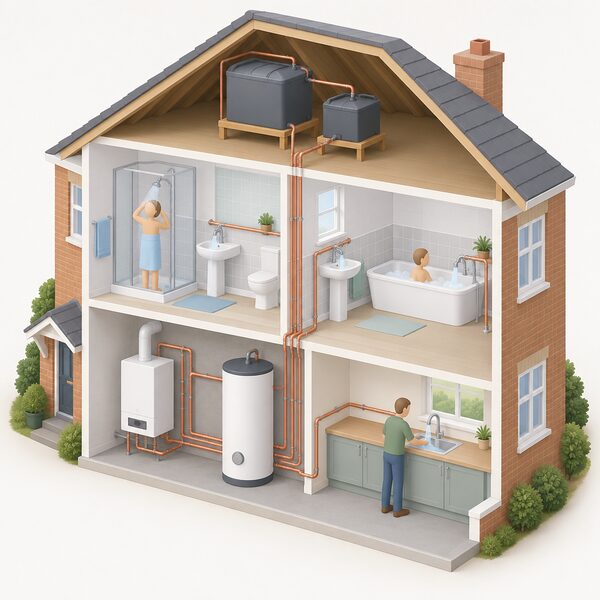
The sources agree on the core case. The Energy Saving Trust says heat-only boilers "tend to suit larger properties or where you have low water pressure"1. Which? describes them as good for larger households with several bathrooms where people frequently need hot water in different places at once3. E.ON Next adds homes with old radiator systems7.
Makers put it the same way for their own products. Baxi lists as advantages: a good option where mains water pressure is low; replacing an old boiler while keeping the existing central heating system; homes with more than one bathroom or high hot water demand; and plenty of hot water from several taps at once2. Ideal Heating states that in a very large home or a low water pressure area, continuing with a heat-only boiler is recommended19, and that these boilers suit homes "such as a property with two bathrooms"20.
The low pressure point matters because a combi or a system with an unvented cylinder depends on the mains supply for its flow. A heat-only system draws from its own loft tank, so weak mains pressure affects only how quickly the tank refills.
Where one fits poorly:
- Flats, because the tanks must sit above the highest outlet and there is rarely space to do so1.
- Homes without loft space for two tanks1.
- Small households with modest hot water use, where a combi's on-demand supply avoids storage losses3.
Confused.com summarises the demand-side test in its own words: the type suits homes where "You need hot water from more than 1 tap at a time"4. The heating by home type page compares options across property types.
Sizing: from 12 kW for 1 to 2 radiators to 35 to 42 kW for 20 or more
A heat-only boiler can often be smaller than a combi for the same home, because it reheats a cylinder over time instead of heating tap water instantly. E.ON Next gives 12 to 15 kW for a system or regular boiler with up to 10 radiators, against 24 to 27 kW for a combi of the same size21. At 15 to 20 radiators it gives 30 to 40 kW for a system or regular boiler and 32 to 40 kW for a combi21.
Ideal Heating's guide for its heat-only boilers links size to radiators and bathrooms10:
| Radiators | Bathrooms | Suggested output (Ideal Heating) |
|---|---|---|
| 1 to 2 | 1 | 12 kW |
| 3 to 4 | 2 to 3 | 15 to 18 kW |
| More than 4 | More than 3 | 24 to 30 kW |
The guides differ at the top end. Confused.com gives 35 to 42 kW for a house with 20 or more radiators4, while the same guidance also carries a figure of 30 to 35 kW, and the documents do not settle which applies. Uswitch frames it by bedrooms: 24 to 30 kW for any home with up to three bedrooms, and 35 kW or more for larger houses22.
Ideal Heating names three factors behind the figure: the number of radiators, the number of bedrooms and how well insulated the home is10. Radiator counts are a rough proxy for heat loss, so a well-insulated house needs less than the tables suggest and a draughty one more. The ranges are rules of thumb; an installer's heat loss calculation sets the final output. The boiler sizing page covers the method.
Cost: from around £1,500 for the boiler to £2,500 to £4,100 installed
Uswitch lists the heat-only boiler as the "Cheapest type of boiler to buy"5. Confused.com, citing Checkatrade, puts a conventional boiler at about £1,500 without installation4. Ideal Heating states the boiler itself typically costs upward of £1,000 and installer labour usually £1,000 to £2,00019.
| Item | Figure | Source date |
|---|---|---|
| Gas heat-only boiler, installed | £2,500 to £4,1005 | September 2026 |
| Conventional boiler, unit only | around £1,5004 | November 2025 |
| Heat-only boiler, unit (maker) | upward of £1,00019 | 2026 |
| Installer labour (maker) | £1,000 to £2,00019 | 2026 |
| Heat-only oil boiler, unit | £1,200 to £2,450, average total £3,07522 | January 2024 |
| Any new boiler, unit only | £500 to £4,500 depending on gas or oil23 | September 2025 |
The sources do not state whether their figures include VAT; they are guide ranges, and actual prices are installer-quoted. The largest cost drivers are whether the boiler is a like-for-like swap and whether the tanks and cylinder are kept. Which? notes that a heat-only boiler can cost more to install than a combi if the home does not already have the cold water feed and expansion tanks3; where they already exist, keeping them avoids that cost. Ideal Heating adds that switching from heat-only to a combi or heat pump raises costs further because the full heating system often needs replacing19.
Grants for replacement boilers differ between England, Scotland, Wales and Northern Ireland. The wider picture is on the new boiler cost page.
Efficiency: around 60 to 70% for older models, over 90% for condensing
The efficiency of a heat-only boiler depends mainly on its age and whether it condenses, not on its type. Older, non-condensing heat-only boilers are where the losses lie. The industry figures:
- An old, non-condensing boiler runs at about 70% efficiency4.
- Condensing boilers are up to 97% efficient "as opposed to the 60 to 70% efficiency of an older boiler"6.
- Standard efficiency boilers "can be as little as 60% efficient"17.
- Some older boilers can fall below 50% efficiency, while the newest condensing boilers should exceed 90%24.
For modern boilers the figures converge. Which? puts modern condensing gas boilers at 92 to 94% labelled efficiency25. The liquid fuel industry body states modern oil condensing boilers exceed 90%, on a par with gas26. E.ON Next applies the same over-90% figure to regular, system and combi boilers using condensing technology7. How condensing works is covered on the condensing boilers page.
Two features hold a heat-only system back. First, the cylinder loses heat while it stores water, which is why Which? rates these boilers less efficient than combis3. Second, the flow temperature cannot be turned down as far. The Energy Saving Trust states that a conventional boiler with a cylinder has one dial, which must stay at least 65 degrees so the cylinder reaches a safe temperature, "Otherwise there's a risk of legionella bacteria growing in the cylinder"8. A combi owner can lower the flow temperature further in mild weather; a conventional boiler owner "can't go below 65 degrees"8. The flow temperature page sets out the rule.
Even at its best, a gas boiler produces less than one unit of heat for each unit of gas it burns27. Higher efficiency cuts the bill; it does not remove the dependence on the fuel.
Where a heat-only boiler falls short: space, waiting for the cylinder and running out
The limits are the direct cost of storing water:
- Space. Two extra tanks need room, usually in the loft1, plus a cylinder in the airing cupboard2.
- Waiting. Baxi lists "You need to wait for the water in the cylinder to heat up before you can use it"2.
- Running out. Heat-only boilers can run out of hot water "because they draw water from a cylinder rather than directly from the mains"20. E.ON Next puts the wait at around an hour if the cylinder is emptied at very busy times7.
- Standing losses. Heat is lost from the stored water3, although newer cylinders can hold water hot for up to 48 hours28.
- Freezing. Loft tanks can be susceptible to freezing2.
In practice, the hour-long wait bites mainly in households where baths and showers run back to back. Timer settings that heat the cylinder before peak use reduce it, and the heating controls page explains the options. The Energy Saving Trust notes that a regular boiler with a separate cylinder has a single control, set no lower than 65°C so the cylinder can reach 60°C29.
For independence, the stored cylinder is a modest buffer: a filled cylinder still gives hot water for a time if the boiler stops, and newer cylinders hold heat longest28.
Common faults and noises: gurgling, banging, kettling and cold radiators
Ideal Heating's troubleshooting guide for heat-only boilers links each sound to a likely cause30:
| Symptom | Likely cause (maker guidance) |
|---|---|
| Gurgling | Air trapped in the system; radiators may need bleeding |
| Banging | Overheating, from thermostat faults, debris or heat exchanger problems |
| Whistling | Kettling |
| Radiators cold at the bottom | Trapped sludge, fixed by power flushing |
| No heating or hot water | Faulty thermostat, broken diverter valve, defective pump or airlocks |
Independent guidance agrees on air. Smart Energy GB gives the clearest signs of radiators needing bleeding as a radiator "cold at the top, slow to warm up or making gurgling noises"31, and Uswitch adds higher heating bills and damp or mouldy patches on walls32. Northern Gas Networks describes a different gurgle on condensing boilers in winter: a frozen condensate pipe, where the boiler switches itself off and gurgles near the outside pipe33.
Some signs point to a failing heat exchanger, which Ideal Heating lists as "yellow flames rather than blue, formaldehyde scents, kettling noises, and sometimes visible leaking"30. Its guidance for that case is to switch off the heating, turn off the gas and call a Gas Safe engineer, and it states that unless the boiler is new and in warranty, a replacement is likely30.
Older heat-only boilers sometimes use a pilot light. Ideal Heating is emphatic on one point:
"an automatic pilot light should NEVER be ignited manually"
It lists causes of a pilot going out as a faulty gas valve, a blocked pilot mesh, a faulty thermocouple, high winds or draughts, or a blocked jet, and in its relighting procedures it states the gas should be left to disperse for fifteen minutes with a window open30. More faults are on the boiler faults page.
No pressure gauge: why open vent systems differ from sealed systems
Sealed system and combi boilers carry a pressure gauge, which Confused.com says should read 1.0 to 2.0 bar36. Those boilers are pressurised and have no cold water tank4. A heat-only boiler is different: the loft feed and expansion tank maintains the water level of the heating circuit11, so the system is held full by the tank's height rather than by pressure. The boiler pressure page covers sealed systems.
Solar water heating and other heat sources
The cylinder is what makes a heat-only system adaptable. The Energy Saving Trust states that a conventional boiler with a hot water cylinder is often compatible with solar water heating, although the existing cylinder usually needs replacing with one designed for solar37. OFTEC describes the link as a twin-coil cylinder, with two heating coils, one for the solar panels and one for the gas or oil boiler38. By contrast, Which? says it is difficult to use solar water heating with a combi39, and the Energy Saving Trust says a combi owner will likely need a solar cylinder and a conventional boiler or heat pump40.
Solar water heating reduces the fuel a boiler burns in summer; it does not remove the boiler. See solar thermal water heating.
Owning one as new gas boilers are phased out from the mid-2030s
The UK government's Heat and Buildings Strategy set "the ambition of phasing out the installation of new natural gas boilers from 2035"41. Which? describes this as a plan to phase out gas boilers in new homes beyond 203542. Scotland has gone further on paper: its 2021 Heat in Buildings Strategy committed to phasing out the need to install new or replacement fossil fuel boilers off the gas grid from 2025 and on the gas grid from 203043, and Nesta reports a later proposal to set 2035 as an end date for installing new fossil fuel boilers44. The rules are set separately in each nation, and the gas boiler ban page tracks them.
These are ambitions and proposals rather than a ban on using an existing boiler. Which? describes boilers as purchases to make once every 10 to 20 years45, so a heat-only boiler fitted now falls within the window the policies cover. The case for a heat-only system has one advantage here: an existing cylinder and pipework suit a heat pump or a hybrid better than a combi does. The Energy Saving Trust describes hybrid systems where the boiler supplies only hot water while the heat pump heats the home46.
What remains dependent: gas or oil, mains power for the pump and controls, and a maker's parts supply. See heat pumps compared with boilers and home heating and energy independence.
Servicing: once a year
Every source gives the same interval. Uswitch recommends a service "at least once a year"9, and Which? says a gas boiler should be serviced every year by a Gas Safe registered engineer47. Ideal Heating adds that an annual service protects the warranty20. See boiler servicing and the pillar guide.
Sources47 cited
- Boilers, Energy Saving Trust, 2026-05-20
- Different types of boilers, Baxi, 2026-09-17
- What are the different types of boiler, Which?, 2025-09-16
- Best boilers, Confused.com, 2025-11-03
- Different boiler types, Uswitch, 2026-09
- Help and advice, UKIFDA, 2026-01-29
- Regular boilers, E.ON Next, 2026-09-17
- Should I turn my boiler's flow temperature down, Energy Saving Trust, 2026-05-20
- Boiler maintenance, Uswitch, 2026-09-03
- Heat only boiler size guide, Ideal Heating, 2026-09-17
- Regular boiler overview, Worcester Bosch, 2026-09-17
- Ideal heat only boilers, Ideal Heating, 2026-09-17
- Boiler FAQs, Ideal Heating, 2026-09-17
- How long does it take to fit a boiler, Uswitch, 2026-09-16
- Boiler energy efficiency, Which?, 2025-09-19
- Boiler prices, Which?, 2025-09-17
- Glossary, Baxi, 2026-09-17
- Combi, heat only and system boilers compared, Ideal Heating, 2026
- How long does a heat only boiler last, Ideal Heating, 2026-09-17
- What is a heat only boiler, Ideal Heating, 2026-09-17
- What size boiler do I need, E.ON Next, 2026-09-17
- Boiler statistics, Uswitch, 2024-01-04
- Heat pumps vs boilers, Which?, 2025-09-22
- New boiler cost, Uswitch, 2024-11-06
- Air source heat pumps explained, Which?, 2026-04-14
- Future liquid fuels, UKIFDA, 2026-01-27
- An introduction to heat pumps, Which?, 2025-09-22
- Hot water guide, Uswitch, 2025-01-31
- Thermostats and heating controls, Energy Saving Trust, 2026-02-10
- Heat only boiler troubleshooting guide, Ideal Heating, 2026-09-17
- How to bleed a radiator, Smart Energy GB, 2026-08-17
- How to bleed a radiator, Uswitch, 2026-09-04
- My boiler isn't working, Northern Gas Networks, 2026-07-24
- Take no chances with gas safety, Northern Gas Networks, 2026-09-14
- Carbon monoxide: be aware, Wales and West Utilities, 2026-09-20
- Energy saving tips for the home, Confused.com, 2025-10-14
- Solar water heating, Energy Saving Trust, 2026-05-20
- Your home guide to solar water heating, OFTEC, 2026-09-20
- Solar water heating with solar thermal panels, Which?, 2026-05-15
- Could solar water heating work for you, Energy Saving Trust, 2026-05-20
- Heat and Buildings Strategy, UK Government
- Gas central heating, Which?, 2025-09-22
- Heat in Buildings Strategy, Scottish Government, 2021-10
- Using home purchase regulations to grow clean heating in Scotland, Nesta, 2025-05-13
- Glow-worm boilers review, Which?, 2025-09-17
- Hybrid heat pumps, Energy Saving Trust, 2026-07-16
- Getting the best boiler service, Which?, 2025-09-17
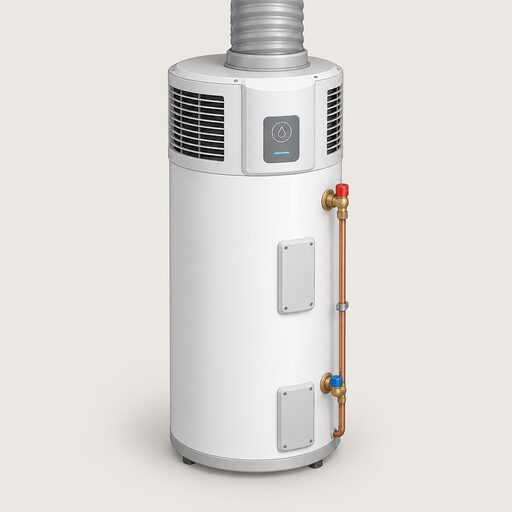 Hot Water Heat PumpsA hot water heat pump heats only the water in your cylinder, using air instead of a boiler flame.
 System Boilers ExplainedA system boiler heats your radiators and stores hot water in a separate cylinder, so several taps and showers can run at once.
 The Full Boilers and Heating GuideWhich boiler suits your home, and when is it worth swapping the old one?
 Replacing a Gas or Oil BoilerSwapping a gas, oil or LPG boiler for a heat pump changes how your home is heated and how much it costs.
 Heating Schedules and SetbackIs it cheaper to leave the heating on low all day, or set it to come on only when you need it?
 Hot Water CylindersA heat pump needs a cylinder to store hot water, so swapping a combi means getting one.