
In this guide
A gas safety certificate is the record a Gas Safe registered engineer produces after checking the gas appliances and flues in a property. It is a legal requirement for landlords in the UK, and it lasts 12 months1. For homeowners who own and occupy their home, there is no legal duty to hold one, but the Health and Safety Executive strongly advises that gas appliances and flues are regularly checked for safety at least once every 12 months3.
The certificate is more often called a CP12, or a landlord gas safety record. It records the engineer's name, registration number and signature, the address of the property, the location and condition of each appliance, the result of operational checks, any safety defects found and the date of the check2. Every gas appliance in a home needs one, and the check covers leaks, signs of wear, gas pressure and carbon monoxide2.
The safety regime rests on one rule: by law, all gas engineers must be on the Gas Safe Register and hold current qualifications to install, repair or maintain domestic gas appliances4. That single requirement is what makes the certificate worth anything, and it is the first thing to verify before any work begins. If gas is smelled, the National Gas Emergency number is 0800 111 999, free to call5.
What a gas safety certificate is and what it covers
The certificate is a record of a physical inspection, not a warranty or a statement that the system will keep working. The engineer checks for leaks and signs of wear, tests the gas pressure, and ensures there are no carbon monoxide leaks2. The record then sets out the location and condition of each appliance, the result of those operational checks, any safety defects found and the repair mechanisms identified, alongside the engineer's name, registration number and signature, the property address and the date of the check2.
Three types of certificate exist: residential or domestic certificates for homes, flats and hostels; commercial certificates for restaurants, offices and hotels; and new build certificates for any property under construction or renovation2. A householder will only ever encounter the first.
The scope is wider than the boiler. All permanent and portable gas appliances and flues in a rented property require an annual gas safety check1. That includes cookers and gas fires as well as the boiler, and it includes flues, which are the route by which combustion products leave the building. A property with no gas appliances but pipework or a flue passing through it has no requirement for an annual gas safety check, but the pipework must still be maintained in a safe condition and repairs carried out1.
For a household's energy independence, the certificate changes nothing about where the gas comes from: it remains a mains supply, bought from a supplier, subject to the price cap. What it does is establish that the combustion happening inside the home is being checked by someone with a legal qualification to check it. That is the limit of what it guarantees.
Who legally needs one: landlords versus homeowners
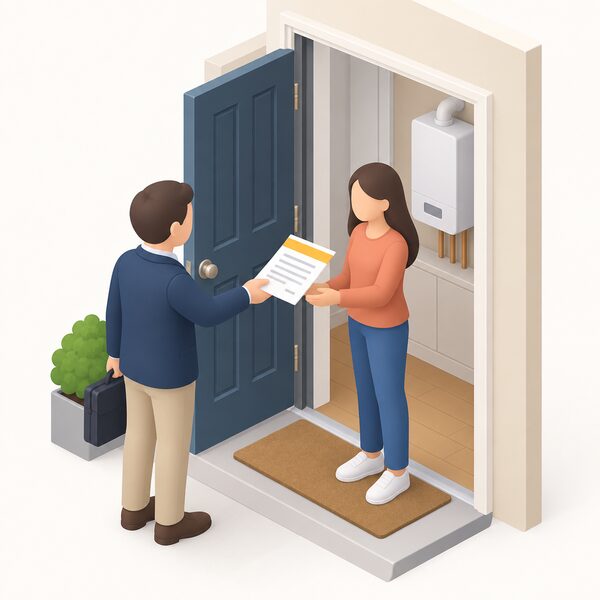
The duty falls on landlords. By law landlords must carry out an annual safety check and provide the tenant with a Gas Safety Certificate8. Landlords are responsible for ensuring that annual gas safety checks are carried out in their properties by a Gas Safe registered engineer10, and must make sure that anyone carrying out work on gas appliances, fittings or flues provided for tenants' use has the required competence11.
The requirement is not conditional on the tenant using gas. If there is a live gas supply to the rented premises, a safety check will need to be carried out irrespective of whether a tenant uses gas7. A landlord cannot argue that a disconnected or unused appliance removes the duty while the supply is live.
For owner occupiers the position is different. There is no legal requirement to hold a gas safety certificate, but the Health and Safety Executive strongly advises that gas appliances and flues are regularly checked for safety at least once every 12 months3. Northern Ireland guidance for homeowners is the same in substance: all gas appliances or flues should be regularly maintained and a safety check carried out annually, or at any other time if there is a safety doubt, by a Gas Safe registered installer11.
The distinction matters because it is widely misunderstood. A homeowner selling a property is not required to produce a gas safety certificate. The document required when you sell or rent out your home is an Energy Performance Certificate12, and that has its own separate validity rules. A gas safety record is a landlord's compliance document, and its absence at a sale is not a breach of anything.
Validity: 12 months, renewal and record-keeping
A gas safety certificate is valid for 12 months and needs to be renewed every year before the expiry date2. The underlying duty is expressed as an annual check carried out within 12 months of the installation of a new appliance or flue, and annually thereafter, by a Gas Safe registered engineer7.
There is a useful piece of flexibility. A landlord can have the annual gas safety check on each appliance or flue carried out up to 2 months before the date the check needs to be carried out, while retaining the original deadline date7. That allows a check to be brought forward to fit around access without shifting the anniversary, so the compliance date does not drift earlier each year.
Record keeping is a separate duty from the check itself. A landlord must keep a record of the safety check for 2 years and issue a copy to each existing tenant within 28 days of the check being completed, and to any new tenants before they move in7. An electronic copy is allowed if it can be reproduced in hard copy format when required, is secure from loss and interference, and uniquely identifies the gas operative7.
The 12 month cycle is worth contrasting with the other certificates a home may hold, because the periods differ and householders conflate them. An Energy Performance Certificate is valid for 10 years14, and the legislation behind it states that its validity shall not exceed 10 years15. In Scotland, an energy performance certificate is valid from 5 years from the date on which it is issued, or until another certificate for the property is subsequently issued16. A Display Energy Certificate is valid for 12 months beginning on the nominated date17, and for buildings over 1,000 m2 total useful floor space, 12 months only, against 10 years from the nominated date for all other buildings18. None of these is a gas safety certificate, and none substitutes for one.
What the annual check involves and what the certificate shows
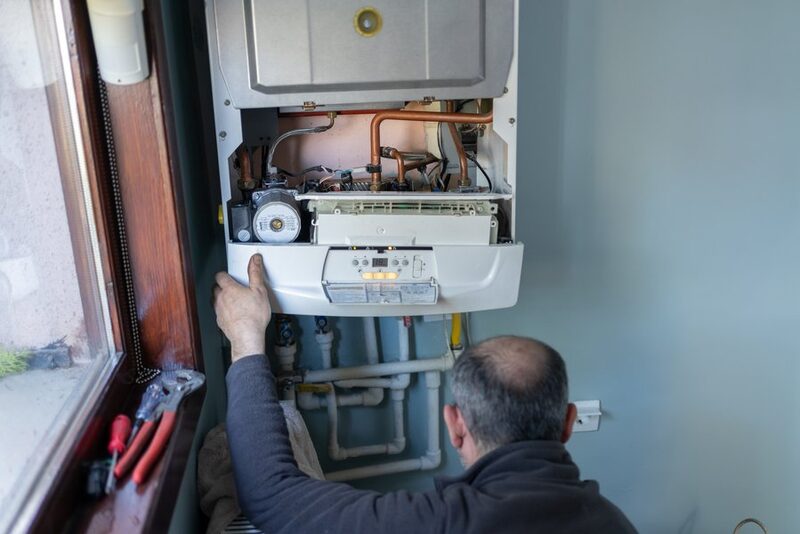
The check is appliance by appliance and flue by flue. A gas safety check must be done every year on each gas appliance and flue1, and all permanent and portable gas appliances and flues in the property require an annual gas safety check1. Maintenance and annual safety checks are carried out by a qualified Gas Safe registered engineer10.
In practice the engineer examines each appliance for leaks and signs of wear, tests the gas pressure, and checks for carbon monoxide2. The certificate then records the location and condition of each appliance, the result of the operational checks, any safety defects found and the repair mechanisms, along with the engineer's registration number and signature and the date2. That structure is what makes the document useful to a tenant or a landlord later: it is a dated snapshot of condition, not a pass mark.
One change to the underlying procedure is worth knowing. The Gas Industry Unsafe Situations Procedure has removed the "not to current standards" (NCS) category, because by definition these situations are not unsafe7. Older certificates may carry an NCS note against an appliance that met the standards of its day but not later ones. Its removal means the classification now turns on whether something is actually unsafe, rather than whether it is merely dated.
The legal framework behind the check is long established. Gas boilers are assessed in accordance with the legislation implementing Directive 90/396/EEC, the relevant UK legislation being the Gas Appliances (Safety) Regulations 199220. Gas meters must comply with the specific requirements listed in Annex IV of the Measuring Instruments Directive and the Gas Safety (Installation and Use) Regulations 199821. Health and safety disconnection powers rest on the Gas Safety (Installation and Use) Regulations 1998, the Pipeline Safety Regulations 1996 and the Gas Safety (Management) Regulations 199612.

Cost: £35 to £150 depending on the property and appliances
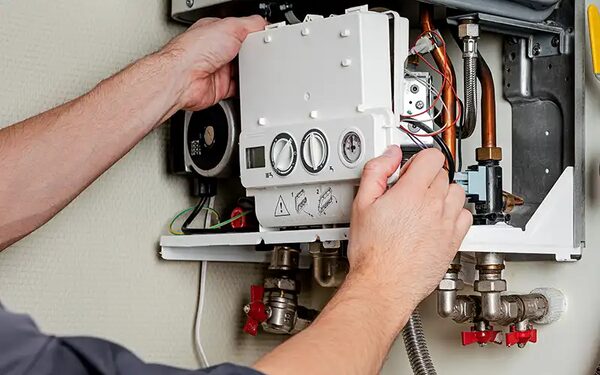
The cost of a gas safety certificate is not published as a national figure. It is quoted by the engineer or firm carrying out the work, and it varies with the number of appliances, the flues to be checked and the access arrangements at the property. Prices are installer-quoted, and no reliable published range exists to quote here.
What can be said is what drives the figure. A check covers every permanent and portable gas appliance and flue in the property1, so a home with a boiler, a gas fire and a hob takes longer than a flat with a combi and a cooker. A commercial certificate for a restaurant or hotel covers different equipment again2. Travel and access in rural areas, and the need to return where an appliance cannot be reached, also bear on the quote.
For context on what a household spends on gas itself, the annual cost of heating a three-bedroom semi-detached house with gas was £1,300 to £1,500 at March 2026 prices, the cheapest heating fuel in that comparison22. Under the price cap for 1 July to 30 September 2026, the benchmark maximum annual bill at 9,500 kWh was £817.06 in the North West on standard credit, with a standing charge of £127.57, and £730.40 in the North West on prepayment, with a standing charge of £101.3923. Those are cap levels, not a household's actual bill, and they are set against a certificate cost that is a one-off annual charge.
The independence point is straightforward. A safety check buys no energy and reduces no dependence on the grid or a supplier. It is a compliance and safety cost, and for a landlord it is a condition of letting a property with a live gas supply at all.
Gas Safe registered engineers: the only people who can issue one
The Gas Safe Register is the official register for gas engineers4. By law, all gas engineers must be on the register and hold current qualifications to install, repair or maintain domestic gas appliances4. That is the whole basis of the certificate: only an engineer on the register can produce a valid one.
The register is not a one-off listing. Registration must be renewed every year, and there is a 3 month probation period for new registrations24. To register, an engineer must prove the necessary qualifications and experience to carry out gas work, and qualifications more than 5 years old must be renewed before registering24. Registration requires National Insurance numbers for any engineers being registered24, and the engineer receives a Gas Safe ID card on registration24.
For a householder, the practical rule is simple and it applies to every job, not just the annual check. Always use a Gas Safe registered engineer to fit, fix and check appliances13. For gas appliances, engineers must be Gas Safe registered and show proof8. Landlords must ensure only Gas Safe registered installers are used11.
The register also has a consumer-facing side. Gas Safe Register operates a freephone helpline on 0800 408 55003, and the same number is given for checking whether an engineer is registered25. Registration enquiries run a 24-hour service, and renewal can be done online, by post using an application form, or by phone24.
Checking an engineer's ID card and registration
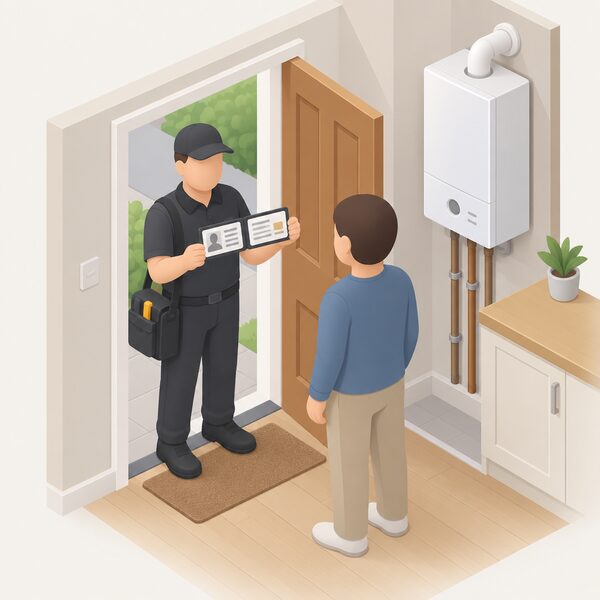
Every gas engineer carries a Gas Safe Register ID card4, and all Gas Safe Register engineers carry an ID card showing the type of work they are qualified to do, so it is worth asking to see it11. The card is the check that matters, because registration is held by the business and by the individual, and the qualification is specific to the task.
On the front of the card, check the engineer's photograph, the start and expiry dates, the licence number, the security hologram, and that the engineer is from the business you contacted26. On the back, check the engineer's qualification to do the gas work you asked them to do, and that the engineer's qualifications are current26. The gas engineer's competencies are clearly marked on the back of the card3.
There are two other routes to verification. Consumers can check an engineer is registered by texting Gas and the engineer's seven digit licence number to 850807. Alternatively, ring Gas Safe Register on 0800 408 5500 or check the website to see if the engineer is registered3.
"By law, all gas engineers must be on the register and hold current qualifications to install, repair or maintain domestic gas appliances."
The card check is not a formality. A qualification for a boiler is not a qualification for a gas fire or a commercial appliance, and the back of the card is where that distinction is visible. A householder who checks the front only has confirmed identity, not competence for the job in hand.
If you smell gas: the emergency number 0800 111 999 and what to do first
The National Gas Emergency number is 0800 111 999, and the service is free to call5. In Northern Ireland the number is 0800 002 001, and in the Republic of Ireland it is 1850 20 50 505.
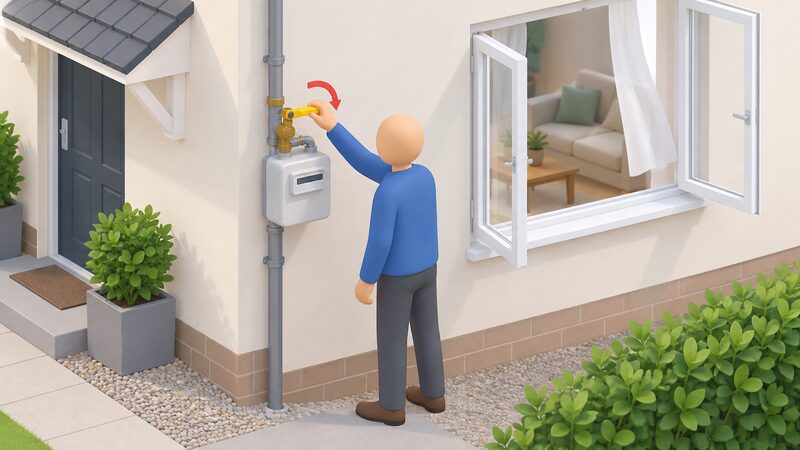
The steps are set out by the gas networks and are worth knowing before they are needed. Open windows and doors to help ventilate the gas, turn off the gas supply at the meter as well as any gas appliances, and call the National Gas Emergency number on 0800 111 9995. Tell the advisors if you have any vulnerabilities or special circumstances that they need to be aware of5.
There are things not to do, and they matter as much as the actions. Do not smoke or use any naked flames, do not touch any electrical switches, and do not enter a cellar, even if the gas meter is located in the cellar5. A light switch, a doorbell or a phone charger can all produce a spark, which is why the instruction is to leave electrical fittings alone rather than to investigate.
Where carbon monoxide is suspected rather than a gas escape, the Health and Safety Executive advises switching off the appliance and shutting off the gas supply at the meter control valve, opening all doors and windows to ventilate the room, and visiting a GP to say you believe you may have been exposed to carbon monoxide27. Suspected carbon monoxide poisoning should be met by seeking medical help from a qualified healthcare professional28. An annual service by a Gas Safe registered engineer can help prevent carbon monoxide poisoning9.
What the emergency service does and does not test
The emergency service attends gas escapes. It is not a general inspection service, and it does not replace the annual safety check or the certificate. The distinction is worth stating plainly, because a householder who has called the emergency number has not thereby had the appliances checked.
The carbon monoxide route is separate again. Where exposure is suspected, the Health and Safety Executive's advice is to switch off the appliance, shut off the gas supply at the meter control valve, ventilate the room, and see a GP27. Northern Ireland guidance is to seek medical help from a qualified healthcare professional where poisoning is suspected28. Neither is a test of the appliance.
For comparison, the electrical equivalent is instructive. An electrical test certificate is not a requirement for those who own their properties, but it can be beneficial for cautious homeowners, while it is a legal requirement for landlords of tenanted properties29. Gas and electricity therefore differ: the gas safety certificate is a landlord duty only, and the electrical certificate follows the same split. Neither is a substitute for the other, and neither is a service.
The practical consequence for a household is that the annual check is the only routine, documented inspection of the gas installation. The emergency callout is reactive, and the GP visit is medical. A homeowner who wants the same assurance a tenant receives has to arrange the check, because no one else will.
How gas safety fits into the move away from gas boilers
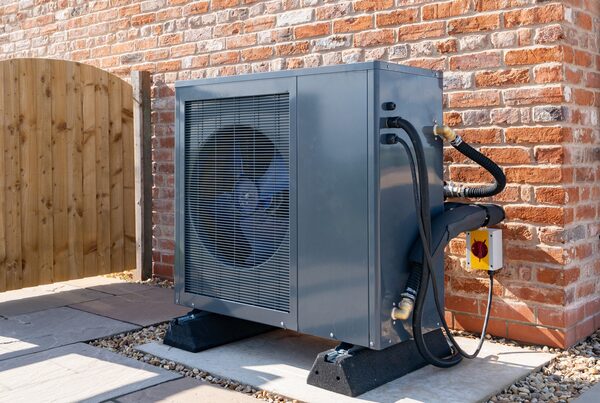
The direction of policy is away from natural gas for heating, and the safety regime sits inside that transition rather than outside it. The Heat and Buildings Strategy signalled an ambition to phase out installation of new natural gas boilers beyond 2035, and intends to phase out the installation of new and replacement natural gas boilers from 203530. The Welsh heat strategy refers to plans to phase out the installation of all new gas boilers beyond 2035, and sets out a regulatory route map for phasing out all new gas boiler installations for commercial properties by 203331.
For a household, the practical effect is that the gas installation has a finite planning horizon. A boiler installed now will still need an annual safety check for as long as it is in use, and the certificate cycle continues regardless of what replaces it. Where a home moves to a heat pump or another electric source, the gas safety duties fall away with the gas supply, and the compliance burden shifts to the electrical side, where a different certificate regime applies29.
Until then, the certificate remains the mechanism by which a landlord demonstrates that the gas appliances in a property have been checked by someone legally qualified to check them. It is a safety document, not an energy one. It does not reduce a household's dependence on the grid, a supplier or imported gas, and it does not make a home more self-sustaining. What it does is establish, once a year, that the combustion equipment in the property has been examined by a registered engineer, and that is the limit of its claim.
Sources31 cited
- Gas safety checks: what they involve, Health and Safety Executive, 2026
- Gas safety certificates, E.ON Next, 2026-09-17
- Gas safety in the home: owner occupiers, Health and Safety Executive, 2026
- Using a Gas Safe engineer, Liquid Gas UK, 2026-09-20
- Smell gas, SGN, 2026
- Get winter ready, Energy Networks Association, 2026-09-17
- Gas safety: frequently asked questions, Health and Safety Executive, 2026
- Your home energy checklist, National Energy Action, 2026-09-10
- Struggling with energy bills, National Energy Action, 2026-05-06
- Carbon monoxide, WW Utilities, 2026-09-20
- Domestic gas installation and health and safety, nidirect, 2025-10-28
- Five top tips to cut your energy bills, Welsh Government, 2026-03-18
- Carbon monoxide, SGN, 2026-09-20
- Energy performance of building certificates in England and Wales, GOV.UK, 2023-10-26
- Domestic RHI: guide to metering, Ofgem, 2026
- Energy performance of buildings directive, legislation.gov.uk, 2026-09-17
- Trading standards guidance, Isle of Anglesey County Council, 2025-09
- Energy performance of buildings: select committee report, Parliament, 2025-05-09
- Gas safety in the home: owner occupiers, Health and Safety Executive, 2026
- Call for input: disconnections, Ofgem, 2025-01-13
- The Gas Appliances (Safety) Regulations 1992, legislation.gov.uk, 1993-12-09
- Energy price cap levels, 1 July to 30 September 2026, Ofgem, 2026
- Home heating costs by fuel, Parliament, 2026
- Registration to carry out gas work, GOV.UK, 2026-09-17
- Carbon monoxide, Energy UK, 2024-11-21
- Gas Safe Register, nidirect, 2025-10-29
- Carbon monoxide, Health and Safety Executive, 2026
- Carbon monoxide poisoning, nidirect, 2026-09-17
- Electricity safety guide, Uswitch, 2025-05-07
- Heat and Buildings Strategy, GOV.UK, 2035
- Heat strategy for Wales, Welsh Government, 2033
 Gas Safety RulesAnyone working on gas in your home has to be on the Gas Safe Register, whether they are installing, fixing or servicing an appliance.
 Landlord Electrical ChecksWho is responsible for checking the electrics are safe in your rented home, and how often should it happen?
 HMOs and Shared HousesWho is responsible for the electrics, the gas and the fire alarms when you rent a room in a shared house?
 F-Gas RulesWho is legally allowed to work on the gas in your home air conditioning?
 Rented Homes and Landlord MetersWho is responsible for the energy in your rented home?
 The Full Your Type of Home GuideLiving in a flat, an old listed house or somewhere off the gas grid changes what energy help you can get and what you are allowed to install.