
In this answer
Short answer
A free annual gas safety check is available to some households, but it is not a universal entitlement. The route that matters most is the one run through gas suppliers: providing free gas safety checks to eligible customers is a licence obligation, and the check is offered to vulnerable consumers living on their own, or where everyone in the household is vulnerable1. If you are a homeowner and on certain benefits you may be eligible for a free annual gas safety check, and the way to find out is to contact your gas supplier to check your eligibility3.
The second route is the Priority Services Register, a free service for consumers who may need extra support4. Free gas safety checks appear among the services associated with it, and annual gas appliance safety checks for homeowners are listed as one of the things the register can bring5. Eligibility criteria apply, and some schemes require PSR membership or other conditions such as household income or receipt of certain benefits6.
Renters sit outside both routes. By law landlords must carry out an annual safety check and provide a Gas Safety Certificate, and where there is a live gas supply to the rented premises a safety check must be carried out whether or not the tenant uses gas7. A tenant's first call is the landlord, not the supplier.
Eligibility: a means-tested benefit plus a vulnerable person in the home
The supplier-run check turns on two things at once: the household's benefit position and the presence of someone the criteria treat as vulnerable. Guidance for consumers puts it plainly: you might be able to get a free annual gas safety check if you own your home and claim a means-tested benefit11. The benefits named in that guidance are Universal Credit, Income-related Employment and Support Allowance, Income Support and Guarantee Credit as part of Pension Credit11.
Related energy schemes use a wider list, which shows how the phrase "means-tested benefit" is applied in practice. Scheme rules for the Warm Homes: Local Grant name Universal Credit, Pension Credit (Savings or Guarantee), Income Support, Income-based Jobseeker's Allowance, Income-related ESA and Housing Benefit12. The Warm Home Discount eligibility statement for England and Wales for the 2026 to 2027 scheme year requires a qualifying means-tested benefit on the qualifying date13. The lists overlap but are not identical, and the supplier applies the criteria attached to the licence obligation rather than any single published list.
The vulnerability limb is defined in several places. Official scheme rules describe households identified by a person registered in the General Practitioner Register, an NHS Foundation Trust or an NHS Trust as vulnerable, with an occupant whose health conditions may be adversely affected by living in a cold home; the conditions may be cardiovascular, respiratory, immunosuppressed or limited mobility related14. A separate proxy used in ECO4 Flexible Eligibility covers a person vulnerable to the cold through cardiovascular, respiratory or mental health conditions, disabilities, people aged 65 and over, young children and pregnant women15.
In Northern Ireland the support landscape differs. The Code of Practice for Consumers in Vulnerable Circumstances sets out that if you are vulnerable and live on your own, or if everyone who lives in your household is vulnerable, your gas supplier can arrange a free gas safety inspection for your home2. The Better Energy Homes Plus scheme, available throughout Northern Ireland, uses income thresholds: a single person household with income or pension less than £28,000 gross, or a couple, joint household or single parent family with income or pension less than £35,000 gross16. Those thresholds belong to that scheme, not to the gas safety check, but they show how eligibility is drawn differently across the four nations.
How to apply: speak to your gas supplier
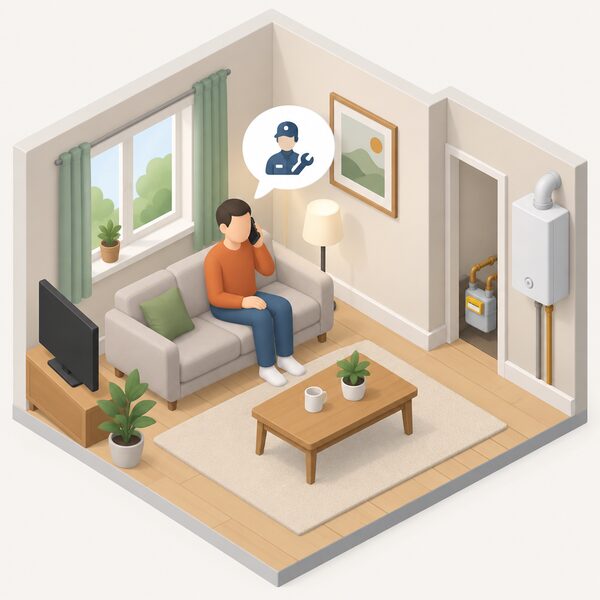
The application route is deliberately simple and there is no separate form or portal. Contact your gas supplier to check your eligibility3. Suppliers can arrange a free gas safety inspection for vulnerable consumers living on their own, or where everyone in the household is vulnerable2.
If the household does not know which company supplies its gas, the supplier can be identified through Find My Supplier or by calling 0870 608 152417. That step matters because the obligation sits with the supplier, not with the network operator or the local authority.
Two other numbers are useful once a check is booked or an engineer attends. Gas Safe Register runs a freefone helpline on 0800 408 5500 for checking that an engineer is registered10. The Health and Safety Executive runs a free Gas Safety Advice Line offering advice on gas safety, on freephone 0800 300 3637.
For households whose gas appliance has been isolated and condemned by a gas distribution network, a separate service exists. Services Beyond the Meter is open to customers in that position, or who are on the Priority Services Register, or who meet further eligibility criteria such as household income or receipt of certain benefits6. That is a distinct route from the annual safety check and applies where an appliance has already been shut off.
Where a household is on a low income but not on a qualifying benefit, other support may still be available. The Priority Services Register is a free support service offered by energy suppliers and network operators to help vulnerable people20, and it is worth registering for in its own right because it carries a range of services beyond the gas check.
How often the check is done: every 12 months
The interval is annual. The Health and Safety Executive strongly advises that gas appliances and flues are regularly checked for safety at least once every 12 months9. For landlords, the duty is firmer: a gas safety check must be done every year on each gas appliance and flue8, and the annual gas safety check must be carried out within 12 months of the installation of the appliance or flue7.
There is a small amount of flexibility built into the landlord regime that is worth understanding because it explains why a check may fall slightly earlier than the anniversary. The annual gas safety check on each appliance or flue can be carried out up to two months before the date it needs to be carried out while retaining the original deadline date7. In other words, an early check does not reset the clock forward.
For tenants who own their own appliances, the same annual rhythm applies. Guidance for Northern Ireland states that gas appliances or flues you own should be regularly maintained, with a safety check carried out at least once every 12 months by a Gas Safe registered installer21. That is a separate duty from the landlord's, and it sits with the tenant as the owner of the appliance.
For a supplier-provided free check, the entitlement is described as annual, and the practical expectation is one check every 12 months. A household that has had a check in the past year should not expect a second free check inside that window.
Suppliers that offer free checks through the Priority Services Register
The Priority Services Register is the mechanism through which much of this support is delivered. It is a free service for consumers who may need extra support4, and it is offered by energy suppliers and network operators to help vulnerable people20. Network operators use it to identify customers who need priority support in a gas emergency or during an interruption to supply22.
The services attached to the register go well beyond the gas check. The official consultation that set out the required services lists a password scheme, a free gas appliance safety check, advice on interruptions, information about planned interruptions, alternative heating and cooking facilities, quarterly meter readings, moving a prepayment meter, accessible bills and information, redirection of bills to a nominated person, facilities to complain, information about the PSR in accessible formats, and assistance for customers whose English is not their first language23.
Free gas safety checks are named by suppliers themselves. British Gas lists free gas safety checks among its PSR services, and EDF Energy lists a free gas safety check24. Annual gas appliance safety checks for homeowners are also listed as a PSR benefit in independent guidance5. Network operators publish their own PSR pages: SGN administers a register that helps identify customers needing priority support22, and free gas safety checks appear on PSR listings for both Northern Gas Networks and SGN, in each case with eligibility criteria applying25.
The register is free to join and does not require a means-tested benefit in itself. Northern Gas Networks describes it as a free service which helps you, or someone else in your household, if you experience an unexpected interruption to gas supply27. The Energy Ombudsman describes it as a free service for consumers who may need extra support4. Swansea Council describes it as a free support service offered by energy suppliers and network operators to help vulnerable people20.
Why the check matters for vulnerable households
The eligibility criteria for free gas appliance safety checks are not arbitrary. The official consultation that reviewed them states that current eligibility criteria are based on evidence from HSE and focus on those likely to be at an increased risk from gas appliances, and in particular at increased risk of carbon monoxide poisoning23. That is the reasoning behind tying the check to vulnerability rather than to income alone.
The evidence base for the check's value is long-standing. An earlier official consultation recorded a high level of satisfaction among customers who had received the check28. That finding supports the case for the check as a service households actually value, not merely a compliance exercise.
For a household managing a health condition, the check is one of the few interventions that addresses risk directly rather than through bills. A person with a cardiovascular or respiratory condition, or with limited mobility, faces a different risk profile from a gas appliance fault than a healthy adult does, which is why the scheme rules single out those conditions14. The proxy definitions used elsewhere add mental health conditions, disabilities, people aged 65 and over, young children and pregnant women15.
The risk being managed is real but not uniform. On pipework safety, guidance notes that for most properties the chance of an incident is low and will depend on a number of factors including the type of home, the floor you have and features of your gas supply29. The check is therefore a proportionate safeguard rather than a response to a widespread hazard.
For a household's energy independence, the free gas safety check does something specific and limited. It keeps a gas appliance safe to run, which sustains the household's ability to heat and cook on its own supply, and it does so without a charge where eligibility is met. What it does not do is reduce dependence on the gas network, the supplier or imported gas. The household remains connected, metered and billed, and the check is a condition of using that connection safely rather than a step away from it. Households weighing that wider position can read more on vulnerable and medically dependent households and on fuel poverty in UK households.
Renters, landlords and where the two routes divide
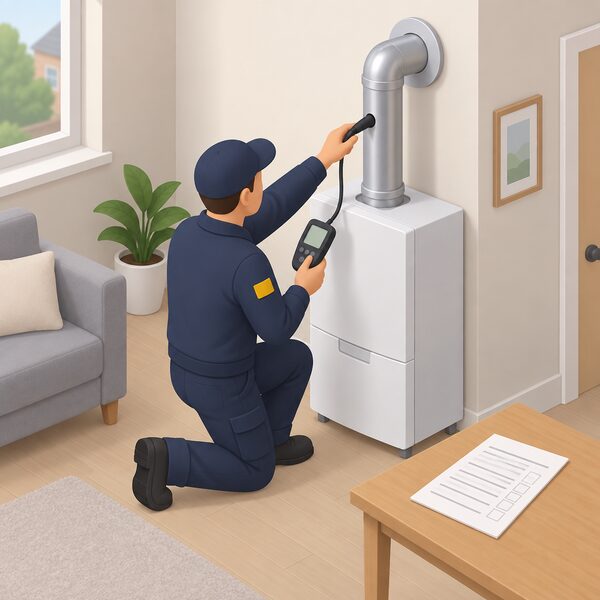
Renters do not use the supplier route for the annual check, because a different duty already covers them. By law landlords must carry out an annual safety check and provide a Gas Safety Certificate3. The check must be done every year on each gas appliance and flue8, and where there is a live gas supply to the rented premises a safety check will need to be carried out irrespective of whether a tenant uses gas19. Access should be allowed for that purpose7.
The record-keeping side is specific. A landlord must keep a record of the safety check for two years and issue a copy to each existing tenant within 28 days of the check being completed, and to any new tenants before they move in7. Before any new lease starts, the checks must have been done within one year before the start of the lease8. Tenants who rent their home should contact their landlord to arrange a safety check for all gas appliances and flues by a Gas Safe registered engineer30.
For LPG appliances owned and provided by the landlord, a Gas Safe registered engineer must carry out a safety check at least once every 12 months7. The same annual rhythm applies, with a different fuel.
The practical consequence is that a renter asking about a free gas safety check is usually asking the wrong body. The landlord carries the duty and the cost, and the certificate is the evidence. A renter who wants to know what else can be changed in a rented home can read renting and home energy and landlord duties on energy, heating and home safety.
Sources30 cited
- Gas and carbon monoxide safety, Electricity North West, 2026-09-19
- Code of Practice for Consumers in Vulnerable Circumstances, Utility Regulator, 2025
- Struggling with energy bills, National Energy Action, 2026-05-06
- Worried about your energy bills, Energy Ombudsman, 2026-03-24
- Priority Services Register, Turn2us, 2026-09-08
- Services Beyond the Meter, Cadent Gas, 2026-09-20
- Gas safety in the home: frequently asked questions, Health and Safety Executive, 2026
- Landlords: what a gas safety check involves, Health and Safety Executive, 2026
- Gas safety advice for homeowners, Health and Safety Executive, 2026
- Gas Safe Register, nidirect, 2025-10-29
- Getting extra support from your energy supplier, Citizens Advice, 2026-09-17
- Warwick Warm Homes Local Grant, Act on Energy, 2026-09-07
- Warm Home Discount eligibility statement, England and Wales, 2026 to 2027, GOV.UK, 2026-09-17
- ECO4 and GBIS Flex statement of intent, Birmingham City Council, 2025-08-11
- ECO flexibility funding, Ceredigion County Council, 2026-09-17
- NISEP list of schemes 2026-27, Utility Regulator, 2026-04
- Understanding energy flexibility, Smart Energy GB, 2026-08-17
- Switching supplier, tariffs and bills, Smart Energy GB, 2026-03-16
- Gas safety in the home: frequently asked questions, Health and Safety Executive, 2026
- Energy costs, Swansea Council, 2022-12-14
- Domestic gas installation and health and safety, nidirect, 2025-10-28
- Our customer promises, SGN, 2026
- Priority Services Register review, Ofgem, 2014-06-30
- Energy for those with sight loss, Uswitch, 2026-04-09
- Priority Services Register: Northern Gas Networks, Fuel Bank Foundation, 2025-09-24
- Priority Services Register: SGN, Fuel Bank Foundation, 2025-09-24
- My boiler isn't working, Northern Gas Networks, 2026-07-24
- Priority service research project, Ofgem, 2003-12-15
- Pipework safety check, Liquid Gas UK, 2026-09-20
- Getting your gas back on: repair and replacement, Cadent Gas, 2026-09-20
 Gas Safety in the HomeYour landlord has to arrange a yearly gas safety check by a Gas Safe registered engineer and give you the record if you rent.
 Gas Safety RulesAnyone working on gas in your home has to be on the Gas Safe Register, whether they are installing, fixing or servicing an appliance.
 Who to Call for Energy HelpA single reference to the right contact for each situation: gas escapes, power cuts, water leaks, meter faults, billing disputes, scams and free advice.
 Landlord Electrical ChecksWho is responsible for checking the electrics are safe in your rented home, and how often should it happen?
 Getting a New Gas ConnectionHow a household applies for a new or upgraded gas connection, who carries out the work, the quotation and contribution rules, typical timescales, and what a connection means for a home's energy independence.
 Energy Security for HouseholdsCan a household really protect itself from gas and electricity price shocks, and what actually makes a difference?