
In this guide
Northern Gas Networks is the gas distribution network operator for Northern England, providing new gas connections to much of Yorkshire, the North East and northern Cumbria1. Its pipes deliver gas to 2.9 million properties, and there are 37,000km of gas mains in the North of England2. It is one of four gas distribution network operators in Great Britain, alongside Cadent Gas Ltd, SGN and Wales & West Utilities Limited4.
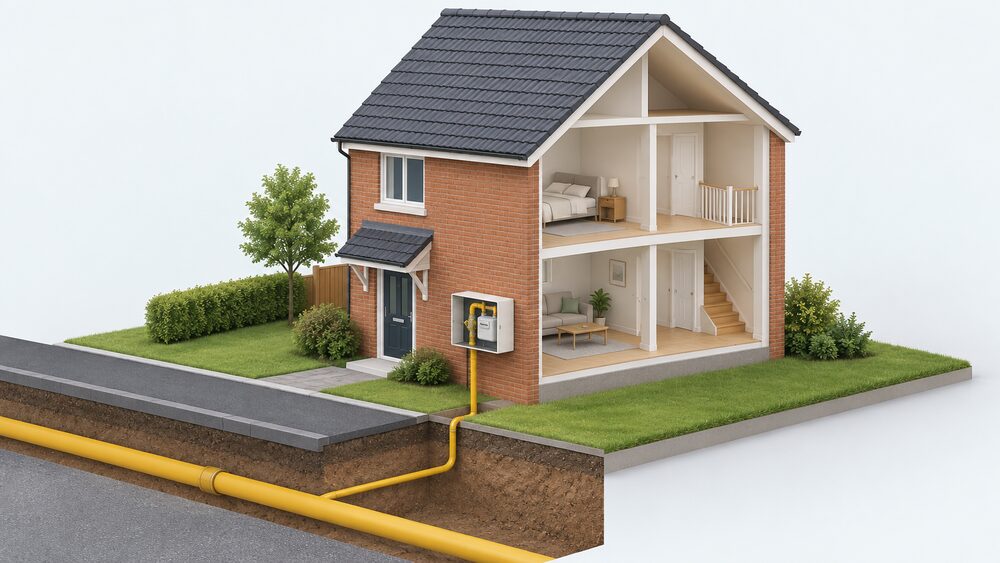
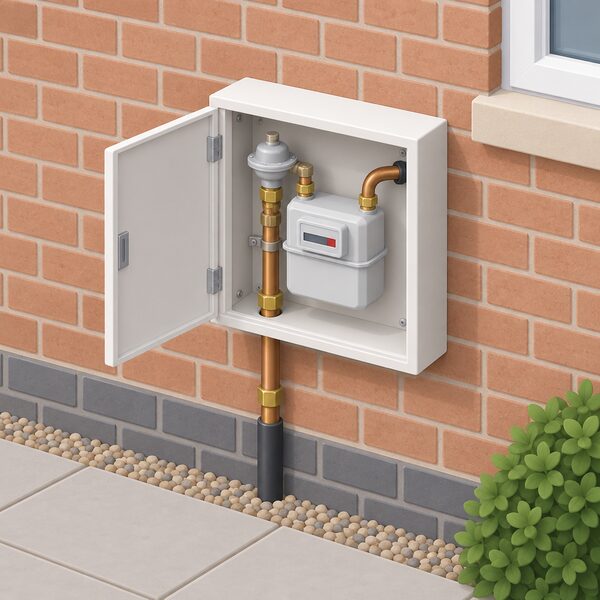
The company does not sell gas and does not fit meters. It is a transporter: it moves gas through its pipes on behalf of gas suppliers, and Ofgem oversees and approves the prices it can charge gas shippers to do so5. Its responsibility runs up to the Emergency Control Valve (ECV), located just before the gas meter6. Everything downstream of that valve, including the meter, the internal pipework and the appliances, sits with the householder, a supplier or a Gas Safe registered engineer.
For a household, that defines both what the network provides and what it does not. A connection to the Northern Gas Networks system means access to mains gas, but it also means a continuing dependence on the gas grid, on a chosen supplier for the meter and the fuel itself, and on the network's own emergency and repair arrangements. This page sets out the area served, the connection process and specifications, the cost figures that are published, the emergency and safety position, and what the arrangement means for a home's energy independence.
What Northern Gas Networks does in the UK
Northern Gas Networks is a gas transporter for Northern England8. Its service area covers much of Yorkshire, the North East and northern Cumbria, and it is the network a household in those areas deals with for a new connection or an alteration to an existing supply1. The wider gas grid it forms part of is a network of gas pipelines across Great Britain9, with the high pressure National Transmission System owned and operated separately by National Gas Transmission10.
The company's role splits into three functions that matter to a household. First, connections: bringing a new supply from the nearest viable main to a property, or altering an existing one. Second, the emergency service: Northern Gas Networks provides the region's 24/7 gas emergency service, and its engineers are available day or night2. Third, planned work on the mains themselves, where the company says it gives plenty of notice before digging starts3.
It is not a supplier. Northern Gas Networks states plainly that it is not a gas supplier, and that it does not supply gas meters12. A householder wanting gas must therefore deal with two organisations: the network for the pipe to the property, and a chosen supplier for the meter and the fuel. That split is standard across the four GB gas distribution networks, and it is the reason a new connection does not by itself deliver gas.
The network also carries out a long term replacement programme. Northern Gas Networks plans to invest £850 million to replace a further 2,900km of ageing gas pipes and smaller service pipes with plastic equivalents by 2031, and targets a further 24% reduction in annual gas leakage between 2026 and 2031 through that programme and effective pressure management13. For a household, that work is the main reason a street may see excavation, and it is also the mechanism by which the safety and emissions profile of the local network changes over time.
Connections: what the process requires
A new connection application asks for accurate hourly gas load details, because the company cannot provide a quotation without them1. The annual gas load can be calculated as hourly gas load multiplied by usage hours per day, usage days per week and usage weeks per year14. For business or industrial premises, or an upgrade of supply, hourly and annual gas loads are required14.
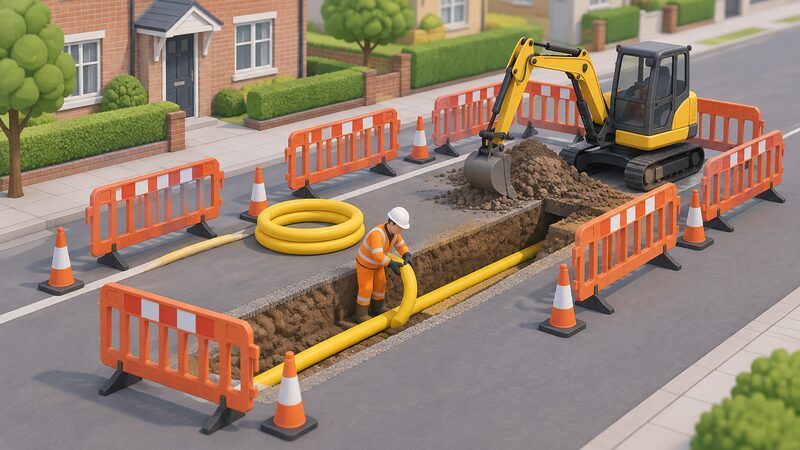
The application itself can be made by online postcode lookup, by telephone, or by downloadable PDF forms, and all sections of the form need completing1. The applicant must have permission for a new gas connection to be installed1. Once the application is in, Northern Gas Networks sends the quote, design and any additional documents within 21 working days, though works considered complex, such as large loads or sites of five or more properties, are exempt from that timescale1. Following payment and acceptance, planners make contact within 20 working days to agree a start date1. Lead times vary in each area and change frequently12.
Two practical choices sit inside the application. The applicant can dig and reinstate the trench, or Northern Gas Networks can dig and reinstate it1. On metering, the company supplies surface mounted or semi concealed meter boxes, and the available options include a surface mounted meter box, a semi concealed meter box, a built-in box, an internal meter, or a meter kiosk for gas loads under 65kWh1. Above a 65kWh peak gas load, a meter kiosk applies, and the applicant can supply their own kiosk or Northern Gas Networks can supply it1.
For alterations to an existing supply, the Meter Point Reference Number is required when filling in the application form15. The MPRN is the identifier that ties a property to its supply point, and it is the reference the network, the supplier and the meter operator all use.
Costs: what is published and what is quoted
There is no published list price for a new gas connection. Northern Gas Networks states that there is a cost to get connected and that it is determined by the type of property being connected, the position of the nearest viable main and how much pipework is required to connect the property12. In other words, the connection charge is site-specific and quoted after an application, not drawn from a tariff.
The figures that are published cover alterations and reconnections. Basic one-metre alterations start from around £810 without digging and rise to £1,362 with digging, with each additional metre costing an additional £24 to £1148. Partial or full meter reconnection services cost £40 to £231 depending on the length of the new pipe8. Where the new pipe is more than 2 metres in length, a Gas Safe registered engineer must complete the reconnection8.
On the ongoing charge, Northern Gas Networks states that £167 of the average annual gas bill pays for the distribution services it provides, which it describes as £14 a month5. The company notes that this figure varies annually based on a number of regulatory cost factors during a given year5. Ofgem oversees and approves the prices Northern Gas Networks can charge gas shippers to move gas through its pipes on behalf of gas suppliers5.
The regional price cap figures give a sense of the wider bill the distribution charge sits inside. For the period 1 July to 30 September 2026, the gas benchmark maximum charges for the Northern region are a £101.33 standing charge and a £739.84 annual bill at 9,500 kWh for prepayment, and for Northern Scotland a £101.58 standing charge and a £730.70 annual bill at the same consumption16. Earlier periods show the same regional split: for 1 October to 31 December 2025, the Northern region cap level was £118.70 at nil consumption and £837.33 annual at 12,000 kWh on other payment methods, while Northern Scotland was £118.94 and £804.1717. For 1 July to 30 September 2025, the Northern nil consumption figure was £103.95 and the Northern Scotland annual cost at 12,000 kWh on other payment methods was £820.5818. 33 annual at 12,000 kWh for 1 October to 31 December 2025, another gives £814.22 for the same period and region, and that conflict is unresolved17.
| Item | Published figure | Date |
|---|---|---|
| Distribution share of average annual gas bill | £167, or £14 a month5 | 2025-09-18 |
| One-metre alteration, no digging | from around £8108 | 2026-08 |
| One-metre alteration, with digging | up to £1,3628 | 2026-08 |
| Each additional metre | £24 to £1148 | 2026-08 |
| Partial or full meter reconnection | £40 to £2318 | 2026-08 |
| Northern region gas cap, prepayment, 9,500 kWh | £739.84 annual, £101.33 standing charge16 | 1 July to 30 September 2026 |
Emergencies, safety and the flood position
Northern Gas Networks provides the region's 24/7 gas emergency service2. The number to call is the National Gas Emergency Service on 0800 111 999, which the company directs households to if they smell gas, experience low gas pressure or suspect carbon monoxide11. Its engineers do not repair appliances or pipework inside the home, but their specialist training means they can assess the situation, identify potential hazards and take the right action to make things safe2. The network is authorised to carry out repair work at very short notice3.
The company also runs a customer care line on 0800 040 7766 (Option 4) and a connections team on the same number (Option 2)11. Contact hours for the connections route are 08:00 to 17:00 Monday to Friday12. Engineers carry ID cards so they can be identified when they knock on the door6, and the company will always carry an ID badge visible at all times19. It offers, free of charge, to agree a password that a customer can use to help identify the person attending19.
Flood advice is specific and worth stating exactly, because it runs against intuition. Northern Gas Networks advises not to switch off the gas supply at the meter, especially if the gas meter is now under water7. It states there is no safety reason to turn off the gas supply before vacating a property, though it may be turned off at the emergency control handle if preferred or advised by an authorised agency, and not if the meter is under water or in a cellar7. It does recommend ensuring gas appliances are switched off before evacuating7. If water has got into gas pipes within the home, a Gas Safe registered engineer is needed to clear the system, and a list of local registered engineers is available on 0800 408 55007. After flood waters have left, if a householder can smell gas, experiences poor pressure or has no gas, the gas emergency line is the route7. A gas supply that has been turned off must be restored by an appropriate qualified person7.
Priority customers and additional support
Northern Gas Networks supports over 38,000 of its highest risk households with their specific needs, such as debt and energy advice or appliance repairs13. It is part of Infrastructure North, an initiative aiming to create a fairer and safer north for vulnerable customers19. Its customer data procedures are compliant with current GDPR legislation19.
Practical support includes the free password scheme and the visible ID badge policy19. The website itself carries ReciteMe, an accessibility tool for customers with extra communication needs, and braille, large print or alternative language formats are available on request19. The company also runs a priority services register for customers who need additional help11.
The wider vulnerability framework differs by nation. In Northern Ireland, the Utility Regulator's Code of Practice for Consumers in Vulnerable Circumstances sets out that a consumer's electricity or gas supplier or NIE Networks will provide alternative forms of communication free of charge20. The Northern Ireland Sustainable Energy Programme is an energy efficiency programme for domestic and non-domestic customers21. Northern Ireland also has its own gas price guarantee direction, which applies to Northern Ireland22. These arrangements sit outside Northern Gas Networks' own area, which is in Great Britain, but they matter to any household comparing what support exists across the UK.

Company status and the network's future
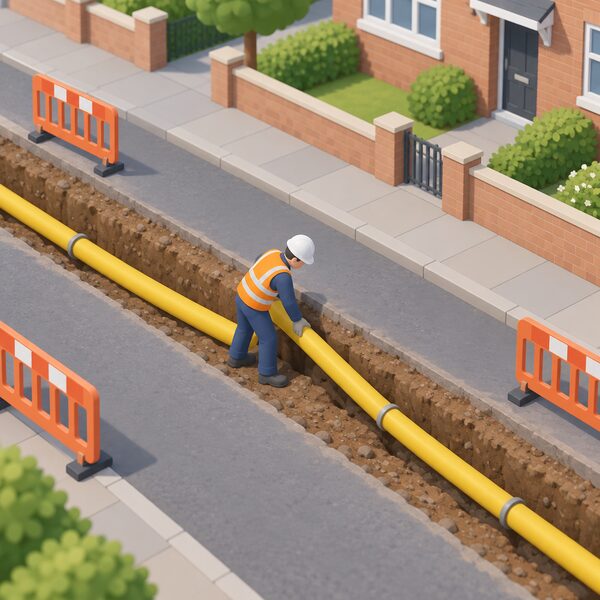
Northern Gas Networks Limited is one of the four gas distribution network operators listed in Ofgem's guidance, alongside Cadent Gas Ltd, SGN and Wales & West Utilities Limited4. It is an active, operating network, not a company in administration, and it is currently delivering a published business plan for 2026 to 2031 that sets commitments on customer service, safety, resilience, environment and value for money13.
That plan includes the £850 million pipe replacement investment and the 24% leakage reduction target13. It also sits alongside the company's work on lower carbon gas. Northern Gas Networks has published on the Howdon biomethane plant, describing 20 connected facilities generating 0.71 TWh a year and plans to double biomethane output over five years13. Biomethane is injected into the existing gas network, so it changes the carbon content of the gas rather than the network a household depends on.
The company's own communications also cover carbon monoxide risk, including a summer warning campaign run with Doctor Hilary Jones and a giveaway of 1,000 free CO alarms to customers in its distribution area13. That is a safety function rather than an energy supply one, but it reflects the network's role in the household's gas safety chain.
For a household, the status question is straightforward: the network is operating, regulated and investing. The dependence it represents is structural rather than commercial. A property connected to Northern Gas Networks remains on the gas grid, and the network's charges are recovered through gas bills regardless of which supplier is chosen.
What it means for household energy independence
A connection to Northern Gas Networks delivers access to mains gas, and that access is the single largest determinant of a home's heating fuel. It also fixes several dependencies that a household cannot remove while staying on the network. The gas itself comes from a supplier, and the meter is arranged with that supplier, not with the network12. The distribution charge is set by a regulated process that Ofgem oversees and approves, and it appears on the bill whether or not the household engages with it5. The emergency and repair route runs through the network and the National Gas Emergency Service2.
The network's own figures show how much of the bill is outside a household's control. £167 of the average annual gas bill pays for distribution services, and that figure varies annually based on regulatory cost factors5. The regional cap figures show the same pattern at the supply level, with the Northern region and Northern Scotland carrying different standing charges and annual amounts in the same periods16.
What a household can control is narrower. It can choose whether to connect at all, and it can choose a supplier and a tariff. It can arrange a voluntary disconnection, which Ofgem defines as a gas disconnection carried out at the request of the consumer and not required under health and safety legislation, for which gas distribution networks charge a reasonable and cost reflective charge approved under their connection charging methodology10. Beyond that, the fuel and the network remain shared infrastructure.
The wider context is that the gas grid is a Great Britain network of pipelines, with the high pressure transmission system owned and operated separately9. Northern Gas Networks is one of four distribution networks that connect that backbone to streets and homes4. For a household in Yorkshire, the North East or northern Cumbria, the practical position is that mains gas is available, the network is investing in its pipes, and the dependence on the grid and a supplier continues for as long as the property stays connected.
Sources22 cited
- What to expect, Northern Gas Networks, 2026-09-17
- Take no chances with gas safety, Northern Gas Networks, 2026-09-14
- Upgrading our pipes, Northern Gas Networks, 2024-09-18
- Energy terms explained, Ofgem, 2026
- Your gas bill, Northern Gas Networks, 2025-09-18
- Get connected, Northern Gas Networks, 2026-09-04
- Flood advice, Northern Gas Networks, 2025-10-22
- How to move your gas or electricity meter, Uswitch, 2026-08
- Gas grid research briefing, House of Commons Library, 2026-09-17
- Call for input on disconnections, Ofgem, 2025-01-13
- What support is available for customers who need additional help, Northern Gas Networks, 2026-01-14
- FAQs and guidance, Northern Gas Networks, 2025-10-30
- Highlights of our plan, Northern Gas Networks, 2026
- Apply now, Northern Gas Networks, 2026-09-17
- Make changes, Northern Gas Networks, 2026-09-04
- Energy price cap levels 1 July to 30 September 2026, Ofgem, 2026
- Energy price cap levels 1 October to 31 December 2025, Ofgem, 2025
- Energy price cap levels 1 July to 30 September 2025, Ofgem, 2025-07-01
- Priority customers, Northern Gas Networks, 2025-10-22
- Code of Practice for Consumers in Vulnerable Circumstances, Utility Regulator, 2025-06
- Northern Ireland Sustainable Energy Programme annual report, Utility Regulator, 2026-07-03
- Energy Price Guarantee for Domestic Gas Consumers in Northern Ireland, GOV.UK, 2022-12-19