

In this comparison
Northern Ireland has two funded routes to a warmer home, and they are not alternatives in the ordinary sense. The Affordable Warmth Scheme is the older, targeted programme, introduced in September 2014 and aimed at fuel poor households in the private sector1. NISEP, the Northern Ireland Sustainable Energy Programme, is an £8 million fund collected from both domestic and non-domestic customers and administered by the Energy Saving Trust on behalf of the Utility Regulator2. In general, NISEP schemes are targeted at households who do not qualify for assistance from other government schemes such as Affordable Warmth4.
That single sentence is the hinge of the comparison. A household that qualifies for Affordable Warmth is generally expected to use it; a household that does not may find a NISEP scheme open to it. The two are designed to sit alongside each other rather than to be stacked, and a household is not eligible for NISEP if it has already been approved under another grant-funded programme for the same measure at the same property, or has received a grant within the last 15 years for the same measure at the same property4.
Both routes are changing. The Affordable Warmth Scheme was extended for a further two years, meaning the current scheme continues until March 2026, and it is currently planned to run to 20265. The Warm Healthy Homes Fund will replace the current Affordable Warmth Scheme7. NISEP has been extended for a further two years until March 2029, with a break clause after the first year if the Department for the Economy successor scheme is fully developed8.
Two routes to the same goal, run by different bodies
The Affordable Warmth Scheme addresses the effects of fuel poverty and energy inefficiency, and is directed at low-income households3. It is funded by the Department for Communities and delivered in partnership with the Housing Executive, local councils and a range of local installers9. The Housing Executive delivers the scheme10. Independent guidance describes the same structure: the Northern Ireland Housing Executive work with local councils to deliver the scheme11.
NISEP sits under a different owner entirely. It is administered on behalf of the Utility Regulator by Energy Saving Trust12. The programme began life as the Northern Ireland Energy Efficiency Levy Programme, renamed the Northern Ireland Sustainable Energy Programme in March 200913. It is an energy efficiency programme for domestic and non-domestic customers14, and the schemes funded through it are published as a list each year by the Utility Regulator15.
The practical consequence for a household is that the two schemes have separate application routes, separate eligibility tests and separate administrators. Affordable Warmth is a housing and communities programme delivered through councils and the Housing Executive. NISEP is a levy-funded programme delivered through named scheme managers, each with its own telephone number or email address16.
| Affordable Warmth Scheme | NISEP | |
|---|---|---|
| Funder | Department for Communities9 | Levy on domestic and non-domestic customers2 |
| Administrator | Housing Executive, with local councils9 | Energy Saving Trust, for the Utility Regulator12 |
| Introduced | September 20141 | Renamed March 200913 |
| Fund size | £14 million in 2023/246 | £8 million2 |
| Application route | NI Energy Advice Service3 | Named scheme manager16 |
| Planned end | 20266 | March 20298 |
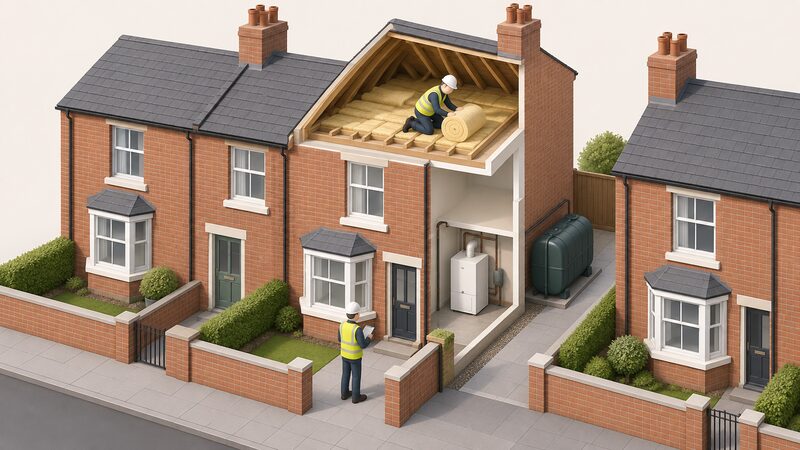
What the Affordable Warmth Scheme offers low-income households

The scheme aims to help with the effects of fuel poverty and energy inefficiency17, and it is primarily a targeted scheme aimed at homeowners and private renters most likely to be in severe to extreme fuel poverty9. It is a targeted scheme where local councils actively identify the most vulnerable households who can then benefit from improvements9. Fuel poor households in privately rented or owner-occupied properties in Northern Ireland can access support to install measures11.
The measures themselves are a range of insulation and heating measures to improve the thermal efficiency of homes18. The scheme replaced the Warm Homes Scheme19. By the time of the 2026 consultation on its successor, it had installed more than 56,000 energy efficiency measures in over 31,000 low-income households20.
Delivery has changed shape over the years. Up to 2023 the scheme was administered on a partnership basis between NIHE and local councils using a mix of self and targeted referrals18. From September 2023 the Affordable Warmth Scheme moved to an applications-based process and was delivered solely through that route18. Earlier consultation had proposed that one installer, managing the installation of all measures to the household, becomes the preferred delivery method19.
For a household, the significance is that the scheme is not a voucher or a cash payment. It is a survey-and-installation programme: a household is assessed, measures are specified, and an installer carries out the work. That is what makes it a route to energy independence in the narrow sense, reducing the amount of heat a home loses and the fuel it must buy, while leaving the household still connected to whatever heating system and fuel supply it already has.
Eligibility: who qualifies under each scheme
The headline test for Affordable Warmth is income. Households with a total annual gross income of less than £23,000 may be able to get funding2. Applicants must live in Northern Ireland, and the property must not be a holiday home, bed and breakfast or commercial establishment3. Rent from a private landlord is an accepted tenure3.
Certain benefits are excluded from the income calculation. Disability Living Allowance, Personal Independence Payment, Carer's Allowance and Attendance Allowance were disapplied from the calculation of income9. Belfast City Council had strongly agreed that these benefits are removed as in many cases they take households over the income threshold21.
NISEP works differently, because it is a family of schemes rather than one scheme. Most schemes have their own vulnerability criteria or income thresholds, and where demand is higher than funding available, a vulnerability matrix may be used to prioritise applicants12. The published thresholds vary widely by scheme. In the 2024-25 list, the Heating and Insulation schemes fully funded by NISEP used a single person household income or pension under £28,000 gross, and a couple or single parent family under £35,000 gross; the part-funded version of the same schemes used £45,000 and £50,000 respectively, with a 50% financial contribution required by the applicant for heating only and the remainder of costs funded under NISEP12.
Other NISEP schemes carry their own conditions. The Priority PV Scheme is for Northern Ireland Housing Executive tenants only, outside a natural gas area, in a single storey Housing Executive property with oil or electric heating, and a couple or single parent family with an income or pension less than £35,000 gross4. The Keep Warm Scheme uses £33,000 for a single person household and £40,000 for a couple or single parent family, and Northern Ireland Housing Executive leaseholders are not eligible4.
How to apply through the Energy Advice Service
For Affordable Warmth, the route in is the NI Energy Advice Service. Contact the NI Energy Advice Service, and if the household meets the entry requirements an application form will be sent out, to be completed and returned with supporting documents to the local Grant Office3. The freephone number is 0800 111 4455, open 9am to 5pm Monday to Friday4. The email address is nienergyadvice@nihe.gov.uk5. The same number appears in the 2026-27 NISEP list of schemes as the contact for the Energy Advice Service4.
NI Energy Advice offers independent and impartial energy advice to domestic householders in Northern Ireland, plus referrals to energy grants and other sources of help22. That referral function is the part that matters here: the service is the front door for Affordable Warmth and a signposting point for other help.
For NISEP, the process is set out in the list of schemes. Identify the scheme you want to apply for, check that you are eligible to receive funding and that it is available in your area, then contact the relevant scheme manager via the telephone number or email address provided16. There is no single NISEP application form, because each scheme is run by its own manager.
- Check whether the household meets the Affordable Warmth income test of under £23,000 gross2.
- If it does, call the NI Energy Advice Service on 0800 111 4455 or complete the online form10.
- Complete and return the application form with supporting documents to the local Grant Office3.
- If the household does not qualify, identify a NISEP scheme, check its own thresholds and area, and contact that scheme manager directly16.

Where NISEP stands now and what comes next

NISEP has been extended for a further two years until March 20298. The Utility Regulator announced the programme will run from 1 April 2027 to 31 March 2029, closable after the first year if the Department for the Economy successor scheme is fully developed8. If the successor scheme is not operational, NISEP will continue for the second year 2028/20298. The Framework Document for April 2027 to March 2029 and a Call for Schemes were due to be published at the end of September 2026, and organisations not currently registered as Primary Bidders had to submit a registration form by 31 July 20268.
The current year is settled. The Utility Regulator approved the NISEP schemes for 2026/2027 and published the full list of schemes4. The 2024-25 annual report, published in July 2026, reviewed the performance of that year's schemes, outlining measures installed, financial benefits and energy and carbon savings14. A rule change also ended in-year scheme variations for cost uplifts for the 2025/27 programme14.
The Affordable Warmth Scheme is on a different trajectory. It was extended for a further two years, meaning the current scheme continues until March 20265, and it is currently planned to run to 20266. The Warm Healthy Homes Fund will replace the current Affordable Warmth Scheme7, and official guidance confirms the fund will replace the Affordable Warmth Scheme17. The scheme was worth £14 million in 2023/246, and had confirmed scheme funding of £12 million across Northern Ireland for 2020-202123.
Where each scheme leaves a household
Neither scheme delivers energy independence on its own. Affordable Warmth reduces heat loss and improves heating in a home that remains connected to a grid, an oil tank or an electricity supplier. NISEP funds measures through named scheme managers, and the household still buys its fuel from the same market. What both do is lower the amount of energy a home must buy to stay warm, which is the part of energy independence a grant can actually reach.
The dependence that remains is administrative as much as physical. Affordable Warmth depends on the Department for Communities continuing to fund it, on the Housing Executive and councils continuing to deliver it, and on the scheme surviving its planned replacement. NISEP depends on the levy continuing to be collected and on the Utility Regulator approving a list of schemes each year, which it has now done through to 2026/27 with an extension to March 20294.
For households in Great Britain, the comparison is different. The Warm Home Discount Scheme does not run in Northern Ireland, but an Affordable Warmth Scheme is available there instead24. In England and Wales the Warm Home Discount uses qualifying benefits including Housing Benefit25. Wales runs its own route: the Warm Homes Nest scheme provides free energy efficiency measures and affordable, low carbon heating solutions for people on low incomes living in cold, damp homes26, and the new Warm Homes Programme will take over from Nest as the Welsh Government's primary mechanism to tackle fuel poverty27. Comparable schemes elsewhere help households that are not eligible to find other schemes that suit their circumstances28.
For a Northern Ireland household weighing the two, the sequence is straightforward. Affordable Warmth is the first test, because NISEP is generally aimed at those who do not qualify for it. If the income test of under £23,000 gross is met and the property is an eligible home in Northern Ireland, the Energy Advice Service is the route. If it is not, the NISEP list of schemes is where the thresholds, areas and scheme managers are set out, and each scheme must be checked on its own terms.
Sources28 cited
- Northern Ireland housing statistics 2023-24, Northern Ireland Statistics and Research Agency, 2024-09-25
- Fuel poverty in Northern Ireland, House of Commons Library, 2026-05-13
- Affordable Warmth Scheme, Northern Ireland Housing Executive, 2026-09-17
- NISEP List of Schemes 2026-27, Utility Regulator, 2026-04
- Changes to the Affordable Warmth Scheme, Department for Communities, 2023-09-08
- Northern Ireland Sustainable Energy Programme, House of Commons Library, 2026-09-17
- Warm Healthy Homes Fund, Department for Communities, 2026-09-17
- Extension announced for the Northern Ireland Sustainable Energy Programme, Utility Regulator, 2026-04-02
- Minister Hargey announces improvements to Affordable Warmth eligibility criteria, Department for Communities, 2021-06-09
- Stay warm at winter, Belfast City Council, 2026-09-20
- Northern Ireland, National Insulation Association, 2026
- NISEP List of Schemes 2024-25, Utility Regulator, 2024-10
- NISEP Framework Document, Utility Regulator, 2009-09
- 2024/2025 annual report for NISEP published, Utility Regulator, 2026-07-03
- List of schemes published for 2023/2024, Utility Regulator, 2023-05-09
- NISEP 2024/2025 List of Schemes, Utility Regulator, 2024-04-03
- Energy saving grants in your area, nidirect, 2026-09-17
- Change in delivery of the Affordable Warmth Scheme, Department for Communities, 2023-06-02
- DfC Affordable Warmth Scheme consultation document, Belfast City Council, 2017-11
- Warm Healthy Homes Fund consultation, Department for Communities, 2026-05
- Belfast City Council minutes, Belfast City Council, 2018-02
- Insulation, nidirect, 2026-09-02
- Affordable Warmth Update, Belfast City Council, 2020
- Warm Home Discount Scheme, Ofgem, 2026-09-17
- Warm Home Discount Scheme: if you live in England and Wales, GOV.UK, 2026-09-17
- Written statement on fuel poverty, Welsh Government, 2025-08-07
- New Warm Homes Programme children's rights impact assessment, Welsh Government, 2024-03-08
- Nest Warm Homes Programme, Welsh Government, 2026-09-18
 Housing Stock Data for NIMost homes in Northern Ireland heat with oil, so why are the grants and help different from the rest of the UK?
 Home HeatingWhy do so many homes in Northern Ireland run on heating oil, and will that ever change?
 Fuel PovertyWhy does Northern Ireland have such a high rate of fuel poverty, and how many households are affected?
 Energy Bills in Northern IrelandNorthern Ireland has no price cap.
 Utility Regulator NIWho sets your energy prices in Northern Ireland and who can you complain to?
 Devolved vs Reserved PowersWho decides what you pay for gas and electricity, and who decides how your home is insulated or improved?