

In this comparison
The Renewable Heat Incentive and the Green Gas Levy are often spoken of as if one replaced the other. They did not. The Renewable Heat Incentive paid money out to households and businesses that installed renewable heating, and it was funded out of general taxation rather than via levies on consumer bills1. The Green Gas Levy is a charge that flows the other way: it places an obligation on licensed fossil fuel gas suppliers in Great Britain to pay a quarterly levy based on the number of gas meters they serve, and suppliers recover it through gas bills1.
The timing matters more than the mechanism. The Domestic Renewable Heat Incentive closed to new applicants, including metering and monitoring service package applications, at midnight on 31 March 20222. The Green Gas Levy arrived to fund a different scheme entirely, the Green Gas Support Scheme, which provides financial incentives for new anaerobic digestion biomethane plants to increase the proportion of green gas in the gas grid3. One paid households to change how they heat. The other charges gas customers to change what is in the gas.
For a household, the practical difference is this: the RHI was something a home could claim, and the levy is something a home pays whether or not it ever claimed anything. The RHI is closed. The levy is live on gas bills, and Ofgem's price cap decision recorded an increase in the Green Gas Levy of £3 for the period 1 April to 30 June 20254.
Who pays the Green Gas Levy, and who was paid under the RHI
The Green Gas Levy is paid by suppliers, not by households directly. The obligation falls on licensed fossil fuel gas suppliers in Great Britain, charged quarterly on the number of gas meters they serve1. A supplier with more meters pays more, and the cost is passed through to gas bills. That structure means the levy reaches every gas customer on a licensed supply, including those who have never installed a heat pump, never claimed a grant and never heard of the scheme.
The Renewable Heat Incentive ran the other way. It was a government financial incentive to promote the use of renewable heat, which can help reduce carbon emissions and meet the UK's renewable energy targets6. Money moved from government to accredited participants. The non-domestic side of the scheme was substantial: one published transaction records RHI non-domestic AME payments of £79,359,757.00, with a payment date of 02/07/20247. That is a single recorded payment line, not a scheme total, but it shows the scale at which the non-domestic scheme continued to pay out after the domestic scheme had closed.
The two schemes also differ in who they were designed to reach. The non-domestic RHI was designed to support people with renewable heating systems which heat commercial, public, or industrial premises, as well as multiple residential premises including businesses, hospitals, schools and district heating schemes8. The domestic scheme was aimed at individual homes. The levy, by contrast, has no participant class at all: it is a charge on supply.
For a household's independence, the distinction is sharp. The RHI gave a home a reason to generate its own heat and a payment stream for doing so. The levy takes a small amount from every gas connection and puts it into the gas grid itself. One builds self-sufficiency at the property. The other maintains the shared network.
What the levy funds: the Green Gas Support Scheme and biomethane injection
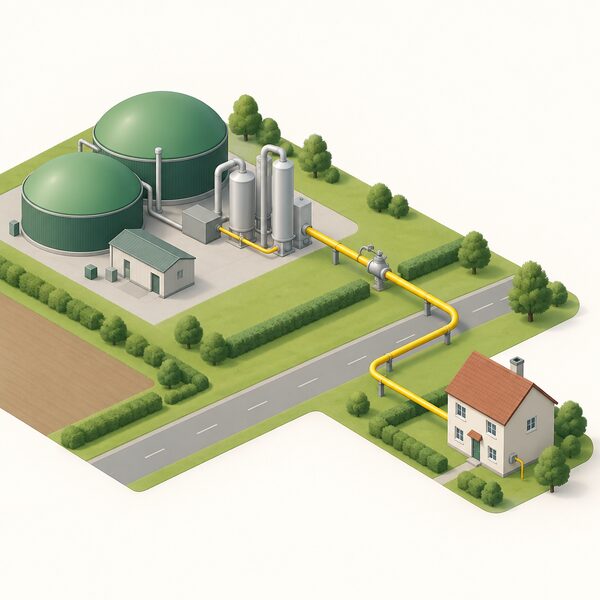
The Green Gas Support Scheme provides financial incentives for new anaerobic digestion biomethane plants to increase the proportion of green gas in the gas grid3. The Carbon Budget Delivery Plan describes the same purpose: to support the generation of biomethane by anaerobic digestion, for injection into the gas grid9. The scheme is funded via a Green Gas Levy9.
That is the whole architecture. Biomethane is produced by anaerobic digestion, cleaned to grid specification and injected into the network. The levy raises the money that pays the plants. The gas then arrives at homes through the same pipes as fossil gas, blended into the supply rather than delivered separately.
The policy intent is stated plainly: this is intended to increase the proportion of green gas in the grid, decarbonising our gas supply and continuing the transition to net zero10. The Green Gas Levy itself was introduced to help fund the use of greener fuels11. Earlier consultation proposals described two new schemes to incentivise the cost effective installation of low carbon heat technologies and the generation of renewable heat12.
"This is intended to increase the proportion of green gas in the grid, decarbonising our gas supply and continuing the transition to net zero"
The limits are as important as the purpose. The government committed to implementing stringent budget control measures for the Green Gas Support Scheme, limiting the funds that could be raised by the Green Gas Levy13. A levy with a cap on what it can raise is a levy with a cap on how much biomethane it can buy. The scheme is also time-limited: under the Carbon Budget Delivery Plan it will be open for applications until 20259.
For a household, this is grid decarbonisation, not household independence. A home on a gas supply gets a greener molecule in the same pipe. It does not get its own heat source, its own fuel store or any reduction in its exposure to gas prices. The dependence on the network, the supplier and the wholesale gas market is unchanged.
How the RHI worked for households: payments, metering and tariff length
The Domestic RHI paid every three months for up to seven years, the tariff lifetime, running from the application date5. Tariff rates were set by the Department for Energy Security and Net Zero5. Installations that were metered for payment had payments based on meter readings5.
Metering was not optional in every case. Installations not regularly or exclusively heating the home might need metering for payment, and a heat pump had to be metered for performance, with an electricity meter arrangement measuring the electricity consumed by the heat pump to generate heat14. That requirement tied the payment to measured output rather than to the installation alone.
Two features shaped what a participant actually received. Tariffs for new accreditations of a technology type were degressed by 10% when expenditure or growth thresholds were reached, so later applicants could receive less than earlier ones5. Applications submitted before 1 April 2016 had their tariffs adjusted in line with the Retail Price Index, calculated in April each year5. The scheme therefore paid different households differently depending on when they applied and how much had already been spent.
The scheme's reach can be measured. Payments since the start of the scheme were made against an estimated low carbon heat generation of 8,841 GWh15. In Scheme Year 10 the scheme subsidised 811.4 GWh of renewable heat generation in domestic properties16.
| Domestic RHI feature | Detail |
|---|---|
| Payment frequency | Every three months5 |
| Tariff lifetime | Up to seven years from application date5 |
| Tariff set by | Department for Energy Security and Net Zero5 |
| Payment basis | Meter readings where metered for payment5 |
| Degression | 10% for new accreditations when thresholds reached5 |
| Indexation | RPI, April each year, for applications before 1 April 20165 |
| Estimated heat generation since start | 8,841 GWh15 |
| Scheme Year 10 domestic heat | 811.4 GWh16 |
Eligibility had its own conditions. An applicant had to solely or jointly own the renewable heating system and have made a financial contribution towards the cost of the heating equipment or its installation, or both, unless the owner was a local authority or a registered investor had paid under an Assignment of Rights agreement14. The scheme was underpinned by the Domestic Renewable Heat Incentive Scheme Regulations 2014, as amended17.
Why the RHI closed to new applicants and what replaced it

The Domestic RHI closed to new applicants on 31 March 202218. The closure covered metering and monitoring service package applications as well2. The non-domestic scheme had already closed to new applicants earlier, in March 202119. The scheme opened in April 2014 and closed in March 202220.
The successor is the Boiler Upgrade Scheme21. The government added a note about the closure of the DRHI scheme and its successor the Boiler Upgrade Scheme21. The change was not a like-for-like swap. The Clean Heat Grant, as the successor was then conceived, was assessed as offering less than under the RHI, making domestic heat pumps a less attractive option than at present22.
That last condition is worth stating plainly, because it catches people out. If a participant received a grant after their installation was accredited to the scheme, they were no longer eligible to receive payments17. Support schemes do not generally stack.
The wider policy picture is that the RHI was judged only partly effective. Others such as the Renewable Heat Incentive have been marginally more successful, although sale volumes of low carbon heating have remained stubbornly low23. That assessment sits alongside the scheme's own output figures: substantial heat generation, but not a transformation of the domestic heating market.
For households, the practical position is that the payment route that existed for renewable heat has ended and been replaced by a grant scheme with different terms. The Boiler Upgrade Scheme and the wider set of closed and abandoned home energy policies are covered elsewhere on this site. What matters here is that the RHI's closure removed a recurring payment and replaced it with a one-off capital contribution.
What the Green Gas Support Scheme means for green gas capacity
The Green Gas Support Scheme is intended to increase the proportion of green gas in the grid, decarbonising our gas supply and continuing the transition to net zero10. It funds new anaerobic digestion biomethane plants3. The mechanism is injection: biomethane produced by anaerobic digestion is fed into the gas grid9.
Capacity is bounded by two things. The first is the budget control: stringent budget control measures for the Green Gas Support Scheme, limiting the funds that could be raised by the Green Gas Levy13. The second is the application window. Under the Carbon Budget Delivery Plan the scheme will be open for applications until 20259.
The levy rate itself gives a sense of scale. For the second scheme year the rate was 0.576p per meter per day1. Ofgem's price cap decision modelled that gas customers could see their annual bills rise by approximately £4.70 at the peak of the levy in 2028, assuming a transition to a volumetric levy1. That is the modelled peak, not a current charge, and it depends on a change in how the levy is applied.
| Green Gas Levy figure | Value |
|---|---|
| Who pays | Licensed fossil fuel gas suppliers in GB1 |
| Basis | Quarterly levy on number of gas meters1 |
| Rate, second scheme year | 0.576p per meter per day1 |
| Increase, 1 April to 30 June 2025 | £34 |
| Modelled peak annual bill impact, 2028 | Approximately £4.701 |
The comparison with the RHI's output is instructive. The domestic RHI subsidised 811.4 GWh of renewable heat generation in domestic properties in Scheme Year 1016, against an estimated 8,841 GWh since the start of the scheme15. The Green Gas Support Scheme's contribution is measured differently, in biomethane injected into the grid rather than heat generated at a property, and no equivalent output figure is published for it.
What the scheme does not do is reduce a household's dependence on gas. It changes the carbon content of the gas. A home connected to the network still buys from a supplier, still pays the levy through the bill, and still depends on the grid and on imports for the balance of supply.
What this shift means for household energy independence
The shift from the RHI to the levy model moves support away from the property and towards the network. The RHI was a government financial incentive to promote the use of renewable heat, which can help reduce carbon emissions and meet the UK's renewable energy targets6. It paid a household for heat it generated itself, over seven years, on a metered basis5. That is a direct contribution to a home's energy independence: the heat comes from the property, and the payment recognises it.
The Green Gas Levy does something structurally different. It charges gas supply to fund biomethane injection1. The household's relationship with energy is unchanged: same pipe, same supplier, same exposure to gas prices, with a greener blend in the flow. The independence gained is collective, in the carbon intensity of the national gas supply, not individual.
There is a further asymmetry. The RHI was funded out of general taxation rather than via levies on consumer bills1. The levy is funded by consumer bills. So the transition moved the cost of supporting low carbon heat from the tax base onto gas customers, at the same time as it moved the benefit from individual properties to the shared network.
The Climate Change Committee has recommended rebalancing environmental and social obligation costs on energy bills to reduce the difference in unit costs between gas and electricity19. That recommendation points at the same tension: levies on gas raise the cost of the fuel that most homes still depend on, while the alternatives carry their own policy costs. The Budget in March 2020 also announced an increase in the Climate Change Levy that businesses pay on gas11, a separate charge on the same fuel.
For a household weighing what to do, the position is that the RHI route is closed, the levy is unavoidable on a gas supply, and the support that remains for changing a home's heat source sits in grant schemes rather than in recurring payments. The energy price cap determines how the levy reaches the bill, and the regulatory framework sets what schemes exist. Independence at the property level now depends on installing and owning generation, not on being paid for heat by a scheme that has ended.
Sources23 cited
- Price Cap: Decision on changes to Annex 4, Policy cost allowance methodology of SLC 28AD to include a Green Gas Levy allowance, Ofgem, 2022-02-04
- Domestic RHI participants, Ofgem, 2022-03-31
- Energy terms explained, Ofgem, 2026
- Summary of changes to energy price cap, 1 April to 30 June 2025, Ofgem, 2025-02
- Domestic RHI tariffs and payments, Ofgem, 2026
- Domestic Renewable Heat Incentive, Ofgem, 2026-09-17
- DESNZ July 2024 payments data, GOV.UK, 2024-07-02
- Domestic RHI Essential Guide, Ofgem, 2022-03
- Carbon Budget Delivery Plan, GOV.UK, 2023-03-30
- Key green heat scheme closes and what comes next, Ofgem, 2021-04-01
- Budget 2020, GOV.UK, 2020-03-12
- Help design digital services for future low carbon heat schemes, Ofgem, 2020-09-14
- Equality impact assessment for the Heat and Buildings Strategy, GOV.UK, 2023-03-01
- Domestic RHI applicants, Ofgem, 2026
- DRHI 2023-24 Annual Report, Ofgem, 2024-07
- Domestic Renewable Heat Incentive annual report, April 2023 to March 2024, Ofgem, 2024-03-31
- DRHI Essential Guide, Ofgem, 2024-06
- Domestic Renewable Heat Incentive annual report, April 2024 to March 2025, Ofgem, 2025-07-31
- Heat and Buildings Strategy, Scotland, Scottish Government, 2021-02-26
- Heat pump deployment quarterly statistics, United Kingdom, 2025 Q2, GOV.UK, 2025-09-04
- Changes to the Renewable Heat Incentive schemes, GOV.UK, 2022-03-04
- Heat Pump Sector Deal Expert Advisory Group, Scottish Government, 2021-12-02
- Written evidence to the House of Commons, UK Parliament, 2026
 Policy Costs on BillsGreen levies are the part of your bill that pays for government schemes, not the energy itself.
 Replacing a Gas or Oil BoilerSwapping a gas, oil or LPG boiler for a heat pump changes how your home is heated and how much it costs.
 Living Off the Gas GridNo mains gas at your home?
 Green Hydrogen Made and CostGreen hydrogen is made by splitting water using wind or solar power, so it produces no carbon when burned.
 Grants and Energy IndependenceCan you get a grant for solar panels or a battery?
 Green Energy TariffsDoes a green tariff really mean greener electricity comes into your home, or just that your supplier buys renewable certificates to match what you use?