

In this answer
Short answer
The Northern Ireland Renewable Heat Incentive is closed. It was the Northern Ireland arm of the Renewable Heat Incentive programme, whose non-domestic scheme opened in November 2011 and closed to most applicants on 31 March 2021, with extensions offered in some cases until 31 March 20231. The scheme's own supporting information for intending applicants dates from 1 November 2012, and it is that document which names the NIRHI Guidance Documents, Volumes One and Two as the reference point for further guidance2.
The scheme is remembered for two things: the metering rules that governed payment, and the compliance machinery built around them. Ofgem publishes a template pack for the authors of the Independent Report on Metering Arrangements, to be commissioned by applicants for the Northern Ireland Renewable Heat Incentive3. That single sentence explains why the scheme still generates searches: the paperwork was the scheme, and the paperwork is what remains on the record.
For a household today, the practical position is that no new application can be made. What follows sets out what the scheme was, what the official documents required, how metering errors arose, how a public grant is treated, and where the guidance volumes sit.
What the Northern Ireland Renewable Heat Incentive was
The Renewable Heat Incentive was a government financial incentive to promote the use of renewable heat, intended to reduce carbon emissions and help meet the UK's renewable energy targets7. It ran in two forms. The non-domestic scheme opened in November 2011 and closed on 31 March 20211. The Domestic Renewable Heat Incentive was introduced in 2014, and is set out in legislation under The Domestic Renewable Heat Incentive Scheme Regulations 2014 and subsequent amendments6.
The Northern Ireland strand sat alongside these. Its supporting information for intending applicants was published on 1 November 2012, and its guidance was issued in two volumes2. The scheme's records are filed under the publication type "Correspondence and other", which is a fair description of how much of the Northern Ireland material survives: correspondence, templates and guidance rather than a live application route3.
The wider programme's deployment data was published as Official Statistics, detailing the number of applications and accredited installations on the non-domestic and domestic schemes9. That data is the main public record of how many installations the money reached.
For a household's energy independence, the scheme's significance is historical rather than practical. It paid for renewable heat equipment, which reduced reliance on delivered fuel, but it did so through a central grant and a metering regime, so the household remained tied to a scheme administrator, an accredited installer and a reporting obligation. The independence it bought was partial: less oil or gas burned on site, but a continuing administrative dependence for the payment period.
The official documents: supporting information for intending applicants

The published material for applicants falls into a small number of document types, and the distinctions matter if you are trying to reconstruct what was required.
The summary of supporting information for applicants is the entry point, published on 1 November 20122. The checklist of documents and information needed for an RHI application sets out what an application required and refers applicants to the RHI Guidance Documents, Volumes One and Two10. The Northern Ireland equivalent points to the NIRHI Guidance Documents, Volumes One and Two2.
The scheme's records also include a consultation. The Renewable Heat Incentive Guidance Consultation: Volume Two opened on 24 June 2011 and is filed as a consultation11. That is the earliest dated document in the sequence, and it shows the guidance volumes were consulted on before they were issued.
| Document | Type | Date |
|---|---|---|
| NIRHI supporting information for applicants | Official guidance | 1 November 20122 |
| Independent Report on Metering Arrangements template pack | Correspondence and other | 1 November 20123 |
| RHI Guidance Consultation: Volume Two | Consultation | 24 June 201111 |
| Checklist of documents for an RHI application | Official guidance | 28 November 201110 |
| RHI monthly deployment data | Official Statistics | January 20219 |
The pattern is that the Northern Ireland documents are dated 2012 while the wider scheme's checklist is dated 2011. Anyone working through the archive should expect the Northern Ireland material to be the later of the two, and to refer to its own volumes rather than the GB ones.
Metering: the rules and the independent report
Metering is where most of the scheme's difficulty sat, and the published rules are unusually specific.
If you have a heat pump, your heat pump must be metered for performance, with an electricity meter arrangement measuring the electricity consumed by the heat pump to generate heat4. Installations that do not regularly or exclusively heat the home may also need metering for payment4. There is one clear exception: equipment that only generates heat for domestic hot water, such as an immersion heater, falls outside that requirement5.
The rules also bite after accreditation. If certain circumstances change during the accreditation, meters may need to be installed to carry on receiving payments5. That is the mechanism behind most of the metering disputes associated with the scheme: an installation accredited on one set of assumptions, then altered, then found to need metering it did not have.
"If certain circumstances change during the accreditation, you may need to install meters to carry on receiving payments."
The Independent Report on Metering Arrangements exists to resolve exactly this. Ofgem publishes a template pack described as a template for authors of the Independent Report on Metering Arrangements, to be commissioned by applicants for the Northern Ireland Renewable Heat Incentive3. The commissioning party is the applicant, not the administrator, which places the cost and the choice of author on the household.
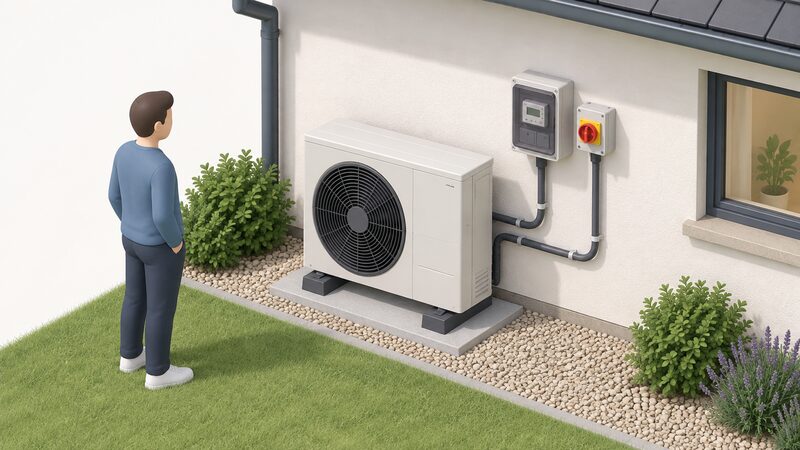
Repaying a grant through the NI NDRHI
The treatment of public grants is set out plainly. An installation fully funded by a public funds grant is not eligible for the Domestic RHI4. Where a grant covered only part of the purchase and installation cost, the grant is deducted from payments and spread evenly over the seven years of accreditation4.
Payments themselves are quarterly for seven years. For most installations they are based on the annual heat demand of the property, taken from its EPC, with two exceptions: solar thermal, where the estimate comes from the MCS certificate, and installations metered for payment8. The annual heat demand figure is the one on the EPC, so the payment is fixed by the property's assessed demand rather than by what the system actually generates, unless the installation is metered.
The scheme's own accounts give a sense of scale. Almost £106.2 million was paid out in Scheme Year 11, the past year of the scheme at the time of that report8. Heat generation in that year was 599 GWh from air source heat pumps, 127 GWh from ground source heat pumps, 34 GWh from biomass and 2 GWh from solar thermal, a total of 763 GWh8. The previous year's total was 811.4 GWh13. Solar thermal has received £18.4 million since scheme launch14.
The Domestic RHI scheme, as well as the audit and compliance programme, is funded by general taxation8. That is the answer to the repayment question in its widest form: money paid under the scheme came from taxation, and money owed back is recovered through the compliance process rather than through an energy supplier.
The NIRHI Guidance Documents, Volumes One and Two

The guidance volumes are the scheme's own reference point. The supporting information for applicants states: "For further guidance, please refer to our NIRHI Guidance Documents, Volumes One and Two."2 The equivalent sentence appears in the GB checklist, referring to the RHI Guidance Documents, Volumes One and Two10.
That parallel is worth noting because it explains a common confusion. Searches for the Northern Ireland scheme often land on GB documents, and the two sets of volumes are named differently. The Northern Ireland set is the NIRHI volumes; the GB set is the RHI volumes. Both are structured in two volumes, and both are named in the applicant-facing documents rather than in the regulations themselves.
The volumes are not the only record. Quarterly reports on the Domestic RHI are published as transparency documents, and the series runs to at least Issue 31, dated 28 February 202215. Earlier issues cover reporting periods from 9 April to 31 July 2014, 1 November 2015 to 31 January 2016, and 1 May to 31 July 201616. Annual reports continue the series, with one covering April 2025 to March 20266. Deployment data for the programme was published as Official Statistics, with a December 2017 release and a January 2021 release9.
For anyone reconstructing a Northern Ireland installation's history, the sequence is: the NIRHI volumes for the rules as they applied, the template pack for the metering report, and the quarterly and annual reports for the payment record.
What remains for a Northern Ireland household
The scheme is closed, and no new application can be made. What a household can still do is understand the rules that governed it, because those rules shaped the equipment installed across Northern Ireland and the metering arrangements that came with it.
Independent advice is available. NI Energy Advice offers independent and impartial energy advice to domestic householders in Northern Ireland, plus referrals to energy grants and other sources of help20. Its advice topics include energy grants and support, heating and energy use, energy bills and fuel poverty support, damp, condensation and ventilation, insulation and home improvements, renewable energy, changing electricity or gas supplier, and heating-oil savings21. Homeowners are advised to seek independent advice on solar panels, heat pumps and other energy efficiency measures from organisations that do not sell or install those measures22.
Other Northern Ireland support sits outside the RHI. The Affordable Warmth Scheme is delivered by the government of Northern Ireland, and its application route runs through the NI Energy Advice Service: if the household meets the entry requirements, an application form is sent out, completed and returned with supporting documents to the local Grant Office23. The Home Heating Oil (Temporary Financial Assistance) Regulations (Northern Ireland) 2026 are filed as new25. The Energy Price Guarantee for domestic energy consumers in Northern Ireland was issued as ministerial directions, with separate scheme documents for domestic gas consumers and domestic electricity consumers26. The Northern Ireland Energy Bills Support Scheme provided a £400 discount on energy bills for households in Northern Ireland28.
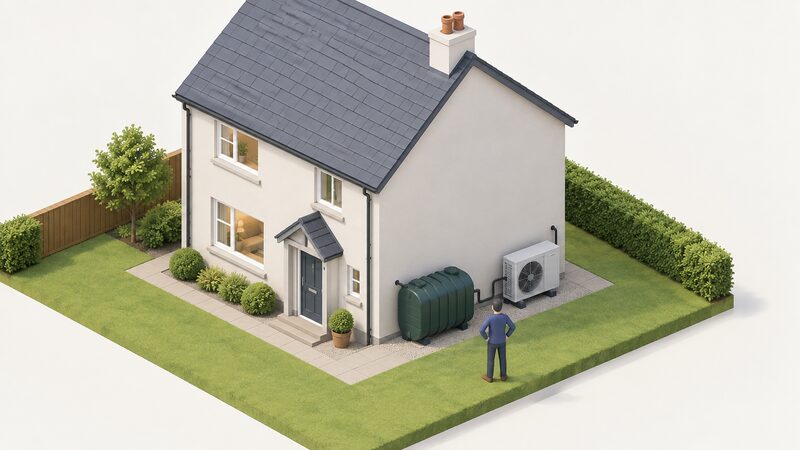
The dependence that remains is the ordinary one: a household heating with oil or gas still buys that fuel from a supplier, and a household with a heat pump still draws electricity from the grid. The RHI reduced the capital cost of renewable heat equipment and paid for its output for seven years. It did not make a home self-sustaining, and it is no longer open.
Sources28 cited
- Northern Ireland Renewable Heat Incentive FAQs, Ofgem, 1 November 2012
- Northern Ireland Renewable Heat Incentive: Summary of Supporting Information for Applicants, Ofgem, 1 November 2012
- Northern Ireland Renewable Heat Incentive: Independent Report on Metering Arrangements Template Pack, Ofgem, 1 November 2012
- Domestic Renewable Heat Incentive: Applicants, Ofgem, 2026
- Domestic Renewable Heat Incentive: Installers and Metering, Ofgem, 17 September 2026
- Domestic Renewable Heat Incentive Annual Report April 2025 to March 2026, Ofgem, 17 July 2026
- Domestic Renewable Heat Incentive, Ofgem, 17 September 2026
- DRHI Annual Report Scheme Year 11, Ofgem, July 2025
- RHI Monthly Deployment Data: January 2021, Department for Energy Security and Net Zero, 18 February 2021
- Checklist of Documents and Information Needed for an RHI Application, Ofgem, 28 November 2011
- Renewable Heat Incentive Guidance Consultation: Volume Two, Ofgem, 24 June 2011
- Domestic Renewable Heat Incentive: Tariffs and Payments, Ofgem, 2026
- DRHI 2023-24 Annual Report, Ofgem, July 2024
- Domestic Renewable Heat Incentive Quarterly Report Issue 36, Ofgem, May 2023
- Domestic Renewable Heat Incentive Quarterly Report Issue 31, Ofgem, 28 February 2022
- Domestic Renewable Heat Incentive Quarterly Report Issue 1, Ofgem, 28 August 2014
- Domestic Renewable Heat Incentive Quarterly Report Issue 7, Ofgem, 25 February 2016
- Domestic Renewable Heat Incentive Quarterly Report Issue 9, Ofgem, 31 August 2016
- RHI Deployment Data: December 2017, Department for Energy Security and Net Zero, 18 January 2018
- Ventilation Systems, nidirect, 17 September 2026
- Heating Technologies to Suit Your Home, nidirect, 17 September 2026
- Support to Generate Your Own Electricity, nidirect, 22 September 2025
- Affordable Warmth Scheme, Northern Ireland Housing Executive, 17 September 2026
- Energy, Northern Ireland Housing Executive, 17 September 2026
- Home Heating Oil (Temporary Financial Assistance) Regulations (Northern Ireland) 2026: Screening, Department for Communities, 3 September 2026
- Energy Price Guarantee Scheme Documents, Department for Energy Security and Net Zero, 31 October 2022
- Energy Price Guarantee for Domestic Gas Consumers in Northern Ireland Direction No.2, Department for Energy Security and Net Zero, 23 June 2023
- Northern Ireland Energy Bills Support Scheme, UK Parliament, 18 October 2022
 Home HeatingWhy do so many homes in Northern Ireland run on heating oil, and will that ever change?
 Community Energy in NICan a community group in Northern Ireland sell power to its neighbours, and is there funding to get a project off the ground?
 Housing Stock Data for NIMost homes in Northern Ireland heat with oil, so why are the grants and help different from the rest of the UK?
 Utility Regulator NIWho sets your energy prices in Northern Ireland and who can you complain to?
 Check Which Energy Grants ApplyWhich energy grants can you actually get right now, and which have closed?
 Closed Energy PoliciesIf a scheme you used has closed, do you still get paid?