

In this guide
Northern Ireland's housing stock stood at 835,988 dwellings as of April 2024, an increase of just under 1% on the 828,829 recorded in 2023, and equal to 432 dwellings per 1,000 population in 2023-241. The figure comes from the Northern Ireland Housing Statistics series, which is published separately from the equivalent dwelling stock estimates for England, Wales and Scotland. That separation is the single most important thing to understand about home energy data in Northern Ireland: the statistics are produced by different bodies, on different cycles, and cannot be read off a Great Britain series.
The energy profile of that stock is distinctive. Roughly two thirds of homes in Northern Ireland rely on oil heating, and approximately 500,000 homes use oil as a primary heating source2. A 2023 building regulations discussion document put reliance on oil at 68% of existing dwellings and 31% of new dwellings3. That dependence shapes everything downstream: the grants available, the advice services, the fuel poverty exposure, and the pace at which low carbon heating can be taken up.
What the Northern Ireland House Condition Survey is and what it covers
The household evidence base for Northern Ireland is built on the Continuous Household Survey, known as the CHS. It is a Northern Ireland wide household survey administered by the Central Survey Unit of the Northern Ireland Statistics and Research Agency, and its coverage is Northern Ireland as a whole7. The heat and insulation results from the 2024-25 run are published through NISRA's data visualisation service, which is where the current figures on heating and insulation in the stock are found7.
Alongside the survey work sits the census. Census 2021 estimates for the number of households in Northern Ireland by the type of central heating are published as a household based dataset, classified by heating type8. That gives a fixed point in time against which the rolling survey data can be compared.
The Decent Homes Standard applicable to Northern Ireland provides the condition benchmark against which dwellings are judged, and a summary table of the current standard was published in August 20259. The standard matters for the data because it defines what counts as a decent home, and therefore what the statistics are measuring when they report on condition.
For a household, the practical value of this material is diagnostic rather than immediate. It establishes what the stock looks like, how it is heated, and where the weaknesses are. It does not tell an individual householder what to do about their own property, and it is not designed to. The survey and census outputs are aggregate: they describe the population of dwellings, not any one dwelling. Where a household wants property specific information, the certificate regime described below is the route, and the two datasets serve different purposes.
Northern Ireland's housing stock: 835,988 dwellings and how they are counted
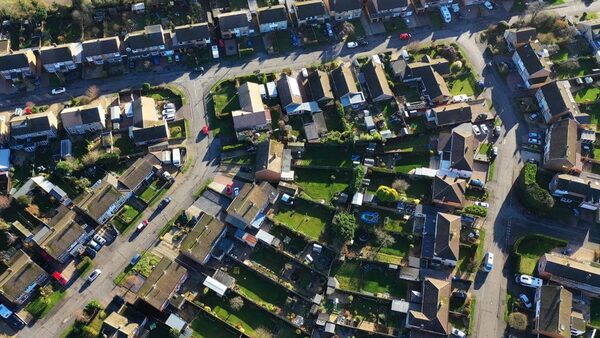
The headline count of 835,988 dwellings at April 2024 is drawn from the Northern Ireland Housing Statistics 2023-24 release1. The same release records 35,464 applicants in housing stress at 31 March 2024, and a Northern Ireland House Price Index standing at 166.8 index points on a Q1 2015 equals 100 basis in the second quarter of 2024, with 5,064 verified residential property sales in that quarter, a decrease of 3.0% on the same quarter of 20231.
Counting dwellings is less straightforward than it sounds, and the quality reporting is explicit about the gaps. Statistics on the breakdown of owner-occupied and privately rented dwellings by local government district are not yet available for Northern Ireland10. That is a real limitation: the tenure split, which matters enormously for energy efficiency policy because private rented stock typically performs worse, cannot currently be resolved below the national level from this source.
| Measure | Figure | Period | Source |
|---|---|---|---|
| Total housing stock | 835,988 dwellings | April 2024 | 1 |
| Previous year stock | 828,829 dwellings | 2023 | 1 |
| Stock per 1,000 population | 432 dwellings | 2023-24 | 1 |
| Applicants in housing stress | 35,464 | 31 March 2024 | 1 |
| NI House Price Index | 166.8 (Q1 2015 = 100) | Q2 2024 | 1 |
| Verified residential sales | 5,064, down 3.0% year on year | Q2 2024 | 1 |
The stock is growing slowly, at just under 1% a year, which means the energy performance of the existing stock dominates any national picture. New build standards affect a small annual addition; retrofit of the existing 835,988 dwellings determines the trajectory. That is why the oil reliance figure of 68% for existing dwellings against 31% for new dwellings matters so much: the new build share is already markedly less oil dependent, but it is a thin slice of the total3.
Energy Performance Certificates in Northern Ireland: what they show and when one is required
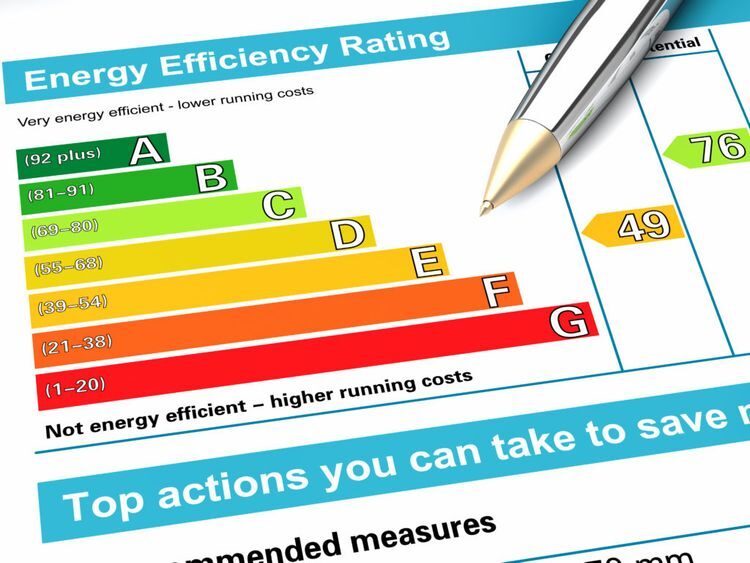
An Energy Performance Certificate provides information about the energy efficiency and emissions of a building, together with information on measures which could be made to improve the energy efficiency of the building and an indicative cost for each improvement11. Buildings are rated on a scale from A to G, with A being the most efficient11.
In Northern Ireland, an EPC is needed whenever a property is built, or marketed for sale or rent4. The certificate must be produced by an accredited energy assessor12. The requirement applies to selling or renting out a property, whether privately or through an agent12.
The legal framework is the Energy Performance of Buildings (Certificates and Inspections) Regulations (Northern Ireland) 2008, which implement Articles 7, 9 and 10 of the Energy Performance of Buildings Directive 2002/91/EC, covering energy performance certificates, inspection of air-conditioning systems and independent experts respectively13. The Regulations were amended in 2009 and again in 201315.
The wider UK picture on EPC reform is moving. Reform proposals include introducing new ratings, redesigning the certificates and improving the operational infrastructure17. Scotland has consulted on EPC reform, and the Scottish consultation describes the Energy Efficiency Rating as providing an A-G band and a numerical 1-100 rating based on the cost to run the dwelling normalised to the floor area, while the Energy Performance Rating displays an A-G rating and 1-100 value based on calculated emissions in kg CO2/m2/year18. Those definitions are Scottish, and Northern Ireland has its own instrument, but they show the direction of travel across the UK.
Validity, the national register and how to find a property's certificate
Each EPC is valid for 10 years and can be used multiple times during that period4. The same 10 year validity is stated in the England and Wales statistical release19 and in the ONS energy efficiency analysis20. A decade of validity means a certificate can serve several transactions, and it also means the rating on file may describe a dwelling as it was assessed years earlier, before any subsequent work.
Part 6 of the 2008 Regulations deals with the register of documents and establishes the duties relating to disclosure of the documents held on the register13. That register is the mechanism by which a certificate is retrieved rather than held only by the party who commissioned it.
The data on certificates is publicly available, and some of the underlying data may be shared with others for the monitoring and compliance of the energy performance of buildings regulations, with government also able to use some data for research or statistical purposes4. That is the basis on which aggregate EPC statistics are produced.
Coverage is the caveat that applies to any certificate dataset. In England, EPCs cover around 60% of the housing stock, and in Wales around 55%, based on Census 2021 analysis by the ONS20. Those figures are for England and Wales and are given here because no equivalent Northern Ireland coverage figure appears in the published material. The lesson transfers: a certificate register describes the dwellings that have been assessed, which is not the same as the whole stock.
District councils as the enforcing authority, and what owners and landlords must do
District councils are the enforcing authority in Northern Ireland4. Regulation 31 imposes a duty on the enforcement authority to enforce the duties relating to certificates and air-conditioning inspections13. A 2009 amendment substituted regulation 31(1) so that the enforcement authority is a district council within its district, except in relation to duties enforceable against a district council, where the Department is the enforcement authority15. The 2008 Regulations as made had set the same split: a district council within its district under regulation 31(1)(a), and the Department under regulation 31(1)(b) for duties enforceable against a district council13.
The building control role is broader than certificates. Every district council shall enforce building regulations in its district, subject to and in accordance with the Building Regulations (Northern Ireland) Order 197921. District councils have sole responsibility for the enforcement of the Building Regulations3. Under Article 13(1) of the 1979 Order, a council must pass plans that are neither defective nor contravening, and reject defective or contravening plans, and under Article 13(3) it must notify the depositor whether it has passed or rejected the plans21. Councils may pass plans by stages in prescribed cases and impose conditions as to depositing further plans under Article 14(1), and may pass defective plans provisionally subject to modifications, or approve compliant plans provisionally subject to prescribed investigations, under Article 14(3)21.
Enforcement does not end at completion. A district council may serve a contravention notice on the owner requiring work to be pulled down, removed or altered to comply with building regulations under Article 18(1) of the 1979 Order21. Under the transitional provisions of regulation 3(2) of the Building Regulations (Northern Ireland) 2012, a district council may serve a contravention notice under Article 18 at any time up to 12 months from the date of completion of the work in question22. A regularisation certificate relating to unauthorised work is evidence, but not conclusive evidence, that the work complies with such of the substantive requirements of the relevant building regulations as are specified in the certificate22.
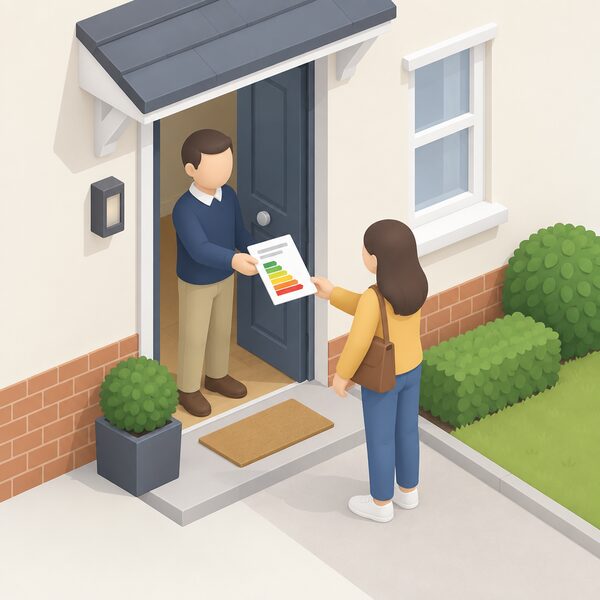
For owners and landlords, the certificate duty is personal. It is the responsibility of the owner or landlord to make sure they have an EPC, to make it available to potential buyers or tenants, and to give a copy to the new owner when selling4. Not having an EPC could lead to enforcement action and the issuing of a penalty charge notice, and regulation 33 empowers the enforcement authority to issue penalty charge notices for any breach4.
How EPC ratings describe the stock: bands A to G and what the data can and cannot tell you
Certificates are banded from A to G, where A, or A+ for non-domestic properties, is the most efficient in terms of lighting, heating and insulation, and G is the least efficient19. Both the energy efficiency and environmental impact ratings are scored on a scale of 1 to 100 and split into bands A to G23.
The England and Wales release gives a sense of what certificate data can show at scale, and it is useful as a benchmark for what a Northern Ireland equivalent would reveal. In the quarter January to March 2026, 460,000 EPCs were lodged in England and Wales, domestic and non-domestic, a 2% decrease compared to the same quarter in 202519. Of these, 416,000 domestic EPCs were lodged in England, a 1% decrease on the same quarter, comprising 368,000 for existing dwellings, a 2% decrease, and 48,000 for new dwellings, a 6% increase19. In the 12 months to March 2026, 1,649,000 domestic EPCs were lodged in England, a 4% increase on the previous 12 months, of which 204,000 were for new dwellings, a 2% increase19.
The rating distribution is where the policy signal sits. In the quarter January to March 2026, 87% of new dwellings in England were given an A or B rating, an increase from 86% in the same quarter a year earlier19. In Wales, 92% of new domestic properties received an energy efficiency rating of A in that quarter19. New build performance is therefore high and improving, while the existing stock, which is the great majority of dwellings, is assessed through a different route.
That route is Reduced Data SAP, which is used to assess existing dwellings24. The distinction between the full Standard Assessment Procedure and its reduced data form is fundamental to reading certificate statistics: the two are not interchangeable, and a comparison between a new build rating and an existing dwelling rating is a comparison between two assessment methods as well as two buildings. The Standard Assessment Procedure is planned to be replaced by the Home Energy Model19.

The Energy Rating of Housing in Northern Ireland statistics and the user engagement survey
The Analytics Division produces the annual Energy Rating of Housing in Northern Ireland publication25. Its status is that of Official Statistics in Development, which is a formal designation indicating that the statistics are still being developed and are not yet fully established25.
A user engagement survey has been run to better understand how the statistics are being used and whether there are any improvements that can be implemented to better meet users' needs25. The survey opened on 10 July 2024 and closes on 12 July 202825. The audiences identified for the publication span academia, business, Department for Communities staff, electricity generators, energy consumers, energy suppliers, government departments, industry, local government, the private sector and research25.
The breadth of that audience list is itself informative. It shows that the energy rating statistics are used by market participants, not only by policy makers: generators and suppliers appear alongside consumers and researchers. That has implications for how the data is maintained and how quickly it is revised.
For a household, the practical significance is that the official rating statistics for Northern Ireland carry a development status rather than the settled status of a long established series. Figures should be read with that in mind, and comparisons over time treated with appropriate caution. The annual frequency means the picture updates once a year, which is slower than the certificate register itself, where lodgements occur continuously.
Home Energy Index and other data sources for NI household energy

Domestic electricity consumption data for Northern Ireland is published by the Department for Energy Security and Net Zero, and Northern Ireland local government district figures are only available from 2015 onwards26. That start date is a hard boundary: any local analysis reaching further back is working with a different geography or a different dataset.
Advice and referral infrastructure is part of the data landscape because it is where the statistics meet households. NI Energy Advice offers independent and impartial energy advice to domestic householders in Northern Ireland, plus referrals to energy grants and other sources of help27. The Consumer Council NI and Northern Ireland Energy Advice give free, independent and impartial energy advice to all domestic householders in Northern Ireland6. The Consumer Council also offers an energy price comparison tool to compare electricity and gas tariffs for all suppliers in Northern Ireland29.
The scale of need is documented. Forty one per cent of households spend more than 10 per cent of their income on their home energy costs6. That is the context in which the stock data, the certificate data and the advice services sit together.
On heating technology specifically, official guidance covers heating technologies suited to a home, low carbon heating, and ventilation systems, and there is a home heating oil support scheme for Northern Ireland residents who may be eligible to apply online30. These pages are the practical counterpart to the aggregate statistics: the statistics describe the stock, and the guidance describes the options within it.
NISEP: the Northern Ireland Sustainable Energy Programme and funding for improvements
The Northern Ireland Sustainable Energy Programme is an £8 million fund collected from both domestic and non-domestic customers5. Energy Saving Trust is the Programme Administrator of NISEP on behalf of the Utility Regulator in Northern Ireland5.
The programme funds various energy saving schemes such as boiler upgrades, LED light bulbs and draught proofing6. The list of schemes for 2024-25 is published by the Utility Regulator34.
The application process is set out in the scheme rules. Identify the scheme you want to apply for, check that you are eligible to receive funding and that it is available in your area, then contact the relevant scheme manager via the telephone number or email address provided34. There is no central application: each scheme is administered separately, and eligibility and availability are scheme specific.
The programme sits alongside the wider grant and support landscape. Energy saving grants vary by area, and there is separate advice for households struggling to pay energy bills27. For a household considering a heating change, the low carbon heating guidance and the heating technologies guidance set out the options, while NISEP and the area based grants determine what support exists30.
What this means for independence is mixed. A household that insulates and upgrades its heating reduces the energy it needs to buy, which is a genuine gain in sovereignty over its own costs. But the funding itself comes from a levy on all customers, the schemes are administered by others, and the household remains connected to a supplier and, for most homes, dependent on delivered oil. The data shows a stock that is unusually exposed to a single delivered fuel, and the programmes described here are the current mechanism for reducing that exposure.
Sources34 cited
- Northern Ireland Housing Statistics 2023-24, NISRA, 2024
- Lyons announces agreement on Home Heating Oil Support, Department for Communities, 2026
- Building Regulations Discussion Document and Pre-Consultation, Department of Finance, 2023
- Energy Performance Certificates, nidirect, 2026
- The Northern Ireland Sustainable Energy Programme, House of Commons Library, 2026
- Cost of Living and Winter Support, Belfast City Council, 2026
- Continuous Household Survey: Heat and Insulation 2024-25, NISRA, 2025
- CT0082 Central Heating, NISRA, 2024
- Current Decent Homes Standard: Summary Table, Department for Communities, 2025
- Dwelling Stock Estimates Quality Report, Welsh Government, 2024
- Energy Performance Certificates Guide, Scottish Government, 2026
- Energy Performance Certificates Leaflet, Building Control Northern Ireland, 2014
- The Energy Performance of Buildings (Certificates and Inspections) Regulations (Northern Ireland) 2008, legislation.gov.uk, 2008
- Energy Performance of Buildings Regulations (Northern Ireland) 2008, Building Control Northern Ireland, 2008
- Energy Performance of Buildings (Certificates and Inspections) (Amendment) Regulations (Northern Ireland) 2009, Building Control Northern Ireland, 2009
- Energy Performance of Buildings (Certificates and Inspections) (Amendment) Regulations (Northern Ireland) 2013, Building Control Northern Ireland, 2013
- Energy Performance of Buildings (Scotland) Regulations 2025 Update, Scottish Government, 2025
- Energy Performance Certificate Reform Consultation, Scottish Government, 2023
- Energy Performance of Buildings Certificates: January to March 2026, England and Wales, Department for Energy Security and Net Zero, 2026
- Energy Efficiency of Housing in England and Wales, Office for National Statistics, 2025
- Building Regulations (Northern Ireland) Order 1979, legislation.gov.uk, 1979
- The Building Regulations (Northern Ireland) 2012, legislation.gov.uk, 2012
- Energy Performance Certificates: A Guide, House of Commons Library, 2026
- National Calculation Method: Product Characteristics Database, NCM PCDB, 2026
- Energy Rating of Housing in Northern Ireland User Engagement Survey, Department for Communities, 2024
- Domestic Electricity Consumption Indicator, Office for National Statistics, 2025
- Energy Saving Grants in Your Area, nidirect, 2026
- Low Carbon Heating, nidirect, 2026
- Advice if You're Struggling to Pay Your Energy Bills, nidirect, 2026
- Heating Technologies to Suit Your Home, nidirect, 2026
- Ventilation Systems, nidirect, 2026
- Home Heating Oil Support, nidirect, 2026
- Energy Performance of Buildings Regulations 2008, Building Control Northern Ireland, 2008
- NISEP 2024-2025 List of Schemes, Utility Regulator, 2024
 Home HeatingWhy do so many homes in Northern Ireland run on heating oil, and will that ever change?
 Housing Stock and EPCsNorthern Ireland's homes score best in the UK for energy efficiency, yet most run on heating oil.
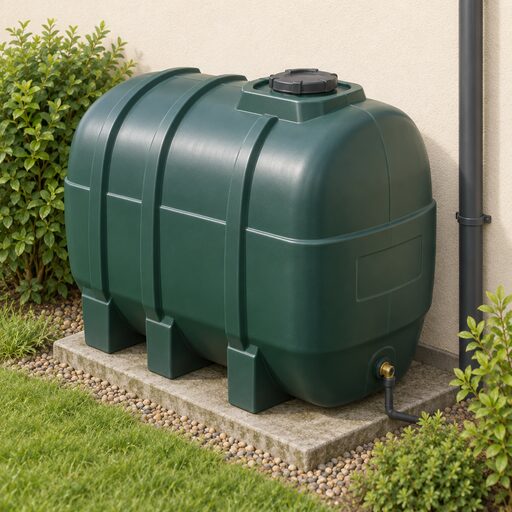 Fuel PovertyWhy does Northern Ireland have such a high rate of fuel poverty, and how many households are affected?
 Housing Stock Data for ScotlandScotland's housing is measured differently from England's, so the numbers you see may not compare directly.
 Housing Stock Data for WalesHow energy efficient are Welsh homes, and how many have a rating?
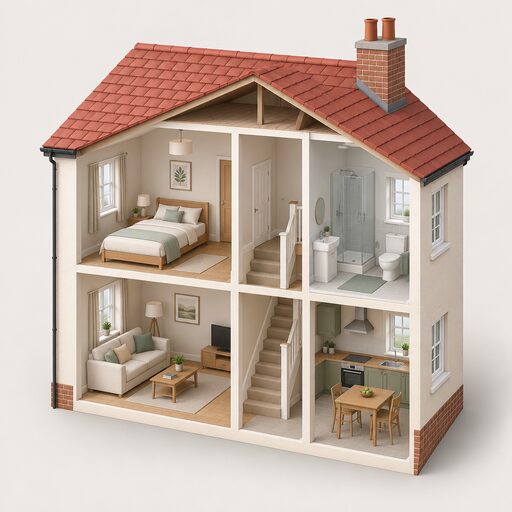 Housing Stock Data for EnglandHow energy efficient are English homes, and how many have insulation or low carbon heating?