
In this guide
Solar thermal is the renewable heat technology that uses the sun's rays to heat water rather than generate electricity, and the statistics that track it are published annually by Solar Heat Europe, the Brussels-based industry association. Its headline figure for the European market is around 2GW of solar heat installed every year, with 1.8 million m² of newly installed collector capacity recorded across Europe in 20231. The association's members sit in more than 15 European countries, and the sector it represents delivers 41GWth of clean energy harnessed from the sun's free energy1.
The numbers matter to a UK household because they set the context for a technology that is small here but substantial on the continent. Solar thermal systems always include a thermal storage unit, and the components are almost 100% recyclable or reusable2. The market is not growing everywhere: sales of solar thermal panels were declining at a rate of over 6% per year in the late 2010s, and the EU water heater market has been declining recently even as the installed base has grown since 20043.
For a household weighing solar thermal against other options, the practical figures are these: a domestic system needs 3 to 4 square metres of southeast to southwest facing roof, covers roughly half of hot water needs on average, and costs around £6,000 to install according to Energy Saving Trust5. The sections below set out what the European statistics record, how the market has scaled, what certification means for subsidy eligibility, and where solar thermal fits in a UK home.
What the European solar thermal market statistics show
The European solar thermal market statistics are compiled from national market data and published by Solar Heat Europe, which describes itself as the voice of the solar thermal sector and acts as Secretariat of the Solar Keymark certification scheme9. The association's annual market report and outlook records newly installed collector area, cumulative installed capacity and the split between market segments. The 2026 edition was published in September 2026 and made available free on the association's website.
The most recent headline figures are these: 1.8 million m² of newly installed capacity of solar thermal collectors across Europe in 2023, and around 2GW of solar heat installed in Europe every year1. The sector delivers 41GWth of clean energy harnessed from the sun's free energy1. Those figures describe a market that is large in absolute terms but not expanding quickly. Sales of solar thermal panels were declining at a rate of over 6% per year as of January 2019, and the EU water heater market, which includes solar systems both sophisticated (multi-valent cylinder) and simple (thermosiphon), has been declining recently even though it increased since 20043.
The manufacturing base is European. Approximately 90% of products in the EU market are of European origin, and the sector supported probably 15,000 installer jobs for products in scope as of January 20192. That domestic supply chain is one reason the statistics are tracked closely by policymakers: the technology is made, installed and maintained within Europe, so spending on it stays largely within the European economy.
For a UK reader, the European figures are a benchmark rather than a description of the home market. The UK's solar thermal sales were recorded at 41 1000 m² in 2014, a small fraction of the European total, against EU sales of 1.7 million m² in 2004 alone4. The gap between the two figures reflects both the size of the continental market and the slower uptake of solar thermal in the UK, where the technology competes with a well-established gas grid.
Growth from 250.000 to over 800.000 kWth a year: how the market has scaled
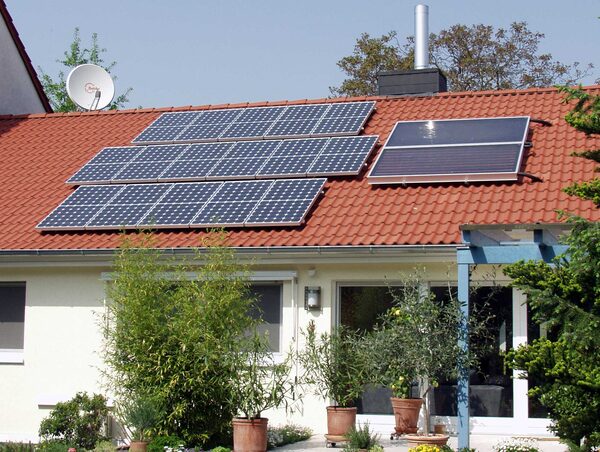
The long-run trend in European solar thermal is one of growth in the installed base alongside a recent slowdown in annual additions. The European market grew quickly from 250.000 kWth to over 800.000 kWth of newly installed capacity per year from the 1990s, a roughly threefold increase in annual installations8. That scaling happened against a backdrop of policy support, rising fossil fuel prices and the broader European push to decarbonise heating.
The pattern is not unique to solar thermal. The European heat pump market grew for a decade, hit a peak in 2022, and since then has come back down to previous levels, according to the European Heat Pump Association's 2025 market report10. The 5% drop from the 2.77 million units sold in 2022 to 2.64 million in 2023 reverses a decade of growth across 16 European markets11. The same report notes that the EU's 60 million heat pump target for 2030 was based on 2015 to 2021 sales growth of 18% every year, a trend that would have delivered 45 million units10. The gap between the trend and the target is the central fact of European renewable heat policy.
Solar thermal's own growth figures are more modest and more contested. The 2023 market reporting recorded 1.8 million m² of newly installed capacity across Europe, and Solar Heat Europe's own material records around 2GW installed annually1. Market growth has been reported at both +70% and +8% in the same year by different independent news sources, and the two figures disagree; both should be treated as reported rather than settled.
What drives the annual figure is a mix of new build, retrofit and replacement. In markets with strong building regulations, solar thermal is specified into new homes; in markets with subsidy schemes, it is retrofitted to existing ones. The UK sits in the second category, where installations depend on grant availability and household choice rather than a regulatory requirement. The European statistics therefore describe a market shaped by policy as much as by sunlight, and the annual additions move with the policy cycle rather than with the weather.
Solar Heat Europe: the industry body behind the numbers
Solar Heat Europe is the industry association that publishes the European solar thermal market statistics and represents the sector to European institutions. It has members in more than 15 European countries, and in June 2024 it coordinated a statement in which EU solar thermal manufacturers urged public authorities for clear policy signals to accelerate renewable-based heat decarbonisation1. The association is also the Secretariat of the Solar Keymark, the certification scheme that underpins quality assurance and subsidy eligibility across Europe9.
The association's role extends beyond publishing figures. It was involved in developing the Solar Keymark alongside CEN, the European Committee for Standardization, with the support of the European Commission12. The mark is owned by CEN/CENELEC and is the main quality label for solar thermal products, widely spread across the European market and beyond12. That combination of market reporting and certification administration gives Solar Heat Europe a central position in how the sector is measured and how its products are recognised.
The wider renewable heat sector in Europe employs a substantial workforce. The European heat pump sector alone provides around 170,000 direct jobs and had over 250 manufacturing sites in Europe as of July 2024, rising to over 300 manufacturing sites by July 202510. Solar thermal's own installer base was estimated at probably 15,000 jobs for products in scope as of January 20193. Those figures are not directly comparable, but they show the relative scale of the two technologies in the European renewable heat workforce.
For a household, the significance of Solar Heat Europe is indirect but real. The association's statistics inform the policy decisions that determine whether subsidy schemes exist, and its administration of the Solar Keymark determines which products qualify for them. A UK household considering solar thermal is therefore affected by a Brussels-based body's work even though the installation itself is a local transaction.
Solar Keymark: certification, quality standards and subsidy eligibility
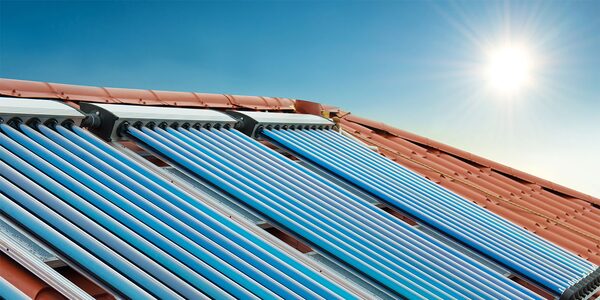
The Solar Keymark is a voluntary third-party certification mark for solar thermal products, owned by CEN/CENELEC and developed by Solar Heat Europe/ESTIF and CEN with the support of the European Commission11. It aims to promote the use of high quality solar thermal products in the European market and beyond, and it is the main quality label for solar thermal products14. Every certified product is in full conformity with the relevant European standards, and the certificate can only be issued by an empowered certification body11.
The mark's practical importance is in subsidy eligibility. It is required by several public authorities as an eligibility criterion for public support schemes, and it is the basis for most European supporting schemes11. It offers a certification scheme that can be used in subsidy schemes, and it provides market surveillance authorities with reliable technical information11. For a household, that means a certified product is more likely to qualify for grant funding, though the specific rules of each scheme still apply.
The certification covers two product families. Solar thermal collectors are certified against the European standard series EN 12975, and factory made solar thermal systems are certified against EN 1297612. Factory made systems according to EN 12976-1 can currently be granted the Solar Keymark11. The distinction matters because a factory made system is tested as a complete unit, whereas a collector is a component that an installer assembles into a system on site.
"The Solar Keymark is a voluntary third-party certification mark for solar thermal products"
In the UK, the mark's role is less direct than in continental markets. Scottish building standards require that solar thermal systems subject to EU standards, including eco-labels and other technical reference systems established by the European standardisation bodies, meet those standards15. That is a building regulation requirement rather than a grant condition, but it points the same way: certified products are the ones that satisfy official criteria. A household checking grant eligibility should confirm the current rules with the scheme administrator, because the mark is a necessary condition in some schemes rather than a sufficient one in all.
Market segments: homes, tertiary buildings, district heating and industry
The European solar thermal market is not one market but four. The 2023 market reporting splits installations into residential buildings, tertiary buildings, district heating, and industrial applications1. Each segment has a different economics, a different collector type and a different policy driver, and the aggregate figures hide substantial variation between them.
Residential buildings are the segment most familiar to UK households. Solar thermal in this segment supplies hot water or space heating, and the most common use for this renewable heat is the supply of hot water or space heating2. A domestic system always includes a thermal storage unit, and it copes with daily and, in some cases, seasonal variations in demand2. The residential segment is where the UK's small solar thermal market sits.
Tertiary buildings cover commercial and public sector premises such as schools, hospitals and offices. The heat and buildings sector as defined by the Carbon Budget framework covers residential, commercial and public sector market segments, and the government's heat and buildings factsheet was published in part to support the launch of the Warm Homes Plan18. The tertiary segment is significant because these buildings have large, predictable hot water demand that solar thermal can serve for much of the year.
District heating and industry are the segments where solar thermal's scale advantage is greatest. District heating equipment supplied water heating solutions to 24 million dwellings in the EU as of 2014, and solar thermal can be used for district heating or industrial process heat2. Solar thermal systems can enable industrial processes up to 150°C, which covers a substantial share of industrial heat demand2. The EU heating and cooling sector's consumption splits 45% residential, 37% industry and 18% services, so industry is the single largest segment by share19.
That split explains why the European statistics look the way they do. A market dominated by residential installations would rise and fall with household subsidy cycles; a market with a substantial industrial and district heating component has a steadier base. The 2023 figures record all four segments, and the industrial and district heating portions are the ones most likely to grow as European policy focuses on decarbonising heat at scale.
What a solar thermal system costs in the UK: £3,000 to £5,000 plus commissioning
Solar thermal panels typically cost around £6,000 to install according to Energy Saving Trust5. That figure is the most recent published UK cost, and it sits above the £3,000 to £5,000 range often quoted for a basic system, because it includes the full installed cost rather than the equipment alone. Prices are installer-quoted, and no published price range beyond the Energy Saving Trust figure is available, so households should expect to obtain quotes rather than rely on a headline number.
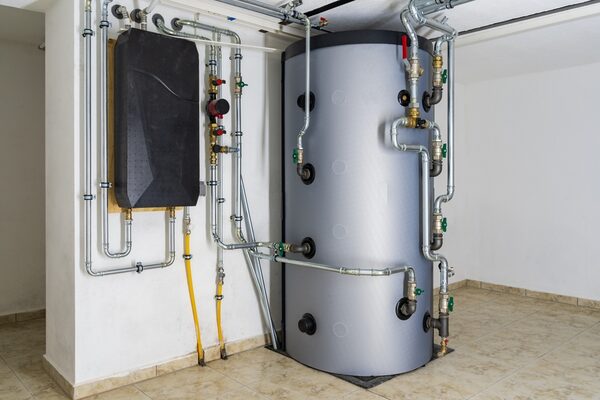
The cost structure explains the figure. A solar thermal system always includes a thermal storage unit, which for a domestic installation means a hot water cylinder or thermal store2. The system also needs a heat transfer system and a hot water cylinder for domestic hot water20. Those components, plus the collectors, the pump, the controls and the labour, make up the installed cost. A household replacing an existing cylinder as part of the installation may face additional cost, and a household with a combi boiler would need to add a cylinder and potentially replace the boiler, which changes the economics substantially7.
| Component | What it does | Source |
|---|---|---|
| Collectors | Capture solar heat on the roof | 6 |
| Heat transfer system | Moves heat from collectors to store | 20 |
| Hot water cylinder or thermal store | Stores heated water | 2 |
| Pump | Circulates the transfer fluid, lasts around 10 years, costs from around £80 to replace | 5 |
The UK cost sits in a different context from the European market figures. The European statistics record capacity in m² and kWth, not in pounds, and the two are not directly convertible without assumptions the sources do not provide. What can be said is that the UK's installed base is small relative to the continent's, and the cost per installation is a household-level figure that the European market reports do not address.
For a household's energy independence, the cost is the entry barrier. A solar thermal system reduces the amount of gas, oil or electricity bought for water heating, but it does not eliminate the backup source, so the household remains connected to a supplier for the remainder. The saving is on the metered bill rather than on the standing charge or the connection itself.
Savings and payback: £60 to £275 a year, and why payback often exceeds 15 years
The savings from solar thermal are modest and the payback period is long. Annual savings have been reported at around £275 and around £160 by different guidance published in June 2026, and the two figures disagree; both should be treated as reported rather than settled. Against an installed cost of around £6,000, even the higher figure implies a payback period well over 15 years before any maintenance or replacement costs5.
The payback picture is complicated by the fact that solar thermal is usually installed alongside another heating system rather than replacing it. Solar thermal systems are usually used alongside a conventional boiler or immersion heater, so the household continues to pay for the backup fuel7. The saving is the difference between what the backup would have cost to heat the water and what it actually costs after solar thermal has pre-heated the cylinder. That difference varies with the household's hot water consumption, the system size and the fuel displaced.
For comparison, Bristol City Council's Warm Homes Plan records that solar panel payback could be in the region of 6 to 12 years21. That figure is for solar photovoltaic panels, which generate electricity and are eligible for export payments, not for solar thermal. The comparison is useful because it shows that the payback case for solar thermal is weaker than for solar PV on the same roof, which is one reason the UK's solar thermal market has remained small.
The Renewable Heat Incentive, the scheme that supported solar thermal installations in the UK, paid £19,156,389 to solar thermal installations, representing 1.8% of the scheme's payments and 98.3% of something the report records as a separate measure22. The scheme is closed, so those payments are historical. A household considering solar thermal now cannot rely on RHI-style support, and the current grant landscape for solar thermal is limited compared with solar PV and heat pumps.
How much hot water a system covers: around 50 to 70% of domestic demand

A solar thermal system covers roughly half of a household's hot water needs on average, with wide seasonal variation. Energy Saving Trust states that solar water heating systems normally provide roughly half of your hot water needs, on average, and that in the summer a system should provide around 90% of your hot water requirements, dropping to around 25% in the winter7. Which? gives the same seasonal figures: about 90% of hot water needs in summer and 25% in winter5.
Official guidance puts the annual figure slightly higher. Hart District Council's technical advice note records that solar thermal equipment can generate between 55% and 70% of a home's hot water requirements, reducing a home's carbon footprint23. The difference between the two figures is a matter of system size, household consumption and how the annual average is calculated. The 55% to 70% range is the official planning guidance figure; the roughly half figure is the consumer guidance figure. Both are consistent with the seasonal pattern of 90% in summer and 25% in winter.
| Period | Share of hot water needs met | Source |
|---|---|---|
| Summer | around 90% | 5 |
| Winter | around 25% | 5 |
| Annual average | roughly half | 7 |
| Annual range, official guidance | 55% to 70% | 23 |
The seasonal pattern is the key fact for a household. A solar thermal system is at its most productive when hot water demand is lowest and at its least productive when demand is highest, which is why it cannot stand alone. The cylinder stores summer heat for evening use, but it cannot store it across seasons at domestic scale. Solar Heat Europe notes that solar thermal systems cope with daily and, in some cases, seasonal variations, but domestic systems are designed for daily storage rather than interseasonal storage2.
For energy independence, the coverage figure is the honest measure of what solar thermal delivers. A household that meets roughly half its hot water needs from the sun still buys the other half, and in winter it buys most of it. The technology reduces dependence on a supplier rather than removing it, and the reduction is largest in the months when the household's overall energy bill is lowest.
Where solar thermal fits: backup sources, cylinders and roof suitability
Solar thermal fits into a home heating system as a pre-heat for a cylinder, not as a standalone heat source. Solar water heating uses energy from the sun to heat water for the home through roof-mounted collectors, and the heated water is stored in a hot water cylinder or thermal store7. For domestic hot water, the system needs a heat transfer system and a hot water cylinder20. That cylinder is the interface between the solar system and the rest of the heating.
Roof suitability is the first practical constraint. A domestic system needs 3 to 4 square metres of southeast to southwest facing roof receiving direct sunlight for the main part of the day6. Collectors work best on a south-facing roof, or somewhere between east and west but not north facing7. Welsh Government guidance states that collectors can be used for a building with a roof or wall that faces within 90 degrees of south, and that for best performance they should face between southeast and southwest and be clear of the shade of trees and buildings24. Which? records that panels need a south-facing roof at a 30-degree angle to the horizontal, with up to 65 degrees still workable in the UK5.
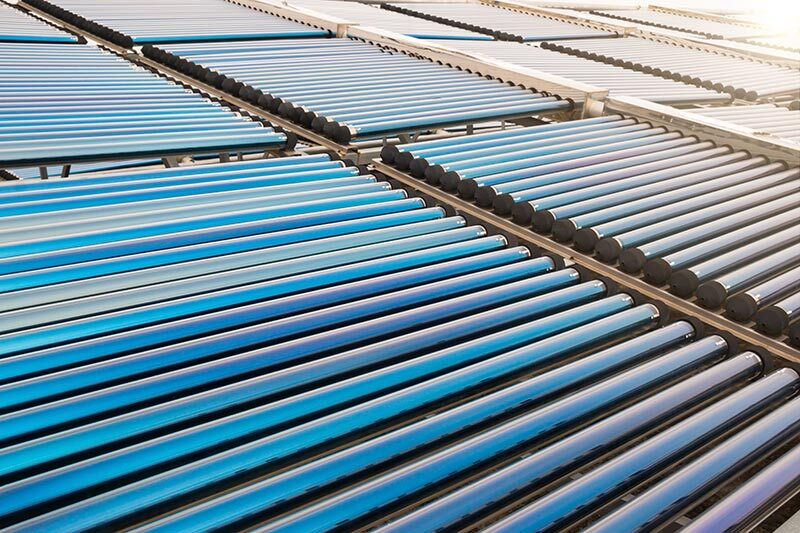
The roof area requirement is smaller than for solar photovoltaic panels. A 3.5kWp solar PV system typically covers between 10 and 20 square metres of roof surface, against 3 to 4 square metres for a solar thermal system6. That difference means a household with limited roof space may find solar thermal easier to accommodate, though the two technologies can also be combined on the same roof.
Planning rules vary by nation and by building. In England, solar thermal is generally permitted development, but listed buildings and conservation areas have additional requirements; Bristol City Council's Clifton Local Listed Building Consent Order guidance sets out how listed building consent applies in that area27. Scottish building standards require solar thermal systems subject to EU standards to meet those standards15. Northern Ireland's guidance on solar thermal panels is published by nidirect28. A household in a listed building or a conservation area should check the position with the local planning authority before proceeding.
Why solar thermal is best combined with gas, oil or another backup heat source
Solar thermal is a complementary technology, not a replacement one, and the sources are consistent on this point. Because the amount of solar energy varies throughout the year, solar thermal systems are usually used alongside a conventional boiler or immersion heater7. The backup source provides hot water when the solar system cannot, which in a UK winter is most of the time.
The compatibility of the backup source matters. Solar thermal panels can be installed alongside other renewable or traditional heating systems, though they are not so easy to combine with a combi boiler29. Few combi boiler models are compatible with solar thermal systems, because combis are not designed to heat water in a cylinder8. A household with a combi would likely need to add a solar hot water cylinder and replace the boiler with a conventional boiler or a heat pump7. That is a significant additional cost and disruption, and it is the main reason solar thermal is a harder proposition for homes with modern combi installations.
Where the backup is a conventional boiler, an immersion heater or a heat pump, the integration is more straightforward. Solar thermal can be coupled with an existing gas boiler, and it can also be coupled with a heat pump2. The heat pump combination is particularly relevant to households planning a low-carbon retrofit, because the cylinder required for solar thermal is also required for a heat pump system. A household that installs a cylinder for solar thermal has taken a step towards heat pump readiness.
For energy independence, the backup requirement is the central limitation. A solar thermal system reduces the amount of gas, oil or electricity a household buys, but it does not remove the connection to a supplier or the need for a backup heat source. The household remains dependent on the grid, the gas network or a delivered fuel, and the solar system's contribution is largest when that dependence is least costly. The technology is a partial hedge against fuel prices rather than a route to self-sufficiency, and the European market statistics describe a continent where that partial hedge is installed at scale.
Sources29 cited
- EU solar thermal manufacturers urge public authorities for clear policy signals, Solar Heat Europe, 2024-06-28
- Solar thermal article, E-magazine final revision, Solar Heat Europe
- Water heater task 2 draft final report, Solar Heat Europe, 2019-01
- Boiler task 2 draft final report, Solar Heat Europe, 2019-01
- Solar water heating with solar thermal panels, Which?
- Solar thermal water heating, Planning Portal
- Solar water heating advice, Energy Saving Trust
- Could solar water heating work for you, Energy Saving Trust
- Solar Keymark network, Solar Heat Europe
- EHPA market report 2025 executive summary, European Heat Pump Association, 2025-07
- Solar Keymark for public authorities, Solar Keymark
- The origin and composition of the Solar Keymark, Solar Keymark
- EU could end up 15 million heat pumps short of 2030 ambition, European Heat Pump Association, 2024-07-18
- Solar Keymark for consumers, Solar Keymark
- Building standards technical handbook 2022: domestic, energy, Scottish Government, 2022-06-01
- Building standards technical handbook 2019: domestic, energy, Scottish Government, 2019-09-17
- Building standards technical handbook 2020: domestic, energy, Scottish Government, 2020-12-02
- Carbon Budget and Growth Delivery Plan: heat and buildings factsheet, Department for Energy Security and Net Zero, 2026-06-23
- Europe's struggle to switch on low carbon heating, Carbon Brief, 2016-02-16
- Solar thermal panels, nidirect
- Bristol Warm Homes Plan, Bristol City Council, 2025-04
- Domestic Renewable Heat Incentive annual report 2023-24, Ofgem, 2024-07
- Solar equipment on residential buildings technical advice note, Hart District Council, 2025-01
- Generating your own energy: solar water, Welsh Government
- Generating your own energy: solar electricity, Welsh Government
- Solar panels energy improvement options, London Borough of Hammersmith and Fulham
- Clifton local listed building consent order guidance, Bristol City Council
- Sustainable home energy solutions, Planning Portal, 2024-09-02
- Heating your home with renewable energy, Which?
 Paid and Restricted Energy DataWhere can you actually read the numbers behind a news story about heat pumps or solar?
 European Heat Pump MarketEuropean heat pump sales data from the European Heat Pump Association and the IEA Heat Pump Centre, covering sales per thousand households, country rankings, the 2024 downturn and how the UK compares.
 Solar PV Deployment StatisticsHow much solar power does the UK actually have, and how much of it sits on people's roofs?
 Installation Cost TrendsTracks the published median and average installed costs of domestic solar, heat pumps and batteries and how they have moved.
 UK Cooling DemandPublished data on air conditioning ownership and home overheating, with projections for summer temperatures in each UK nation, and what rising cooling demand means for summer electricity use.
 The Full Statistics GuideHow many homes in the UK have solar panels, heat pumps or batteries?