

In this guide
The Microgeneration Certification Scheme (MCS) is the closest thing the UK has to a running count of small-scale renewable energy systems installed in homes. More than 2.2 million MCS certified installations have been recorded, delivered by close to 6,000 certified installers1. The pace has accelerated sharply: there were 210,000 certified installations in the UK between January and June 2026, including 36,000 battery storage systems2, and 207,619 certified installations had been recorded in the year to mid-September 20263.
The monthly series shows the same picture. March 2026 was the highest single month ever recorded, at 28,861 certified installations, with July and June following at 28,489 and 28,2003. MCS was tracking 2026 as the sixth consecutive record-breaking year for certified installations4.
What the numbers do not show matters as much as what they do. MCS is a certification scheme for microgeneration installation companies and products5, and its data only encompasses MCS certified installations6. A system fitted by an uncertified firm, a self-installed array, or a heat pump above the size threshold leaves no trace in these figures. The totals are therefore a measure of the certified market, not of all renewable generation in UK homes.
What the statistics count: technologies and size limits
MCS certifies low-carbon products and installations used to produce electricity and heat from renewable sources, and describes itself as the UK's quality mark for renewable energy systems such as solar panels and heat pumps10. Government scheme guidance describes MCS as the leading quality assurance organisation for microgeneration, defined as small-scale renewable technologies of 50kW or smaller9. For product certification the categories are solar PV, solar mounting, small wind turbines, heat pumps, biomass, solar heating and micro combined heat and power, with a 50kW limit for electrical technologies11. Ofgem's feed-in tariff statistics likewise point to the MCS database for numbers of solar photovoltaic, wind and micro CHP installations12.
Two exclusions shape the totals. Official heat pump deployment statistics state that installations not covered by MCS include heat pumps with a thermal output larger than 45kW and the majority of installations in new-build properties13. MCS began collecting new-build solar data in October 2023, and by November 2025 reported 139,425 certified solar PV installations on new builds, 32% of total solar installations over that period7. New build accounted for 28% of all certified installations in 202514.
The underlying record is an installation certificate. Installation data is taken from the certificates raised by MCS certified installers for each specific system they have delivered6. That is a strength, in that each row corresponds to a commissioned job, and a weakness, in that the dataset stops at the boundary of the certified market.
Over 2.2 million certified installations, and how fast the total is moving
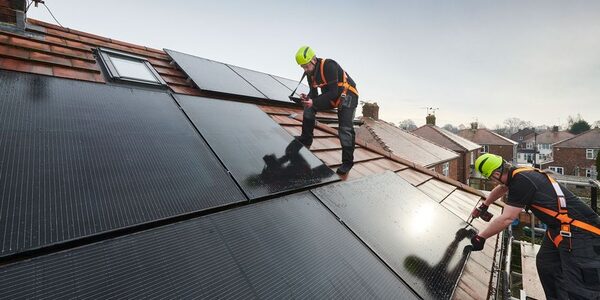
The cumulative figure has moved quickly. In December 2023 MCS reported that more than 1.7 million certified systems had gone into UK homes since it began recording installations16. By late 2025 the total stood at more than 2.2 million, delivered by close to 6,000 certified installers1. That is a difference of roughly half a million certified systems between the two published totals of 1.7 million and 2.2 million, in around two years.
The recent annual pattern is one of consecutive records: 2024 was described as a record year for small-scale renewables8, 2025 saw record numbers of MCS certified installations14, and 2026 was tracking to be the sixth consecutive record-breaking year4. The half-year figure of 210,000 installations between January and June 20262 is the clearest single indicator of current run-rate.
| Period | Certified installations | Source type |
|---|---|---|
| Since recording began, to December 2023 | more than 1.7 million16 | MCS |
| Cumulative, to October 2025 | more than 2.2 million1 | MCS |
| January to June 2026 | 210,0002 | MCS |
| Single month, March 2026 | 28,8613 | trade body |
| Single month, July 2026 | 28,4893 | trade body |
| Single month, June 2026 | 28,2003 | trade body |
For anyone comparing these with other datasets, the counting basis differs: cumulative MCS totals count installations since 2009, while government heat pump deployment series count government-supported installations in a period. The heat pump installation statistics and solar PV deployment statistics pages set out those alternative series.
Growth of more than 500% across one leadership era
MCS reported in July 2026 that annual certified installations had increased by more than 500% under Ian Rippin's leadership as chief executive, with nearly 6,000 MCS certified businesses then delivering installations across the UK4. The certified contractor base has grown alongside the installation count: in March 2025 MCS recorded over 5,250 certified contractors, the highest since the scheme began in 200817.
That growth is not evenly spread across technologies. The 2024 record year combined almost 60,000 certified heat pump installations with nearly 20,000 certified battery storage installations8. By 2026 battery volumes alone had reached 36,000 in six months2. Solar has grown from a large base, while battery storage has grown from a small one, so percentage changes for the two are not comparable measures of market weight.

Growth in certified businesses matters for households because certification capacity limits how quickly grant-eligible work can be done. It also means the dataset itself becomes more complete over time, which is one reason published figures get revised.
Heat pumps: almost 60,000 certified in 2024, against a 600,000 target
Heat pumps saw a record rise in 2024, with almost 60,000 certified installations8. Official statistics for the year ending September 2024 recorded a 46% increase in the number of government-supported heat pumps installed compared with the previous 12 months18. Scotland's heat in buildings progress reporting put MCS annual domestic heat pump installations at 7,355 for 202419.
Set against policy, the gap remains wide. The British Energy Security Strategy set an ambition of 600,000 heat pump installations per year by 202820, and a 2025 parliamentary committee report noted the Climate Change Committee's finding that current installation rates are around one tenth of that21. Workforce analysis from the Heat Pump Association put the trained and active installer base at 31,261 against 42,152 trained installers needed to deliver 600,000 annual installations by 202822.
| Measure | Figure | Period |
|---|---|---|
| Certified heat pump installations, UK | almost 60,0008 | 2024 |
| MCS annual heat pump installations, Scotland | 7,35519 | 2024 |
| Government-supported heat pumps, year on year change | 46% increase18 | year ending September 2024 |
| Annual deployment ambition | 600,000 per year20 | by 2028 |
| Trained and active installers | 31,261, against 42,152 needed22 | 2026 |
For a household, the practical read is that certified heat pump capacity exists but is thin relative to ambition, and that grant routes such as the Boiler Upgrade Scheme depend on finding a certified firm locally. The Boiler Upgrade Scheme statistics page covers voucher volumes separately.
Battery storage: installations nearly double year on year
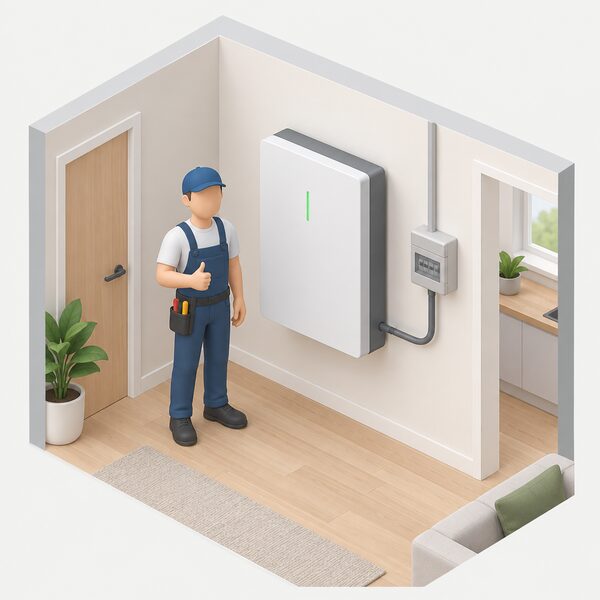
Battery storage is the fastest-moving category in the MCS series. MCS reported 36,000 certified battery installations in the first six months of 2026, almost double the same period the previous year23. In that half-year, the previous annual record of 40,000 installations had almost been surpassed in six months2. By the end of September 2025, certified battery storage installations had increased by 122% on the equivalent period, reaching 59,000 installations7. January 2025 was itself a record month, exceeding 2,600 installations, a 176% increase compared with January 202417.
Battery storage had already become the third most popular technology type installed across the MCS certified contractor base by December 202316.
The government publishes a separate series, MCS certified domestic battery installation statistics, first released on 29 May 202524 and updated on 28 May 202625. It draws on the MCS database, covers the United Kingdom, and includes domestic and existing installations only: commercial and new-build data is not included. The cost value attached to each installation includes the cost of the battery, the cost of installing and connecting it to the electricity supply, and VAT where applicable25. More detail sits on the home battery installation statistics page.
Solar PV, solar thermal and the remaining certified technologies
Solar dominates the certified total. By the end of September 2025 there had been 1.85 million certified solar panel installations to date7. In the first six months of 2026 there were almost 150,000 solar panel certified installations, up 17% on the previous highest start to a year in 202523, and 207,619 certified installations in total had been recorded in the year to mid-September 20263.
The other certified technologies are far smaller but still counted. Product certification is available for solar PV, solar mounting, small wind turbines, heat pumps, biomass, solar heating and micro CHP11. Ofgem's feed-in tariff reporting refers readers to the MCS database for solar photovoltaic, wind and micro CHP counts12, a legacy of the closed scheme covered on the feed-in tariff installation statistics page.
Procurement documents show how the standards are used in practice: a Welsh social landlord specification required that solar PV systems be installed and certified only by MCS certified contractors working to the latest published MIS3002 standards26. That is how certification propagates beyond grant schemes into social housing and contract terms.
The regional picture: 128 certified contractors in Wales, 11 in Northern Ireland
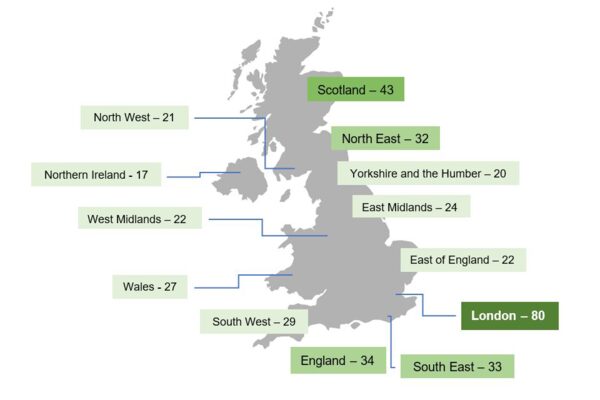
Certified capacity is unevenly distributed across the four nations. Energy Saving Trust reporting on Northern Ireland's fuel poverty strategy noted only 11 MCS certified contractors in Northern Ireland, compared with 128 in Wales27. Which? analysis of certified insulation installers found a median of 14 certified installers per 100,000 people in Wales, one firm per 2,747 households, against 1 per 100,000 in Northern Ireland, one firm per 38,461 households28.
Deployment figures follow. In the second quarter of 2025, government-supported heat pump installations numbered 1,493 in Wales and 0 in Northern Ireland, and over the year ending June 2025 Wales accounted for 13% of government-supported installations29. The principal reason is that grant support differs by nation: the Boiler Upgrade Scheme runs in England and Wales, and Northern Ireland has no equivalent counted in that series.
| Nation | Certified contractors | Government-supported heat pump installations, 2025 Q2 |
|---|---|---|
| Wales | 12827 | 1,49329 |
| Northern Ireland | 1127 | 029 |
For households in Northern Ireland, the consequence is concrete: a thin certified installer base restricts choice, competition and lead times, and can put grant-linked work out of reach entirely. The renewable installations in Northern Ireland and heat pumps in Wales pages go further into each nation.
Where the numbers are published: the MCS Data Dashboard
MCS installation and contractor data is freely available for everyone to view and use on the MCS Data Dashboard30. Launched in 2022, it is an interactive tool providing near-real-time updates on MCS certified installations for small-scale renewables across the UK, divided into two sections, Installation Insights and Scheme Insights30. It draws its data from the MCS Installations Database31 and provides a dynamic view of every certified installation since 200910. Phase 3 added total installers by technology to the Technology Type Breakdown graphic31.
MCS describes itself as the go-to source for data on the uptake of renewables in the UK, with industry data used to track growth. Alongside the dashboard, MCS operates a data requests route for more detailed extracts6. A separate route into the same underlying data is the government battery statistics release, whose annual summary table includes only financial years from 2024/25, because of the small number of certified installations before that25.
The MCS Data Dashboard page describes the tool in more depth, and MCS data by local authority covers the geographic breakdowns. General guidance on provisional figures and revisions sits on the reading energy statistics page.
Certification, complaints and what protection actually covers
MCS sets and maintains technical standards for installations and products, certifies installers and products against those standards, issues MCS certificates for completed eligible installations, and assists certification bodies in reviewing consumer cases relating to installers or products5. A requirement of companies seeking MCS certification is membership of a Chartered Trading Standards Institute approved consumer code of practice scheme in the first instance32.
MCS is the single point of contact for complaints about certified installers or installations, after the issue has first been raised with the installer33. It will consider complaints on system performance and design, quality of work, incomplete or delayed installation, commissioning and handover, installer conduct, damage to property, mis-selling, contractual issues, product issues and breaches of the customer commitment33. Installers must acknowledge a complaint within two working days and signpost customers to the MCS complaints process if they are unhappy with the outcome34. Complaints can be sent to mcscomplaints@mcscertified.com35, and MCS publishes the telephone number 0333 103 813036.
Time limits differ between sources. Ofgem states that for MCS certified installations a complaint must be raised no more than two years after the date the system was commissioned37. MCS states that it will not take a complaint where the installation was completed over six years ago, five years in Scotland, citing consumer protection requirements33. Both limits are published, and they do not match.
Where an installer is no longer certified or no longer trading, MCS says it can still review the complaint and set out the options33. Under the redeveloped installer scheme, now live and rolling out across the installer base, MCS states that consumers benefit from improved financial protections "guaranteeing remediation even if an installer goes out of business or refuses to carry out work"38. Every installer must operate under the new rules by 31 March 2027.
"MCS does not require remediation of systems that are underperforming relative to their design."
Certification and access to grants
Ofgem states that to be eligible for the Boiler Upgrade Scheme, installers must be MCS certified and meet the MCS standards39. All installations under the scheme must be delivered by an MCS installer, using MCS certified products, installed to MCS standards40. Independent guidance notes that MCS certification is required for installations under the Boiler Upgrade Scheme and the Home Energy Scotland grant, and that for those grants the installer must be from an MCS certified business41. That link between certification and public money is a large part of why the dataset grows in step with grant schemes, and why a nation without an equivalent grant scheme shows far fewer certified installations.
What the statistics mean for a household seeking independence

Certified installation figures are a useful proxy for how far UK homes have moved towards generating and storing their own energy, but they measure market activity rather than achieved independence. A record 210,000 certified installations in six months2 tells you how many systems were commissioned, not how much grid electricity or gas those homes still buy.
Several dependencies remain visible in the data itself. Grant eligibility ties much of the heat pump market to MCS certification and to schemes run by Ofgem, so a household's route to a subsidised system runs through a certified business39. The certified contractor base is geographically uneven, from 128 firms in Wales to 11 in Northern Ireland27. Certification is a design-stage assurance rather than a performance guarantee15, so the running efficiency of a system remains a matter for the household and the installer. And the numbers themselves are revisable: MCS figures may change as more complete data reaches the database25.
What the data does support is a clear reading of direction. Battery storage almost doubling year on year23, solar approaching 150,000 installations in a half-year23 and heat pumps at record certified volumes8 all point to more households combining generation and storage. MCS states that its redeveloped scheme is intended to give households considering these technologies "the confidence they need to make the move"38. Whether that translates into lower bills or genuine resilience depends on the individual system, not on the certificate. The wider context sits on the UK home energy statistics pillar and on what the data says about household energy independence.
Sources41 cited
- MCS responds to consultation outcome on certification requirements for clean heat schemes, MCS, 2025-10-31
- Record number of UK households combining renewables, MCS, 2026-08-20
- 2026 set for record solar power take-up, Solar Energy UK, 2026-09-14
- Ian Rippin to step down as MCS CEO, MCS, 2026-07-07
- Boiler Upgrade Scheme, Ofgem, 2026-09-17
- MCS data requests, MCS, 2026-04-20
- UK rooftop solar installations hit record high, MCS, 2025-11-13
- 2024 was a record year for small-scale renewables, MCS, 2025
- Warm Homes Social Housing Fund wave 3 scheme guidance addendum, GOV.UK, 2026-06
- MCS for consumers, MCS, 2026-06-23
- Certifying your product, MCS, 2026-05-18
- Feed-in tariffs quarterly statistics, Ofgem, 2026-09-17
- Heat pump deployment tables, Q2 2026, GOV.UK, 2026-09-10
- The Future Homes Standard: a landmark moment, MCS, 2025
- Report on the heat pump transition, GOV.UK, 2026-05
- UK sees the best year ever for renewable energy and heating installation, MCS, 2023-12-13
- MCS hits record number of certified contractors, MCS, 2025-03-05
- Heat pump deployment quarterly statistics, UK 2024 Q3, GOV.UK, 2024
- Heat in Buildings progress report 2025, Scottish Government, 2025
- British Energy Security Strategy, UK Parliament, 2022
- Energy Security and Net Zero Committee report, UK Parliament, 2025-05-09
- Projecting the future domestic heat pump workforce, Heat Pump Association, 2026-03
- Households can save as plug-in solar panels come to market, GOV.UK, 2026
- MCS certified domestic battery installation statistics, GOV.UK, 2025-05-29
- MCS domestic retrofit battery installations 2025 to 2026, GOV.UK, 2026-05-28
- Solar panel installation scheme specification, Sell2Wales, 2026-06-15
- Northern Ireland fuel poverty strategy report, Energy Saving Trust, 2025-07-03
- Priority places for insulation index, Which?, 2023-11-15
- Heat pump deployment quarterly statistics, UK 2025 Q2, GOV.UK, 2025
- MCS Data Dashboard, MCS, 2026-05-21
- Phase 3 of MCS Data Dashboard launches, MCS, 2026-08-24
- Renewable Energy Consumer Code, Chartered Trading Standards Institute, 2026-09-20
- Consumer complaints, MCS, 2026-09-07
- Complaints handling for installers, MCS, 2026-05-13
- Whistleblowing, MCS, 2026-05-13
- Boiler Upgrade Scheme guidance for property owners, Ofgem, 2026-03-25
- Who to contact, domestic RHI, Ofgem, 2026-09-17
- Ian Rippin comments on the future of consumer protection, MCS, 2026-06-22
- Boiler Upgrade Scheme eligibility, Ofgem, 2026-09-17
- MCS outreach reveals high satisfaction rates for Boiler Upgrade Scheme installations, MCS, 2026-02-02
- How can I find a trustworthy installer, Nesta, 2025-01-21
 MCS Data by Local AuthorityHow many solar panels, heat pumps or batteries have gone into homes in your council area?
 Home Battery Install StatisticsHow many homes in the UK actually have a battery, and is that number growing quickly?
 Heat Pump Install StatisticsHow many heat pumps are actually being fitted in the UK each year, and is that number going up?
 MCS ExplainedMCS is the quality mark for solar panels, heat pumps and other home renewables.
 Solar PV Deployment StatisticsHow much solar power does the UK actually have, and how much of it sits on people's roofs?
 MCS CertificationWhy do so many installers and tariff schemes ask about MCS certification when you get solar panels?