

In this guide
Every home energy rating in the UK rests on a calculation, not a measurement. The Standard Assessment Procedure (SAP) is the methodology the government currently uses to estimate the energy performance of homes, and it produces the content of the domestic Energy Performance Certificate1. For existing dwellings, assessors use the reduced form, RdSAP, because the full dataset a SAP calculation needs is not available from a site visit3.
The consequence matters for any household trying to judge its own energy independence. An EPC describes the building, not the people in it. Standard assumptions are made about occupancy and use so that different buildings can be fairly compared, and the assessment reflects the energy performance of the building itself, not the way it is used by its occupants5. That is what makes two certificates comparable, and it is also why a rating can sit some distance from a metered bill.
The methodology is also moving. SAP version 10.3 is the approved version for new dwellings in England from 24 March 2026, updated from version 10.26. The Home Energy Model is planned to replace SAP, with a 2027 date given in the EPC statistical release7. Scotland has said EPCs there will be generated using the Home Energy Model, replacing SAP in autumn 20268.
What SAP is: the standard assessment behind every home energy rating
SAP stands for the Standard Assessment Procedure for Energy Rating of Dwellings. It is the methodology currently used by the government to estimate the energy performance of homes, and it supports the production of EPCs as well as the Green Deal and Energy Companies Obligation schemes1. It is not a consumer tool or a supplier's estimate. It is the government's calculation, and it is the reason two homes of the same size and shape can be ranked against each other at all.
The procedure produces the content of the domestic EPC, and it is the calculation that sits behind the energy efficiency rating a buyer or tenant sees on the certificate2. Because it is a standard method, it can be applied to a dwelling that has never been occupied, to one that has just changed hands, and to one being assessed for a grant or an obligation scheme, and produce figures that can be set side by side.
SAP is also the reference point for compliance work. Approved Document L Volume 1 for dwellings names the Home Energy Model and the government's Standard Assessment Procedure for the Energy Rating of Dwellings as approved calculation methodologies under Regulation 2411. The same methodology family underpins the economic feasibility tests used in scheme design, where an annual energy saving is estimated using the latest version of SAP12.
For a household, the practical point is that the rating is a modelled output from a fixed set of inputs. It is not a prediction of a particular family's consumption, and it is not a meter reading. It is a comparable statement about the dwelling's fabric, services and fuel, calculated to a national method. That is what makes it useful to a lender, a landlord, a scheme administrator or a policy analyst, and it is also the source of the gap between the certificate and the bill.
RdSAP: the reduced version used for existing homes
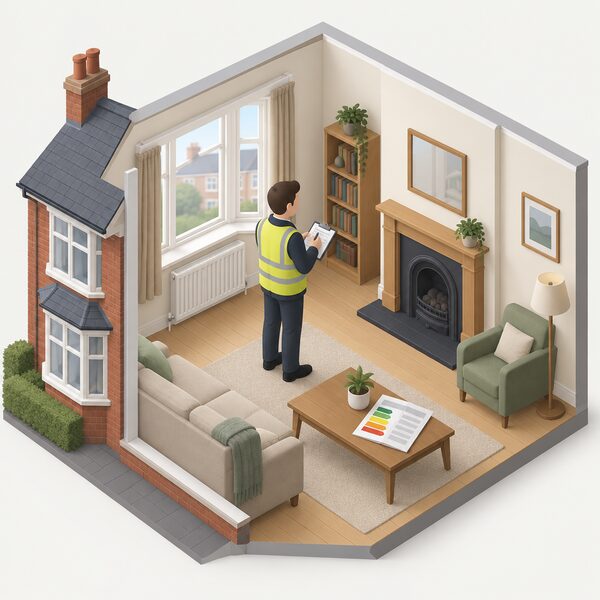
RdSAP is the Reduced Standard Assessment Procedure, and it exists because most existing homes cannot be assessed to the full SAP standard. For existing domestic buildings, the assessor usually does not have access to the full dataset required to undertake a full SAP calculation, so RdSAP sets out procedures to collect and infer data, including the use of default values4. EPCs for existing dwellings are produced using this simplified implementation of the SAP methodology, based on a site survey5.
The distinction is not cosmetic. A full SAP calculation for a new dwelling works from design drawings, specifications and product data. An assessor standing in a 1930s semi has none of that. RdSAP therefore provides a structured way to infer what cannot be seen, and default values stand in where evidence is missing. The result is a rating that is comparable across the stock but built partly on assumption.
RdSAP is also the version that scheme rules reference. The Warm Homes: Local Grant policy guidance states that any energy performance or heating measures compatible with the latest Reduced data Standard Assessment Procedure are eligible, with fossil fuel heating not eligible13. That makes the RdSAP version in force a practical matter for households applying for support, not just a technical footnote.
The version history shows in the data. Scottish House Condition Survey figures for 2024 give a mean SAP 2012 (RdSAP v9.93) rating of 69.5 for dwellings in urban areas, with 60% in band C or above, and a lower figure for rural areas14. The same survey reports mean SAP 2012 ratings ranging from 65.8 in dwellings owned outright to 73.5 in housing association dwellings14. Those are modelled ratings from a specific RdSAP version, and they are not directly comparable with ratings produced under a later version.
The rating scale: 1 to 100, bands A to G, and why scores can exceed 100
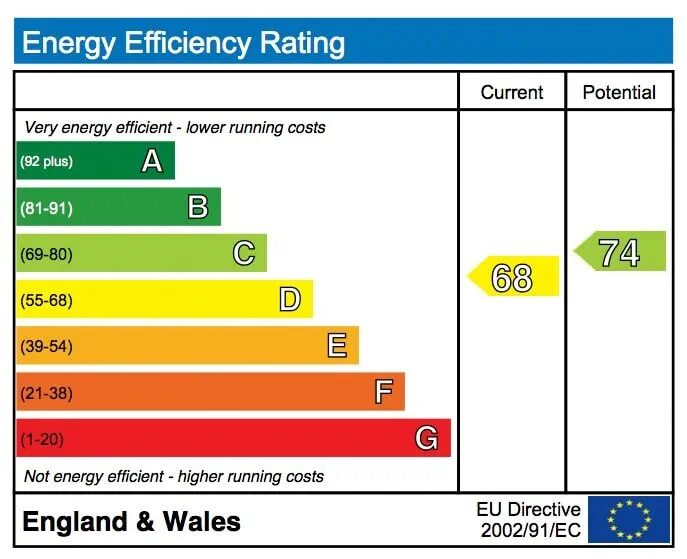
Both the energy efficiency rating and the environmental impact rating on a domestic EPC are scored on a scale of 1 to 100 and split into bands from A to G3. SAP assigns one of seven bands to a dwelling, from A (most energy efficient) to G (least energy efficient)2. For non-domestic properties the banding runs to A+, and the assessments are banded from A to G, where A (or A+ for non-domestic properties) is the most efficient in terms of lighting, heating and hot water8.
The numerical score and the band are related but not identical pieces of information. In Scotland, the Energy Efficiency Rating provides an A to G band and a numerical 1 to 100 rating based on the cost to run the dwelling normalised to the floor area4. That normalisation is why two homes of very different size can carry the same band: the rating is about intensity, not total spend.
Scores above 100 arise because the scale is anchored to a reference rather than to a physical maximum. A dwelling that generates more energy than it consumes under the standard assumptions can score beyond the top of the nominal range, and the banding accommodates that. The practical effect is that a very high rating is a statement about modelled net performance under standard conditions, not a guarantee about a particular year's bills.
The distribution of ratings across the stock is heavily skewed by age and tenure. In England in the quarter January to March 2026, 87% of new dwellings were given an A or B rating, an increase from 86% in the same quarter a year earlier, while existing dwellings were more likely to be given a C or D energy efficiency rating, at 88%8. In Wales, 92% of new domestic properties received an energy efficiency rating of A in the same quarter, and existing dwellings were more likely to receive a C (47%) or D (31%) rating8.
| Measure | Scale | Notes |
|---|---|---|
| Energy efficiency rating | 1 to 100, bands A to G | A is most efficient2 |
| Environmental impact rating | 1 to 100, bands A to G | Both ratings use the same scale3 |
| Non-domestic banding | A+ to G | A+ applies to non-domestic properties8 |
| Scottish Energy Efficiency Rating | A to G band plus 1 to 100 score | Based on cost to run, normalised to floor area4 |
Standard occupancy: the assumptions that make ratings comparable but not personal
The single most important thing to understand about a home energy rating is that it describes a standard household, not the one living in the property. Standard assumptions are made about occupancy and use so that different buildings can be fairly compared, and the assessment reflects the energy performance of the building itself, not the way it is used by its occupants5. The calculation is based on standard assumptions of occupancy and use and does not take into consideration variations in occupant behaviour or state of repair5.
That design choice is deliberate and defensible. Without a fixed occupancy pattern, a rating would say as much about the residents as about the dwelling, and a buyer comparing two houses would be comparing two lifestyles. With it, the certificate isolates the building. The cost is that the certificate cannot tell a household what its own bills will be.
The evidence that ratings track real consumption at all is reasonably strong at the aggregate level. More energy efficient houses, as measured by the EPC rating, tend to have lower gas consumption, even after adjusting for floor area15. That is a statement about a trend across many homes, not about any individual one, and it is the strongest form of validation the methodology gets.
The assumptions also carry social information. Written evidence to a parliamentary committee notes that the SAP rating has been consistently much higher for social housing compared to both private rental and owner-occupied housing in the UK16. That reflects the age, fabric and heating systems of the stock, and it is visible in the modelled data rather than in metered consumption.
"This means that standard assumptions are made about occupancy and use, so that different buildings can be fairly compared."
What SAP assumes about your home: fabric, air tightness and the Product Characteristics Database
Behind the certificate sits a database of product performance. The National Calculation Methodology and Product Characteristics Database holds the certified performance data that calculation software draws on when it models a dwelling's heating, hot water and fabric. It is the reason a named boiler or cylinder can be modelled with its own figures rather than a generic default.
The fabric side of the calculation is expressed in the outputs. Scotland's consultation on EPC reform describes a Fabric Rating in kWh/m2/year, calculated through the SAP assessment17. That unit is the giveaway: the fabric element is an intensity measure, normalised to floor area, so a large poorly insulated house and a small well insulated one can be compared on the same axis.
Air tightness and ventilation are handled within the same calculation, and the outputs feed compliance as well as certificates. SAP 10.3 calculates a target CO2 emission rate for a dwelling as designed and constructed6. Under SAP 10.2, the calculated outputs included a minimum energy efficiency rate7. The shift in what the methodology emphasises is visible in which outputs are named.
Where a dwelling contains multiple homes, the rules allow some averaging. An average target primary energy rate, average target emission rate and average target energy use intensity may be calculated as an alternative to individual targets for buildings containing flats, but not across separate buildings on the same site or a row of terraced houses18. That is a narrow allowance, and it does not extend to a terrace.
Where the rating diverges from real life: heating costs, heat pumps and household behaviour
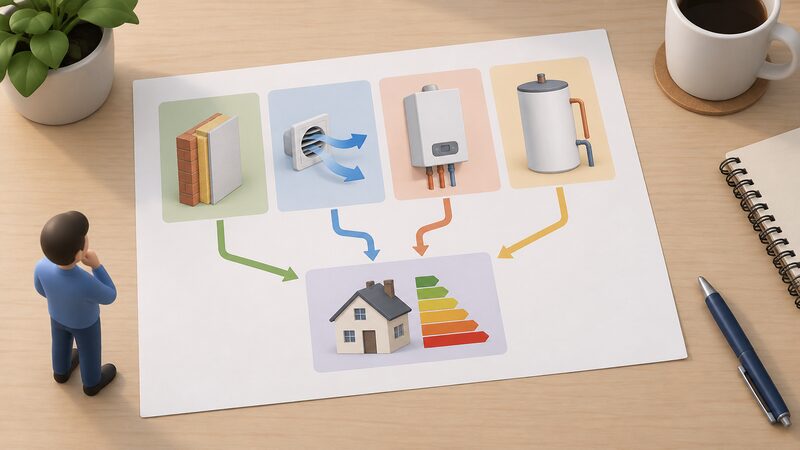
The gap between modelled and measured performance is the most consequential thing about SAP for a household. In one monitored development, the measured space heating fuel use for houses was on average around 3 times higher than the developer's SAP estimate, and for flats around 2 times higher10. That is a large divergence, and it runs in the direction that costs households money.
Part of the explanation is that the rating is built on cost, not carbon. EPC ratings are based on the costs of home heating rather than its carbon footprint, which means that cheaper heating systems score better19. This is why replacing a gas boiler with a heat pump can reduce a property's EPC score, which can negatively impact the property's value19. The household has almost certainly reduced its carbon emissions and may have reduced its running costs, and the certificate can still move the wrong way.
Fuel choice shows up systematically in the modelled data too. Dwellings with main heating fuels other than mains gas, for example oil or coal, have systematically lower SAP ratings in SAP 2012 v9.93 than in SAP 2009, with the effect of methodology on ratings particularly pronounced at the lower end of the SAP range20. Off gas grid homes are therefore penalised twice: once by the fuel they use and once by how the methodology treats it.
Household composition appears in the aggregate figures as well. Mean SAP 2012 ratings ranged from 66.8 for older households to 70 for families and 68.3 for other households14. Those differences are small relative to the fabric and fuel effects, but they show that the modelled stock carries a demographic signature even though the calculation itself is occupancy-neutral.
SAP 10.3: what changed and what it emphasises
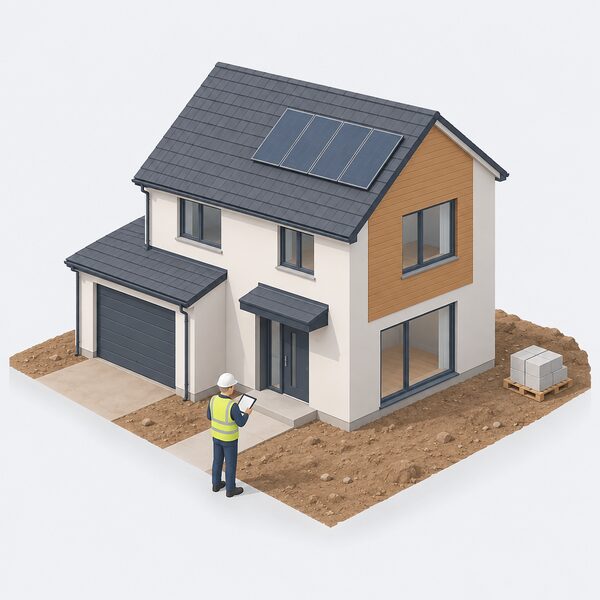
SAP 10.3 is the current approved version for new dwellings in England. The government's notice of approval names the Standard Assessment Procedure for the Energy Rating of Dwellings, version 10.3, and records that it has now been updated from version 10.2 to version 10.36. The approval date is 24 March 20266.
The change in emphasis is visible in the outputs. SAP 10.3 calculates a target CO2 emission rate for a dwelling as designed and constructed6. Under SAP 10.2, the calculated outputs included a minimum energy efficiency rate, and that version was approved from 23 November 20227. The move from an efficiency-led output to a carbon-led one reflects where building regulation compliance has moved.
The version has a guaranteed life. The government has confirmed there will be a minimum lifetime for SAP 10.3 of 24 months once the statutory instrument is laid, and expects to give industry six months' notice before setting a date beyond which SAP 10.3 can no longer be used to file Building Control plans for the Future Homes Standard21. That gives builders and assessors a defined window rather than an open-ended one.
The Future Homes and Buildings Standards will launch with only SAP 10.3 available, and the Home Energy Model will be approved for use as an alternative to SAP 10.3 once it meets the full criteria required of an approved calculation methodology21. In other words, the two methodologies will coexist for a period rather than one switching off the other.
| Version | Status | Key output | Date |
|---|---|---|---|
| SAP 10.2 | Superseded for new dwellings in England | Minimum energy efficiency rate | Approved from 23 November 20227 |
| SAP 10.3 | Current approved version for new dwellings in England | Target CO2 emission rate | From 24 March 20266 |
| Home Energy Model | Planned replacement, approved as an alternative once criteria met | Not yet in force | 2027 planned7 |
The Home Energy Model: what will replace SAP
The replacement is already scheduled. The EPC statistical release states that the Standard Assessment Procedure, the methodology used to calculate the energy efficiency rating of a home, will be replaced with the Home Energy Model, with 2027 given as the planned methodology change7. The Home Energy Model is described as replacing SAP as the calculation methodology for EPCs, as part of establishing a new technical infrastructure22.
The devolution picture is uneven, and it matters. Scotland has said EPCs there will be generated using the UK Government's new Home Energy Model, replacing SAP in autumn 20268. That is earlier than the 2027 date given for the England and Wales release, so a Scottish certificate and an English one may be produced under different methodologies during the transition.
The Home Energy Model is not simply a new version number. The Scottish Government's reform response describes establishing a new technical infrastructure to replace the current Standard Assessment Procedure with the new UK Home Energy Model, together with a new EPC Register23. A new register is a substantial operational change, not just a calculation update.
For a household, the practical implication is that ratings produced before and after the transition are not directly comparable, and that a certificate's date and methodology matter when it is being used for a decision. The same dwelling can carry a different number under a different methodology without any physical change having taken place.

EPC reform: three headline ratings instead of one
The certificate itself is being redesigned. The Scottish Government's reform programme describes reforming EPCs by introducing new ratings, redesigning the certificates, and improvements to the operational infrastructure24. The direction of travel is towards more than one headline number, so that a single band no longer has to carry every question a reader might have.
The additional ratings are already specified in outline. An Energy Cost Rating will be based on the cost of energy to run the home to standardised conditions and will be in line with the current Energy Efficiency Rating or SAP Rating22. A separate Energy Use Rating is also proposed, and the information required to calculate it is already gathered as part of the current EPC assessment and would not require changes to the SAP calculation methodology5.
The Energy Cost Rating is modelled on UK-wide fuel cost factors and normalised climate data, showing a current and potential rating23. That is a modelled cost under standard conditions, not a quote, and it will move when fuel price assumptions move rather than when the building changes.
A Fabric Rating in kWh/m2/year, calculated through the SAP assessment, is also part of the reform package17. Taken together, the three ratings separate three questions that a single band currently conflates: how much energy the home uses, what that energy costs, and how good the building fabric is.
How to get, read and use an EPC

An EPC can only be produced by an accredited energy assessor who visits the property to carry out an assessment9. The certificate contains information on potential energy costs and carbon dioxide emissions, with a coloured chart showing how energy efficient the building is or could be, alongside information on measures which could be made to improve the energy efficiency of the building and an indicative cost for each improvement5.
A copy is lodged on a national register and can be accessed through the EPC search facility on the EPC Register9. Coverage of the stock is substantial but not complete: EPCs cover around 60% of the housing stock in England and around 55% in Wales, based on Census 2021 analysis by ONS26. A property without a certificate on the register has simply not had one lodged, which is common for homes that have not changed hands recently.
The legal triggers are specific. EPCs are needed whenever a property is built or marketed for sale or rent, and they are required upon completion of construction of a new building9. They must also be displayed by certain large non-domestic buildings17. Exemptions include protected buildings, places of worship, temporary buildings of two years or less, low energy demand industrial and agricultural buildings, seasonal residential buildings, stand-alone buildings under 50 square metres, and buildings suitable for demolition27.
There are narrow exceptions within the letting rules. An EPC is not required where a housing association sells an additional share to an existing shared owner, or where a tenant is renting a room with shared access to facilities such as a bathroom, kitchen or living area11. For shared ownership properties, responsibility for obtaining an EPC sits with whichever party is initiating the sale or letting11.
Not having one carries consequences. Not having an EPC could lead to enforcement action and the issuing of a penalty charge notice9. The certificate is publicly available, and some of the underlying data may be shared with others for the monitoring and compliance of the energy performance of buildings regulations, with the government also able to use some data for research or statistical purposes9.
The volume of certificates lodged shows how routine the process has become. In the quarter January to March 2026, 460,000 EPCs were lodged on the register in England and Wales, a 2% decrease compared with the same quarter in 20258. Of these, 416,000 domestic EPCs were lodged in England, a 1% decrease, and 22,000 domestic EPCs were lodged in Wales, an 8% decrease8. In the twelve months to March 2026, 1,649,000 domestic EPCs were lodged in England, a 4% increase on the previous twelve months8.
For a household thinking about energy independence, the certificate is a starting document rather than an answer. It says what the building is, under a fixed set of assumptions, at a point in time and under a named methodology version. It does not say what the household will spend, how a heat pump will perform in practice, or what the next version of the methodology will make of the same house. The EPC statistics show how the stock is distributed across bands, and the measured versus modelled home energy performance comparison sets out where the calculation and the meter part company.
Sources27 cited
- National Calculation Methodology and Product Characteristics Database, NCM PCDB, 2026
- Energy Performance Certificates: research briefing, House of Commons Library, 2026
- Technical annex for chapter 2: what EPCs measure, UK Government, 2026
- EPC reform consultation, Scottish Government, 2023
- Domestic EPC reform consultation, Scottish Government, 2021
- Notice of approval of calculation methodologies for new buildings, UK Government, 2026
- Notice of approval of updated calculation methodologies for Wales, Welsh Government, 2022
- Energy Performance of Buildings Certificates statistical release, January to March 2026, UK Government, 2026
- Energy Performance Certificates, nidirect, 2026
- Building for 2050: low cost, low carbon homes, UK Government, 2022
- Energy Performance Certificates: buildings for let, Scottish Government, 2023
- Warm Homes: Local Grant policy guidance, UK Government, 2026
- Energy efficiency of housing in England and Wales, Office for National Statistics, 2025
- Scottish House Condition Survey 2024: key findings, Scottish Government, 2026
- National Energy Efficiency Data Framework need report, UK Government, 2026
- Written evidence on social housing SAP ratings, UK Parliament, 2019
- EPC reform consultation: government response, Scottish Government, 2025
- Building Regulations Approved Document L Volume 1, 2026, Welsh Government, 2026
- Energy Performance Certificates and heat pumps, UK Parliament, 2025
- Scottish House Condition Survey local authority tables: energy efficiency, Scottish Government, 2026
- Future Homes and Buildings Standards consultation response, UK Government, 2026
- Energy Performance Certificate reform consultation, Scottish Government, 2025
- Review of retrofit assessment in Scotland, Scottish Government, 2025
- Energy Performance of Buildings (Scotland) Regulations 2025 update, Scottish Government, 2025
- Heat in Buildings progress report 2025, Scottish Government, 2025
- Energy Performance of Buildings Certificates statistical release, April to June 2025, UK Government, 2025
- Energy Performance Certificates guidance, Isle of Anglesey County Council, 2025
 Measured vs Modelled PerformanceWhy does a home use more energy than its rating predicts, and what does that mean for your bills?
 The New Build Performance GapWhy does a new build use more energy than its rating promises?
 Home Energy ModelThe energy rating on your EPC is about to be worked out differently when you buy, sell or build a home.
 Energy Performance CertificatesAn Energy Performance Certificate rates how energy efficient your home is, from A down to G.
 Reducing Your BillRanks household electricity and gas uses by share of the bill and sets out what each measure changes, from heating settings and insulation to appliance use and tariff choice.
 How Energy Products Are TestedWhy does a solar panel's datasheet power rating look better than what you actually get on a UK roof?