

In this guide
An Energy Performance Certificate is a standardised rating of a building's energy performance, produced by an accredited assessor and lodged on a national register. It rates a home on a scale of 1 to 100 and splits that score into bands A to G, with A the most efficient1. It is required when a building is sold or let to a new tenant, and on completion of construction of a new building2. It is valid for ten years3.
What it measures is narrower than most householders assume. The assessment reflects the energy performance of the building itself, not the way it is used by its occupants4. It is a modelled figure built from the fabric, the heating system and standardised assumptions about occupancy, climate and fuel prices, not a reading of the household's actual consumption. The Scottish Government describes EPCs as intended as a basic, standardised assessment and not a substitute for detailed, technical, retrofit assessment and advice5.
That distinction matters for energy independence. An EPC tells a household where the building sits against a fixed benchmark and what measures would move it. It does not tell the household what it spends, what it could generate, or how exposed it remains to a supplier, a grid connection or a fuel it does not control. The certificate is a starting point for fabric work, not a measure of self-sufficiency.
What an EPC is and what it measures
An EPC is a widely used measure of the energy performance of buildings, both in the residential and commercial sectors8. It provides information about the energy efficiency and emissions of a building, and it comes with information on measures which could be made to improve the energy efficiency of the building, plus an indicative cost for each improvement4.
The certificate carries two headline ratings. Both the energy efficiency rating and the environmental impact rating are scored on a scale of 1 to 100 and split into bands A to G1. The energy efficiency rating is the one that carries legal weight: it is the only metric currently used in government policies targeting domestic buildings8. That single fact explains much of the criticism the certificate attracts, because a policy instrument built on one number will be judged on whether that number drives the right decisions.
A home rated EPC C or above is generally regarded as having an adequate level of energy efficiency9. That is a working threshold rather than a statement about comfort or bills. A Band C home can still be expensive to run if it is large, poorly used or heated by a costly fuel, and a Band D home with a well-matched heating system can cost less than a Band C home with an oversized one.
For a household thinking about independence, the certificate's value is diagnostic. It identifies the fabric and system measures that would raise the modelled rating, and it does so in a form that lenders, landlords and grant schemes recognise. It does not measure how much of the household's energy comes from its own roof, its own wood, or its own decisions.
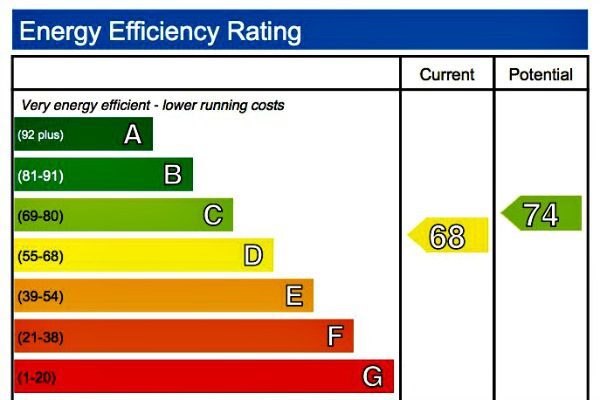
The rating scale: 1 to 100 points, bands A to G
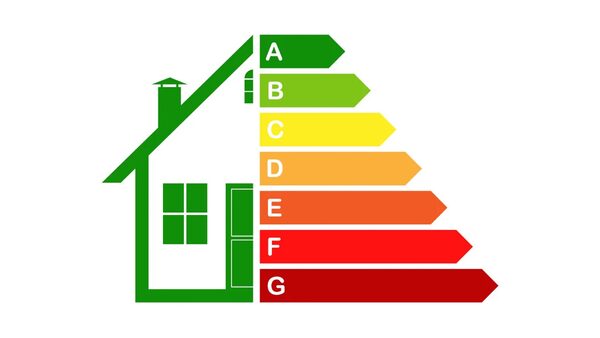
The scale runs from 1 to 100, though the underlying SAP score is described as a 1-100+ score presented on a distinctive graphic which shows how the score maps onto seven rating bands represented by the letters A-G10. In practice, published statistics describe the EPC score as typically ranging from 1 to 1006.
The band boundaries are not evenly spaced, and the lower bands are narrow. Band G covers 1 to 20, the least efficient, and Band E covers 39 to 546. A home sitting at the top of Band E is a short step from Band D; a home at the bottom of Band G needs substantial work before it reaches the rental minimum.
| Band | Score range | What it signals |
|---|---|---|
| A | Highest | Most efficient; typical of newer stock |
| B | Above C | Strong fabric and a low-carbon or efficient heating system |
| C | Around the median | Generally regarded as an adequate level of energy efficiency9 |
| D | Below C | Common in older existing dwellings |
| E | 39 to 546 | The current rental minimum in England and Wales7 |
| F | Below E | Cannot be let without an exemption7 |
| G | 1 to 20, least efficient6 | Cannot be let without an exemption7 |
The certificate shows a current rating and a potential rating. The gap between them is the modelled effect of the measures in the recommendation report, and it is the part of the document most useful to a household planning fabric work. A large gap usually points to insulation, glazing or heating controls rather than to behaviour.
How the rating is calculated: SAP and RdSAP
To determine the energy efficiency rating of a home, EPC assessors use the standard assessment procedure, known as SAP1. SAP stands for the Standard Assessment Procedure for Energy Rating of Dwellings, and it supports the production of EPCs11. The content of the domestic EPC is produced by calculations carried out in the SAP methodology8.
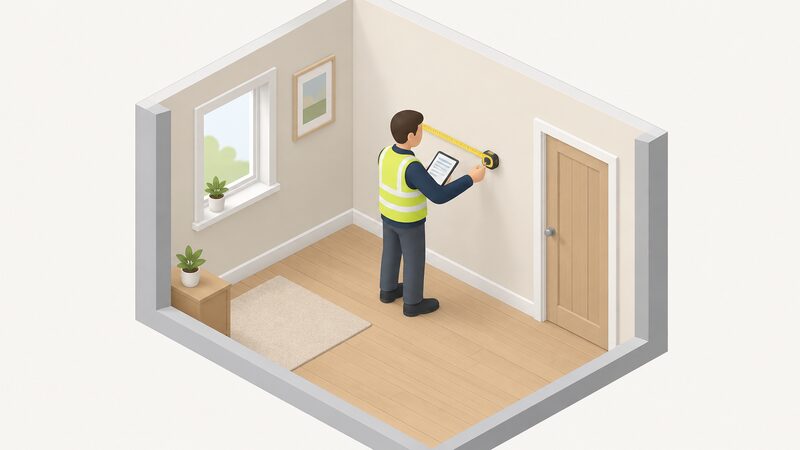
For existing homes, where full construction information is often unavailable, assessors use a reduced version. The methodology is standard assessment procedure for new and existing dwellings, with reduced SAP, RdSAP, applied to existing homes where information may not be available1. RdSAP is the reason two superficially similar houses can score differently: where a wall type, insulation thickness or glazing specification cannot be established, the software falls back on defaults drawn from the age and type of the building.
That defaulting is the mechanism behind most disputes about accuracy. An assessor who cannot see inside a cavity wall, under a floor or behind a dry lining will record what the convention assumes for that construction and era. The resulting score is reproducible and comparable across the stock, which is what a policy instrument needs, but it is not a measurement of that particular house.
"they are intended as a basic, standardised assessment and not a substitute for detailed, technical, retrofit assessment and advice"
The Scottish Government has consulted on not treating EPCs as a substitute for a more detailed or specialist retrofit advice or technical survey, such as assessment following PAS 2030 or PAS 203512. That position is consistent across administrations: the certificate is a screening tool, and a whole-house retrofit plan sits above it. Households planning fabric work at scale will get more from a whole-house retrofit plan than from the certificate alone.
What the certificate contains, including the recommendation report
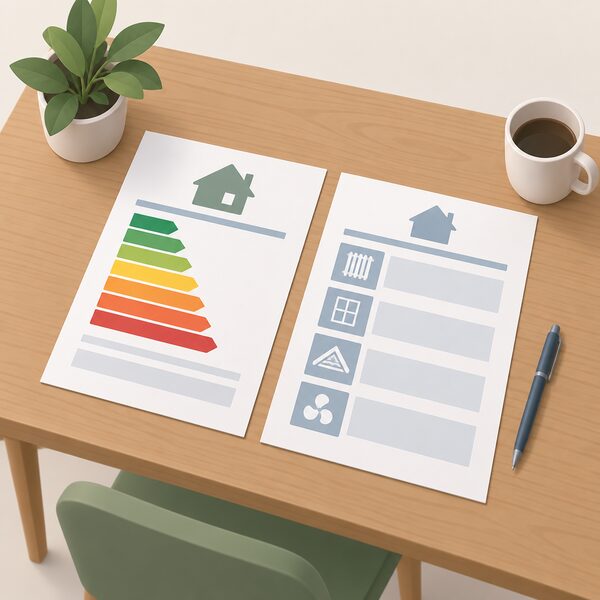
An EPC should contain a minimum set of items: the building asset rating against a benchmark, a recommendation report, the reference number and date of issuance, the building address, and the building's total useful floor area4. It also carries information on potential energy costs and carbon dioxide emissions, with a coloured chart showing how energy efficient the building is or could be13.
The recommendation report is the substantive part for a household. It provides more detailed information about improvement measures, and it outlines the recommended measures that can be taken to improve the energy rating4. Cost effective recommendations to improve the energy efficiency of the building are included with the certificate15.
The legal basis for the report is long-standing. Under the Northern Ireland energy performance of buildings regulations, the certificate shall be accompanied by a recommendation report16. In Wales, the approved document amendments require the certificate to include a recommendation report unless there is no reasonable potential for energy performance improvements17. Where a report is included in an energy performance certificate, its validity runs for ten years from the date of that certificate18.
That advisory status is worth holding onto. The measures listed are the ones the software associates with a rating improvement for that building type, not a surveyor's judgement about what that particular house needs first. A household acting on the report should expect to have the measures specified properly before work starts, and the fabric pages on this site set out what each measure involves: loft insulation, cavity wall insulation and solid wall insulation each carry their own conditions and risks.
What an EPC does not cover
The certificate is deliberately bounded, and the boundaries are stated in official guidance. The EPC assessment reflects the energy performance of the building itself, not the way it is used by its occupants4. A household that heats one room, runs a heat pump on a smart tariff or generates its own electricity will not see that reflected in the rating.
It does not contain personal information, other than the name and contact details of the assessor who carried it out4. It is not a condition survey, a structural report, a damp survey or an electrical certificate. It does not record appliance efficiency, hot water cylinder insulation in isolation, or the state of the heating system beyond its type, fuel and controls.
For non-domestic buildings, the EPC shows an asset rating, alongside an indication of energy performance based on primary energy use4. Domestic certificates work differently, and the Scottish consultation on reform focused on domestic EPCs and did not include non-domestic EPCs12.
Coverage of the stock is incomplete, which limits what any single certificate can be compared against. Around a third of domestic properties in England and Wales do not have an EPC rating19. EPCs cover around 60% of the housing stock in England and around 55% in Wales, based on Census 2021 analysis by the ONS3. A household comparing its score with a national average is comparing against a partial sample, weighted towards homes that have changed hands or tenancy.
Validity: 10 years, and when you need a new one
An EPC is valid for a maximum of ten years, or until another EPC is commissioned for the same building, whichever is sooner20. Each EPC is valid for 10 years and can be used multiple times during that period13. Ratings are valid for 10 years21, and the same ten-year figure appears in the boiler upgrade scheme guidance, which requires an EPC that is no more than 10 years old22.
The trigger for a new certificate is a transaction, not the passage of time. A new EPC does not need to be produced when the previous certificate's ten-year validity period expires, unless the property is being sold or let to a new tenant20. EPCs do not have to be provided where an existing tenant is renewing their lease20. A household staying put does not need to renew anything.
Where a certificate is needed, the obligations are specific. An EPC is required when selling or letting an existing building2. EPCs must be provided when a building is advertised for sale or for let to a new tenant, and they are also required upon completion of construction of a new building23. They must be displayed by certain large non-domestic buildings23.
For buildings for sale, the EPC must be provided to the purchaser, free of charge, and this is a legal requirement24. When a building is advertised for sale, the EPC rating must be included in the property advertisement24. Where there is not enough space to include the colour coded chart energy indicator, the EPC energy rating must be stated, for example EPC F3615.
The Scottish Government has consulted on a reduction of the validity period of EPCs from 10 to five years to ensure consumers have more up-to-date information25. That proposal has not replaced the ten-year rule. Reform consultations point to shorter validity, while the operative guidance continues to state ten years20.
Minimum ratings for rental homes and the road to Band C

The current legal floor for domestic private rented property in England and Wales is Band E or above7. The legal basis is the 2018 Minimum Level of Energy Efficiency standard, which set EPC band E for domestic, private rented property14. Landlords of domestic private rented properties, including public sector landlords, may not grant a tenancy to new or existing tenants if the property has an EPC rating of band F or G, unless an exemption applies7. Landlords must not continue letting a domestic property that is already let if that property has an EPC rating of band F or G, unless an exemption applies7.
Where a property is let with a rating of F or G, it must be improved to a minimum rating of E or an exemption registered where applicable14. The exemption route matters for older and harder-to-treat homes, and the conditions attached to it are set out in the MEES guidance for rented homes.
The next step is proposed rather than in force. The UK Government has proposed raising the minimum EPC standard for domestic private rented properties to band C by 20307. That is a proposal, and it should be read as such until the regulations are made.
The four nations diverge here. England and Wales operate the Band E minimum through the 2018 standard14. Scotland has consulted separately on energy efficiency standards for the domestic private rented sector, with proposals that would extend to all private rented sector properties by the end of 2033 if passed as proposed26. Northern Ireland's requirements sit in its own energy performance of buildings regulations16. A landlord with property in more than one nation is dealing with more than one regime.
How homes across the UK actually rate today
The most recent published figures give a clear picture of the existing stock. Homes in England had a median Energy Performance Certificate score of 69, Band C, as of March 20256. That median conceals a wide spread, and the spread is where the policy problem sits.
New build performance is markedly different from existing stock. In England, in the quarter January to March 2026, 87% of new dwellings were given an A or B rating, an increase from 86% in the same quarter a year earlier3. Most new dwellings, 67%, were given a B energy efficiency rating3. Existing dwellings were more likely to be given a C or D rating, at 88%, compared with 12% of new dwellings3.
Wales shows a similar pattern with a different distribution. In the quarter January to March 2026, 92% of new domestic properties received an energy efficiency rating of A, the highest band3. The majority of new dwellings in Wales, 55%, were given an A rating3.
Tenure matters as much as age. Around two-thirds of Council or Housing Association houses have EPC ratings A to C, compared to around 40% of houses in other tenure types19. Age compounds it: around a quarter of gas consuming properties built before 1945 have EPC ratings A to C, compared with around 95% among newer properties19.
| Measure | England | Wales |
|---|---|---|
| Domestic EPCs lodged, Q1 2026 | 416,000, a 1% decrease3 | 22,000, an 8% decrease3 |
| Existing dwellings, Q1 2026 | 368,000, a 2% decrease3 | 20,000, an 11% decrease3 |
| New dwellings, Q1 2026 | 48,000, a 6% increase3 | 2,000, a 43% increase3 |
| New dwellings rated A or B, Q1 2026 | 87%3 | 92%3 |
| Domestic EPCs, 12 months to March 2026 | 1,649,000, a 4% increase3 | 90,000, a 10% increase3 |
Activity across the register is substantial. In the quarter January to March 2026, 460,000 EPCs were lodged on the register in England and Wales, domestic and non-domestic, a 2% decrease compared to the same quarter in 20253. Over the 12 months to March 2026, 1,649,000 domestic EPCs were lodged in England, a 4% increase on the previous 12 months3. The regional picture is uneven: the largest increase in EPCs lodged for new dwellings compared with the same quarter in 2025 was in London, and the largest decrease was in the North West3.
For a household, the useful comparison is with homes of the same age, type and tenure, not with the national median. The energy efficiency of the UK housing stock sets out how the stock divides by era and construction.
Limitations of the EPC as a measure of real energy use
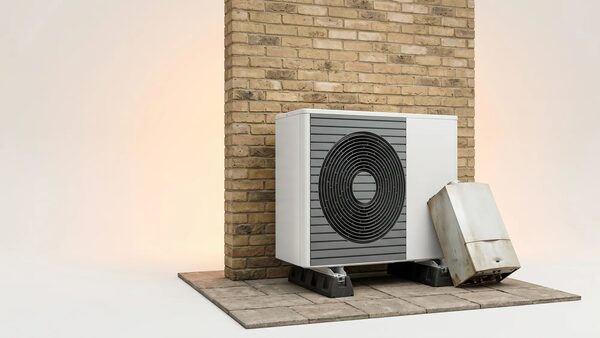
The certificate's own authors are candid about its limits. The ratings on EPCs are an important policy tool, used to define standards and targets for reducing emissions from homes, but poorly suited to this role27. The Climate Change Committee states that the current EPC rating metrics do not accurately incentivise the energy efficiency and heating solutions required to deliver Net Zero homes27.
The most cited example is the treatment of heat pumps. Replacing a gas boiler with a heat pump can, in fact, reduce a property's EPC score, which can negatively impact the property's value28. That outcome follows from a metric built on running cost and primary energy under standardised assumptions, where gas has historically compared favourably with direct electric heating. A household that electrifies its heat and improves its fabric can see the fabric gain partly offset by the fuel switch.
"Replacing a gas boiler with a heat pump can, in fact, reduce a property's EPC score, which can negatively impact the pro"
The Energy Cost Rating proposed in reform work is intended to address part of this. It will be based on the cost of energy to run the dwelling to standardised conditions, modelled based on UK-wide fuel cost factors and normalised climate data, showing a current and potential rating5. That is a modelled cost, not a bill, and it will move when fuel price assumptions move.
Reform is under way. The stated intention is to reform EPCs by introducing new ratings, redesigning the certificates, and improvements to the operational infrastructure23. Until those changes take effect, the certificate in force is the one described here, and its limits are the ones a household should plan around. For fabric measures that raise a rating and reduce real demand, the guide to improving an EPC rating sets out the order of works.
Sources28 cited
- Energy Performance Certificates: research briefing, House of Commons Library, 2026
- When is an Energy Performance Certificate required?, Planning Portal, 2026
- Energy performance of buildings certificates, January to March 2026, GOV.UK, 2026
- What does an Energy Performance Certificate contain?, Planning Portal, 2026
- EPC reform consultation: government response, Scottish Government, 2025
- Energy efficiency of housing in England and Wales, Office for National Statistics, 2025
- Trading standards guidance: other consumer problems, Isle of Anglesey County Council, 2026
- Technical annex for chapter 2: what EPCs measure, GOV.UK, 2026
- Bristol warm homes plan, Bristol City Council, 2025
- Energy performance of buildings Scotland regulations 2025: stock model research, Scottish Government, 2025
- Standard Assessment Procedure for Energy Rating of Dwellings, NCM PCDB, 2026
- Domestic EPC reform consultation, Scottish Government, 2021
- Energy Performance Certificates, nidirect, 2026
- Minimum energy efficiency standards, Carmarthenshire County Council, 2026
- EPC leaflet, Building Control NI, 2014
- Energy Performance of Buildings Regulations (Northern Ireland) 2008, Building Control NI, 2008
- Amendments to the approved documents Part L, Welsh Government, 2019
- The Energy Performance of Buildings (England and Wales) Regulations 2012, legislation.gov.uk, 2012
- National Energy Efficiency Data Framework: need report summary of analysis 2026, GOV.UK, 2026
- Buildings for let, Scottish Government, 2026
- Edinburgh local housing energy efficiency strategy, City of Edinburgh Council, 2023
- Boiler upgrade scheme guidance for installers, Ofgem, 2026
- EPCs are changing, Scottish Government, 2026
- Buildings for sale, Scottish Government, 2026
- EPC reform consultation government response, Scottish Government, 2025
- Energy performance of buildings Scotland regulations 2025: update and government response, Scottish Government, 2025
- Letter: reform of domestic EPC rating metrics, Climate Change Committee, 2026
- Environmental Audit Committee report, UK Parliament, 2025
 EPC Regulations and ReformSelling or renting out a home means you need an Energy Performance Certificate.
 Get an EPC for Your HomeSelling or renting out a home means you need an Energy Performance Certificate.
 EPC StatisticsHow energy efficient are UK homes, and is it getting better?
 Read an EPCA walk through each part of an EPC: the A to G rating and potential rating, the estimated costs, the fabric and heating assumptions and the recommendation table, plus what the assessor did and did not inspect and how the rules differ across the UK.
 Energy Checks Before BuyingHow energy efficient is the house, and what will it cost to heat?
 Home Energy AssessmentsWhich home energy check do you actually need?