In this guide
Insulation certification in the UK is a layered system rather than a single badge. A product carries a declared thermal conductivity and, often, an independent agrément certificate. The installer carries registration with a competent person scheme or with TrustMark. The work itself is meant to follow PAS2030 and PAS2035 where public money is involved. Each layer answers a different question, and none of them answers all of them.
The figures that matter most to a household are the declared performance of the material, the standard the installation must meet, and the guarantee that survives the installer. Under the Great British Insulation Scheme, all installers had to be TrustMark-registered businesses and all measures had to be delivered to PAS2030 and PAS2035 standards1. The Cavity Insulation Guarantee Agency issues guarantees for cavity wall insulation fitted in the UK and Channel Islands2.
The system is not a guarantee of quality on the day. Ofgem wrote to 65,000 households potentially affected by poor-quality solid wall insulation fitted under ECO and GBIS since 2022, which is the clearest evidence that certification and competent workmanship are separate things. Certification tells a household what was specified and who was responsible. It does not tell them the cavity was filled evenly.
What certification actually covers
Certification in UK insulation operates at three levels, and conflating them is the most common source of confusion. The first is the product: a manufacturer declares a thermal conductivity, usually written as lambda, and may seek independent approval for it. The second is the system, where a board, a fixing method and a substrate are assessed together. The third is the installer, who must be registered with a competent person scheme for certain notifiable work.
The Building Regulations 2010 set out which wall insulation work can be self-certified and by whom. Installation of insulating material to the internal walls of a building may be self-certified by a person registered by Ascertiva Group Limited, Benchmark Certification Limited, CERTASS Limited, NAPIT Registration Limited or Stroma Certification Limited7. External wall insulation carries the same list of schemes, excluding demountable-clad buildings7. Hybrid insulation, meaning material applied to both external and internal walls, has a shorter list: Ascertiva Group Limited, Benchmark Certification Limited or NAPIT Registration Limited7.
That self-certification route applies in England, or to excepted energy buildings in Wales7. The self-certification scheme system operates in England and Wales8. Scotland and Northern Ireland run their own building standards and building control arrangements, so a household there should not assume an English scheme registration carries the same weight.
Above the scheme level sits accreditation. The United Kingdom Accreditation Service is the sole national accreditation body recognised by the UK government to assess certification, testing, inspection and calibration organisations4. A certificate issued by a body that UKAS has assessed is therefore a stronger document than one issued without that oversight, because the issuing body's own competence has been checked.
"the United Kingdom Accreditation Service is the sole national accreditation body recognised by the UK government to assess certification, testing, inspection and calibration organisations"
Declared thermal conductivity and what a certificate states
A declared thermal conductivity is the figure a designer must use. It is not the best result a laboratory has ever recorded for a sample, but a value that accounts for manufacturing tolerance, moisture and the conditions the material will actually meet in service. When a U-value calculation is submitted to building control, the declared lambda is the input, and substituting a more flattering figure invalidates the calculation.
This is why agrément certificates matter to lenders and warranty providers. An agrément certificate states the product, its declared performance, the conditions of use and any restrictions. It is a fitness-for-purpose judgement rather than a test report. A manufacturer may hold several: SuperFOIL announced in August 2026 that it had secured a KIWA BDA Agrément certification for its Room-in-Roof insulation system, its second Agrément-accredited system with KIWA BDA.
The distinction between a product certificate and a system certificate is worth holding onto. A board that performs well in isolation may perform differently when fixed to a particular substrate with a particular adhesive in a particular exposure zone. System approval covers that combination. A household reading paperwork should look for the element being insulated, the substrate, and the fixing method, not just the material name.
For the underlying physics of these figures, U-values and R-values explained sets out how declared conductivity feeds into the number that appears on an EPC. The material comparison pages, including insulation materials compared, give the declared ranges for each family.
The standards installers must work to
PAS2030 and PAS2035 are the two standards that govern publicly funded retrofit. PAS2035 covers the assessment and design process, including the role of a retrofit coordinator and the production of a medium-term improvement plan. PAS2030 covers installation. Under the Great British Insulation Scheme, all measures available under the scheme had to be delivered according to PAS2030 and PAS20351.
The delivery guidance is explicit about the chain of responsibility. The insulation measure must be installed by, or under the responsibility of, a person who is registered with TrustMark for the purposes of that measure, and a certificate of lodgement must be issued by the operator of TrustMark in respect of that measure9. That lodgement certificate is the document a household should expect to receive, and it is the one that ties the work to a registered business rather than to a sole trader who has since moved on.
The same guidance sets out conditions that attach to particular measures. For party wall measures, the installer must obtain the necessary consent from all properties adjacent to the wall before the measure is carried out9. Floor insulation can only be installed to a floor that is either in contact with the ground, above an unheated space such as a cellar, or suspended and in contact with the outside air9. These are not preferences; they are the conditions under which the measure qualifies.
Work must also be carried out in accordance with relevant provisions of PAS 2030:2019, PAS2035:2019, building regulations and any other applicable regulations9. Where a measure is delivered under ECO4 rather than GBIS, ECO4 approved installer measures can be delivered where the measure type and eligibility requirements for the Great British Insulation Scheme are met10.
Guarantees: who stands behind the work

A guarantee is only as good as the entity behind it, and insulation guarantees come from three different places. The Cavity Insulation Guarantee Agency issues guarantees for cavity wall insulation fitted in the UK and Channel Islands, and can be contacted on 015258533002. That is a standalone guarantee provider rather than an installer or a manufacturer, which matters because it survives the original installer ceasing to trade.
The second source is the TrustMark lodgement certificate, which records that a registered business carried out the measure and that the work was lodged with the scheme operator9. This is evidence of who did the work and to what standard, and it is the document a conveyancer will ask for.
The third source is the manufacturer's own material warranty, which typically covers the product rather than the installation. A board that fails within its stated period may be replaced under the maker's warranty, but that does not cover the labour to remove and refit it, and it does not cover consequential damage.
Where a scheme has closed, the guarantee position does not automatically close with it. The ECO4 and GBIS insulation failures page covers the remediation routes and what Ofgem's letter to households means. For cavity wall work specifically, cavity wall insulation problems, guarantees and claims sets out how a claim is pursued and against whom.
How the rules differ across the UK nations
Building regulation and scheme eligibility are devolved in practice, even where the underlying standards are shared. The Great British Insulation Scheme operated across Great Britain, targeting the least energy-efficient homes in Great Britain12. It did not extend to Northern Ireland, which runs its own building control system and its own technical booklets.
Eligibility under the scheme required an energy performance certificate of D to G, alongside Council Tax bands A to D in England or A to E in Scotland or Wales13. That band difference is one of the few explicit territorial variations in the published eligibility material, and it reflects different property tax systems rather than different insulation standards.
On building regulations, Wales states plainly that insulation has to comply with the relevant building regulations both when installed during construction and when fitted retrospectively14. The self-certification scheme system operates in England and Wales8, while the Building Regulations 2010 self-certification provisions apply in England or to excepted energy buildings in Wales7. Scotland's building standards and Northern Ireland's technical booklets set their own materials and workmanship requirements.
For heat pumps, the Microgeneration Certification Scheme operates across the UK, delivering standards for heat pump installations through the industry-led scheme6. Guidance on the planning regime for heat pumps relates to England, and the policy in Wales may differ5. A household in Scotland, Wales or Northern Ireland should check the devolved position rather than relying on an England-facing page.
The dedicated pages for each nation set out the detail: Scottish building standards for insulation, Welsh building regulations for insulation, and the grant routes in insulation grants Scotland, insulation grants Wales and insulation grants Northern Ireland.
What the scheme data shows about certification in practice

The published statistics for the Great British Insulation Scheme cover measures installed and households upgraded, analysed by measure type and geographical region15. That breakdown by region and measure type is the most useful public record of what was actually certified and installed, and it is published as accredited official statistics16.
The scheme was designed to complement the Energy Company Obligation, yet unlike ECO4's whole house approach, it delivered predominantly single measures targeted at a wider range of households17. That design choice has a direct bearing on certification: a single measure is easier to specify and to certify than a whole-house package, but it also means the certificate covers one element rather than the interaction between elements.
The scheme worked by placing an obligation on medium and large energy companies to deliver measures that result in reduced energy usage18. Suppliers and local authorities needed to collect sufficient evidence from all local authority and supplier flex measures installed to ensure they met the eligibility and compliance requirements18. The eligibility and pre-installation declaration form exists to confirm the eligibility of properties receiving measures under either ECO4 or the Great British Insulation Scheme and to collect project-level information before installation19.
The scoring methodology outlines the scores energy companies receive for measures installed under the scheme20. That scoring is what drives supplier behaviour, and it is why the measure mix in the statistics is not simply a reflection of what households asked for.
| Document | What it records | Who holds it |
|---|---|---|
| Agrément certificate | Product fitness for purpose and declared performance | Manufacturer |
| PAS2035 assessment | Design, ventilation and improvement plan | Retrofit coordinator |
| TrustMark lodgement certificate | Registered installer and measure lodged | Scheme operator |
| Building control completion certificate | Notifiable work signed off | Local authority |
| CIGA guarantee | Cavity wall insulation guarantee | Guarantee provider |
What it means for household energy independence
Certification is the mechanism by which a household's insulation becomes a durable asset rather than an unverifiable improvement. A declared lambda and a lodged certificate are what allow a later assessor, buyer or lender to treat the work as real. Without them, the physical insulation may still be in the wall, but its contribution to the EPC and to the property's value is unproven.
The dependence that remains is structural. Insulation reduces the energy a home needs, but it does not remove the connection to a supplier or, for most homes, to the gas grid. The Great British Insulation Scheme was a government energy-efficiency scheme delivered through an obligation on energy companies, which means the route to a certified installation ran through a supplier rather than through the household directly21. When the scheme closed, that route closed with it.
The wider policy picture is one of intermittent support. The Climate Change Committee stated in February 2023 that incentives to act and a greater awareness of what should be done to prepare for climate risk and reduce emissions is urgently needed22. Parliamentary evidence in 2019 recorded that current rates were just 9,000 measures a week23, and the historical series on homes with loft and cavity wall insulation runs back to December 201424. The retrofit rate has been the persistent constraint, not the certification framework.
For a household, the practical meaning is that the paperwork is the part of the installation that keeps working after the installer has gone. The finding an insulation installer page covers how to check registration before work starts, and insulation, glazing and energy independence sets out how fabric measures fit into a wider reduction in reliance on bought energy.
Sources24 cited
- Great British Insulation Scheme: supply chain, Ofgem, 2026-09-17
- Issues arising from cavity wall insulation installations: guidance, Welsh Government, 2022-02
- Great British Insulation Scheme: homeowners and tenants, Ofgem, 2026-09-17
- Technical Booklet B: Materials and workmanship, Building Control Northern Ireland, 2013-07
- The Microgeneration Certification Scheme, Planning Portal, 2026-09-17
- Heat pumps investment roadmap, GOV.UK, 2023-04-03
- Building Regulations 2010, Schedule 3, legislation.gov.uk, 2012-12-17
- Reforming consumer protection for home upgrade schemes, GOV.UK, 2026-06-17
- Great British Insulation Scheme Delivery Guidance, Ofgem, 2023-08-31
- ECO4 New Measures and Products Guidance v3.0, Ofgem, 2026-03-26
- Great British Insulation Scheme collection, GOV.UK, 2023-11-30
- Great British Insulation Scheme, Ofgem, 2026-09-17
- Home and business grants, schemes and advice, East Herts Council, 2026-09-17
- Building regulations: insulation, Welsh Government, 2026-09-17
- Great British Insulation Scheme release: July 2025, GOV.UK, 2025-07-24
- English Housing Survey 2024 to 2025: home insulation fact sheet, GOV.UK, 2026-05-14
- ECO flexible eligibility statement of intent, Bristol City Council, 2023-09-04
- Great British Insulation Scheme: local authorities, Ofgem, 2026-09-17
- ECO4 and GBIS Eligibility and Pre-Installation Declaration v1.1, Ofgem, 2026-09-17
- Great British Insulation Scheme scoring methodology, Ofgem, 2023-05-30
- Great British Insulation Scheme: energy suppliers, Ofgem, 2026-09-17
- A lack of leadership is preventing essential investment, Climate Change Committee, 2023-02-01
- Written evidence on insulation retrofit rates, UK Parliament, 2019-01
- Green Deal, ECO and insulation levels in Great Britain, GOV.UK, 2014
 Finding an Insulation InstallerHow to find, verify and check an insulation, glazing or ventilation installer in the UK: the registration schemes, trade bodies and guarantee arrangements that cover the work, how to compare quotes, what a written specification should state, and how complaints and disputes are handled.
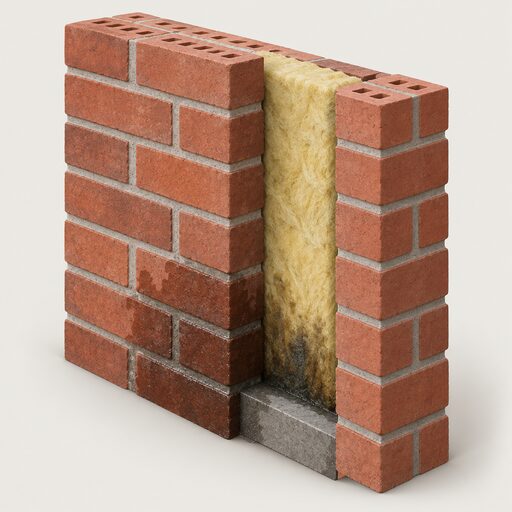 Cavity Wall Insulation ProblemsDamp patches after cavity wall insulation, and whether the guarantee actually pays out, are the two things people most want answered.
 Certificates You Should ReceiveAfter work like solar panels or a new boiler, what paperwork should you actually be handed, and by when?
 Checking an InstallerBefore you sign anything, how do you know your installer is genuine?
 When Your Installer Goes BustWhat happens to deposits, part-completed work, workmanship guarantees and complaints when a home energy installation company fails, and how to claim on deposit protection, an insurance-backed guarantee, card or finance cover, and who honours the manufacturer's warranty.
 Replacement Window RulesWho signs off replacement windows so they meet building rules?