

In this answer
Short answer
Yes. Under ECO4, all measures except district heating connections must be installed by, or under the responsibility of, a person registered with TrustMark or an equivalent, and lodged with TrustMark or an equivalent1. Ofgem's homeowner guidance puts it in the same terms: installers under ECO must be TrustMark accredited and will have a registration number, except in the case of installers of district heating connections2. The requirement is a condition of the funding, not a marketing label an installer can choose to carry.
The practical effect is that a householder can check a single register before work begins. TrustMark is the Government Endorsed Quality Scheme covering work a consumer chooses to have carried out in their home, and it is the only Government endorsed scheme for domestic trades3. Registration is also what allows a business to touch the money at all: businesses including installers, Retrofit Assessors and Retrofit Coordinators must be registered with TrustMark to access ECO and other taxpayer funded, UK government led energy efficiency schemes4.
What follows is a page about the rule, its edges and its limits. The rule is firm for the measures that matter most, the exceptions are narrow and specific, and TrustMark registration is not the same thing as a warranty or a dispute service. Those are separate arrangements with separate routes.
What TrustMark is, and why the scheme leans on it
TrustMark describes itself as the Government Endorsed Quality Scheme, covering work a consumer chooses to have carried out in their home, and states that it is the only Government endorsed scheme for domestic trades3. Bristol City Council's grant pages use the same phrase, describing it as a government endorsed quality scheme9. That status is what makes it usable as a gate: a single register that a scheme administrator, a local authority or a householder can check.
The Energy Company Obligation is the main reason the register matters at GB scale. Scottish Government quality assurance material states that a key driver for TrustMark registration is the GB wide Energy Company Obligation scheme, which requires suppliers to be TrustMark approved in order to access the funding10. The same wording appears in the Scottish Government's published quality assurance statement4. This is not a Scottish rule: it describes a GB-wide obligation, and the requirement applies across England, Scotland and Wales through the ECO order.
The register also functions as a starting point for households. Leeds City Council's ECO pages suggest searching a competent person register, such as TrustMark, to find an installer that will assess your circumstances and property to identify suitable measures11. That is the intended use: the register narrows the field before any assessment happens.
TrustMark's reach extends beyond ECO. Registration in the TrustMark Data Warehouse is required for installations funded by certain energy efficiency schemes, and where work is funded by those schemes the installation contractor must register the installation12. Warm Homes: Local Grant measures are lodged in the same warehouse: around 14,700 measures were lodged up to the end of July 2026, covering around 6,700 households8. The register is therefore the common spine running through several grant schemes, not an ECO4 quirk.
For a household, the independence question is straightforward. A TrustMark registered installer is a checkable entity with a registration number and a lodgement trail. That does not remove dependence on a supplier, a grant administrator or a warranty provider, but it does mean the firm doing the work is traceable through a government endorsed route rather than through a leaflet.
The rule in the scheme documents

The requirement appears in the same form across the current guidance. All ECO4 measures except district heating connections must be installed by, or under the responsibility of, a person who is registered with TrustMark or equivalent for the measure, and lodged with TrustMark or equivalent1. The delivery guidance repeats it: the measure covered by PAS should be installed by or under the responsibility of a TrustMark registered installer and have a relevant certificate of lodgement6. The same delivery guidance, in its quality assurance section, applies that expectation to measures covered by PAS and to projects containing such measures, including MCS6.
The wording has been stable. The 2023 version of the measures guidance carried the identical sentence about all ECO4 measures except DHC13, and the ECO4A legislation states that the measure is installed by, or under the responsibility of, a person who is registered with TrustMark for the purposes of the scheme, with a certificate of lodgement issued by the TrustMark operator, or subject to equivalent quality assurance arrangements14. The obligation is written into the order, not only into guidance.
Innovation measures follow the same path. All innovation measures must be lodged with TrustMark or an equivalent and delivered by TrustMark or an equivalent registered business15. Earlier versions of the approved innovation measures list used the same wording in 2023, 2024 and 202416, so the position has not loosened as the innovation route expanded.
The phrase "or under the responsibility of" matters. It allows a registered business to carry responsibility for work delivered by others, which is how larger installers operate. It does not allow an unregistered firm to contract directly with a household and then seek registration afterwards. The Green Homes Wales loan terms are explicit that the installer contracted to supply and install the eligible measures must be registered with TrustMark and must remain registered until the installation work has been completed19. That is a Welsh loan scheme rather than ECO4, but it shows the same condition being applied at the point of contract.
"All ECO4 measures (except DHC) must be installed by, or under the responsibility of, a person who is registered with TrustMark or equivalent for the measure, and lodged with TrustMark or equivalent."
Where the TrustMark requirement does not apply
The exceptions are narrow and named. District heating connections are carved out of the installer requirement in the homeowner guidance2, and the measures guidance excludes DHC from the general rule1. The summary of updates to the measures guidance confirms that DHC measures excluding shared ground loop ground source heat pumps must still be lodged with TrustMark or an equivalent and delivered by a TrustMark or an equivalent registered business20. So the carve-out is partial: some district heating work is outside the installer rule but not outside lodgement.
In-fill retrofits are the other documented exception, and it is an eligibility exception rather than an installer one. The delivery guidance states that the only exceptions to the usual eligibility requirements or minimum requirement are in-fill retrofits21, and the later delivery guidance states that the eligibility requirements do not apply to in-fill premises22. That does not exempt the installation itself from the TrustMark requirement; it exempts the premises from the eligibility tests that would otherwise apply.
There is also a deeming provision in the 2025 amendment order. An installation is deemed to adhere to the relevant TrustMark or equivalent requirements unless the measure is referred by TrustMark or the equivalent person and the referral is not withdrawn before 1 July 202623. The amendments apply in relation to a measure where the installation is completed on or after the day on which the order comes into force23. In other words, the default is compliance, and TrustMark can displace that default by referring a measure.
Where a measure is exempt in a project lodged with TrustMark, it will be validated against data held in the TrustMark Data Warehouse21. Exemptions are therefore checked against the register rather than simply asserted.
ECO4 Flex and the installer route
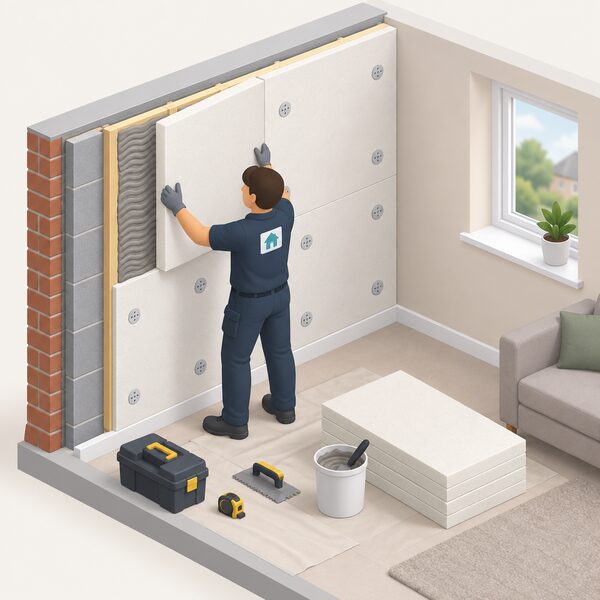
ECO4 Flex does not offer a way around the register. All potentially eligible households should apply through a TrustMark-registered or approved ECO or GBIS installer to see if they qualify24. Ceredigion's Flex pages state that the installations of most energy efficiency measures under ECO4 Flex must be carried out by TrustMark-registered businesses adhering to PAS standards25, and the county's Flex information document states that ECO4 providers, agents, installers and contractors should be TrustMark registered26. South Cambridgeshire's Flex pages add a second check for gas work: the household should confirm whether the installer is Gas Safe registered to work on gas boilers27.
That layering is worth understanding. TrustMark registration covers the quality assurance and lodgement side. Gas Safe registration covers the competence to work on gas appliances. A household checking one does not thereby check the other, and the Flex guidance treats them as separate questions.
The Flex route is administered by local authorities, and the statements of intent published by councils set the installer expectations for their areas. Birmingham's statement of intent, superseded on 1 November 2024, used the same TrustMark-registered or approved installer language24. Because Flex is a local authority declaration, the practical experience of applying can differ between councils, but the installer registration condition is common to the published statements.
For a household, Flex is the route that most often involves a council referral or a council-approved installer list. The independence position is mixed: the household depends on the local authority's declaration and on the installer's registration, but the measure itself is funded through the supplier obligation rather than through a loan or a household contribution. The register is the part of that chain a household can verify directly.
What registration does not cover: warranties, complaints and disputes
TrustMark registration is a condition of doing the work. It is not itself a warranty, and it is not a dispute resolution service for every complaint. The warranty floor sits elsewhere: TrustMark sets a minimum two-year warranty for work, and a minimum 25-year guarantee for certain measures installed under the ECO5. A 2024 consultation proposed requiring guarantees with a duration of at least 6 years for loft insulation through TrustMark's Framework Operating Requirements28. That proposal is a consultation position, not a settled requirement.
Complaints have a documented route. TrustMark can be contacted on 0333 555 12347, by email at disputes@trustmark.org.uk, or through an online form for customers of CES at trustmark.org.uk/homeowner/support/ces7. The Department for Energy Security and Net Zero confirmed that it nominated TrustMark to directly support customers of CES7. For solid wall insulation, Citizens Advice states that if problems are found, TrustMark should get an installer to fix them29.
The record is not unblemished. The Public Accounts Committee reported that neither TrustMark nor the Department for Energy Security and Net Zero have been able to provide minutes of meetings which took place between 2022 and 202419. The same report records that, as of November 2025, 22 installers had been fully reinstated after meeting requirements on TrustMark's robust six-point plan, including full remediation of the problems identified19. Reinstatement after remediation is a different thing from a clean record, and households reading the register should understand that a current registration does not by itself describe a firm's history.
Where a measure has been found non-compliant through TrustMark's Quality Assurance framework, that framework is the relevant process30. The Green Homes Grant precedent is instructive: that scheme operated by only allowing TrustMark and PAS registered companies to participate31. Registration has been the standard gate for grant-funded domestic work for years, and it has never been a guarantee of outcome.
Checking a registration and the lodgement trail

Installers under ECO must be TrustMark accredited and will have a registration number2. That number is the thing to check, and it should be checked against TrustMark's own records rather than against a certificate shown on a doorstep. TrustMark is the Government Endorsed Quality Scheme covering work a consumer chooses to have carried out in their home3, and its register is the authoritative list.
The lodgement trail is the second half of the check. The measure covered by PAS should be installed by or under the responsibility of a TrustMark registered installer and have a relevant certificate of lodgement6. TrustMark is the competent person register for finding an installer that will assess your circumstances and property to identify suitable measures7. Around 14,700 WH:LG measures had been lodged in the TrustMark data warehouse up to the end of July 2026, covering around 6,700 households8.
The sequence matters as much as the registration. The application must be approved before the measure is installed32. Work carried out ahead of approval sits outside the documented process, whatever the installer's registration status. Households can search a competent person register such as TrustMark to find an installer that will assess their circumstances and property to identify suitable measures11.
For energy independence, the register is a modest but real asset. It gives a household a way to verify who is doing the work and to trace the measure afterwards, without relying on the installer's own paperwork. What it does not do is remove dependence on the supplier obligation, the local authority declaration in a Flex area, the warranty provider, or the installer company itself. If that company ceases trading, the registration does not by itself replace the firm.
Sources32 cited
- ECO4 New Measures and Products Guidance v3.0, Ofgem, 2026-03-26
- Energy Company Obligation: homeowners and tenants, Ofgem, 2026-09-17
- TrustMark, CIGA, 2026-09-20
- Heat in Buildings Quality Assurance Statement, Scottish Government, 2022-06-07
- Research briefing CBP-9585, House of Commons Library, 2026-05-13
- ECO4 delivery guidance version 4.0, Ofgem, 2026-03-26
- Written statement: support for householders impacted by the closure of the Energy Company Obligation scheme, Welsh Government, 2026-03-13
- Warm Homes: Local Grant statistics, August 2026, Department for Energy Security and Net Zero, 2026
- Get a grant or loan to improve your home energy efficiency, Bristol City Council, 2026
- Heat in Buildings Strategy: Quality Assurance Policy Statement, Scottish Government, 2022-05
- Energy Company Obligation (ECO) scheme: home energy efficiency, Leeds City Council, 2026-09-20
- Register energy devices in homes or small businesses, Department for Energy Security and Net Zero, 2021-03-31
- ECO4 Guidance: New Measures and Products V1.0, Ofgem, 2023-06-22
- The Energy Company Obligation Order 2023, legislation.gov.uk, 2023-07-24
- ECO4 Innovation: Approved Innovation Measures v1.17, Ofgem, 2026-02
- ECO4 Innovation: Approved Innovation Measures v1.5, Ofgem, 2023-10
- ECO4 Innovation: Approved Innovation Measures v1.6, Ofgem, 2024-01
- ECO4 Innovation: Approved Innovation Measures v1.10, Ofgem, 2024-07
- Public Accounts Committee report 1229, House of Commons Public Accounts Committee, 2025-11
- ECO4 New Measures and Products Guidance v3.0: Summary of Updates, Ofgem, 2025-08-07
- Energy Company Obligation ECO4 Guidance Delivery V1, Ofgem, 2022-10-14
- ECO4 Delivery Guidance v1.1, Ofgem, 2023-02-03
- The Energy Company Obligation (Amendment) Order 2025, legislation.gov.uk, 2025-07-31
- Birmingham City Council ECO4 Flex Statement of Intent (superseded), Birmingham City Council, 2024-11-01
- ECO Flexibility Funding, Ceredigion County Council, 2026-09-17
- ECO4 Flex and GBIS Flex Information Document, Ceredigion County Council, 2025-11
- ECO4 Flex Open, South Cambridgeshire District Council, 2026-09-17
- ECO4 and the Great British Insulation Scheme: mid-scheme changes consultation, Department for Energy Security and Net Zero, 2024-11-14
- Get help with faulty solid wall insulation, Citizens Advice, 2026-09-17
- ECO4 summary updates document from draft, Ofgem, 2026-09-17
- Energy Market Consumer Protection, 17 June 2026, Hansard, 2026-06-17
- ECO4 Guidance: New Measures and Products, draft for comment, Ofgem, 2022-07-04
 Installer Schemes and CodesCheck whether your installer is on TrustMark, and whether they belong to HIES or the Renewable Energy Consumer Code.
 ECO4 and GBIS Install FailuresYour home may have insulation fitted under ECO4 or GBIS that was not done properly.
 Using an Installer in EnglandHow do you check an installer is registered to sign off their own work, and what happens if they are not?
 Installer ReviewsCheck whether an installer is signed up to a scheme like MCS or TrustMark before you trust their star rating.
 Finding an Insulation InstallerHow to find, verify and check an insulation, glazing or ventilation installer in the UK: the registration schemes, trade bodies and guarantee arrangements that cover the work, how to compare quotes, what a written specification should state, and how complaints and disputes are handled.
 Insulation StandardsHow do you know your insulation was fitted to a proper standard, and who backs the guarantee if the installer disappears?