

In this guide
The Energy Company Obligation, universally shortened to ECO, is a government energy efficiency scheme for Great Britain designed to tackle fuel poverty and help reduce carbon emissions. It works not by paying householders from the Treasury but by placing legal obligations on larger energy suppliers to deliver energy efficiency measures to domestic premises: insulation, heating systems and, in later phases, solar panels. Ofgem administers it, decides which suppliers are obligated, and divides the overall target between them according to their relative share of the domestic gas and electricity market.1
It began in January 2013, replacing the carbon emissions reduction target (CERT) and the community energy savings programme (CESP), and has run through four completed iterations, ECO, ECO1, ECO2 and ECO3, with ECO4 covering 2022 to 2026.1 Between 2013 and December 2025 it delivered 4.4 million measures in 2.6 million homes across Great Britain.3 The cost reached households through a levy on energy bills rather than through taxation: 0.87p on each unit of electricity and 0.30p on each unit of gas.4
ECO is now closing. The government announced in Budget 2025 that funding for ECO would end in March 2026, on the basis that it did not represent strong value for money, though measures already in train continue until the end of 2026.3 Energy suppliers have stopped advertising and accepting applications for ECO4 funding.5 For a household, that means ECO is no longer a route to a funded boiler or insulation package, and the page below is a record of how the mechanism worked, what it delivered, and what it cost.
What ECO is, and why it is not a grant
The scheme requires obligated energy companies to deliver energy efficiency measures to domestic premises in Great Britain.9 Its main objective is to reduce fuel poverty by improving the least energy efficient housing occupied by low income and vulnerable households.10 The current phase focuses on supporting low-income, vulnerable and fuel poor households through delivering energy efficiency measures.6
The word "grant" attaches itself to ECO in everyday use, and Ofgem is explicit that this is wrong:
"ECO is not a grant scheme and as such, different companies or installers may provide different levels or types of support"
That distinction has practical force. It is up to energy suppliers to determine which energy efficiency measures they want to fund, the level of funding they provide, and the retrofit coordinator or installers they choose to work with.11 A household that meets every published criterion still has no entitlement: eligibility for ECO does not necessarily mean that an energy supplier or installer will decide to install energy efficiency measures in a given home, and in some cases a household may be asked to contribute to the cost of the installation.11 That is the single most misunderstood feature of the scheme and the reason so many householders who qualified on paper never received a measure. It also shaped what got installed, since suppliers naturally favoured measures that scored well against their obligation at low cost.
Original design set three obligations on suppliers: Affordable Warmth, Carbon Saving and an area-based Carbon Saving Communities obligation.12 Those carbon-facing elements did not survive: from December 2018 ECO has only set suppliers a target to reduce household energy bills.3 The scheme worked in conjunction with the Green Deal, providing support in the domestic sector where Green Deal finance alone was not enough.13
The figures: £1 billion a year, 4.4 million measures
Scale is the clearest way to understand ECO. Obligation sizes were set in legislation for each phase. The first ECO order set a carbon emissions reduction obligation of 4.18 MtCO2 for phase 1 and 8.36 MtCO2 for phase 2.15 Under ECO3 the home-heating cost reduction obligation was set at £1.179 billion for phase 2 and the same £1.179 billion for phase 3.16
| Measure type | Share of ECO measures, 2013 to December 2025 |
|---|---|
| Cavity wall insulation | 25% |
| Other heating measures, mainly new heating controls | 23% |
| New boilers | 21% |
| Loft insulation | 18% |
| Solid wall insulation | 6% |
| Other insulation | 4% |
Those shares are official statistics covering 4.4 million measures in 2.6 million homes.3 Figures for total spend and homes treated vary slightly between sources: one independent assessment puts lifetime spend at over £13 billion across almost 2.6 million homes, while another counts 4.6 million measures installed in around 2.5 million homes since 2013.17
Annual funding figures also differ by who is counting and what they include. The government expanded ECO to £1 billion per year for 2022 to 2026, an increase from £640 million a year.8 Independent estimates run higher: £1.1 billion per year for heat and efficiency measures, with a further £475 million raised by the same levy since 2022 for the Great British Insulation Scheme, and a separate figure of around £1.3 billion every year.4 A further estimate puts the cost to households at £1.7 billion a year on their bills.18 These figures are not reconciled with one another: the £1 billion is the government's own commitment to ECO alone, while the larger totals fold in associated levies or a wider measure of cost to bill payers.

What drives the cost, and who actually pays it
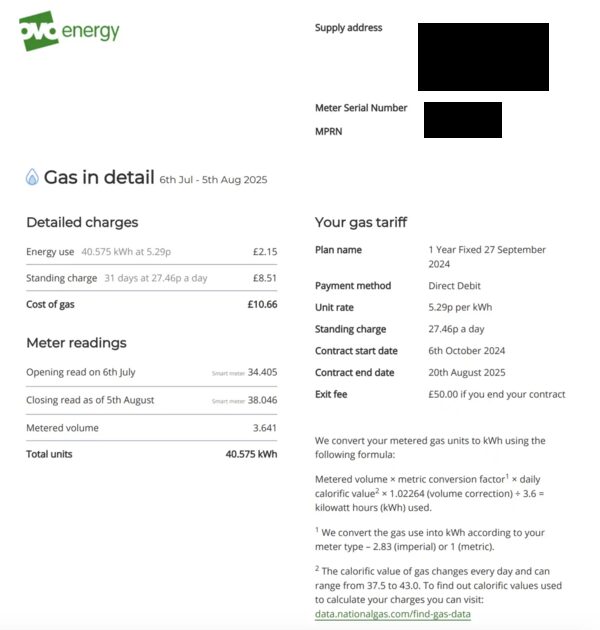
ECO is funded through a levy on energy bills.2 It was delivered and funded by energy suppliers, not general taxation, through a levy on household energy bills.17 Suppliers recover the cost of meeting their obligation from the customers they serve, which is why ECO appears in the breakdown of a standard variable tariff and in Ofgem's price cap. A £1 increase in the ECO allowance formed part of the cap changes for 1 April to 30 June 2025.20
The levy raises equal amounts from domestic gas and electricity bills, adding 0.3p to each unit of gas and 0.87p to each unit of electricity.4 Because a unit of electricity carries three times the levy rate of a unit of gas, ECO has had a side effect that matters for households moving away from fossil heating: it weighted the running cost of electric heating upwards relative to gas.4
What that came to per household depends on the estimate. One assessment puts it at around £40 to £45 per dual-fuel household each year.17 Another puts it at roughly £60 a year on the average household bill.21 When closure was announced, removing ECO from electricity bills was expected to cut the average household energy bill by about £59.18 These are different bases and different dates rather than a straightforward contradiction, but they are not reconcilable into a single number.
The distributional criticism is sharp. One analysis found that for 97 per cent of families in fuel poverty, the scheme has cost them more than it has saved, because every billpayer funded it while only a minority received a measure.18
How ECO worked across England, Scotland and Wales
ECO is an energy efficiency scheme for Great Britain.6 That is a hard boundary: Northern Ireland is outside the scheme entirely and households there rely on separate arrangements covered on the Northern Ireland grants page. Domestic households in Great Britain are eligible where they are considered to be in fuel poverty.7
The obligation rules themselves are set in GB-wide secondary legislation, so a supplier's duty is identical in Cardiff, Carlisle and Cumbernauld. Variation entered through the local authority flexible eligibility route, under which local authorities can set their own criteria for eligibility for funding for domestic energy efficiency measures, and must publish a statement of intent that defines who is eligible for funding before this can happen.22 Energy companies can spend up to a maximum of 10 per cent of their full obligation within these criteria.22 That is the mechanism explained in more detail under ECO4 Flex, and it is why two neighbouring councils could apply different income thresholds to identical houses.
The devolved governments engaged with ECO alongside their own programmes. The Welsh Government provided a further £500,000 of funding to support local authorities in 2024 to 2025, and in February 2025 Ofgem confirmed there were over 11,600 ECO Flex submissions made by Welsh local authorities.23 The Welsh Government also recorded the closure of the Energy Company Obligation and the Great British Insulation Scheme as announced by the Chancellor of the Exchequer in the autumn Budget.24 In Scotland, ECO has been described in government publications as a UK Government energy efficiency scheme designed to tackle fuel poverty and help reduce carbon emissions, and operated alongside the devolved fuel poverty programmes set out on the Scotland grants page.25 Equivalent routes in England and Wales are covered separately.
The rules: who is obligated and who could qualify
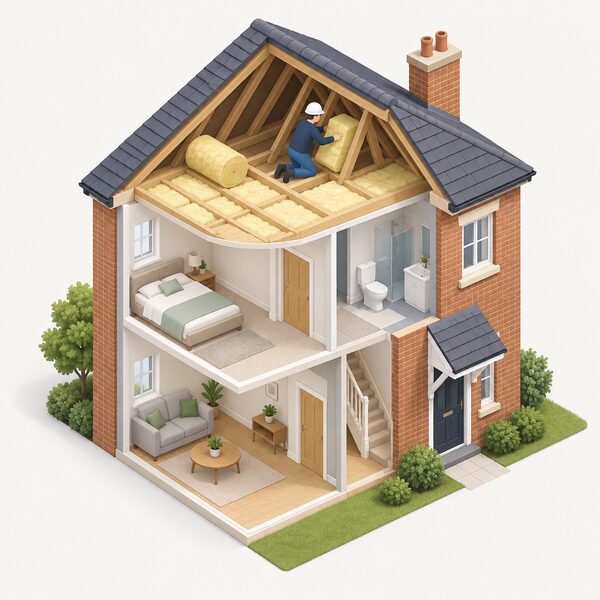
ECO places legal obligations on larger energy suppliers to deliver energy efficiency measures to domestic premises.9 The obligated parties are medium and large energy suppliers, carrying a Home Heating Cost Reduction Obligation, and the overall target is divided between suppliers based on their relative share of the domestic gas and electricity market.1 The carbon budget delivery plan describes it as a statutory obligation on energy suppliers with over 250,000 domestic customers who also deliver over a certain amount of electricity or gas.26 Legislation sets the thresholds precisely: a qualifying supply is defined by reference to the supply to domestic customers of 400 gigawatt hours of electricity, and a supplier which is not a group company and has notified a supply not exceeding a qualifying supply has obligations of zero for a phase.27 Which companies that captured is set out on the obligated suppliers page.
ECO4 sits on the Electricity and Gas (Energy Company Obligation) (Amendment) Order 2026 and the Electricity and Gas (Energy Company Obligation) (Amendment) (Specified Period) Order 2026.28 Measure eligibility will not change unless the legislation does.29
On the household side, the criteria were:
- Receipt of at least one qualifying benefit: Child Benefit, Pension Guarantee Credit, income-related Employment and Support Allowance, income-based Jobseeker's Allowance, Income Support, Universal Credit, Housing Benefit or Pension Credit Savings Credit.11 Tax Credits, both Child Tax Credits and Working Tax Credits, also appear in independent listings of the qualifying benefits.21
- A property that requires energy efficiency upgrades, with the specific measures determined by a retrofit assessment.11 Owner-occupier eligibility has been described locally as EPC bands D to G.30
- Ownership of the home, or permission from the landlord, including where the property is owned by a social housing provider or management company.11
- Grants and loans were made available for homeowner-occupiers, landlords and tenants for insulation works and heating installations.22
A household could contact any of the obligated energy suppliers to find out how they may be able to help, even if that supplier was not the household's own energy provider.11 Installers under ECO must be TrustMark accredited and will have a registration number, except in the case of installers of district heating connections.11 Fuller detail sits on the ECO4 eligibility and qualifying benefits pages.
Ofgem publishes monthly reports showing how energy suppliers are progressing towards their targets and the number and types of measures installed, and consults from time to time on how it administers aspects of the scheme.31 Complaints about an installation go through Ofgem's ECO4 complaints process; fraud is reported to counterfraud@ofgem.gov.uk, and general queries to eco@ofgem.gov.uk.31 The Energy Ombudsman, where a supplier complaint reaches deadlock, is independent of the energy company.33
Where ECO fell short: defective work and remediation
The closure decision was not only about money. Over 30,000 households have been left with defective installations, many facing damp, mould, stress and in some cases serious health and safety risks.34 The assessment offered was blunt:
"the Energy Company Obligation was allowed to operate within a system that was fragmented, poorly overseen and fundamentally unfit to protect vulnerable households"
Independent analysis identifies systemic failures in the scheme's design, which led to widespread failure of solid wall insulation measures, leaving many households exposed to damp and mould.21 Solid wall insulation was only 6 per cent of measures delivered, but it is the technically hardest and the one where poor workmanship does the most damage.3 A sum of £428 million has been earmarked for the scheme's wrap-up and remediation.34
The one month reporting rule was identified as creating challenging deadlines for the supply chain and very little flexibility or room for error, a pressure that ran through delivery from the early phases onward.35
What the closure means and what replaces it
ECO has been extended to 31 December 2026 to meet existing targets and remediate non-compliant installations.5 Existing applications continue to be processed until ECO ends, with an extra nine months for the work to be completed.21 Local material has described the current phase as running until 31 March 2026, which reflects the funding cut-off rather than the extended scheme end date; the current phase started in 2022 and was due to run until 31 March 2026.30
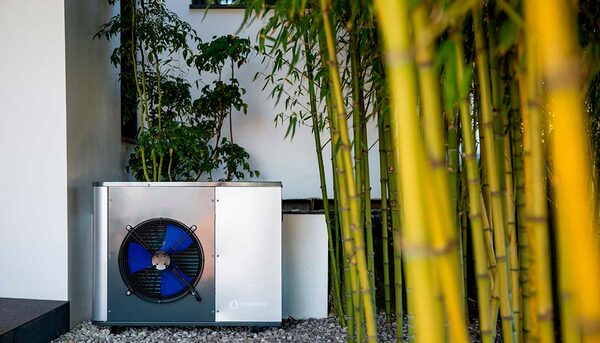
The remaining £1.5 billion set aside for ECO will be rolled into a new programme via direct taxation, a shift from levy funding to Exchequer funding.18 That change has consequences for the supply chain: almost 70,000 job losses are expected following the closure of ECO.36 ECO was responsible for 26 per cent of heat pump installations in the last year, and quarterly official statistics show ECO-supported heat pump installations of 4,173 in 2024 Q3, 3,425 in 2024 Q4, 3,403 in 2025 Q1, 3,223 in 2025 Q2 and 3,790 in 2025 Q3.36 ECO accounted for 31 per cent of government-supported heat pump installations in the year ending June 2025.39 Households looking at heat pumps now fall back on the Boiler Upgrade Scheme, and the Warm Homes: Local Grant covers part of the low-income territory ECO occupied. A parliamentary committee questioned whether the government was committed to ECO beyond 2026, when it was due to expire; the answer has since arrived.40
What supplier-funded retrofit did, and did not, do for independence
Judged as a route to household energy independence, ECO cuts both ways. Insulation is the one measure that reduces a home's demand permanently and without any ongoing relationship: a filled cavity or an insulated loft does not need an app, a tariff or a service contract, and it cannot be switched off remotely. On that count, 25 per cent cavity wall insulation and 18 per cent loft insulation across 4.4 million measures represents a real, durable reduction in how much energy 2.6 million homes must buy.3 ECO contributed directly to two central UK Government objectives, alleviating fuel poverty, and carbon reduction and net zero.17
Against that, the dependence the scheme created was substantial. Nothing about ECO was within a household's control. Suppliers decided which measures to fund, at what level, and which installers to use.11 Qualification never guaranteed an installation.21 The 21 per cent of measures that were new boilers and the 23 per cent that were other heating measures, mainly controls, largely reinforced gas heating rather than displacing it, which locks a home to the gas network for the life of the appliance.3 And because the whole thing was levy funded, every household paid regardless of whether it ever saw an installer: 0.87p on each electricity unit and 0.30p on each gas unit, weighted three to one against the electricity that heat pumps and electric heating run on.4
The failures compound the point. A household that received defective solid wall insulation and now faces damp holds no contract with the supplier that funded it and depends on the £428 million remediation fund to put matters right.34 Self-funded work, or work under a scheme where the householder contracts directly, leaves the household holding the remedy. The broader argument about what publicly and levy-funded schemes can and cannot deliver for a self-sufficient home is set out on the grants and energy independence page, and the full map of current and closed schemes sits at the home energy grants pillar.
Review of the obligation has been argued to be essential to maximise ECO's potential to help meet the statutory 2030 fuel poverty target.41 With ECO ending and its residual budget moving to direct taxation, that target now rests on a different set of instruments.
Sources41 cited
- Energy Company Obligation scheme overview, Ofgem, 2026-09-17
- Energy Company Obligation debate pack, House of Commons Library, 2026-09-20
- ECO and the Great British Insulation Scheme briefing, House of Commons Library, 2025-12
- Household energy bills and green levies, Nesta, 2026-09-20
- Energy Company Obligation briefing, House of Commons Library, 2026-05-13
- ECO4 guidance: new measures and products, Ofgem, 2026-03-26
- Heat pump deployment quarterly statistics, 2025 Q2, Department for Energy Security and Net Zero, 2025-09-04
- Spring Statement 2022, HM Treasury, 2022-03
- ECO4 scoring methodology decision, Ofgem, 2022-04-12
- Grants and funding for energy saving, Tameside Council, 2026-09-17
- ECO guidance for homeowners and tenants, Ofgem, 2026-09-17
- Microgeneration strategy for Scotland, Scottish Government, 2012-06-22
- What is ECO, CIGA, 2026-09-20
- Green Deal and Energy Company Obligation consultation, CIBSE, 2026-09-17
- Electricity and Gas (Energy Companies Obligation) Order 2012, legislation.gov.uk, 2012-12-04
- Electricity and Gas (Energy Company Obligation) Order 2018, legislation.gov.uk, 2018-11-12
- How ECO worked and why it mattered, AgilityEco, 2026-09-20
- ECO scheme to end after March 2026, Elmhurst Energy, 2025-11-27
- Energy efficiency of existing homes report, House of Commons Environmental Audit Committee, 2021-04-30
- Summary of changes to the energy price cap, 1 April to 30 June 2025, Ofgem, 2025
- Energy Company Obligation guide, Uswitch, 2026-06-30
- Energy efficiency advice, Torridge District Council, 2026-09-17
- Tackling fuel poverty: priority actions, Welsh Government, 2024-04
- Written statement on fuel poverty, Welsh Government, 2026-02-26
- Warmer Homes Scotland programme annual review 2018-19, Scottish Government, 2020-07-30
- Carbon Budget Delivery Plan, Department for Energy Security and Net Zero, 2023-03-30
- Electricity and Gas (Energy Company Obligation) Order 2014, legislation.gov.uk, 2014-12-04
- ECO4 new measures and products guidance: summary of updates, Ofgem, 2026-03-26
- Energy Companies Obligation: measures guidance, Ofgem, 2014-12-02
- Energy Company Obligation scheme and home energy efficiency, Leeds City Council, 2026-09-20
- ECO contacts, guidance and resources, Ofgem, 2026-09-17
- ECO consultations and feedback, Ofgem, 2026-09-17
- Eight week and deadlock letter guidance, Ofgem, 2020-02
- 30,000 homes hit by defective insulation, End Fuel Poverty Coalition, 2026-01-23
- Summary of consultation responses, Welsh Government, 2015-10-16
- Clean heat: supporting low income households, Energy UK, 2026-06-11
- Heat pump deployment quarterly statistics, 2024 Q3, Department for Energy Security and Net Zero, 2024
- Heat pump deployment quarterly statistics, 2025 Q3, Department for Energy Security and Net Zero, 2025-12-04
- Heat pump deployment quarterly statistics, year ending June 2025, Department for Energy Security and Net Zero, 2025-09-04
- Committee report on heating and energy schemes, House of Commons Energy Security and Net Zero Committee, 2025-05-09
- The future of the Energy Company Obligation, E3G, 2024-03-21
 Financing an InstallationPaying monthly for a boiler, solar panels, battery or heat pump sounds simple, but who actually lends you the money and what happens if the work goes wrong?
 Supplier Licensing and FailureWhat happens when your energy supplier goes bust?
 Green Energy TariffsDoes a green tariff really mean greener electricity comes into your home, or just that your supplier buys renewable certificates to match what you use?
 Grants and Energy IndependenceCan you get a grant for solar panels or a battery?
 Suppliers and IndependenceCan you really cut your energy bills by making your own power, and how much of your supplier do you still need?
 Financial Resilience RulesYour supplier going bust raises two questions: who takes over and what happens to your credit balance?