
In this guide
Applying for the Boiler Upgrade Scheme is not something a householder does directly. The scheme is installer-led: an installer certified by the Microgeneration Certification Scheme (MCS) applies to Ofgem for a grant voucher on the property owner's behalf, deducts the full grant value from the quote before any payment is made, and then redeems the voucher after the system has been installed and commissioned1. The owner's part is to choose an MCS certified installer, give consent and identity verification, and make sure the property and the system being replaced meet the rules.
The grant values are £7,500 for an air source heat pump, £9,000 for eligible off-gas grid properties applying for an air-to-water or ground source heat pump from 21 July 2026, £5,000 for a biomass boiler in a rural property, and £2,500 for an air-to-air heat pump3. Only properties in England and Wales are eligible, only one voucher can be redeemed per property, and the scheme has been extended to 20302. Ofgem administers it on behalf of the Gas and Electricity Markets Authority4.
The two hard timing rules are the ones most applications fail on. A voucher is valid for three months for air-to-water heat pumps, air-to-air heat pumps and biomass boilers, and six months for ground source heat pumps, and Ofgem states plainly that validity periods cannot be extended under any circumstances5. Separately, where an installer applies after the work is done, the application must be properly made within 120 days of the commissioning date2.
What the scheme is and who runs it
The Boiler Upgrade Scheme is a UK Government scheme providing upfront capital grants towards the cost of installing heat pumps and biomass boilers in homes and non-domestic buildings6. It launched on 23 May 2022, with vouchers issued from that date on eligible technologies installed from 1 April 20228. Its legal basis is the Boiler Upgrade Scheme (England and Wales) Regulations 2022, with grant categories and values approved by the Secretary of State under Regulation 139.
Ofgem is the scheme administrator, acting on behalf of the Gas and Electricity Markets Authority3. Ofgem checks eligibility, issues and revokes vouchers, pays installers, audits claims and publishes the scheme's reporting. MCS is a separate body: it certifies, quality assures and provides consumer protection for microgeneration installations and installers, covering technologies including heat pumps, biomass and solar photovoltaic panels2. The division matters when something goes wrong, because MCS is the contact for problems with the installation process, the installer, or an MCS certificate or product, while Ofgem handles the grant itself2.
Two dates for the scheme's life appear in the official record and they do not describe the same thing. Ofgem's installer guidance states that, as of 28 April 2026, the scheme has been extended to 20302. The government's grant finder listing gives a closing date of 30 December 2029, 11:59pm3. Both are official; the listing is the more precise statement of when applications stop.
For a household, the scheme reduces the capital cost of moving off gas, oil or LPG, but it does not remove dependence. The heat pump still draws electricity from the grid and a supplier, the grant is paid to a company rather than to the household, and the eligibility rules are set by government and can change: the government has said changes will be introduced via scheme regulations when parliamentary time allows.
Grant values: £7,500, £9,000, £5,000 and £2,500
| Technology | Grant | Conditions |
|---|---|---|
| Air source (air-to-water) heat pump | £7,5003 | Residential and non-residential properties2 |
| Air-to-water or ground source heat pump, off-gas grid | £9,0002 | From 21 July 2026 to 31 March 2027; previous system fuelled by oil or LPG; property not fuelled by mains gas2 |
| Ground source heat pump (including water source and shared ground loops) | £7,5002 | Where the uplift does not apply2 |
| Biomass boiler | £5,0006 | Rural properties only2 |
| Air-to-air heat pump | £2,5007 | Residential properties only2 |
The uplifted £9,000 value is time-limited and fuel-specific. It applies to eligible off-gas grid properties where the heating system being replaced was fuelled by oil or liquefied petroleum gas, and Ofgem states the uplift will be in place until 31 March 20272. Properties that do not qualify for the uplift may still be eligible for a grant of £7,5002.
Technical limits sit alongside the values. The maximum permitted capacity is 45 kWth for an individual heat pump system, 70 kWth for a multi heat pump system, and 300 kWth in total for shared ground loop systems with each connected heat pump not exceeding 45 kWth2. An individual biomass boiler system is capped at 45 kWth, and its emissions certificate must show particulate matter not exceeding 30g/GJ net heat input and NOx not exceeding 150 g/GJ net heat input2. Air-to-water and ground source heat pumps must achieve an in situ seasonal coefficient of performance of at least 2.82. All heating systems installed under the scheme must meet the relevant MCS standards approved and published by the Secretary of State, and the main heat-generating unit must always be new2.
For more on the values and how they have moved, see how much the Boiler Upgrade Scheme grant is.
Who qualifies: property, previous system and technology
Eligibility runs on three tests: where the property is, what it currently has, and what is being installed.
- Location. Only properties located in England and Wales are eligible2.
- Ownership. The applicant must own the property, which can include a business, a second home or a property rented out to tenants11. Owner-occupiers, private landlords and custom-builds are within scope9.
- Excluded properties. Social housing is not eligible, and that exclusion includes shared ownership properties12. New builds still being built by a developer are not eligible, although a household moving into a finished new build with a fossil fuel boiler may be able to get a grant for a heat pump13.
- Previous system. For retrofits, the system being replaced must have been fossil fuel based (gas, oil or LPG) or an electric heating system that does not include a heat pump12.
- One per property. Only one voucher can be redeemed per property, and a property is not eligible if a previous BUS grant has already been received for a heat pump or biomass boiler at the same address2.
- Self-builds. Eligible self-builds are those built mainly using the labour or resources of the first owner, and they qualify for heat pumps only, not biomass10.
The funded system must fully replace the property's existing fossil fuel or electric heating system, except where supplementary heating appliances are permitted4. From 28 April 2026, a BUS heat pump can be installed alongside supplementary heating appliances provided those appliances are not fossil fuel based2. That is why a hybrid arrangement pairing a gas boiler with a heat pump attracts no grant1.
The EPC position changed in 2026. From 28 April 2026, properties are no longer required to have a valid EPC to apply2. Where a property does have a valid EPC, the certificate number must be provided, and an EPC counts as valid if it is no more than 10 years old10. The government grant listing still carries the older statement that a property must have a valid energy performance certificate3, so the Ofgem installer guidance dated 2 July 2026 is the later position. Fuller detail sits on Boiler Upgrade Scheme eligibility.
The two stages: voucher application, then redemption
Ofgem describes the grant application as a two-stage process14. Each stage has its own checks and its own failure points.
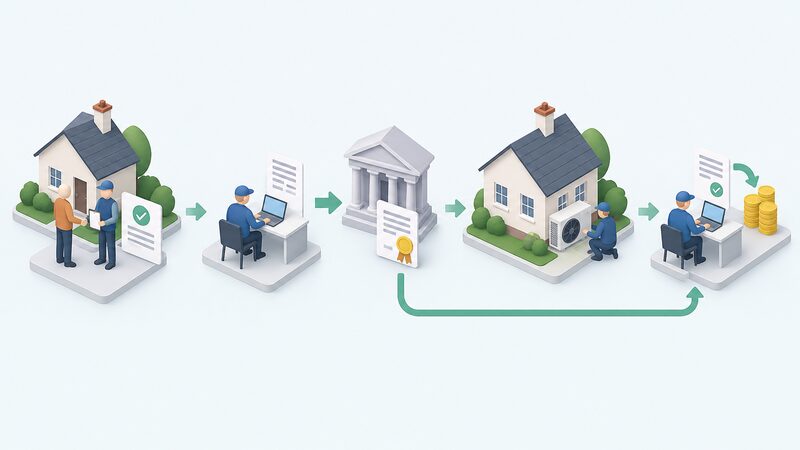
- Stage 1a, voucher application. The installer submits a voucher application and Ofgem checks whether the pre-installation eligibility criteria are met15.
- Stage 1b, voucher issued. If the application is successful, Ofgem issues the voucher15.
- Stage 2a, redemption application. Following commissioning of the installation, the installer submits a voucher redemption application15.
- Stage 2b, payment. Once Ofgem has established that the remaining eligibility requirements have been met, the grant payment is made to the installer15.
An installer must first create a Boiler Upgrade Scheme installer account on Ofgem's website, and it is installers that apply for the grant on behalf of their customers11. All BUS installations must be MCS certified17.
The phrase that governs everything downstream is "properly made". A voucher application is only considered properly made once Ofgem has all the necessary information to assess eligibility, and the property owner has provided consent and identity verification4. Until then the clock has not started and no place in the budget queue has been taken. Consent is therefore not a formality: it is the step that converts a submitted form into a live application. Where required insulation forms part of the picture, Ofgem's earlier property owner guidance stated it must be done by the time the installer submits a voucher redemption application after installing the new low carbon heating system16.
The grant is an upfront discount, not a cheque
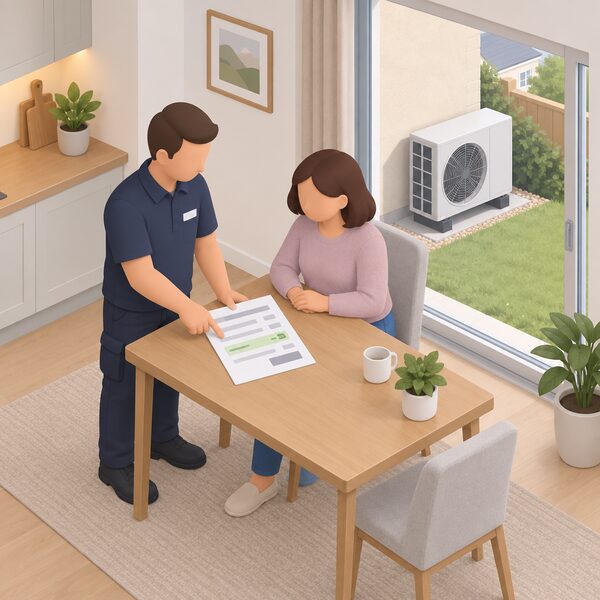
The money never passes through the household's hands. Ofgem's property owner guidance is explicit:
"The grant is applied upfront as a discount to the cost of your installation. You do not receive the grant directly, it is paid to your installer"
The installer guidance sets the corresponding duty on the trade: installers must deduct the full BUS grant value from the quote before any payment is made by the property owner2. So a quoted price should already be net of £7,500, £9,000, £5,000 or £2,500 as applicable, and a household paying the gross figure and expecting a refund has misread the mechanism.
This design has two consequences. First, the household carries no reclaim risk on the grant itself, because the discount has already been applied before any deposit changes hands. Second, the household is dependent on the installer completing stage 2 correctly: the payment is made to the installer after redemption, and Ofgem's guidance notes the point at which an installer should chase, being ten working days after notification of a successful voucher redemption application4. If payment to the installer fails, the commercial consequences sit between installer and Ofgem, not with the grant discount already given.
Voucher validity, the 120-day rule and re-applying
Two separate deadlines are often confused.
| Rule | Period | Applies to |
|---|---|---|
| Voucher validity, air-to-water, air-to-air, biomass | 3 months5 | Time to install, commission and redeem |
| Voucher validity, ground source heat pumps | 6 months5 | Time to install, commission and redeem |
| Retrospective application window | 120 days from commissioning2 | Applying after the work is done |
| Extension of validity | Not possible in any circumstances4 | All vouchers |
The validity period runs forward from issue. Ofgem's earlier guidance put it as the installer having three months from the date the application is approved to complete the installation in line with industry standards, register it with MCS and redeem the voucher16. The 120-day rule runs backwards from commissioning: an eligible new heat pump or biomass boiler must be commissioned no more than 120 days prior to the voucher application being properly made10. The Renewable Energy Consumer Code puts the same rule as heating systems commissioned up to 120 days before the application being entitled to support18. A 120-day limit after commissioning for submitting a redemption application was introduced from 8 May 202419.
If a voucher expires before the work is complete, the route is a new application, not an extension. Ofgem's guidance is unambiguous, stating that validity periods cannot be extended under any circumstances, while also confirming that a new application may be submitted if a voucher expires before work is complete16. There is one narrow relief: Ofgem may grant an extension to the 120-day commissioning rule where the length of time taken to reach certain administrative decisions results, or is likely to result, in the 120-day period being exceeded for a re-application4. That covers delay caused by the administration, not delay caused by the job. Timing questions are dealt with further on how long an installer has to redeem the voucher.
Budget, quarterly caps and the queue

Vouchers are issued on a first come, first served basis to applicants who meet the eligibility requirements, until the budget cap for the financial year is reached17. Queue position is based on when the voucher application is deemed properly made, which is why consent and identity verification carry practical weight rather than administrative weight alone4.
The scheme had an initial budget of £150m per financial year for 2022 to 20252. Funding then rose: a House of Commons briefing records the 2024/25 figure being increased by £30 million and a new, much higher budget of £295 million for 2025/267. Unspent budget is not carried over to the next scheme year15. Voucher caps operate by quarter, with quarters beginning 1 April, 1 July, 1 October and 1 January4.
The scheme's own reporting calendar uses different quarters again. Each scheme year runs from 1 April to 31 March, while the reporting quarters are 1 February to 30 April, 1 May to 31 July, 1 August to 31 October, and 1 November to 31 January20. Quarterly reports are published by 31 August for Q1, 30 November for Q2, 28 February for Q3 and 31 May for Q4, annual reports on 31 July each year, and Ofgem aims to publish monthly operational updates4. Those publications carry the remaining budget, which is the figure a household considering timing would look for2.
Demand has risen sharply against that budget. There were 11,256 applications to the scheme between January and March 2025, up 73% from the first quarter of 202421. Earlier, average monthly applications between November and April were up 49% after the grant increase9.
For the wider funding landscape, see the home energy grants pillar and grants and energy independence.
Combining with other schemes: the ECO4 boundary
Boiler Upgrade Scheme funding cannot simply be stacked on other government support for the same work. Ofgem's ECO4 delivery guidance states that funding from BUS and ECO cannot be blended for the same measure or be included within an ECO4 project22. The rule is broader than BUS alone: funding for measures delivered under ECO4 must not be blended with funding from other government schemes or grants, including but not limited to the Warm Home Discount, the Boiler Upgrade Scheme, the Social Housing Decarbonisation Fund and the Home Upgrade Grant23.
The practical effect is that a household eligible for both routes chooses one for a given measure. The routes differ in who pays and who qualifies: BUS is a government grant open to property owners in England and Wales regardless of income, while ECO4 is supplier-funded and targeted by benefits and property condition. The comparison is set out on Boiler Upgrade Scheme vs ECO4 and BUS or ECO4 for a heat pump.
Audits, compliance and challenging a decision
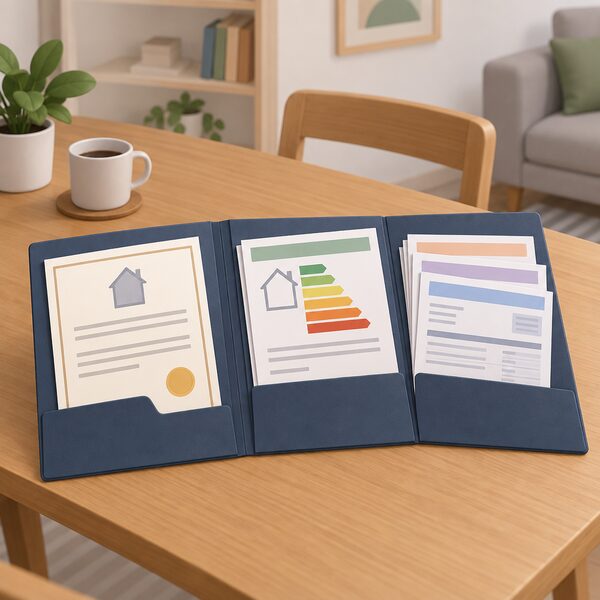
Ofgem can conduct site or desk audits at any point after a BUS application, including after grant payment10. Installers must keep all documentation relied upon in voucher applications and voucher redemption applications for six years from the date the application was properly made2.
Evidence Ofgem may ask for includes valid identification such as a passport or driving licence, proof of address, proof of property ownership, copies of MCS certificates, EPCs and EPC site notes, utility bills or fuel delivery receipts, photographs of the previous and installed heating systems, purchase receipts or quotes, total building heat loss calculations, and an emission certificate for a biomass boiler5. Property owners can provide documents directly to Ofgem at BUS.propertyowner@ofgem.gov.uk12.
Where non-compliance with the BUS regulations has occurred, the actions available to Ofgem include withholding payments, revoking vouchers, offsetting payments due, or seeking repayment16. If a voucher is revoked, Ofgem notifies the installer within 14 days of the decision, and revocation is among the decisions subject to a right of review24. A request for review must be received within 28 days of the date of the notice of the decision being reviewed24.
Complaints route by subject:
| Subject | Contact |
|---|---|
| General scheme queries | BUS.Enquiry@ofgem.gov.uk, 0330 053 20062 |
| Ofgem's administration of the scheme | feedback@ofgem.gov.uk2 |
| Suspected fraud or misuse | counterfraud@ofgem.gov.uk5 |
| Scheme policy, including eligibility criteria | boilerupgradescheme@energysecurity.gov.uk2 |
| Installation, installer, MCS certificate or product | MCS2 |
Recipients who say they are not satisfied are provided with information on the complaints process for their installation and routes to redress if necessary [23 not used]. MCS reports that recipients who say they are not satisfied are given information on the complaints process for their installation and routes to redress where necessary21.
What the grant does, and does not do, for independence
The scheme cuts the capital barrier to leaving gas, oil or LPG behind. A household on oil or LPG off the gas grid can take up to £9,000 against an air-to-water or ground source heat pump until 31 March 2027, removing the delivery contract, the tank and the exposure to fuel deliveries2. That is a genuine shift in where a home's heat comes from.
The dependencies that remain are real and should be stated. The heat pump runs on grid electricity bought from a supplier. The grant is paid to the installer, not the household, so the household relies on an MCS certified company completing a two-stage administrative process correctly12. Eligibility depends on continuing government policy and on a budget that is capped annually and not carried over15. Only one voucher can be redeemed per property, so the decision is effectively once per address2. And the scheme covers England and Wales only: Scotland and Northern Ireland households need Scottish or Northern Irish routes instead2.
Sources24 cited
- Boiler Upgrade Scheme: what you can get, GOV.UK, 2026-09-17
- Boiler Upgrade Scheme guidance for installers v5.1, Ofgem, 2026-07-02
- Boiler Upgrade Scheme grant listing, Find a Grant, 2026-09-18
- Boiler Upgrade Scheme guidance for installers v5, Ofgem, 2026-04-28
- Boiler Upgrade Scheme guidance for property owners, draft v5, Ofgem, 2026-03-25
- Boiler Upgrade Scheme overview, Ofgem, 2026-09-17
- Boiler Upgrade Scheme research briefing, House of Commons Library, 2026-09-17
- Boiler Upgrade Scheme annual report April 2025 to March 2026, Ofgem, 2026-07-31
- Rooftop solar for new builds to save people money, GOV.UK, 2025-06-06
- Boiler Upgrade Scheme: installers, Ofgem, 2026-09-17
- Boiler Upgrade Scheme information for installers, MCS, 2026-07-21
- Boiler Upgrade Scheme guidance for property owners v5, Ofgem, 2026-04-28
- Boiler Upgrade Scheme: check if you're eligible, GOV.UK, 2026-09-17
- Boiler Upgrade Scheme quarterly report issue 14, Ofgem, 2025-11-26
- Boiler Upgrade Scheme quarterly report issue 13, Ofgem, 2025-08-29
- Boiler Upgrade Scheme guidance for property owners v2.3, Ofgem, 2023-09-25
- Boiler Upgrade Scheme statistics July 2026, GOV.UK, 2026-08-27
- Boiler Upgrade Scheme guidance for members, RECC, 2026-09-17
- Boiler Upgrade Scheme annual report 2024 to 2025, Ofgem, 2024-05-08
- Boiler Upgrade Scheme quarterly report issue 15, Ofgem, 2026-02-27
- MCS outreach on Boiler Upgrade Scheme installations, MCS, 2026-02-02
- ECO4 delivery guidance v3.2, Ofgem, 2025-12-08
- Energy Company Obligation: homeowners and tenants, Ofgem, 2026-09-17
- Boiler Upgrade Scheme guidance for installers v2.1, Ofgem, 2023-05-18
 Hybrid Heat PumpsHow hybrid systems pair a heat pump with a gas, oil or LPG boiler, what decides which appliance runs, what they cost, how much gas they displace, and why the Boiler Upgrade Scheme will not fund them.
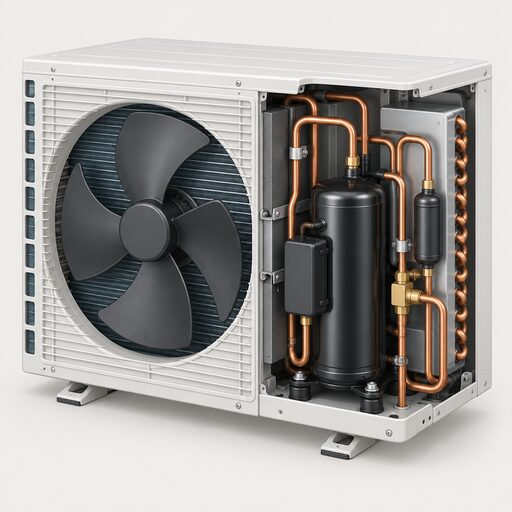 Air Source Heat PumpsHow an air source heat pump takes heat from outdoor air, the difference between air-to-air and air-to-water systems, typical efficiency, the £7,500 Boiler Upgrade Scheme grant, noise and planning limits, and what ownership means for a household's energy independence.
 Apply for a Home Energy GrantThe application sequence common to funded schemes: the checker, the survey or assessment, the installer, the paperwork and the sign-off.
 Financing an InstallationPaying monthly for a boiler, solar panels, battery or heat pump sounds simple, but who actually lends you the money and what happens if the work goes wrong?
 Buying Direct or Via InstallerCan you buy a heat pump yourself and still get the grant, or does it have to go through an installer?
 Replacing a Gas or Oil BoilerSwapping a gas, oil or LPG boiler for a heat pump changes how your home is heated and how much it costs.