
In this guide
There are two ways a UK household ends up with a heat pump: buy the unit and arrange the work, or buy the whole job from a firm that supplies and installs it. The second route is the one the state is built around. The Boiler Upgrade Scheme is installer-led, with the installer applying for the grant on the property owner's behalf, discounting it from the invoice, applying to Ofgem for a voucher and redeeming that voucher after installation and commissioning1. Homeowners do not apply directly2.
That single design decision shapes everything else. Certification, commissioning, grant eligibility and the question of who is liable when a system underperforms all attach to the installation, not to the box. A household can buy a heat pump outright, and units are sold through merchants, distributors and online retail, but the compliance paperwork cannot be bought off the shelf alongside it.
The UK market itself is mixed. Of heat pumps sold in the UK, the UK manufactures around one third, with two thirds imported, and the domestic share is predicted to grow to around one half of heat pumps manufactured in the UK by 20303. There are at least 33 manufacturers supplying air source heat pumps in the UK, with Mitsubishi Electric, Vaillant, Daikin and Samsung accounting for nearly two-thirds of total annual UK sales4. Choice of brand is wide; choice of route is narrower than it looks.
Buying direct or through an installer: the two routes at a glance
The direct route means the household or its contractor sources the unit, then finds someone to design, install and commission it. The installer route means one firm carries the design, the supply, the fitting, the commissioning and the certification, and usually the grant administration as well.
The practical difference is not the hardware. It is who holds the design responsibility and who signs the compliance documents. Under the installer route, the firm that quotes is the firm that answers for the sizing, the emitter circuit and the commissioning record. Under the direct route, those responsibilities split, and the household has to decide which party owns which.
The grant is the clearest illustration. The application is installer-led, with the installer applying for the grant on the property owner's behalf4. The installer discounts the grant from the invoice, applies to Ofgem for a grant voucher, and redeems the voucher after installation and commissioning4. A household that buys a unit itself and then hires an installer has to establish, before any money changes hands, whether that installer will run the voucher process.
There is also a legal condition that catches some finance arrangements. To be eligible for the Boiler Upgrade Scheme, the owner must become the legal owner of the new heat pump or biomass boiler once installed, and third-party ownership finance arrangements are not eligible5. A lease or rental model for the heat pump itself therefore sits outside the scheme, whichever route supplies the unit.
What buying direct from a manufacturer actually involves
Buying direct is not one thing. It covers buying from a manufacturer's own online shop, buying through a merchant that holds trade accounts, and buying a unit that a manufacturer's own installation arm then fits. The last of these is not really self-supply at all: it is the installer route with the manufacturer as the installer.
The market structure explains why direct supply exists. Manufacturers are required to meet a target of 6% of sales with heat pumps or acquire credits from 1 April 2026 under the Clean Heat Market Mechanism9. That obligation pushes manufacturers to move units, and it creates commercial pressure to sell through more channels, including direct. Support is also available for installers and manufacturers to expand supply chains10.
What direct supply does not include is the design. A heat pump is defined in legislation as a device or installation that extracts heat at low temperature from air, water or earth and supplies the heat to the building11, and in later European legislation as a machine, device or installation that transfers heat from natural surroundings such as air, water or ground to buildings or industrial applications by reversing the natural flow of heat such that it flows from a lower to a higher temperature12. Both definitions describe the unit. Neither describes the system.
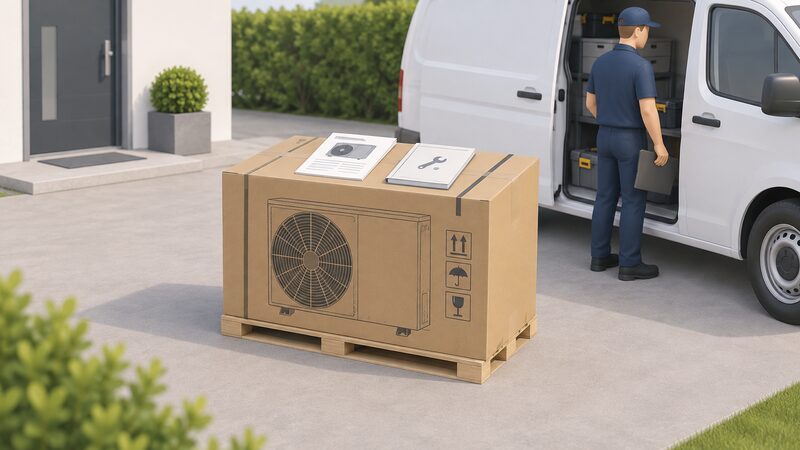
That gap is where the household's exposure sits. A unit bought as a box arrives with a datasheet and a set of installation instructions. It does not arrive with a heat loss calculation, a design flow temperature, an emitter schedule or a commissioning record. Those are the documents that make the installation lawful and the warranty defensible, and they are produced by whoever takes on the design.
What an installer route includes beyond the box price

The installer route bundles work that is invisible in a unit price. The most obvious is the ground or external works. For a ground source heat pump, the installer will usually dig trenches for the pipes, and boreholes are more expensive than trenches if there is little outdoor space13. That is a civil engineering decision made before any hardware is ordered.
The second is certification. Building regulations approval is not needed where an installer registered with a competent person scheme does the work13. All members of MCS are registered with a competent person scheme, and MCS is a quality scheme recognised by the government13. That membership is what converts a job into a self-certified one.
The third is the network notification. Every time an installer or customer installs a heat pump at an existing property, they must inform their network operator accordingly14. Anyone competent to install a heat pump can submit the form, including an installer working on behalf of the customer14, so the duty can be discharged by either party, but it must be discharged.
The fourth is the grant administration described above, and the fifth is the commissioning record. Heat pumps and any dedicated ancillary products such as integrated hot water storage vessels should be commissioned in accordance with both the manufacturer's instructions and the appropriate system design parameters6. A commissioning that follows the instructions but ignores the design parameters is not a compliant one.
| What the installer route carries | What direct supply leaves with the household |
|---|---|
| Heat loss calculation and system design | Must be commissioned separately |
| Building regulations certification via a competent person scheme13 | Separate approval route if the installer is not registered |
| Network operator notification14 | Can be submitted by either party14 |
| Grant voucher application and redemption4 | Depends on the installer agreeing to run it |
| Commissioning to design parameters6 | Depends on who holds the design |
Cost: where each route can be cheaper, and where it is not
No published unit prices are available for the products in this market, so any claim that direct supply is cheaper per kilowatt rests on installer-quoted figures rather than a published list. What can be said is where the costs sit.
Running costs are a separate question from purchase route, and the evidence is more settled. Running costs for heat pumps are typically lower when compared to those of traditional gas boilers, though the same official guidance notes that this depends on the system being set up correctly15. Energy Saving Trust's latest research shows that by switching to a heat pump time-of-use tariff, running costs can be reduced significantly16. Neither of those findings depends on whether the unit was bought direct or through an installer, but both depend on the system being designed and commissioned properly, which is the part direct supply does not include.
The grant is where the routes diverge most sharply on money. Because the installer discounts the grant from the invoice and redeems the voucher afterwards4, the household never handles the grant cash under the installer route. Under a split arrangement, the household has to establish whether the installer will run that process at all, and if not, whether the installation can still meet the scheme rules.
There is a VAT dimension that applies to grant-funded heating supplies, and HMRC publishes internal guidance on the treatment of energy saving materials and grant-funded heating supplies17. The VAT position on a given job is a matter for the supplier and its adviser, and it differs between a supply-and-install contract and a supply-only purchase.
Design and sizing: who is responsible on each route
Sizing is the single most consequential technical decision, and it is a design responsibility rather than a supply one. Official guidance is direct: make sure the heat pump is properly sized for your building's heating needs, because an undersized unit may struggle to meet demand, while an oversized unit may cycle on and off often and lessen efficiency18. Both failure modes are design failures, not manufacturing ones.
Under the installer route, the firm that quotes owns that calculation. Under direct supply, the household has to place it somewhere. If the installer produces the design, the installer owns the sizing. If the household supplies a unit sized on its own estimate, the household owns it, and the manufacturer's warranty conditions on commissioning to the appropriate system design parameters become harder to satisfy6.
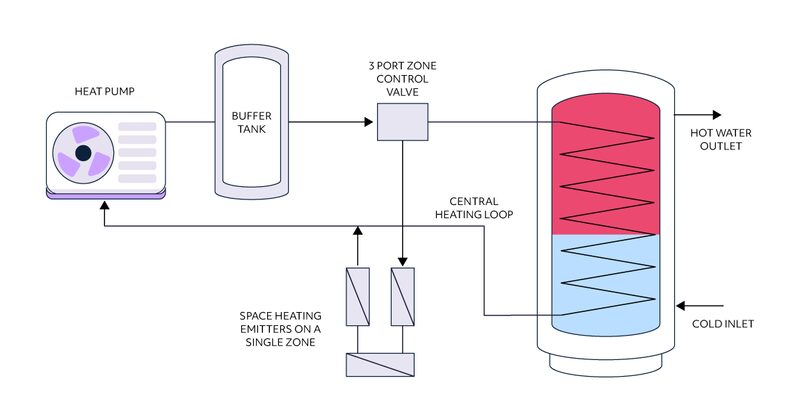
The approved document framework sets out what the dwelling owner should receive. Operating and maintenance information provided to the dwelling owner should include the heat loss calculation, the design flow temperature, competent person scheme confirmation, the size of the emitter circuit and minimum set back temperatures6. That list is the practical test of whether a design was done at all. A household that receives a unit and an invoice but none of those items has bought hardware, not a system.
Planning sits alongside design, and it differs across the UK. Installation of an air source heat pump is permitted development in England8. In Scotland, domestic air source heat pumps are subject to prior notification to the planning authority on siting and design19. Guidance for Wales points to the current planning regulations for the different types of heat pump20, and Northern Ireland publishes its own heat pump guidance18. Siting decisions therefore have a regulatory dimension that a box purchase does not address.
Installation, commissioning and certification

Certification of heat pump installation work follows one of two procedures: self-certification by a registered competent person, or certification by a building control body6. The first is the route that competent person scheme membership unlocks. The second is the fallback where the installer is not registered.
Where a registered competent person does the work, the installer should install and commission the system to the standards set out in the approved document6, and the certificate, or a copy of the information on it, must be given to the building control authority6. That submission is what closes the loop with the regulator.
Commissioning is the point where the manufacturer's conditions and the building regulations meet. Heat pumps and any dedicated ancillary products such as integrated hot water storage vessels should be commissioned in accordance with both the manufacturer's instructions and the appropriate system design parameters6. A commissioning that satisfies one but not the other leaves a gap that can be raised later, either by a warranty assessor or by a building control body.
For households considering a self-supplied unit, the practical question is which of the two certification routes the installer can offer. An installer who belongs to the Microgeneration Certification Scheme or the relevant competent person scheme can self-certify21. An installer outside those schemes cannot, and the job then needs a building control body, which is a different process with different timing.
Warranty, registration and who you claim against
The warranty sits with the manufacturer and the product, and the conditions attached to it usually depend on correct commissioning and registration. That is why the commissioning record matters more than the sales channel. A unit bought direct and commissioned to the manufacturer's instructions and the appropriate system design parameters is in a stronger position than one bought through an installer and commissioned to neither.
Some offers bundle warranty length with a service relationship. Good Energy offers Midea heat pumps with a 10-year warranty and remote monitoring and diagnostics, and holds Which? Trusted Trader status22. That is a maker and supplier claim about its own product and its own offer, and it illustrates the pattern: longer warranty terms tend to come attached to a monitoring or service relationship rather than to a box.
Registration is the step households most often miss. Registering a warranty and keeping it valid is a process in its own right, and the conditions vary by manufacturer. The general principle is that the registration record and the commissioning record have to agree, because a claim is assessed against both.
Who the household claims against depends on what failed. A manufacturing defect is a claim against the maker. A design fault is a claim against whoever produced the design. An installation fault is a claim against the installer. Under the installer route those three parties are often the same firm, which simplifies the claim. Under direct supply they are usually different, and the household has to establish which one applies before making contact.
Servicing, support and spare parts over ownership
Ownership runs for a decade or more, and the support arrangements matter as much as the purchase. Some suppliers install and service heat pumps regardless of whether the household buys its energy from them. Octopus Energy supplies and installs heat pumps, including to non-customers22. That is a service relationship independent of the energy account.
Manufacturer service plans and technical support are separate products. Manufacturer service and maintenance plans vary in what they cover, and manufacturer technical support and spare parts arrangements determine how quickly a fault can be resolved. A household that buys a unit direct and then needs a part has to establish whether the maker supports direct purchasers in the same way it supports its accredited installer network.
The accredited network is the mechanism most makers use. Manufacturer installer networks and accredited schemes exist precisely because the maker wants the installation done to its own standard, and membership usually carries training, access to technical support and sometimes extended warranty terms. Buying outside that network does not remove the product warranty, but it can change the level of support available.
Firmware and app support is the newer dimension. Firmware updates and product support life determine how long a connected heat pump or its controls remain fully functional, and a unit whose app support ends is not the same product it was at installation. That risk attaches to the product, not the route, but it is worth weighing when a longer warranty is offered in exchange for a monitoring relationship.

Which route suits which household

The choice turns on how much of the design and compliance work the household wants to hold. Air source heat pumps are the most common type of domestic heat pump in the UK and are suitable for most types of homes16. They are also easier and cheaper to install than a ground source heat pump because they do not use buried pipes23. For most households, the technical case for air source is settled, and the route question is about paperwork and liability rather than technology.
Ground source changes the calculation. It needs trenches or a borehole, and boreholes are more expensive than trenches where outdoor space is limited13. That is a design and civil works decision that sits naturally with an installer who carries the whole job. Ground source heat pumps transfer energy from the natural heat stored in the earth to heat the home and domestic hot water17, and the ground array design is not something a box purchase addresses.
The installer route suits households that want the grant, the certification and the design handled in one place, and that value a single point of claim if something goes wrong. The direct route suits households with access to a designer and an installer willing to work with a self-supplied unit, and with the appetite to hold the interfaces between them. In both cases the same three questions decide the outcome: who produced the heat loss calculation, who commissioned the system, and who holds the certificate.
Before accepting any quote, the evidence points the same way. Independent guidance recommends getting quotes from at least three different installers to make sure you are getting the best value for money16, and official guidance recommends getting at least three installers to quote so that costs and design can be compared7. Citizens Advice advises getting at least three quotes to make sure you are getting a fair price13. Comparing design as well as price is the point, because the design is what the household will live with.
Sources23 cited
- Boiler Upgrade Scheme: information for installers, Ofgem, 2026-09-18
- £5 million to help Welsh households invest in greener homes, Welsh Government, 2026-03-05
- Raising minimum standards for heat pumps: options assessment, Department for Energy Security and Net Zero, 2024-11-27
- Boiler Upgrade Scheme, GOV.UK, 2026-09-18
- BUS guidance for property owners v5 draft, Ofgem, 2026-03-25
- Approved Document L Volume 1: Dwellings, HM Government, 2026
- Heat pumps explained: experts answer your questions, GOV.UK, 2024-03-28
- Air and ground source heat pumps, London Borough of Croydon, 2026-09-17
- Carbon Budget and Growth Delivery Plan: heat and buildings factsheet, GOV.UK, 2026
- Postnote 699: heat pumps, Parliamentary Office of Science and Technology, 2026-09-19
- Directive 2002/91/EC, legislation.gov.uk, 2002-12-16
- Directive 2010/31/EU, legislation.gov.uk, 2010-05-19
- Deciding if a heat pump is right for you, Citizens Advice, 2025-12-08
- Frequently asked questions about connecting to the networks, Energy Networks Association, 2026-09-17
- What impact can heat pumps have in domestic heating today, GOV.UK, 2023-11-21
- Air source heat pumps, Energy Saving Trust, 2026-07-16
- VAT on energy saving materials and grant funded heating supplies, HM Revenue and Customs
- Heat pumps, nidirect, 2025-02-24
- The Town and Country Planning (Scotland) Amendment Order 2016, legislation.gov.uk, 2015-11
- Generating your own energy: heat pumps, Welsh Government, 2018
- Building regulations, Planning Portal, 2026-09-17
- Air source heat pump costs and savings, Which?, 2026-04-14
- Fact sheet 5: air source heat pumps, Pendle Borough Council, 2026-09-17
 Buying Energy Equipment OnlineWho fits your solar panels, battery or heat pump when you buy them online, and who puts things right if they go wrong?
 Support and Spare PartsYour solar inverter or heat pump has broken down.
 Financing an InstallationPaying monthly for a boiler, solar panels, battery or heat pump sounds simple, but who actually lends you the money and what happens if the work goes wrong?
 The Full Brands GuideWhich boiler, heat pump or solar brand can you trust, and who actually owns it?
 Manufacturer Approved NetworksDoes an approved installer badge mean better work, or just a longer warranty on the boiler or heat pump?
 Installing Heating ControlsSwapping a thermostat or programmer looks simple, but which jobs can you safely do yourself and which need a registered installer?