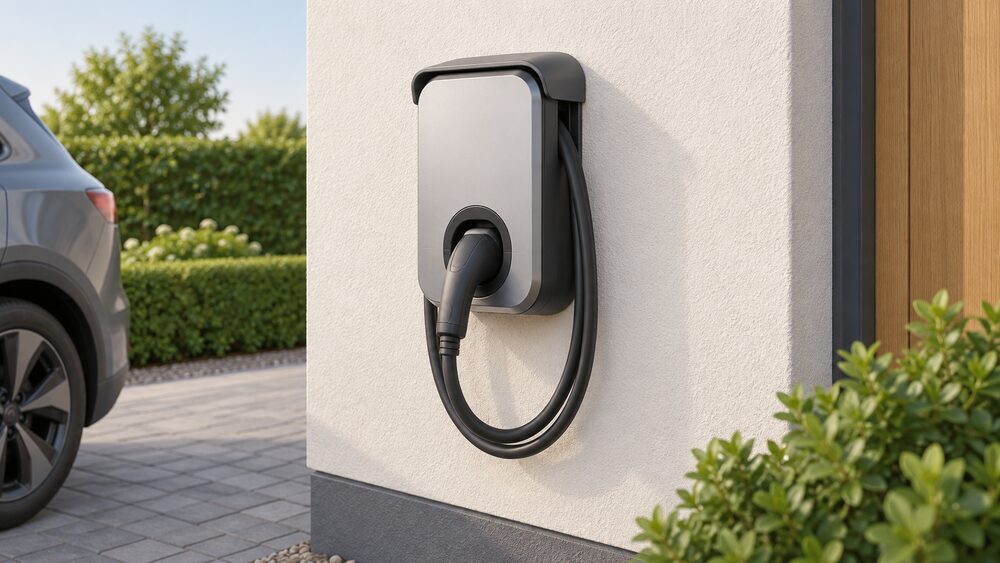
In this guide
More than 50 manufacturers supply charging units suitable for EV charging at home in the UK1. That is a crowded market for what is, electrically, a fairly simple device: a wall-mounted contactor, protective devices, a metering and control board, and a Type 2 connection to the car. The differences that matter to a household are power rating, whether the cable is attached, how well the enclosure survives outdoors, and what the charger's software and app do with tariffs, solar and the home's spare supply capacity.
The installed base is large. Zapmap estimates around 1.4 million chargers at UK homes with driveways as of the end of 20252, while Citizens Advice puts the figure at around 1 million home EV chargers3 and Zapmap counts more than one million charge points installed at home or work4. The estimates differ because there is no official register of home charge devices in the UK: the numbers are modelled from past government scheme data, vehicle registrations and survey work2. For comparison, the public network reached 121,171 public EV chargers on 1 July 20265. Home charging remains the dominant mode: most electric car charging in the UK is done at home, and 82% of EV drivers have access to charging at home6.
Prices for the equipment plus installation are quoted in a fairly narrow band. Which? puts the typical cost to buy and install a home charger at £500 to £1,200, with around £900 for a 7kW unit, as read in February 20267. Planning Portal guidance cites research showing installation costs from £450 for a basic model rising to around £1,200 as power and capability increase8.
A market of more than 50 manufacturers
No single body publishes a definitive list of domestic charger brands sold in Britain. The count of more than 50 manufacturers providing home-suitable units1 sits alongside a vehicle market of 51 manufacturers now offering EVs, so the number of charger brands is broadly comparable to the number of car brands a household might be choosing between. Under the grant schemes that preceded the current arrangements, a list of approved manufacturers and models was published on gov.uk, which was for a long time the closest thing to an official roster of domestic units.
The manufacturers fall into recognisable groups. There are dedicated charging specialists whose only product is the wallbox and its app. There are solar and storage companies adding a charger to an existing home energy range: Sofar Solar lists an AC unit, Fox ESS sells a C Series charger, Enphase offers both an IQ EV Charger and an IQ Bidirectional unit, and Haier's HVAC arm lists an EV charger among its energy products. There are electrical accessory and wiring-device manufacturers, of the kind covered on electrical component manufacturers, bringing a charger into a catalogue of consumer units and switchgear, Sync Energy's Link range being one example. And there are open-source and specialist suppliers such as the emonEVSE, offered in 7kW single-phase and 22kW three-phase forms10.
For a household, the practical consequence of that variety is dependence. A charger is not a dumb appliance: scheduling, solar diversion and tariff response run through a manufacturer's cloud and app, so the brand's continued existence and its firmware support matter over the life of the unit. That is the same exposure described on firmware updates and product support life.

UK-made and imported: where the units come from
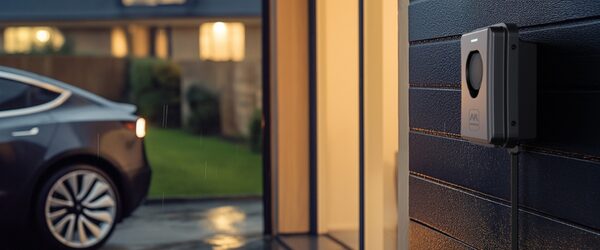
Most brands on the UK market assemble overseas, and no published breakdown of manufacturing country covers the domestic charger sector as a whole. There are British-built exceptions: the VEVA 7.4kW single-phase charger is described as a UK manufactured unit11. Buyers who care about origin have to check model by model, since a British brand name is not evidence of British assembly, a point developed on where home energy products are made.
Origin matters less for the hardware than for support. A charger installed on a driveway is expected to work for years in British weather, and the parts, firmware and warranty handling behind it sit with whoever owns the brand. Where a distributor imports a unit under its own label, the chain between the householder and the factory lengthens. The issues are those set out on manufacturer support and spare parts and manufacturer failures and orphaned products.
Power ratings: 7.4kW single-phase against 22kW three-phase
For a typical UK home, the maximum EV charger power is 7.4kW7. That ceiling is set by the supply: most houses have a single-phase connection, and 7kW or 7.4kW is what a 32A single-phase circuit delivers. A 7kW charger is the most common choice for home charging in the UK12, and most UK homes opt for a 7kW unit compatible with standard single-phase supplies13. Which? notes that a 7.4kW charger is what gets reasonable charging times from a domestic installation.
Faster units exist. Mode 3 charging at three-phase runs to 22 kW14, and home chargers up to 22kW are available but need a three-phase supply, which most homes do not have15. Where three phases are present, some products cover both: the emonEVSE is offered as 7kW single-phase or 22kW three-phase10, and one maker's range spans 7kW, 11 kW and 22kW16. Manufacturer documentation sometimes disagrees with itself on which rating a given model carries, so the rating on the specific unit being quoted is what counts.
| Rating | Supply needed | Position in the UK market |
|---|---|---|
| 7kW / 7.4kW | Single-phase | Most common choice for home charging12; the maximum for a typical UK home7 |
| 11kW | Three-phase | Offered within multi-rating ranges16 |
| 22kW | Three-phase | Significantly faster12; the most expensive class of home charger7 |
Power is also limited by what the house can take. EV chargers and other low-carbon technologies can push a home's electricity demand above the available supply, which may require an upgrade17. This is why load management features, which throttle charging when the rest of the house is drawing heavily, appear across manufacturer ranges: they let a charger coexist with an electric shower, a hob and a heat pump without tripping the main fuse.
Tethered or untethered: which cable arrangement suits which household
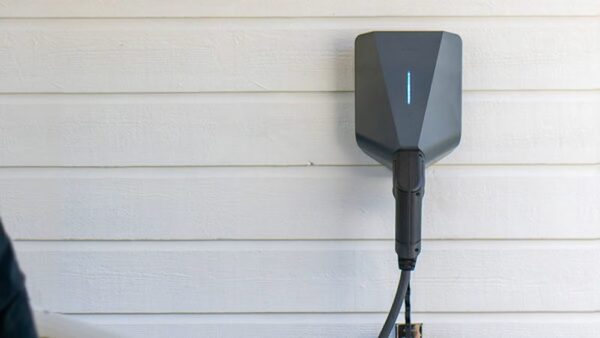
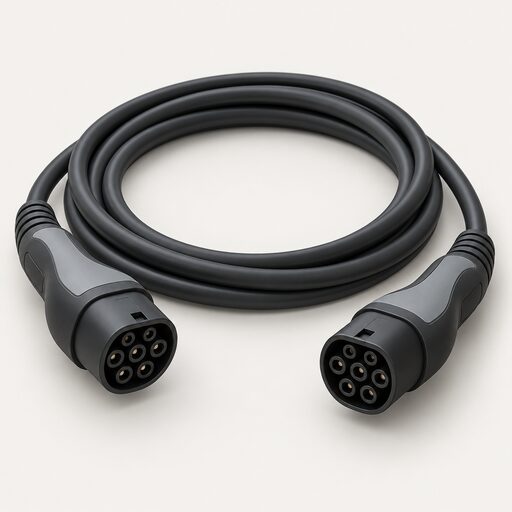
Tethered chargers come with a cable and connector permanently installed, while untethered chargers have only a socket into which the driver plugs their own cable18. Both arrangements are offered across the market: evec, for instance, makes each single-phase unit available as either tethered or untethered19.
- Tethered units have a permanent lead and connector attached20. The cable is always there, which suits a household with one car and a settled parking spot, and there is nothing to store in the boot.
- Untethered units present a universal socket, usually Type 2 in the UK21. The household supplies the cable, which means a damaged cable is replaced rather than the whole unit, and a different connector can be used if a future car needs one.
Almost all electric cars are supplied by the manufacturer with a cable carrying a Type 2 connector at the charger end22, so an untethered wallbox is usable from day one with most vehicles. On the public network the same pattern holds: most standard AC units are untethered and the driver uses their own cable23.
The choice has a small independence dimension. A tethered charger ties the household to one connector standard for the life of the unit; an untethered one keeps the interface swappable. Against that, a fixed cable is one less item to lose or forget.
The Type 2 connector and what it means for compatibility
Type 2, also known as Mennekes, is the standard for EVs in the UK and Europe for home and public AC charging23. The EU mandated that all plug-in cars from 2014 must have a Type 2 socket, which is why it is by far the most common type in the UK7. It is described as compatible with nearly all modern EVs24, and most modern electric vehicles sold in the UK use Type 2 for AC home charging21. Manufacturer specifications reflect this: the Sync Energy Link charger with metal unit lists a Type 2 plug and a Type 2 single-phase socket25.
For a household this is one of the few genuinely settled parts of the system. A Type 2 wallbox is not tied to a car brand, so replacing the vehicle does not usually mean replacing the charger.
Weatherproofing and build: IP54 minimum, IP65 and IK10 in practice
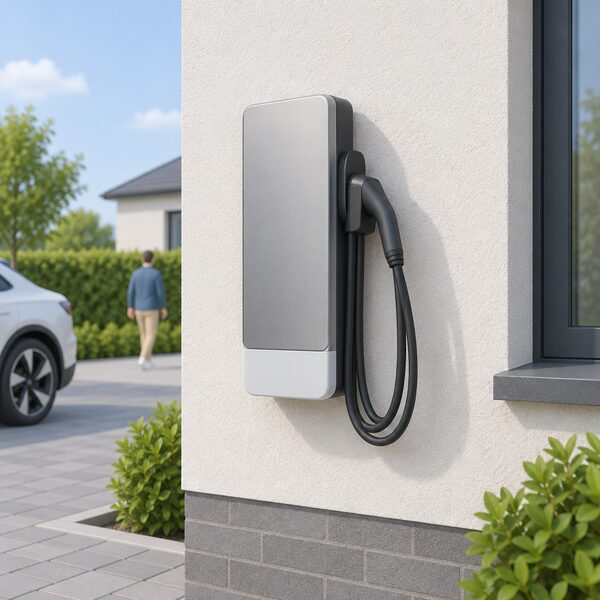
Outdoor EV chargers must be rated at least IP54, and most commercial units are IP54 or IP65 as standard9. IP is the ingress protection rating for dust and water; IK is the impact rating, with IK10 the highest figure commonly quoted on domestic units.
| Model | IP rating | IK rating | Other environmental claims |
|---|---|---|---|
| Sofar EV11K-AC-02 | IP6526 | IK1026 | UV resistant, stated capable of withstanding harsh environments26 |
| Fox ESS C Series | IP5527 | IK1027 | Maker states this supports reliable performance27 |
| Enphase IQ Bidirectional EV Charger | IP5528 | not stated | CE certified, UV resistant, temperature tested for -30°C to 55°C28 |
| Sync Energy Link with metal unit | IP6525 | IK1025 | Aluminium housing, polycarbonate base, operating temperature -25 to +55°C25 |
Materials follow the rating. The Sync Energy Link charger with metal unit uses an aluminium housing on a polycarbonate base with a matt finish, and measures 568x247x151mm25. Aluminium housings are common on units intended for exposed walls, where an all-plastic enclosure is more vulnerable to impact and ultraviolet degradation over a decade outdoors.
Ratings within a maker's own literature are not always consistent, with the same charger described as IP65 in one place and IP54 in another, so the datasheet for the exact model is the reference. For context on how to read such figures like for like, see comparing manufacturer specifications. Note that a general-purpose outdoor wall socket is expected to carry IP66 or above, a stricter threshold than the IP54 minimum applied to chargers29.
Protective devices are increasingly built into the charger rather than the consumer unit. The Sync Energy Link with metal unit integrates a surge protection device, a 40A MCB and Type A protection, with a rated trip current of 30mA AC plus 6mA DC25. Whether protection sits inside the wallbox or in the board affects the installation cost and the electrician's design, which is why two quotes for nominally similar chargers can diverge.
Smart features: app control, solar diversion and tariff sensing
Smart functionality is not optional. All new home chargers sold in the UK must meet smart functionality requirements24, a point returned to below.
In practice the differences between brands lie in what the smart layer does. Three capabilities recur across the market:
- App control and scheduling. Manufacturers pair each charger with an app: the Sync Energy Link range is managed through the Sync Energy app30, and dynamic scheduling is listed among the features worth looking for in a solar-integrated charger31.
- Solar diversion. Some chargers have modes that charge the car only from the extra solar energy the house is not using and would otherwise export20. Smart chargers monitor real-time solar production, adjust charging speed accordingly, and switch between solar and grid supply as availability changes32. A solar-aware charger increases charging speed when surplus is available33. The Sync Energy Link offers Auto Solar Charging30.
- Tariff response. Chargers that read the household's tariff shift load into cheap windows. The Sync Energy Link calls this Tariff Sense30. The supply side has expanded to match: smart time of use tariffs are offered by British Gas, E.ON Next, EDF Energy, Octopus Energy, Ovo Energy and Scottish Power, as well as smaller firms including 100Green, Fuse Energy, Good Energy and So Energy34.
Communications determine whether any of this works. Units list Wi-Fi, LAN and optional 4G30; Wi-Fi, Ethernet, Bluetooth, CAN and 4G LTE35; 4G, Ethernet, Wi-Fi and Bluetooth16; or Wi-Fi, Zigbee and Bluetooth33. The Sync Energy Link with metal unit is specified for Wi-Fi, LAN and 4G25. A cellular fallback removes the dependence on household broadband but adds a dependence on the manufacturer's data arrangement.
The smart charging rules every new home charger must meet
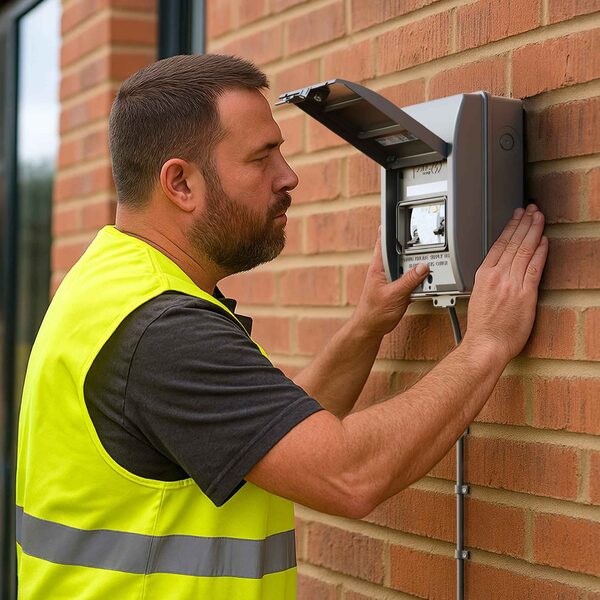
The Electric Vehicles (Smart Charge Points) Regulations 2021 require all charge points sold in Great Britain for private domestic or workplace use to have smart functionality, to help manage the increase in electricity demand from the switch to electric vehicles37. Put more directly, domestic EV chargers must be smart, meaning capable of responding to signals to shift charging to off-peak periods9. New home chargers sold in the UK have had to meet smart functionality requirements since 202224, and all new chargers need to be able to charge when demand on the grid is lower or more renewable electricity is available7.
A separate timetable applies through the EU's Alternative Fuels Infrastructure Regulation, under which smart charging, digital metering and vehicle communication are required from 2027. Enphase states that many chargers will need significant redesigns to comply and that its IQ EV Charger 2 is already built with those requirements in mind35.
Certification sits alongside the regulations. The BSI Kitemark for Smart EV Chargers is built on the UK Smart Charge Regulations together with ETSI EN 303 645 and IEC 61851-138, and BSI offers testing and certification for charge points for both home and commercial use39. Renewable Energy Assurance Limited operates the EV Consumer Code for Home Chargepoints, which sets and enforces standards for domestic chargepoint suppliers40. More on these marks is on manufacturer certification and approvals.
Installation rules are separate from product rules. All home EV charger installations in the UK must comply with the IET Wiring Regulations (BS 7671), be carried out by a qualified electrician, and adhere to building regulations and local planning requirements21. In England, home EV chargers, public charging points and business installations now fall under permitted development rights41.
What a home charger costs, and the grant that exists
Published figures cluster between roughly £450 and £2,000 depending on what is counted and how complex the installation is.
| Source | Figure | Scope |
|---|---|---|
| Which?, February 2026 | £500 to £1,2007 | Buy and install a home charger |
| Which?, February 2026 | around £9007 | 7kW charger, bought and installed |
| Planning Portal | £450 basic to around £1,2008 | Installation, rising with power and capability |
| nidirect (Northern Ireland) | up to £1,00042 | The charger itself |
| Checkatrade, via Uswitch, December 2025 | £1,00043 | Average parts and labour |
| HBF and Octopus, February 2026 | £1,000 to £2,00044 | Typical retrofit cost |
| Fuse Energy, April 2026 | £800 to £1,60021 | Some installations |
Three-phase units are the most expensive class of home charger7, and where the supply already exists the hardware itself need not be dear: evec lists a 22kW three-phase untethered commercial charger at £579.99 including VAT and a 22kW three-phase tethered unit at £689.98 including delivery19. Those are hardware prices from a maker's own listing and exclude installation. The maker's pages quote slightly different figures for the same models depending on whether delivery is included, so the total at checkout is the number that matters.
The remaining grant is narrow. The electric vehicle chargepoint grant offers up to £350 per socket for residential landlords, people living in flats and people who rent their homes45; Uswitch notes that this can reduce the installation cost to as low as £65043. Homeowners with driveways are outside that scheme.
Home charging as a piece of household energy independence
Charging at home changes the household's relationship with transport fuel rather than removing it. The car stops being refuelled at a forecourt and starts being fuelled through the domestic meter, on the household's own tariff, at times the household controls. That is real: 82% of EV drivers have access to charging at home6, most charging in the UK is done at home46, and the public network of 121,171 chargers is a backup rather than the primary source for those drivers5. Of those public units, 33% are classed as on-street5, which matters chiefly for households without a driveway.
What remains is a chain of dependencies, and they are worth stating plainly:
- The grid and a supplier. Even with solar, year-round EV charging in the UK cannot be covered by panels alone32, and the cheapest charging depends on a time of use tariff from one of the suppliers offering them34.
- The supply capacity of the property. A charger can exceed what the connection allows, requiring an upgrade17. This is where load management hardware earns its place.
- The manufacturer's cloud and app. Scheduling, solar diversion and tariff sensing run through the brand's software and a Wi-Fi, LAN or 4G link30.
- Regulatory direction. Smart functionality is now a legal requirement for new units in Great Britain37, and further requirements on metering and vehicle communication are set for 202735.
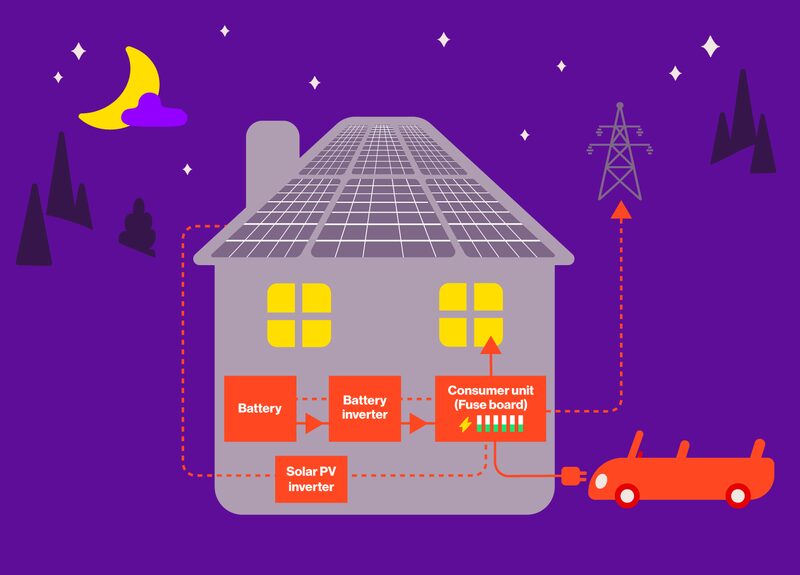
Where solar is present, the pairing is genuinely productive: a charger with a solar diversion mode converts surplus generation that would have been exported into miles20, which is the same logic that makes a home battery worth having. But the car is a large, intermittent load, and the honest position is that a home charger reduces the cost and increases the control of the energy a household buys rather than replacing it. The wider argument is set out on manufacturers and household energy independence, and comparisons of specific domestic brands are covered on Ohme vs Pod Point, Ohme, Pod Point and Myenergi.
Sources46 cited
- Home charging guide, Zap-Map, 19 June 2025
- Home and community charging statistics, Zap-Map, 2026
- Navigating the network: consumer journey for low carbon technology, Citizens Advice, 1 July 2026
- EV charging statistics, Zapmap, 3 September 2026
- Public electric vehicle charging infrastructure statistics, 1 July 2026, GOV.UK, 1 July 2026
- Guide to Electric Vehicle Infrastructure, BEAMA, September 2024
- Electric car charging at home, Which?, 25 February 2026
- Electric vehicle chargers: planning guidance, Planning Portal, 2026
- Section 722 EV charging: complete guide, Elec-Mate, 2 July 2026
- emonEVSE overview, OpenEnergyMonitor, 17 September 2026
- VEVA car charger, Marlec, 2 September 2026
- Which EV charger, Fuse Energy, 25 April 2026
- Choosing the right home EV charger, Fuse Energy, 26 April 2026
- RCDs for electric vehicle supply equipment, IET Wiring Matters, May 2024
- Home electric vehicle chargers, Carwow, 9 January 2026
- EV charger product page, Haier HVAC, 17 September 2026
- If your electricity supply cannot cope with new equipment, NIE Networks, 19 September 2026
- EV charger installation and maintenance, NICEIC, August 2025
- evec chargers, evec, 18 September 2026
- EV chargers for solar panel charging, E.ON Next, 17 September 2026
- Tethered vs untethered EV chargers, Fuse Energy, 26 April 2026
- Tethered vs untethered, Zapmap, 23 February 2026
- Connector types, Zapmap, 20 May 2026
- Home EV charger buying guide, So Energy, August 2026
- Link EV Charger with Metal Unit, 7.4kW, Sync Energy, 17 September 2026
- AC EV charger EV11K-AC-02, Sofar Solar, 19 September 2026
- EV charger C Series, Fox ESS, 17 September 2026
- IQ Bidirectional EV Charger, Enphase, 17 September 2026
- Plug-in solar panels: five top tips, REA, 4 August 2026
- Link EV Charger range, Sync Energy, 17 September 2026
- Integrating solar panels with EV charging, Uswitch, 2 July 2025
- Can solar panels charge electric cars?, The CPA, 15 April 2026
- What are EV chargers and how to optimise their energy usage, Homey, 20 September 2026
- Time of use tariffs explained, Which?, 23 April 2026
- IQ EV Charger 2 for installers, Enphase, 17 September 2026
- Plug-in solar panels, Energy Saving Trust, 17 September 2026
- Approved Document S: frequently asked questions, GOV.UK, 17 April 2023
- What makes BSI Kitemark certified EV chargers a smarter choice, BSI Group, 17 September 2026
- Powering trust in EV charging with BSI Kitemark certification, BSI Group, 17 September 2026
- EV Roam to support roaming between UK charging networks, REA, 7 October 2020
- EV charger regulations in England: what has changed, NICEIC, 19 August 2026
- Electric vehicles, nidirect, 17 September 2026
- EV charging statistics, Uswitch, 15 December 2025
- Watt a Save, HBF and Octopus Energy, February 2026
- Charging electric vehicles, Energy Saving Trust, 23 April 2026
- Making the switch: experiences of people using electric vehicles, Energy Saving Trust, 31 March 2025
 Types of Home EV ChargerWhich home charger suits your car and your driveway?
 Charging With a Home BatteryHow a home battery and an EV charger share one supply, whether a battery can usefully charge a car, and how combined systems are controlled so the battery is not discharged into the vehicle at a loss.
 Charging and Energy IndependenceCharging an electric car at home can cut your fuel costs, but how much does it really free you from the grid?
 Electric Vehicle TariffsCharging an electric car at home can cost far less overnight, but only on special electricity plans.
 Charger Apps and ConnectivityHow a home charge point connects: Wi-Fi, Ethernet, 4G and Bluetooth, what the app controls, what happens when the network drops, and how much of the charger depends on the maker's cloud.
 EV Charging Speeds and TimesHow long an electric car takes to charge depends on the charger and the car together, so a faster charge point will not always speed things up.