
In this answer
Short answer
A regulatory action against Easee chargers, reported in the UK as a sales ban, affected a brand with a substantial British installed base. The ruling turned on compliance with the Radio Equipment Directive rather than on a fault found in the field, and Easee states that its One, Lite, Core, Up, Max and Pro chargers are in full compliance with the new Delegated Act of that directive1. For owners, the practical questions are which model sits on the wall, whether the company still exists to support it, and what the episode says about how much of a household's charging setup depends on one manufacturer staying solvent.
Easee is a Norwegian business founded in 2018, and it reports more than one million chargers installed across Europe by the end of 20252. The United Kingdom is named among its largest markets, alongside Sweden, Germany, the Netherlands, Switzerland and Denmark2. Ownership changed in May 2026, when Brødrene Jensen, a shareholder since 2019, acquired 100 percent of the company3.
The ruling did not remove chargers from driveways. It changed what could be sold and put the emphasis on compliance documentation, cloud connectivity and the maker's continued trading. That last point matters most for independence: a charger that balances load locally keeps working, while features that depend on a cloud account depend on the company behind it.
What the safety ruling covered, and what changed for owners
The action centred on the Radio Equipment Directive and its new Delegated Act, which sets cybersecurity and network-protection requirements for connected products sold in the European market. Easee states that its One, Lite, Core, Up, Max and Pro chargers are in full compliance with that Delegated Act, in a statement dated 16 September 20251. The company had already reported achieving EU cybersecurity compliance in September 20253.
For a household, the change is less about the box on the wall than about what can be sold new and what documentation sits behind it. A charger is a connected device, and the rules that govern it are the same family of rules that govern other networked equipment. The wider safety picture for home charging is set by installation rather than by the product alone: the government's chargepoint grant rules state that the installer will assess whether the parking space allows an electric vehicle to charge safely5. In conservation areas and other designated areas, planning guidance notes an increased chance that an accepted application carries conditions affecting the size, appearance and placement of the charger6.
Voltage behaviour is a separate safety layer. Guidance from Electricity North West explains that if the supply voltage goes outside the permitted range, the charger will stop working and show an error, a safety feature that protects both charger and vehicle7. That behaviour is a normal protective response, not a fault.
Easee: a Norwegian maker with a large UK installed base
Easee was founded in Norway in 2018 and designs, develops and manufactures smart connected EV chargers for homes and workplaces2. Its products are developed in Norway and described as designed to withstand harsh Nordic weather conditions8. The Easee Base accessory is likewise designed and manufactured in Norway9.
The installed base is the number that matters for a UK owner weighing support and spares. Easee reports more than one million chargers installed across Europe by the end of 2025, covering all charger types10. An earlier maker figure, dated March 2026, puts over 870,000 chargers installed across Europe11. The two figures are not directly comparable: one counts all charger types to the end of 2025, the other is a snapshot taken later in the year and is lower.
The United Kingdom is one of six named largest markets2. That matters because a large installed base supports the secondhand market, the availability of installers familiar with the product, and the maker's incentive to keep firmware and app support running. It does not guarantee any of those things, and it does not insulate an owner from a change of ownership or a change of strategy.
Who owns Easee now: the Brødrene Jensen acquisition and the pending AWC deal
Ownership moved in May 2026. Brødrene Jensen, a shareholder in Easee since 2019, acquired 100 percent of the company, according to a maker statement dated May 20263. That consolidates the business under a single Norwegian owner rather than a spread of investors.
The company continues to operate publicly. It joined ChargeUp Europe, described as the voice of the EV charging infrastructure industry in Europe, in July 20262. It also reports becoming the first EV charger manufacturer to achieve Mercury certification for grid flexibility3. Anthony Fernandez is named as CEO at Easee in a maker statement dated 28 October 202512.
For a household, ownership stability bears on the parts of the product that are not local. The charger's core functions run on the device: load and phase balancing between chargers works offline4, and the same offline balancing is described for the wider charger range13. What depends on the company is the cloud connection, the app, and the over-the-air updates that Easee states all its chargers receive14. A change of owner is not a failure, but it is the point at which a buyer should look at which functions survive without a live account.
Which models are supported in the UK: Home and The One
The UK range is narrower than the European one. The Easee Charge is sold only in the UK4. The Easee Charge Up is not listed among its available markets, which are Norway, Sweden, Denmark, Finland, Iceland, Germany, Austria, Switzerland, the Netherlands, Belgium and France15. The Easee Home and The One are the domestic units, and the maker lists Solar Only as supported on both16.
| Model | Key UK-relevant features | Notes |
|---|---|---|
| Easee One | Tethered or untethered, cable locked or unlocked through the Easee app17 | Domestic unit |
| Easee Home | Solar Only supported16 | Domestic unit |
| Easee Charge | Integrated earth fault protection (RCD); automatic detection of power grid type (TN, IT, TT); overvoltage category III; unlimited chargers per site4 | Sold only in the UK4 |
| Easee Charge Up | Not listed among available markets15 | Not a UK model |
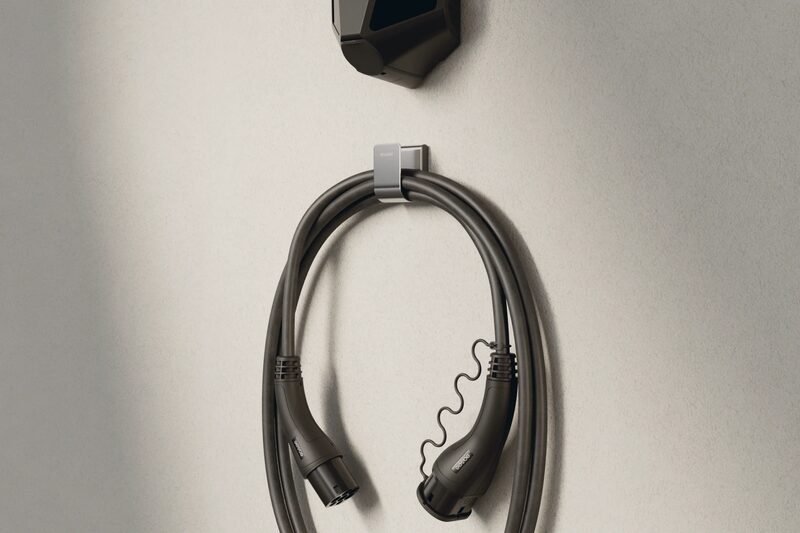
Telling the models apart comes down to the cable and the labelling. The Easee One can be run tethered or untethered, with the cable locked or unlocked at the click of a button in the app17. The Easee Charge carries integrated earth fault protection and detects the grid type automatically4. The Easee Home is the original domestic unit.
Setup is done on the device. The maker states that the Chargeberry unit is configured by connecting a smartphone to its integrated WiFi network13. Where the system is set up with authorisation, an Easee Key tag must be beeped on the charger to start a session9. Approved RFID tags are stored locally in each charger rather than in the cloud13.
What owning an Easee charger means for energy independence
The independence question splits cleanly into what the charger does on its own and what it needs from elsewhere. On the local side, the charger supports WiFi connectivity and both manual and digital control through a free app13. Load and phase balancing between chargers works offline4. The maker states that this makes it possible to use close to 100 percent of the available energy in the home, compared with traditional chargers without phase balancing18.
The Easee Equalizer, a separate accessory, extends that. It is described as allowing charging at all times even with limited grid capacity, without tripping a fuse18, and as letting a household charge faster when the building's consumption is lower, avoiding overload and power interruptions19. That is a local function, and it is the part of the system that most directly reduces dependence on a supply upgrade.
Solar is the other half. Easee's solar charging service includes a Solar mode that charges the car only from the panels19, and the maker states that solar charging balances electricity demand with supply, reducing strain on the grid19. Solar Only is listed as supported on the Easee Home and The One16.
What remains dependent is the cloud. All Easee chargers connect to the maker's cloud and are continually updated with software upgrades14. Tariff-linked behaviour, where the charger automatically charges when it is most cost-effective, is a cloud and supplier function rather than a local one11. The charger also depends on the grid for the energy itself, and on a supplier for the tariff. Local balancing reduces the size of the connection a household needs; it does not remove the connection.
Where Easee sits in the wider charging industry
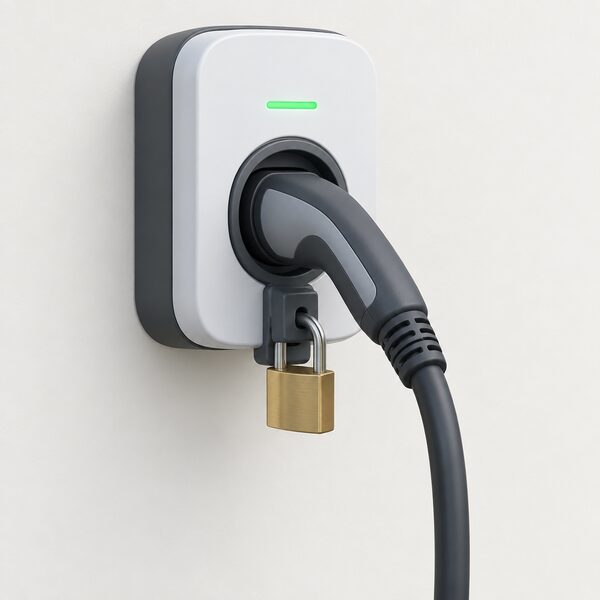
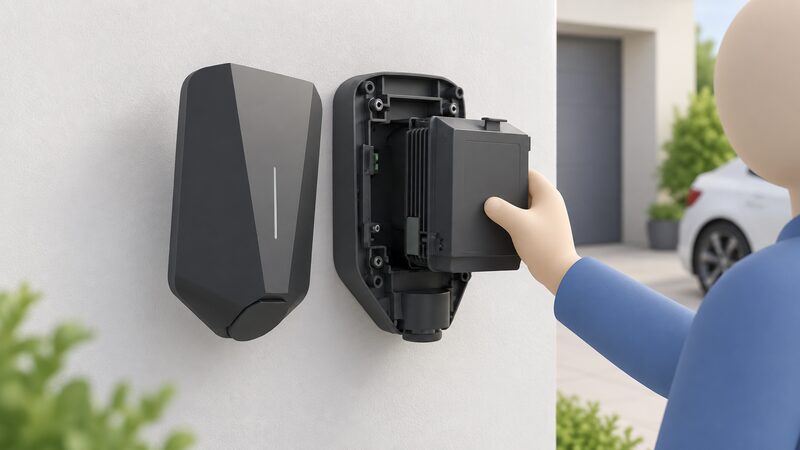
Easee's pitch is a small unit with fewer internal cables. The maker states that, unlike traditional chargers, the Easee charger has no messy cables inside, which it says greatly reduces the risk of human error during assembly and production14. The charger also checks the wiring during installation and notifies the electrician if there is a fault14. The Chargeberry is a separate unit, which the maker describes as easy to upgrade in the future20.
For multi-charger sites, the Easee Charge supports an unlimited number of chargers per site and an automatic queuing system13. That is aimed at apartment blocks and workplaces rather than single homes13. Theft protection is handled by locking the cable permanently in the station, with a padlock bracket for the electronics4.
The wider industry context is a market moving toward regulation of exactly this kind of connected equipment. Electrical Safety First has called for the banning of universal chargers, to prevent dangerously compatible charging arrangements and damage, and for better regulation of non-proprietary charging systems21. That is a consumer-safety body arguing for tighter rules on interoperability, which is the direction the Radio Equipment Directive Delegated Act already takes.
The UK backdrop is scale. Zapmap statistics state that around 19 million households could enjoy the benefits of home charging should they have a chargepoint22. Most UK homes can support a standard EV charger, though the installer will always check existing electrical capacity23. Easee's position in that market is as one of several Norwegian and European makers competing on local load management and solar integration rather than on price alone.
Sources23 cited
- Easee achieves EU cybersecurity compliance, Easee, 2025-09-16
- Easee joins ChargeUp Europe, Easee, 2026-07-13
- Easee achieves Mercury certification for grid flexibility, Easee, 2026-06
- Easee Charge, Easee, 2026-03-12
- Electric vehicle chargepoint grant eligibility, GOV.UK, 2026-09-17
- Planning permission for electric vehicle charging, Planning Portal, 2026
- Managing voltage changes in your property, Electricity North West, 2026-09-19
- Easee home charging, Easee, 2026-04-21
- Easee accessories, Easee, 2026-03-12
- Easee connected insights, Easee, 2025
- Easee Fuse Energy launch, Easee, 2026-03-18
- PAVE V2G project, Easee, 2025-10-28
- Easee for apartment blocks, Easee, 2026-03-13
- Easee smart safety, Easee, 2026-08-10
- Easee Charge Up, Easee, 2026-03-12
- ev.energy Easee integration, ev.energy, 2026-09-17
- Easee One, Easee, 2026-03-12
- Easee Equalizer energy management, Easee, 2026-08-10
- Easee solar charging, Easee, 2026-03-12
- Easee EV chargers, Easee, 2026-08-10
- Treat e-bike batteries like fireworks, government told, Electrical Safety First, 2026-09-17
- Home and community charging statistics, Zapmap, 2026
- Installing EV chargers at home, Hive, 2026-08-05
 Charger Cybersecurity and DataWho can control your home charger, and how do you keep it secure?
 EV Charger WarrantiesCovers typical warranty lengths on UK home charge points, what parts and labour are included, registration conditions and extended warranty options.
 Who Owns Which Energy BrandMaps the corporate groups that sit behind familiar UK boiler, cylinder, heating and renewables brands, and which names are badges rather than separate factories.
 EV Charger Safety and StandardsHow do you know a home charge point is safe to use?
 Energy Independence and MakersWhich brands let you keep control of your heating, solar or car charging, and which tie you to their app and their cloud?
 Energy Smart AppliancesCan your washing machine or car charger be told when to use power, and who gets to decide?