On this page
Most UK households still heat with a fossil fuel system: more than 80% heat their homes with gas or oil, and gas boilers alone provide warmth to over 70% of households1. Only around 2 to 3% of UK households heat their homes using a heat pump1. Behind almost every boiler, heat pump, cylinder or charge point sold in the UK sits a parent group, and the badge on the front panel is often just one of several owned by the same corporation.
That matters to a household in three ways. Ownership decides who administers your warranty, who supplies the spare parts that keep an appliance running for its full life, and how exposed you are if a group consolidates its brands, sells a division or exits the market. This page maps the groups behind the familiar names, tracks the recent changes of control at Easee and Compleo, and explains what ownership means for the practical business of getting a fault fixed.
Major players in brief
Start with the energy suppliers, because their ownership is the clearest illustration of how a familiar badge can sit inside a larger structure. Centrica plc runs three retail brands: British Gas in England, Scottish Gas in Scotland and Nwy Prydain in Wales7. The same Ofgem glossary lists the historic Big Six as Centrica plc, the parent company of British Gas, alongside E.ON UK, Scottish and Southern Energy, RWE npower, EDF Energy and ScottishPower7. At their peak these companies supplied seven out of 10 British households with gas and electricity8.
The newer challengers are structured the same way. OVO Energy's majority owner is OVO Group (UK), with other shareholders including Stephen Fitzpatrick, Morgan Stanley Investment Management and Mayfair Equity Partners, and the Mitsubishi Corporation also owns a 20% stake9. So a household that switched from British Gas to OVO to escape one large group has, in corporate terms, moved from Centrica's ownership to a UK group that counts a Japanese trading corporation among its shareholders. Neither position is better or worse; the point is that the brand on the bill is rarely the whole story.
| Brand | Parent or majority owner | Notes |
|---|---|---|
| British Gas | Centrica plc (UK) | One of three Centrica retail brands7 |
| Scottish Gas | Centrica plc (UK) | Centrica's Scottish retail brand7 |
| Nwy Prydain | Centrica plc (UK) | Centrica's Welsh retail brand7 |
| OVO Energy | OVO Group (UK) | Mitsubishi Corporation holds a 20% stake9 |
Trade bodies add another layer. Energy UK, the industry trade body, represents firms including British Gas, Scottish Power and EDF Energy10. When a household reads a claim about heating policy attributed to "the industry", it is worth remembering that the voice is often the parent groups speaking collectively rather than the badge on the meter.
For energy independence, the lesson is that switching supplier brands rarely changes the underlying corporate relationships in the market. Generating your own power and storing it does, because it removes the retail relationship altogether, whatever group sits behind it.
Boiler and heating firms and the groups behind them
The boiler market is dominated by a handful of names. Which? reports that "big names such as Baxi, Vaillant and Worcester-Bosch dominate the boiler market, boasting thousands of customers"11. Each of those names belongs to a group. Vaillant trades under the Vaillant Group, whose UK presence extends across both boilers and heat pumps. Worcester Bosch sits within the Bosch Group. Ideal Heating belongs to Groupe Atlantic, and Baxi is part of BDR Thermea. The Heat Pump Association UK's governing body committee reads as a map of the same groups: Mark Wilkins co-chairs for Vaillant Group, Ewan Sutherland represents Worcester Bosch Group, Elizabeth Wilkinson represents Groupe Atlantic, and James Law represents Centrica12.

Ownership also shapes consumer protection structures that sit above the brands. The Heat Trust Scheme, which gives heat network customers protections modelled on energy supply rules, is operated by Heat Customer Protection Ltd, a company registered in England and Wales with company number 0945666713. A household on a heat network may never have heard of either entity, but the scheme's rules are set and administered at that corporate level rather than by the installer who fitted the pipework.
Policy is pushing these same groups in a new direction. The UK heat and buildings strategy set the aim for heat pumps to cost the same to buy and run as fossil-fuel boilers by 2030, and proposed a market mechanism that would place an obligation on the manufacturers of gas and oil boilers to sell a rising number of heat pumps, proportional to their sales of fossil fuel systems14. In 2021, 67,000 heat pump units had been sold so far that year, against a target implying a roughly tenfold increase14. The practical consequence for households is that the groups behind today's boiler badges are the ones being recruited to sell tomorrow's heat pumps, which is why several of them now run both product lines under one roof.
Heat pump makers: many brands, few owners

The heat pump market looks more crowded than the boiler market but is similarly concentrated at the top. Official statistics state there are at least 33 manufacturers supplying air source heat pumps in the UK, with Mitsubishi Electric, Vaillant, Daikin and Samsung accounting for nearly two-thirds of total annual UK sales3. The main companies manufacturing air source heat pumps in the UK in 2024 were Mitsubishi Electric, Vaillant, Ideal and Octopus Energy, with a total market share of 34%3.
Where the machines are made is a live policy question. Of heat pumps sold in the UK, the UK manufactures around one third, with two thirds imported4. The Warm Homes Plan sets an ambition that at least 70% of heat pumps installed in the UK are made in the UK15. For a household weighing energy security, that distinction matters: an imported unit ties your long-term spares supply to a foreign factory and a shipping route, while a UK-made unit shortens that chain.
Government support is concentrated on a single scheme. In the year ending September 2024, 49% of government-supported heat pump installations were funded by the Boiler Upgrade Scheme and 46% by the Energy Company Obligation16. The Boiler Upgrade Scheme operates in England and Wales, and a property must be in England or Wales to qualify17. Scotland and Northern Ireland run their own support arrangements, so the grant landscape differs by nation.
Certification also crosses borders. The Heat Pump KEYMARK, a voluntary third-party certification mark based on European standards EN 14825 and EN 14511, is owned by CEN/CENELEC, the European standards bodies18. A UK household buying a KEYMARK-certified unit is relying on a scheme administered outside the UK, whatever the brand on the casing. Ofgem's consumer survey found 2% of respondents had a heat pump, and that 45% of those with heat pumps were on a green tariff19, a reminder that ownership of the hardware and the choice of supplier are separate decisions.
Who is behind Easee and Compleo charge points
Two charge point brands have changed corporate hands recently, and both changes are worth knowing about if one is on your wall.
Easee, the Norwegian maker of the Easee One home charger, was acquired in full by Brødrene Jensen in May 2026, with financing from AWC, which is set to become majority owner pending regulatory approval5. The company reported a strong financial turnaround entering 20265. The Easee One backplate sold in the UK is listed with Norway as its country of origin20, so both the product and the ownership now have Scandinavian roots.
Compleo changed hands earlier. The KOSTAL group completed the acquisition of the whole operating business of the Compleo group on 31 July 2023, with the acquiring company trading as Compleo Charging Solutions GmbH & Co. KG6. The Compleo name survived the takeover, which is the pattern households should expect: brands usually outlive their owners, and the badge gives little clue that the business behind it has moved.
The UK charging network also shows ownership at work closer to home. FOR EV, based in Scotland, owns, installs and operates EV charging points across the UK, with 155 FOR EV chargers across 39 locations listed21. For a fuller picture of the brands on the wallbox market, see home EV charger manufacturers.
Mitsubishi Electric's buying spree and its impact on UK homes
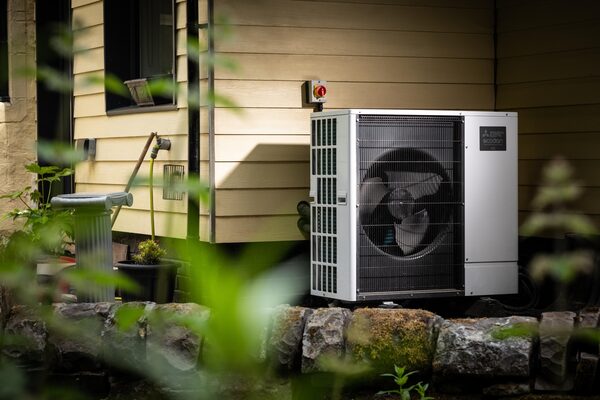
Mitsubishi Electric is one of the most acquisitive companies in the wider home energy sector, and its UK heating business sits inside a corporation that has been buying steadily across unrelated industries.
In the UK heating market itself, the company's position is established. Its Ecodan range of air source heat pumps is promoted with the claim "Made in Britain, to British Standard, for British Homes"22, and Mitsubishi Electric was one of the four main companies manufacturing air source heat pumps in the UK in 20243. It also accounted for a substantial share of UK sales, as one of the four brands making up nearly two-thirds of the market3.
The corporate picture is one of continuous expansion. Mitsubishi Electric Corporation acquired all shares of Irish elevator company Ascension Lifts Limited on 29 April 2025 through its wholly owned subsidiary Motum AB23. On 9 September 2025 it signed an agreement to wholly acquire Nozomi Networks24. On 16 January 2026 its wholly owned Suzhou subsidiary acquired a stake in ADT Technology Service, a manufacturing software developer25. On 1 April 2026 it agreed to wholly acquire Infinity Lifts Limited, another Irish elevator company, with completion expected in the first half of 2026 subject to regulatory approval26. On 7 August 2026 it agreed to acquire the remaining shares of Polish railcar equipment maker MEDCOM through Mitsubishi Electric Europe B.V.27, and on 20 August 2026 it agreed to wholly acquire PCI Energy Solutions28.
None of those acquisitions is a heating business, and that is the point. A household buying an Ecodan unit is dealing with a division of a corporation whose strategic attention is spread across elevators, rail equipment, cybersecurity and energy software. The Climate Change Committee has noted that the Government is pursuing supply-side policies, including obligations on boiler and heat pump manufacturers and potentially energy companies, to deliver a certain number of low carbon heat installations each year29. Groups with the balance sheet to acquire across sectors are also the groups best placed to absorb those obligations, but a household's warranty rests with whichever entity within the group actually stands behind the product. For a comparison of the heating products themselves, see Mitsubishi Electric heat pumps and Mitsubishi vs Daikin heat pumps.
NIBE Energy Systems Ltd: Swedish parent's UK arm
NIBE heat pumps sold in the UK are supplied through NIBE Energy Systems Ltd, the UK subsidiary of the Swedish NIBE group. The subsidiary's leadership changed in October 2023: Paul Smith started as managing director on 16 October 2023, replacing Phil Hurley, who left after 16 years30.
The group's UK marketing is led by Olivia Downing, head of marketing for NIBE UK, who has emphasised the need for consumer education amid expanding interest in heat pumps31. NIBE draws on its experience supplying the technologies in Europe, noting the success of heat pumps in markets such as Sweden31, where the technology is far more established than in the UK.
Its products are sold through UK channels: the NIBE S1156-8 heat pump is listed with retailer purchasing options on the company's UK product pages32. For the range in full, see NIBE heat pumps for UK homes.
For a household, the significance of this structure is straightforward. The brand is Swedish, the UK subsidiary is a separate legal entity, and warranty claims and spares flow through that UK company. A group with decades of heat pump experience in mature European markets brings that track record, but the household's contract is with the UK entity, and its continuity depends on the group's commitment to the UK market.
Grant UK: tie-ups and whole-home heating
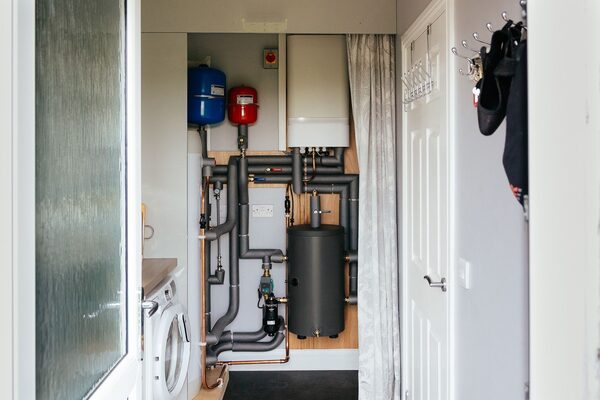
Grant UK illustrates a different model: a specialist heating brand that has grown through partnerships rather than through a sprawling parent group.
In November 2024 Grant UK announced a partnership with Heat Pump Go, giving G1 Installers who are not themselves MCS accredited the option to provide customers with an MCS certified Grant heat pump installation33. That matters because grant funding depends on certification: Boiler Upgrade Scheme installers must be MCS certified and certified to install heat pumps and/or biomass boilers34. A partnership that routes installations through a certified route widens the pool of installers able to fit a Grant system without the household losing grant eligibility.
Grant also positions itself as a whole-house supplier rather than a single-product maker. In August 2025 a Grant whole house heating system was installed at a self-build home in Cornwall, comprising an Aerona 290 air source heat pump, hot water cylinder, solar thermal system and underfloor heating, all supplied by Grant UK35. The company's UK voice is present at industry level too: Neil Sawers represents Grant UK on the Heat Pump Association UK governing body committee12.
Grant's products also appear in government innovation programmes. The Heat Pump Ready Programme's Stream 2 projects include work led by Q-Bot Ltd, listed with no project partners36, and Stream 1 includes the Clean Heat Streets project with Samsung Electronics (UK) Limited as lead organisation37, a reminder that the big electronics groups are embedded in the UK's heat pump rollout alongside specialist firms.
The grant context differs by nation. The Boiler Upgrade Scheme provides grants for heat pump installations across England and Wales38, and a property must be in England or Wales to be eligible17. Welsh households have seen additional support announced alongside the scheme38. For the product range, see Grant UK oil boilers and heat pumps.
How brand ownership affects warranties, parts and choice
Ownership is not a trivia question. It determines who answers when something goes wrong, and how long the answer keeps coming.
Start with spares. Which? surveys heating engineers on brands using criteria that include the availability of parts and spares, how easy it is to fix a common fault such as a heat exchanger on the brand's boilers, how easy it is to carry out a service, the build quality, and the likelihood of the engineer recommending the brand to a customer11. Parts availability is a function of the parent group's logistics and its commitment to the UK market, not of the badge. A group that consolidates two brands' parts warehouses, or that exits a market, changes the repair outlook for every household holding its products. For more on this, see manufacturer technical support and spare parts and what happens when a manufacturer fails.
Certification is the second layer. MCS 012, the Solar Mounting Product Standard, saw issue 3.0 come into effect on 10 May 2025, with a grace period applied to products whose certification had been withdrawn39. Certification status can therefore change after purchase, and the grace periods that follow are set by the certification body rather than the brand. Households can check current listings in the MCS certified product directory.
Even the paperwork of grant schemes is entity-specific. The Boiler Upgrade Scheme Property Owner Consent Portal's terms state that any dispute arising under them will be subject to the exclusive jurisdiction of the courts of England and Wales40. A Scottish or Northern Irish household dealing with a different scheme faces a different legal framework, whatever brand of equipment is installed.
Finally, ownership shapes how companies behave towards customers in difficulty. Ofgem's review of how suppliers support customers in vulnerable situations grouped British Gas with Bulb, EDF, E.ON, Ovo, Scottish Power and Utility Warehouse, and identified minor weaknesses in the first group's performance41. Fuel poverty campaigners note that the households affected include those using prepayment meters and those who rely on heating oil and other fuel sources like LPG, coal and wood10. The parent group's culture, not just the brand's marketing, sets what happens when a household struggles to pay.
For energy independence, the honest summary is this: no purchase removes every dependency. A heat pump ties you to its manufacturer for parts and, often, to an app or cloud service for controls. A boiler ties you to its group's spares operation. A charger ties you to the company that survived the takeover. What ownership knowledge buys you is the ability to see those dependencies before you sign, and to weigh a brand's backing, its UK presence and its certification record rather than its name alone. For the wider picture, see manufacturers and household energy independence and the full guide to home energy equipment manufacturers.
Sources41 sources
- Beyond affordability: why heat pumps feel like a gamble, Which?, 2026-07-02
- The Future of the Gas Network: recommendations for hybrid heating, Cadent, 2025-04
- Energy innovation needs assessments: heat and buildings, Department for Energy Security and Net Zero, 2024
- Raising minimum standards for heat pumps: options assessment, HM Government, 2024-11-27
- Easee delivers strong financial turnaround and enters 2026 with renewed momentum, Easee, 2026-05
- Supplier FAQ, Compleo Charging Solutions, 2023-07-31
- Energy terms explained, Ofgem, 2026
- Big Six energy suppliers guide, Uswitch, 2026-07-17
- Which energy suppliers are British?, Uswitch, 2026-06-26
- Forced pre-payment meter transfer, End Fuel Poverty Coalition, 2026-09-16
- Best gas and oil boiler brands, Which?, 2025-09-17
- HPA UK news, Heat Pump Association UK, 2026-09-17
- The Heat Network (Metering and Billing) Regulations 2018, legislation.gov.uk, 2018-11-12
- In-depth Q&A: how will the UK's heat and buildings strategy help achieve net zero?, Carbon Brief, 2021-10
- Families to save in biggest home upgrade plan in British history, HM Government, 2026-01-20
- Heat pump deployment quarterly statistics, UK, 2024 Q3, HM Government, 2024
- Boiler Upgrade Scheme: installers, Ofgem, 2026-09-17
- Heat Pump KEYMARK certification celebrates a decade of trust, European Heat Pump Association, 2026-01-05
- Consumer Survey 2021: decarbonisation and home energy use, Ofgem, 2021
- Product safety report: Easee One EV Charger Backplate BP-AP-1/s01-01, HM Government, 2026-05-06
- FOR EV charging network, Zapmap, 2026
- Mitsubishi Electric brand profile, Quiet Mark, 2026-09-17
- Mitsubishi Electric acquires Ascension Lifts Limited, Mitsubishi Electric, 2025-04-29
- Mitsubishi Electric to wholly acquire Nozomi Networks, Mitsubishi Electric, 2025-09-09
- Mitsubishi Electric subsidiary acquires stake in ADT Technology Service (Suzhou), Mitsubishi Electric, 2026-01-16
- Mitsubishi Electric to wholly acquire Infinity Lifts Limited, Mitsubishi Electric, 2026-04-01
- Mitsubishi Electric to wholly acquire MEDCOM, Mitsubishi Electric, 2026-08-07
- Mitsubishi Electric to wholly acquire PCI Energy Solutions, Mitsubishi Electric, 2026-08-20
- Taking stock of the UK Government's heat and buildings strategy, Climate Change Committee, 2022-03-09
- Change in management at NIBE Energy Systems Ltd, NIBE, 2023-10-16
- NIBE launches Take the Step campaign, CIPHE, 2024-10-15
- NIBE S1156-8 heat pump product page, Quiet Mark, 2026-09-17
- Grant UK air source heat pumps, Grant UK, 2024-11-29
- Boiler Upgrade Scheme guidance for installers v5.1, Ofgem, 2026-07-02
- Grant UK solar thermal, Grant UK, 2025-08-05
- Heat Pump Ready Programme: Stream 2 projects, HM Government, 2026-05-28
- Heat Pump Ready Programme: Stream 1 Phase 2 projects, HM Government, 2026-05-28
- £5 million to help Welsh households invest in greener homes, Welsh Government, 2026-03-05
- Grace period ends for affected solar mounting products, MCS, 2025-05-10
- Terms and conditions: Boiler Upgrade Scheme Property Owner Consent Portal, Ofgem, 2022-05-18
- Ofgem completes review of how suppliers support customers in vulnerable situations, Ofgem, 2022-11-22