
In this guide
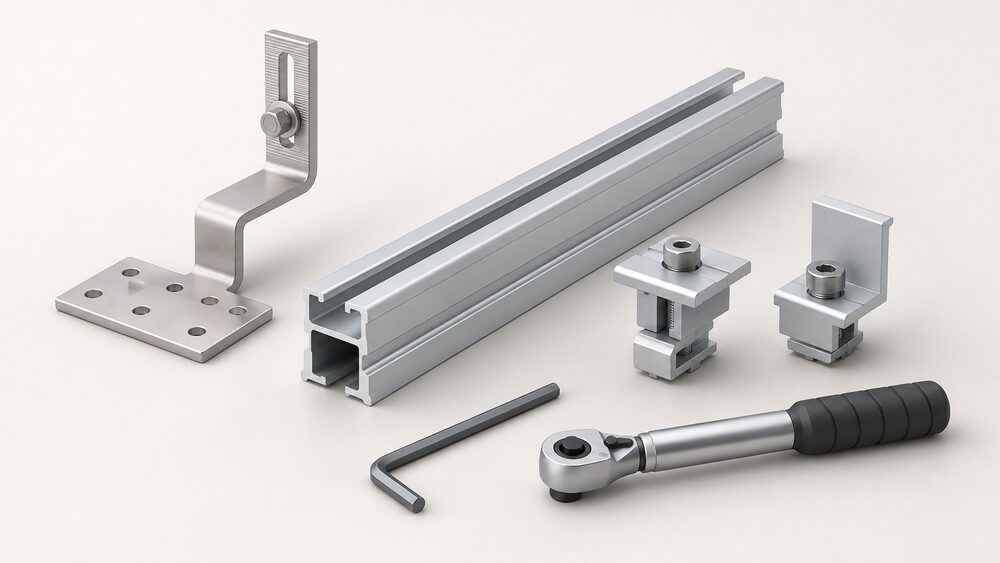
A solar mounting system manufacturer makes the metalwork that holds an array on a building: roof hooks, hanger screws, rails, mid and end clamps, in-roof trays and the frames or ballasted feet used on flat roofs. It is the only part of a domestic solar installation that penetrates the weatherproof layer of a house and the only part that must resist wind uplift and snow load for the life of the array. MCS treats it as a technology in its own right: product certification is available for solar PV, solar mounting, small wind turbines, heat pumps, biomass, solar heating and micro CHP1.
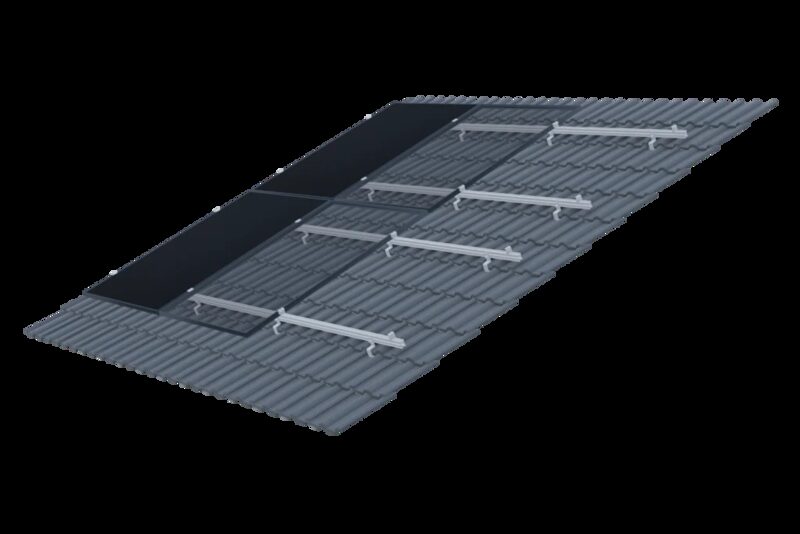
The names a UK householder is most likely to see on a quotation are the pitched roof and flat roof system makers: K2 Systems, Renusol, Enstall (the group behind Esdec), and Van der Valk Solar Systems, alongside in-roof tray suppliers. These makers publish component ranges rather than a single product. Van der Valk states that solutions exist for every type of roof, covering roof tiles, slate, corrugated sheets, standing seam, trapezoidal and sandwich panels and bitumen, EPDM or PVC pitched roofs, with panels attached by roof hooks, clamps, hanger screws or profiles, and a choice of panel clamps or an insert system2. Renusol describes its VS+ as a modular design system suitable for nearly all types of pitched roofs in Europe, with two mounting rails for medium and high load and one clamp for all applications3.
The important recent event for buyers and installers is a certification one. On 10 May 2025 several solar mounting products lost certification to the Solar Mounting Product Standard, MCS 012, and MCS advised affected manufacturers to approach all available certification bodies that offer solar mounting certification4. That is why a mounting brand's MCS status has to be checked against the live product directory rather than a brochure.
What a mounting system manufacturer actually makes
Mounting is a kit of parts, not an appliance. On a pitched roof the load path runs from the panel frame into a clamp, from the clamp into an aluminium rail, from the rail into a hook or hanger screw, and from there into a rafter. Every one of those interfaces is a manufacturer's design decision, and each is specified with a torque figure, a spacing and a permitted load in the maker's own installation instructions.
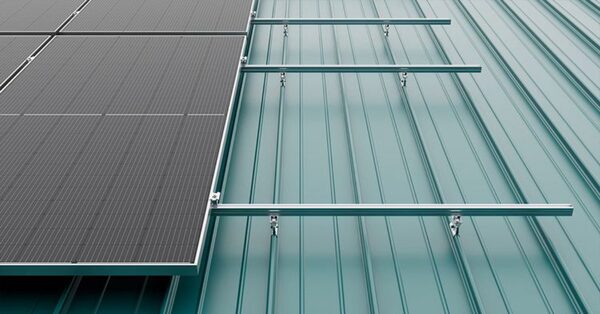
Van der Valk sets out the choice plainly: solar panels on a sloping roof are attached with roof hooks, clamps, hanger screws or profiles, and the panels themselves are held either by panel clamps or by an insert system. Which solution is best depends on the roof and the substructure, and the maker's guidance is to always choose a system that suits the roof type, follow the manufacturer's installation instructions, and always ensure a firm attachment and a good waterproof finish2.
Mounting is also not only a roof product. Solar panels include roof-mounted panels as well as ground-mounted panels within the curtilage of residential accommodation8, and roof mounting remains by far the most common option for domestic installations9. Beyond those two, suppliers work with roof-integrated mounting systems, on-roof systems, ground-mounted systems, solar car ports and floating solar PV10. Solar collectors can also be wall mounted or on stand alone free standing structures, and PV can be found in a roof tile form, mounted vertically or horizontally to form part of the building structure11. Solar thermal, by contrast, is usually roof-mounted panels containing a network of liquid-filled tubes heated by the sun12, and needs its own bracketry.
For a household, the practical point is that the mounting decision is made early and is hard to reverse. Rails and hooks determine where the array sits, how many penetrations the roof takes, and whether a later panel replacement can reuse the same frame.
The main manufacturers available in the UK
There is no official register of mounting brands, only the MCS certified product directory, which as of August 2026 carried products from nearly 600 manufacturers across all MCS technologies5. Mounting sits alongside modules in that directory, and the brands a UK installer stocks are largely European system houses supplying through electrical and solar wholesalers.
| Manufacturer | What the maker states about its range | Where it shows |
|---|---|---|
| Renusol | VS+ modular design system, nearly all types of pitched roofs in Europe; Variosole UK flat tile and pan tile described as a universal PV mounting solution for pitched roofs; VS+ reference project covering flat roof and pitched roof3 | Pitched roof, with flat roof reference work3 |
| Van der Valk Solar Systems | Solutions for every type of roof: tiles, slate, corrugated sheets, standing seam, trapezoidal and sandwich, bitumen, EPDM and PVC2 | Solar & Storage Live UK 2026, Birmingham, 22 to 24 September2 |
| Enstall (Esdec) | Supplies through wholesalers | Solar & Storage Live UK 2026, Birmingham1 |
| K2 Systems | See the dedicated page on K2 Systems solar mounting | UK pitched and flat roof work |
That the mounting metalwork is European while the modules are not is worth noting for anyone thinking about supply chain resilience: the overwhelming majority of panels installed in the UK are imported13, and around 80% of panels available in the UK are made in China14. Mounting is one of the few parts of a domestic array where European manufacture is the norm rather than the exception, though the fixings still reach the UK through an import chain.
Renusol: VS+ and the Variosole UK tile hooks
Renusol's pitched roof offer is built around two ideas the maker sets out itself: modularity and a single clamp. Renusol states that the VS+ is a modular design system, that it is suitable for nearly all types of pitched roofs in Europe, that it offers two mounting rails for medium and high load, and that it uses one clamp for all applications3. The rail choice is the part that matters structurally: a medium load rail spans less between hooks than a high load rail, so the same array on an exposed site or a rafter layout with wide centres moves to the heavier rail rather than to a different system.
The Variosole naming follows British roof coverings. Renusol describes both the Variosole UK flat tile and the Variosole UK pan tile as the universal PV mounting solution for pitched roofs3. Flat tiles and pan tiles have different profiles, so the hook that clears the covering without bearing on it differs between them; using the wrong hook is the classic route to a cracked tile and a leak, which is why Van der Valk's instruction to ensure a firm attachment and a good waterproof finish applies to every brand2.
Renusol also lists a VS+ reference project under both flat roof and pitched roof3, which is a reminder that a system family can extend across roof types through different feet and frames rather than through one universal component. These are the manufacturer's own product descriptions; the load figures that matter on a specific house come from the calculation the installer runs against the maker's tables.
"Renusol VS+ is suitable for nearly all types of pitched roofs in Europe."
Pitched roof or flat roof: which system suits which home
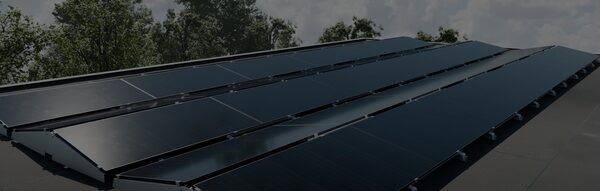
Solar panels can be installed on both pitched and flat roofs, and on a flat roof the panels need to be tilted and spaced to avoid shading15. Contrary to a persistent belief, flat roof solar is entirely normal16. But the mounting task is different in kind.
Pitched roof. The roof already provides the tilt. The system's job is to transfer load into rafters through hooks or hanger screws and keep the covering weathertight. Component choice follows the covering and substructure2.
Flat roof. The system must create the tilt, hold the array down against uplift without necessarily penetrating a single-ply or bitumen membrane, and space rows so one row does not shade the next. Independent guidance is direct about the trade-off: a flat roof installation gives more flexibility over the angle of the panels, but it is more complex, panels may need additional mounting systems, the roof must support the extra weight, and it might cost more than a pitched roof installation17.
| Pitched roof | Flat roof | |
|---|---|---|
| Tilt | From the roof itself | Created by the frame; panels tilted and spaced to avoid shading15 |
| Typical fixings | Roof hooks, clamps, hanger screws or profiles2 | Mechanically attached or non-mechanically attached (ballasted) systems at ≤ 10°6 |
| Main risk | Weatherproofing at the penetration2 | Roof must support the extra weight17 |
| Cost | Baseline | May cost more17 |
MCS 012 v3.0, published on 10 May 2023, expanded the standard's scope to include non-mechanically attached mounting systems in addition to mechanically attached systems designed for installation on flat roofs at 10 degrees or less6. That is the ballasted, non-penetrating category, and its arrival in the standard is the clearest sign that flat roof domestic solar is now mainstream enough to certify rather than treat case by case.
Certification: MCS 012, decertification and the custom route
MCS is a certification scheme for microgeneration installation companies and products18. Product certification exists for solar mounting as a named technology1, separately from solar photovoltaic modules under MCS 00519, building integrated photovoltaic products under MCS 01719 and solar thermal collectors under MCS 00420. Certification bodies must be appointed to a scope before they can issue those certificates: TÜV Rheinland (China) Ltd had its scope expanded to include solar mounting systems on 11 November 202521.
Two dates define the current position. MCS 012 v3.0 was published on 10 May 20236. Then, on 10 May 2025, several solar mounting products lost certification to MCS 012, with MCS advising affected manufacturers to reach out to all available certification bodies that offer solar mounting certification4. MCS has said it will review MCS 012 to address the challenges manufacturers are facing and to enable certification of non-mechanically attached products6.
Where nothing certified fits, MIS 3002 provides a route. Clause 5.5.5 covers installations where there are no certified mounting systems available under MCS 01222. In those cases a custom designed mounting system may be used where no MCS 012 certified mounting systems suitable for a given installation exist, subject to two specific conditions being met6, one of which is completed structural and wind loading calculations in relation to the specific mounting system being installed22.
"Completed structural and wind loading calculations in relation to the specific mounting system being installed."
Why MCS listing matters to the household, not just the installer

Certified installers use MCS certified products, including solar heating panels and mounting kits20. Certification under the MCS Installer Standards means a business has the ability and expertise to fit, test and commission an energy generator or battery storage unit in compliance with ISO 1706523, and MCS certification ensures installers install renewable technologies to industry standards while adhering to recognised safety practices24.
The MCS certificate itself is a record that an installation has been done by a certified installer using certified products, and it is required when accessing some grants and incentives24. Installation by an MCS-certified installer may be a requirement to sign up for export tariffs17, and an installer who is not MCS-certified cannot offer access to those financial benefits, including schemes like the Smart Export Guarantee25. Under the Feed-in Tariff rules, applicants needed to use MCS-certified equipment installed by an MCS-certified installer for solar PV or wind up to 50kW declared net capacity, or CHP up to 2kW total installed capacity26.
Scheme rules repeat the point. The Barcud Solar Panel Installation Scheme Specification in Wales requires that the company providing the installation must carry a valid Trustmark and be MCS certified, and that solar PV systems should only be installed and certified by MCS certified contractors working to the latest published MIS 3002 standards27. Consumer guidance adds a second check: that the solar PV company is MCS certified or equivalent and a member of the Renewable Energy Consumer Code28. Householders are advised to make sure the installers they look at are MCS-certified25, which ensures systems comply with UK standards and qualify for financial incentives29. More on scheme scope and equivalents sits on manufacturer certification and approvals and MCS equivalent schemes.
The practical consequence: a certified mounting product keeps the paperwork clean. An uncertified one pushes the installation down the clause 5.5.5 route, where the structural and wind loading calculations become the evidence, and that evidence needs to be in the handover file.
Does the mounting brand need to match the panel brand?
No. Clamps grip a panel frame, so compatibility is a matter of frame dimensions and the maker's clamping range, not of badge matching. What the manufacturer requires is that the system suits the roof type and that the installation instructions are followed2, and that householders note the manufacturer's recommendations for the model they choose30.
In reality the household rarely chooses either brand. In a January 2026 survey, almost three quarters of solar panel owners only had one brand of panel offered by their chosen installer, while 14% had a choice between two brands14. Among JA Solar owners, 13% said they chose it from several brands recommended by their installer24. Mounting is chosen even more quietly: it is the installer's standing stock item. Obtaining various quotes to compare prices of different installers15 is also, in effect, how different mounting systems get compared, because the kit named on the quotation is the kit the installer already buys. Comparing manufacturer specifications covers reading those documents like for like, and solar panel manufacturers covers the module side.
Trade shows and seeing systems assembled
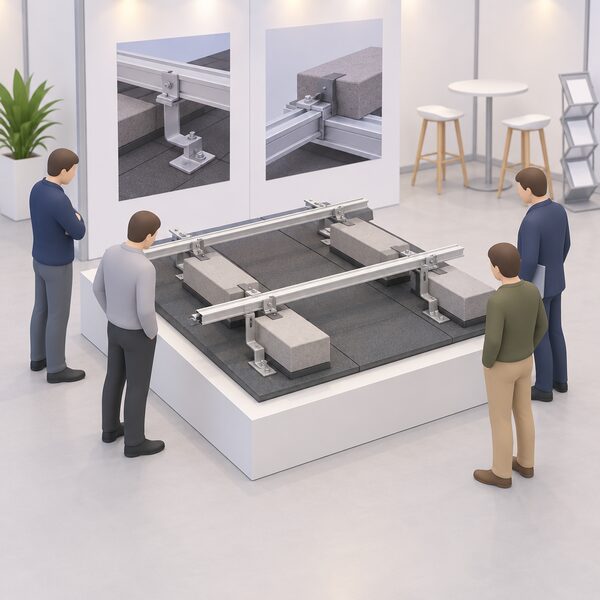
Mounting is hard to judge from a datasheet, which is why the trade exhibition circuit matters more here than for sealed appliances. Solar & Storage Live UK 2026 takes place in Birmingham from Tuesday 22 to Thursday 24 September 2026, and Van der Valk Solar Systems lists it among its exhibitions2; Enstall states it will exhibit there too1. These events are trade-facing, aimed at installers and wholesalers rather than householders, but they are the place where a full rail, hook and ballast assembly can be seen built up rather than as a line on a quotation.
Behind the shows sits the trade body. Solar Energy UK is the largest trade association representing the solar and battery storage sector31 and represents over 400 member organisations31; together with Solar Energy Scotland it represents more than 430 organisations delivering solar and battery storage projects at all scales32.
What mounting means for household energy independence
Mounting is the part of a solar installation that most directly determines how long the array lasts on the building, and therefore how durable the household's own generation capacity is. There are over 1.5 million domestic solar installations in the UK7, and over two million smaller-scale full size solar installations now online, largely on homes, according to MCS data32. Solar is central to the government's stated energy security direction, and the Future Homes Standard is set to include requirements for most new builds in England to have solar panels29.
The dependencies that remain are worth stating plainly. The mounting itself creates no ongoing dependence: there is no app, no firmware, no cloud account and no supplier relationship once it is on the roof. It is the most independent component in the system. But it inherits three dependencies from elsewhere. First, on the manufacturer's calculation tools and load tables, which the installer needs to size rails and hook spacing for a specific roof and which sit behind a trade login. Second, on the certification regime: whether a product is currently listed under MCS 012 governs whether the installation qualifies for export tariffs and grant schemes17, and that listing can be withdrawn, as it was on 10 May 20254. Third, on imports, since the modules the frame carries are overwhelmingly imported13.
For a household weighing longevity, the mounting decision is a structural one: how many roof penetrations, made how, and under whose load calculation. Those answers should be in the handover paperwork alongside the MCS certificate, because they are what a future owner, roofer or panel replacement will need. Further reading on the wider equipment picture sits on the manufacturers pillar and on manufacturers and household energy independence.
Sources32 cited
- Certifying your product, MCS, 2026-05-18
- Pitched roof mounting applications, Van der Valk Solar Systems, 2026-09-17
- Renusol VS+ pitched roof mounting, Renusol, 2026-09-17
- Grace period extension for solar mounting products that lost certification, MCS, 2025-10-17
- MCS strengthens product scheme with new appointment, MCS, 2026-08-13
- Update for solar PV flat roof mounting systems, MCS, 2025-10-23
- UK Solar Roadmap, DESNZ, 2025-06
- VAT on energy saving materials: solar panels, HMRC, 2026-09-17
- Solar panel installation, maintenance and repair, NICEIC, 2026-09-17
- Residential solar PV, Renewables First, 2026-03-30
- Generating your own energy: solar electricity, Welsh Government, 2018-09
- Social housing to get green heaters, GOV.UK, 2011-08-15
- Solar car parks and EV charging call for evidence, DESNZ, 2025-05
- Trina Solar panels review, Which?, 2026-08-12
- Solar panels: energy improvement options, Hammersmith and Fulham Council, 2026-09-17
- Solar panel myths debunked, Which?, 2026-06-09
- Solar panel installation, Energy Saving Trust, 2026-09-07
- Boiler Upgrade Scheme guidance for property owners, Ofgem, 2026-04-28
- MCS microgeneration certification scopes, BSI, 2026-09-17
- Solar heating technology guide, MCS, 2026-08-17
- TÜV Rheinland expands certification scope, MCS, 2025-11-11
- MCS publishes update to MIS 3002, MCS, 2026-03-18
- Renewable Energy Consumer Code, RECC, 2026-07-01
- Small wind turbines technology guide, Which?, 2026-08-18
- Can solar panels charge electric cars?, Energy Saving Trust, 2026-04-15
- Feed-in Tariffs guidance for renewable installations, Ofgem, 2021-12-13
- Barcud Solar Panel Installation Scheme Specification, Sell2Wales, 2026-06-15
- Solar panel installation advice, Which?, 2026-08-12
- Buying a house with solar panels, Energy Saving Trust, 2026-08-13
- Solar panels planning and sustainability, East Herts Council, 2026-09-17
- Solar at the centre of new energy security measures, Solar Energy UK, 2026-04-21
- Scottish industry calls for restored rooftop solar support, Solar Energy UK, 2026-01-21
 Solar Mounting SystemsWill your roof take the extra weight of solar panels, and will it still keep the rain out afterwards?
 Tier 1 and Bankability RatingsDoes a Tier 1 badge mean better panels, or just a bigger company?
 Certification and ApprovalsWhich certificates actually matter when you are choosing solar panels or a heat pump?
 The Full Brands GuideWhich boiler, heat pump or solar brand can you trust, and who actually owns it?
 Electrical Safety for GenerationWho signs off the wiring when you fit solar panels or a small wind turbine, and how do you know it is safe?
 Workmanship WarrantiesIf something goes wrong with your solar panels, who actually fixes it and who pays?