In this guide
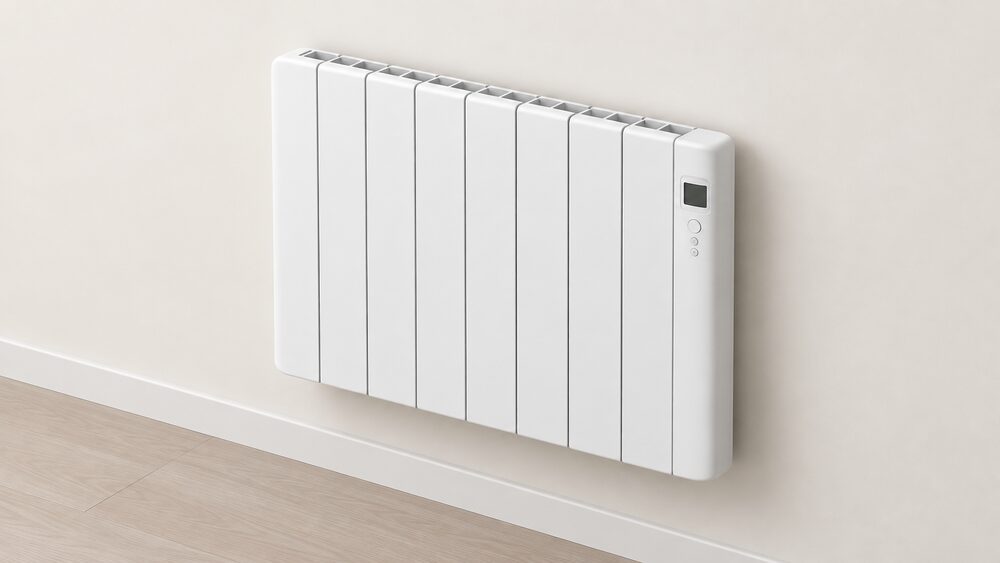
Electric radiators, panel heaters and storage heaters sold in the UK come from a small set of recognisable makers: the French manufacturer Atlantic, whose Oniris and Accessio ranges reach UK buyers through distributors; Electrorad, which designs and manufactures its Digi-Line range in Britain and stocks it in Leeds; Haverland UK, specialising in electric radiators, thermal emitters and smart heating; Dimplex, with the Q-Rad; Fischer Heating, whose radiators are described as German-engineered and designed for UK homes; and Trust Electric Heating, a British manufacturer whose neos radiator is made in Leeds. For instantaneous electric hot water, Stiebel Eltron's DHB-E 27 LCD Set is the reference product at the top of the domestic range.
Direct electric heating is not a niche. It remains the second most common form of home heating after gas1. Around 2.3 million UK households use electric heating such as storage heaters2, and 8.6% of homes are heated by electricity from traditional storage heaters or modern heat pumps3. On price, a UK distributor listed the Atlantic Oniris 2000W Electric Radiator at £397.95 including VAT in September 2026, with the 1000W model at £263.664. The Stiebel Eltron DHB-E 27 LCD Set is rated at 27 kW on a 400 V three-phase supply, drawing 39 A and requiring 40 A fuse protection5.
This page describes what each maker states about its own products, uses distributor listings only for UK price and availability, and sets out plainly where an electrically heated home still depends on the grid, a supplier and a tariff.
Who makes electric radiators and heaters sold in the UK
The UK market divides into three groups. First, European manufacturers exporting complete ranges: Atlantic, the French manufacturer of connected radiators, radiant panels and electric convector heaters7; and Stiebel Eltron, the German maker whose instantaneous water heaters and electric heating reach UK homes. Second, British manufacturers and importers. Electrorad states it was the first company in the UK to import German electric radiators with fireclay cores, and its Digi-Line range is designed and manufactured in Britain8. Its Vanguard range is described as British-made10. Trust Electric Heating describes itself as a British manufacturer delivering in the UK, with the neos radiator made in Britain in Leeds and inspired by German electric heating technology11. Third, specialist brands built around electric heating for UK homes: Haverland UK, described as a company specialising in electric radiators, thermal emitters and smart heating in the UK12, and Fischer Heating, which specialises in high-efficiency electric radiators designed specifically for UK homes, with German engineering and advanced control systems13. Dimplex sits alongside them with the Q-Rad electric radiator14.
Two pieces of context matter when reading maker claims. Radiators of all kinds, wet and electric, account for around 90% of all heating systems in the UK6, so an electric radiator is a familiar object fitted in a familiar place. And the market is not a fixed one: more than 80% of UK households currently heat with gas or oil15, and the same independent work notes that over the next ten years many households will need to move from gas and oil central heating to electrified heating such as a heat pump16. Direct electric heating sits within that shift without being the same thing as a heat pump, and the distinction shapes both cost and independence.
For how these brands sit within wider ownership structures, see brand ownership and parent groups; the equivalent pages for other technologies are listed under manufacturers.
Atlantic: the Oniris and Accessio ranges
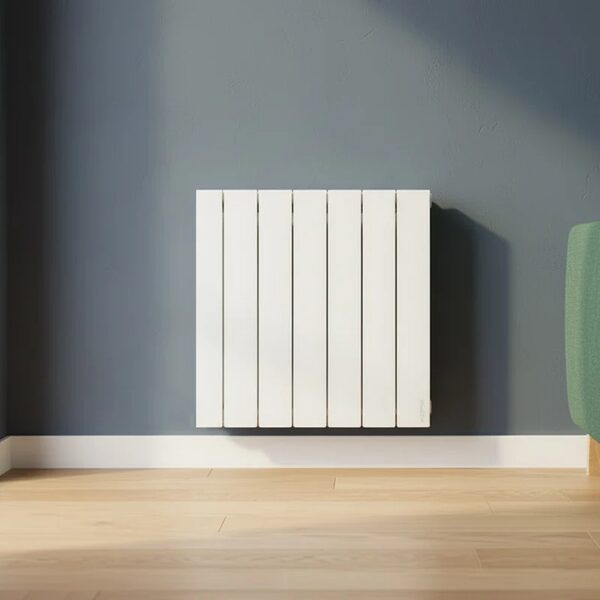
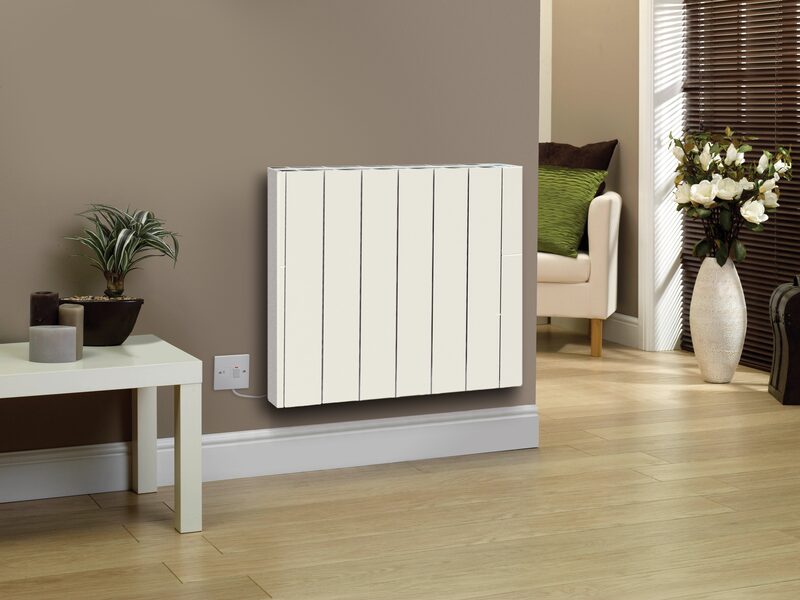
Atlantic is the French manufacturer of connected radiators, radiant panels and electric convector heaters7. Two ranges dominate its UK distributor listings: Oniris, a dry electric radiator, and Accessio, a thermofluid radiator in which a fluid is heated inside the body of the appliance. The practical difference is in how heat is released: a thermofluid body holds warmth after the element cuts out, while a dry unit responds faster in both directions.
Atlantic does not sell to UK households directly. Prices are set by the distributor carrying the range, which means two things for a buyer. Listed figures move, and the same model appears at different numbers depending on whether VAT is shown. For the Oniris 1000W, one UK listing gave £263.66 including VAT and another £219.72 excluding VAT; the 2000W appeared at both £397.95 and £331.63. These are not contradictory findings so much as different VAT positions and offer prices, and no single figure can be treated as the price of the product. The figures below are distributor listings, not manufacturer pricing.
Atlantic Oniris electric radiators: UK listings
| Model | Output | Listed price |
|---|---|---|
| Atlantic Oniris 750W Electric Radiator | 750 W | £269.95 inc. VAT17 |
| Atlantic Oniris 1000W Electric Radiator | 1000 W | £263.66 inc. VAT17 |
| Atlantic Oniris 1250W Electric Radiator | 1250 W | £281.66 inc. VAT17 |
| Atlantic Oniris 2000W Electric Radiator | 2000 W | £397.95 inc. VAT4 |
The 1000W listing at £263.66 sits below the 750W at £269.95, which is a promotion rather than a pricing logic: a regular price of £292.95 inc. VAT was shown against the 1000W model17. Output, not price, is the figure that should guide sizing.
Atlantic Accessio thermofluid radiators: UK listings
| Model | Output | Listed price |
|---|---|---|
| Atlantic Accessio 300W Thermofluid Radiator | 300 W | £187.7418 |
| Atlantic Accessio 500W Thermofluid Radiator | 500 W | £192.56, shown as sold out at another retailer18 |
| Atlantic Accessio 1000W Thermofluid Radiator | 1000 W | £254.7918 |
| Atlantic Accessio 1250W Thermofluid Radiator | 1250 W | £289.9418 |
| Atlantic Accessio 2000W Thermofluid Radiator | 2000 W | £351.4518 |
The Accessio range starts lower, at 300 W, which suits a small room where a 1000 W unit would cycle constantly. Here too the listings disagree between inclusive and exclusive figures: the 500W was shown at £192.56 at one retailer and £160.47 excluding VAT at another, where it was also marked sold out. A buyer should establish the VAT position of any quoted figure before comparing across retailers, and installation by an electrician is a separate cost that no listing includes.
Electrorad: British manufacture, Leeds stock and a 30-year guarantee
Electrorad is the clearest example in this market of a manufacturer selling on availability as much as on product. The company states that it holds large stocks of all products at its Leeds warehouse, with quick response times and next-day delivery if required, and that it was the first company in the UK to import German electric radiators with fireclay cores8. Its conservatory guidance directs buyers to online suppliers offering free next day delivery19. Orders otherwise go through its own team or a nearest-retailer network serving trade professionals, electrical wholesalers and end-users in residential and commercial spaces9.
The ranges divide by origin and appearance. The Digi-Line electric radiator range is designed and manufactured in Britain9 and is described as looking like traditional gas radiators19, which matters in a retrofit where the wet system is being removed and the visual result is meant to be unremarkable. Vanguard is described as British-made10. Aeroflow is the company's best-selling range.
A 30-year guarantee is long by any standard in domestic heating, and its value depends entirely on the company still trading to honour it. The commitment to repair or replace in the UK removes one common friction, the return of a heavy appliance to a European factory. What it does not remove is the ordinary risk any long warranty carries; the general position is set out under manufacturer warranties and what happens when a manufacturer fails, and registration conditions under warranty registration.
Controls fitted as standard, and what they actually do
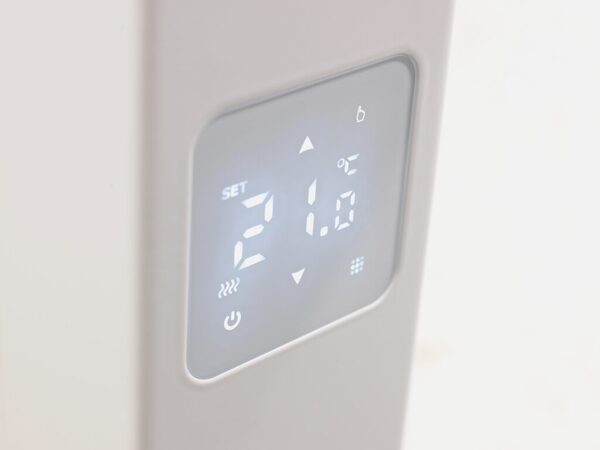
Control is where electric heating manufacturers now compete, because the appliance itself converts electricity to heat in much the same way whatever the badge. Electrorad states that a programmable thermostat is found across all of its electric radiators and towel rails20, and that its Vanguard range offers an eco temperature setting20. Dimplex gives the fullest published specification for a single radiator: the Q-Rad is digitally controlled with an electronic thermostat accurate to plus or minus 0.2 degrees C, a setpoint range of 7 to 30 degrees C, a 7-day programmable user timer with Out All Day and Home All Day options, continuous heat modes of Eco, Manual and Frost Protect, and additional Away, Boost, Setback and Runback modes14. Atlantic's UK proposition is built on new generation connected radiators7, and a supplier describes electric radiators generally as offering room-by-room control with smart features and heat delivery that is fast, responsive and even22.
Room-by-room control is the genuine advantage of the format. A wet system heats a circuit; an electric radiator heats a room, and rooms that are unused need not be heated at all. Electrorad states that with electric radiators a household can achieve complete temperature control and reduce wasted energy within the home23. That is a maker's framing, but the underlying mechanism is real and independent guidance supports the narrower point: direct electric radiators are a suitable option where there is a requirement for rapid response or intermittent heating, and are particularly sustainable with self-generated energy such as from photovoltaic panels24.
The dependency created is worth naming. Connected and app-controlled radiators add a manufacturer's cloud service to the list of things a household relies on. A programmable thermostat on the appliance itself keeps working if that service does not; a smart schedule set from a phone may not. The question of how long app support lasts is covered under firmware updates and product support life, and control hardware more broadly under heating control manufacturers.
IP ratings and where a heater can go
IP ratings decide where an appliance may be positioned, particularly in bathrooms and kitchens. The published figures across these makers are close together but not identical.
| Product | IP rating |
|---|---|
| Stiebel Eltron DHB-E 27 LCD Set | IP255 |
| Dimplex Q-Rad electric radiator | IP2414 |
| Haverland ECO-RAD electric radiator | IP24, Class 125 |
The Haverland ECO-RAD is supplied complete with a UK plug and power cord, and the maker states it is available only through selected wholesalers25. That combination, a plug-in appliance sold through the trade, is common in this sector and has a practical consequence: a plug-in radiator can be moved and replaced by the householder, while a hardwired unit and anything on a three-phase supply is an electrician's work. Nothing on this page is advice on electrical safety; positioning and connection are governed by the wiring regulations and the manufacturer's own instructions.
Stiebel Eltron DHB-E 27 LCD Set: 27 kW instantaneous hot water
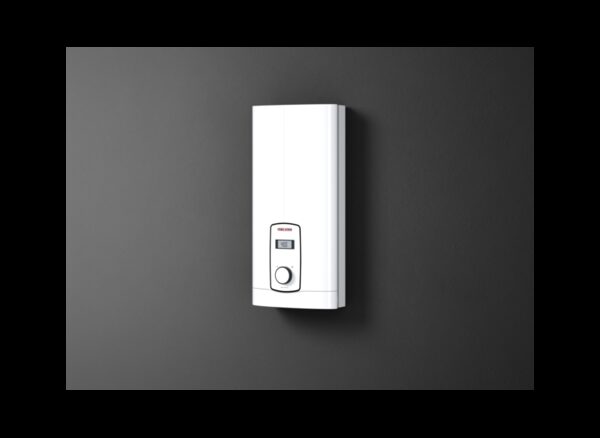
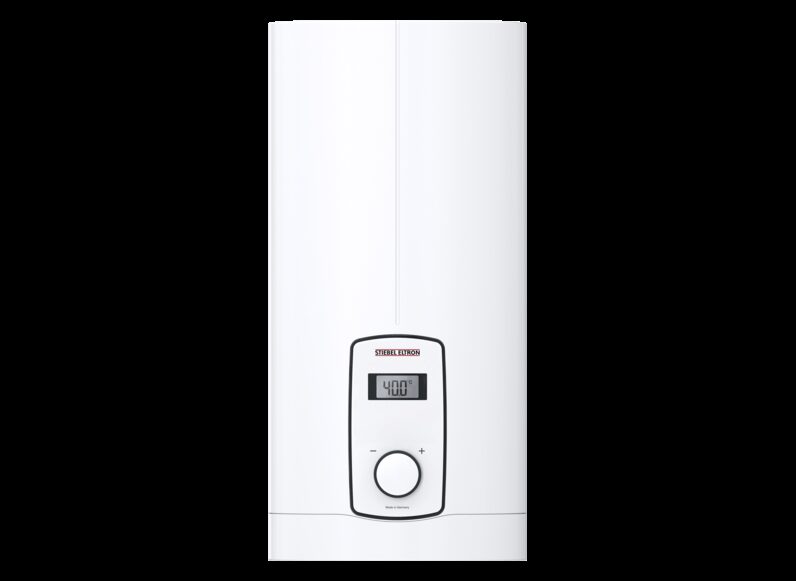
Instantaneous electric water heating is the other half of an all-electric home, and Stiebel Eltron's DHB-E 27 LCD Set is the top of its domestic instantaneous range. The maker states that it manufactures three-phase units at 400 V with outputs up to 27 kW, and that one of these units is capable of running approximately two to three showers, filling a bath or supplying a number of basins at the same time. The biggest unit supplied on single phase at 240 V is the 10/12 kW model, which has an output of 14.3 kW and would be capable of supplying a shower and basin, or a kitchen sink and a basin26.
That distinction is the single most important fact for a UK household. A 27 kW instantaneous heater is not a single-phase appliance. It requires a 400 V three-phase supply, which most UK homes do not have and which is a distribution network operator matter to obtain.
Specification: DHB-E 27 LCD Set
| Attribute | Value |
|---|---|
| Rated output | 27 kW |
| Rated output, variant 1 | 24,4 kW at 380 V |
| Rated output, variant 3 | 19,4/22,6/25,8 kW |
| Rated voltage | 400 V |
| Phases | 3/PE |
| Rated current | 39 A |
| Rated current, variant 1 | 37,1 A |
| Rated current, variant 3 | 30,1/32,2/36,3 A |
| Fuse protection | 40 A |
| Fuse protection, variant 3 | 32/32/40 A |
| Energy efficiency class | A (scale A+ to F) |
| IP rating | IP25 |
| Dimensions | 466 mm high, 225 mm wide, 116 mm deep |
| Weight | 2.90 kg |
| Colour | White |
All figures above are the manufacturer's own published specification5. The stablemate DHE 27 Set is also rated at 27 kW with 40 A fuse protection27.
The variant outputs are not options a buyer chooses freely; they reflect the supply voltage and wiring arrangement, and the fuse protection follows from them. The lowest step in the variant 3 arrangement, 19,4 kW, carries fuse protection of 32/32/40 A rather than a flat 40 A. Sizing, supply and protective device are one decision, not three.
Temperature control, anti-scalding and installation of the DHB-E 27
Stiebel Eltron states that accurate temperature delivery comes from 3i technology and electronic closed-loop control, and that the water temperature is continuously controlled by three electronic sensors5. Temperature is selected on a rotary selector and shown on an LCD screen, with a setting range of Off and 20 to 60 degrees C5. The unit is described as suitable for preheated water up to 55 degrees C with reheating and up to a maximum of 70 degrees C without reheating5, which allows it to act as a booster downstream of a solar thermal or heat pump source rather than only as a standalone heater.
On safety, the maker's own words are specific:
"High safety level as anti-scalding protection can be permanently activated"
Permanent activation matters where children or vulnerable occupants use the outlets, because it removes the possibility of the limit being raised at the control.
For installation, the maker cites quick installation with its PROFI-RAPID system, and greater convenience when installed undersink, since the appliance cover and the programming unit can be turned the other way up5. The same reversible arrangement is described for the DHE 27 Set27. At 2.90 kg and 466 mm by 225 mm by 116 mm, the unit is small enough to sit in a sink cupboard, which is the point of the feature.
Instantaneous heating is one of two approaches. Electric water heaters cover both instant and storage types28; Haier's EWH storage range, for instance, is offered in 30, 50, 80 and 100 litre capacities28. A storage cylinder can be charged when electricity is cheapest; an instantaneous unit draws its full rated load at the moment of use. That difference is central to running cost and is discussed further under hot water cylinder manufacturers. Stiebel Eltron's wider UK range is covered on its own page, Stiebel Eltron, and Dimplex's on Dimplex heating.
What electric heating means for household energy independence
Electric heating is any system that uses electricity as the main energy source to heat a home29. That is both its strength and the limit of its independence. A direct electric radiator removes the gas connection, the flue, the annual gas safety work and the exposure to gas prices. It does not remove the grid. Where radiators use electricity at the moment the room needs heating30, demand falls at the times electricity is most expensive to supply, which is the opposite of the pattern a storage heater was designed around.
The independence case is strongest where the household generates its own electricity. Independent guidance notes that direct electric radiators are a suitable option where rapid response or intermittent heating is needed, and are particularly sustainable with self-generated energy such as from photovoltaic panels24. In practice that means daytime heating in spring and autumn from a roof array, with the grid carrying the winter evening load. It does not mean self-sufficiency: a 2000 W radiator in each of several rooms, or a 27 kW instantaneous water heater, is a demand no domestic solar array meets in December.
What remains is a set of dependencies a household should count honestly:
- The grid and a supplier. Every kilowatt-hour is bought. Electrorad's framing is that the cost of electricity varies by location and energy provider but that electric heating lets a household fully control the cost of its heating23; that is control over how much is used, not over the unit price.
- Tariff structure. The economics of storage heating in particular rest on a cheaper off-peak rate, and that rate is a supplier's commercial decision.
- The manufacturer. A 30-year guarantee21, firmware for a connected radiator, and spare parts all depend on the company continuing to trade.
- A three-phase supply, for anything in the class of the DHB-E 27 LCD Set5, which is outside a household's control.
Set against that, electric heating is well established rather than experimental: it is the second most common form of UK home heating after gas1, used by around 2.3 million households in its storage heater form2, and accounting with heat pumps for 8.6% of homes heated by electricity3. More than 80% of UK households still heat with gas or oil15, and the expectation across independent work is that many will move to electrified heating over the next ten years16. A household choosing electric radiators is moving early in that direction with a technology that needs no new fuel supply, at the cost of paying the electricity price for every unit of heat rather than the smaller fraction a heat pump would draw. The comparison with heat pumps is set out under heat pump manufacturers, and the independence question across equipment types under manufacturers and household energy independence.
Sources31 cited
- What is direct electric space heating and where is it best used, BEAMA, 1 September 2025
- How to make electricity cheaper, Nesta, 5 June 2025
- Decarbonisation of heat guide, Energy Systems Catapult, 27 June 2025
- Atlantic Oniris 2000W electric radiator listing, Air Con Centre, 17 September 2026
- DHB-E 27 LCD Set product page, Stiebel Eltron UK, 17 September 2026
- Stelrad profile, CIPHE, 16 March 2023
- Open window detection and connected heating, Netatmo, 20 September 2026
- Wall mounted electric radiators, Electrorad, 12 June 2025
- Digi-Line Zigbee electric radiators, Electrorad, 9 September 2025
- Create a greener home, Electrorad, 20 September 2026
- Trust Electric Heating Ltd business profile, Which? Trusted Traders, 17 September 2026
- Haverland RCBL electric radiator, Haverland UK, 13 January 2025
- The complete guide to electric heating in the UK, Fischer Future Heat, 19 March 2026
- Q-Rad electric radiator, Dimplex, 17 September 2026
- Beyond affordability: why heat pumps feel like a gamble, Which?, 2 July 2026
- Transforming EPCs: consumer research insights, Which?, 27 September 2024
- Atlantic Oniris 1500W electric radiator listing, Air Con Centre, 17 September 2026
- Atlantic Accessio 1500W thermofluid radiator listing, Air Con Centre, 17 September 2026
- Conservatory electric radiators, Electrorad, 20 September 2026
- Electric radiator sizes: a room by room guide, Electrorad, 20 September 2026
- Electric radiator guarantees, Electrorad, 20 September 2026
- Electric radiators, EDF Energy, 2026
- Why choose an electric heating system, Electrorad, 20 September 2026
- Myson: low temperature heating, CIPHE, 25 January 2024
- ECO-RAD electric radiator, Haverland UK, 13 January 2025
- Can Tempra products be used in the UK, Stiebel Eltron UK, 2026
- DHE 27 Set product page, Stiebel Eltron UK, 17 September 2026
- Electric water heaters brochure 2025, Haier HVAC, August 2025
- Electric heating advice, Energy Saving Trust, 1 July 2026
- Is renewable heat right for your home, Energy Saving Trust, 19 May 2026
- Park homes advice, Centre for Sustainable Energy, July 2026
 Electric Heating CostsHow to work out what electric radiators, panel heaters, infrared and storage heaters cost to run per hour and per season.
 Electric Radiators and PanelsDo electric radiators cost more to run than gas heating, and are they worth it for one room or a whole house?
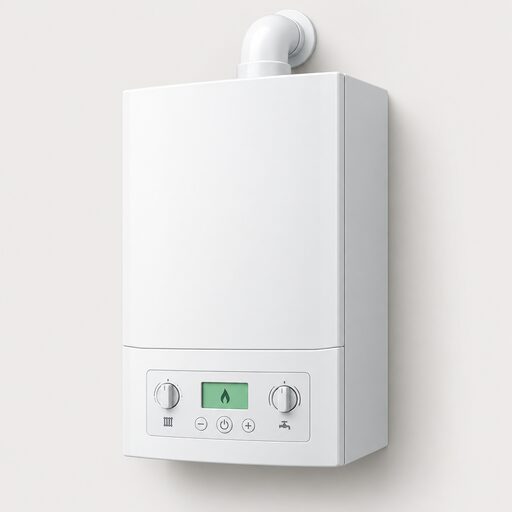 Boiler Manufacturers in the UKCovers the manufacturers supplying gas, oil, LPG and electric boilers to UK homes, their main ranges and where they are made.
 The Full Brands GuideWhich boiler, heat pump or solar brand can you trust, and who actually owns it?
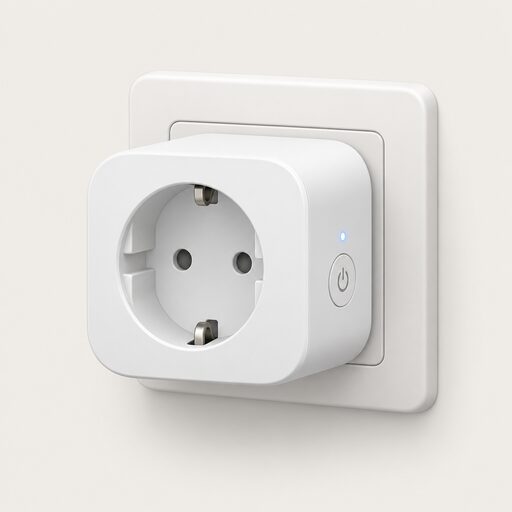 Electric Radiator ControlsElectric heaters cost far more to run than gas, so the controls really matter.
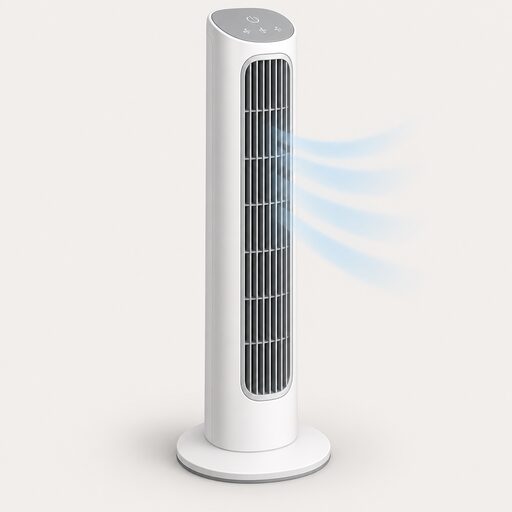 Electric FansHow electric fans cool people rather than rooms, what the main UK fan types (desk, pedestal, tower, ceiling and bladeless) draw in watts and cost per hour, where they fall short in a heatwave, how to use them safely, and how they fit alongside night ventilation and shading.