
In this answer
Short answer
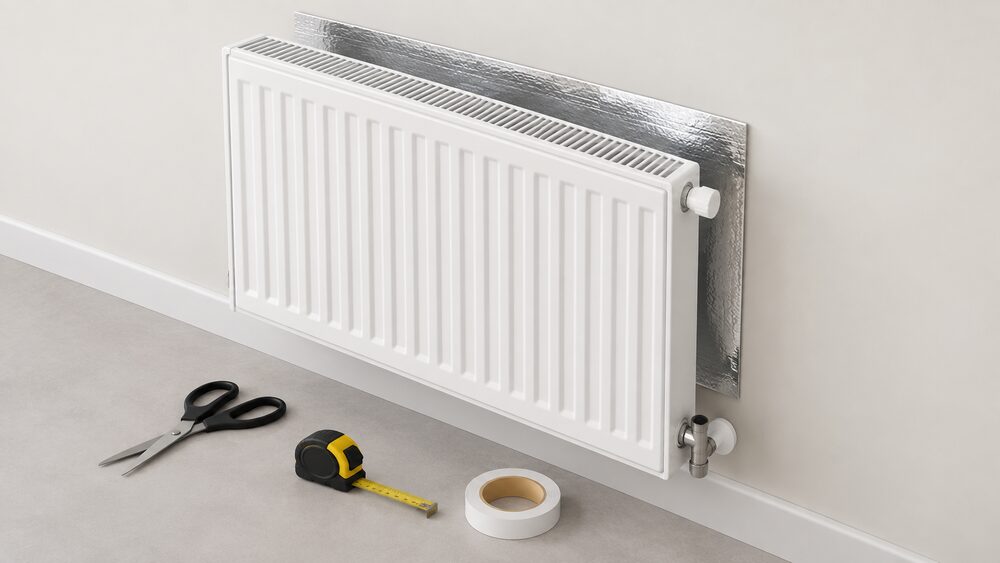
Radiator reflector panels are thin sheets of foil, or foil with a thin layer of insulating material, that sit on the wall behind a radiator and reflect heat back into the room instead of letting it escape through the wall1. They cost around £25 for a roll that is cut to size, or around £20 to £30 per pack, which works out at roughly £8 to £12 per radiator1.
The saving is modest but real. Independent guidance puts it at around £18 a year in Great Britain and £20 in Northern Ireland when the panels are fitted to radiators on uninsulated external walls1. Cadent Gas gives £25 a year for the average household with uninsulated walls, and a consumer guide reports up to £25 a year5. The panels also cut carbon dioxide by 60kg a year in Great Britain and 110kg in Northern Ireland1.
The condition attached to every figure is the same: the panels only pay on uninsulated external walls. On an insulated wall, or an internal wall between two heated rooms, there is little benefit2. That single condition decides whether the measure is worth doing at all.
What radiator reflector panels are and how they work
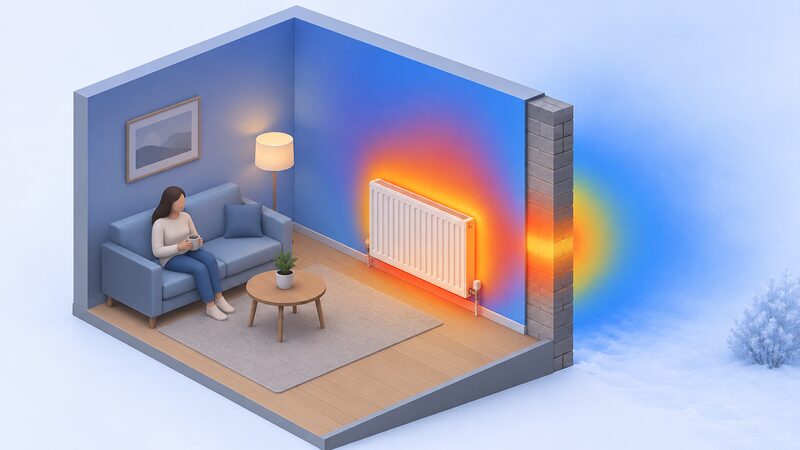
A radiator heats a room in two ways: by warming the air that circulates past it, and by radiating heat from its surface. The back face of a radiator sits a short distance from the wall, and on an uninsulated external wall that gap is where a share of the heat disappears into the brickwork and out to the street. Reflector panels interrupt that path. They are placed behind the radiator to reduce heat loss through the outer wall, with heat reflected back into the room2.
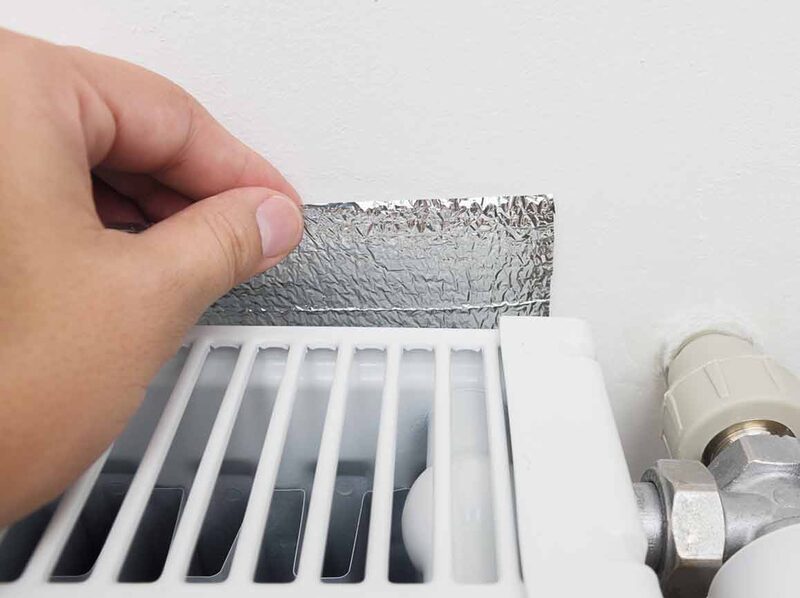
The material is simple. Independent guidance describes them as thin sheets made of foil or other reflective material, sometimes with a thin layer of insulating material bonded to the back1. The Energy Saving Trust states that they reflect heat from the back of a radiator back into a room, stopping the heat from escaping through outside walls1. One supplier describes the mechanism slightly differently, saying the reflective surface reflects heat back into the radiator, keeping the water in the radiator warmer for longer7. Both effects point the same way: less heat lost through the wall, more heat kept in the room or in the system.
National Energy Action summarises the benefit as helping to get warmth from radiators into the room and potentially making the heating more efficient8. The Chartered Institute of Plumbing and Heating Engineering makes the same point in its DIY guidance, noting that installing special foil to the wall behind radiators stops heat escaping through walls and reflects heat back into the room9.
Cost: around £20 to £30, or about £7 per radiator

The headline cost is small enough that the measure is usually grouped with low-cost first steps rather than with insulation proper. The Energy Saving Trust gives around £25 for a roll, which is then cut to size so it fits snugly behind the radiator1. A consumer guide reports around £20 for panels bought online, describing them as fairly inexpensive and easy to fit2. Another independent source puts the cost at around £30 per pack4.
Per radiator, the figure is lower still. Independent guidance gives around £8 to £12 per radiator for panels fitted behind radiators on external walls3. A separate guide quotes £13 per roll for materials only10. The spread between £20 and £30 reflects pack size, thickness and whether the panel is a plain foil sheet or a foil and foam laminate.
| Cost basis | Figure | Source |
|---|---|---|
| Per roll, cut to size | around £25 | 1 |
| Per pack | around £20 to £30 | 2 |
| Per radiator | around £8 to £12 | 3 |
| Materials only, per roll | £13 | 10 |
For scale, replacing a double panel radiator costs around £200 on average, and smart radiator valves typically cost between £35 and £80 each11. Reflector panels are an order of magnitude cheaper than either. They are also a different kind of purchase: not a component of the heating system, but a barrier between the system and the wall.
How much they save: £18 to £35 a year depending on your walls and region
The saving depends on two things: whether the wall behind the radiator is insulated, and where in the UK the home is. Independent guidance gives £18 a year in Great Britain and £20 in Northern Ireland for panels installed on uninsulated external walls1. The same figures appear in rental-specific guidance, which states they could save around £18 a year in GB and £20 in NI4. A cold-weather guide repeats the £18 and £20 split13.
Other sources land higher. Cadent Gas states that adding reflective radiator panels in a home with uninsulated walls could save the average household £25 a year5. A DIY versus professional insulation guide gives around £25 per year10, and a consumer guide reports that radiator foil can trim up to £25 a year off heating bills, attributing the figure to the Energy Saving Trust6. One supplier puts the saving at £5 to £15 per radiator per year for an average radiator on an uninsulated external wall, which for a home with several such radiators would exceed the £25 household figure14.
The range across the sources is therefore roughly £18 to £35 a year, with the lower end tied to a single stated wall condition and the higher end to homes with more than one radiator on an uninsulated wall. The documents do not disagree about the mechanism; they differ on how many radiators and which wall types they assume.
| Region and condition | Annual saving | Source |
|---|---|---|
| Great Britain, uninsulated external walls | £18 | 1 |
| Northern Ireland, uninsulated external walls | £20 | 1 |
| Average household, uninsulated walls | £25 | 5 |
| Radiator foil, fitted correctly | up to £25 | 6 |
| Per radiator, uninsulated external wall | £5 to £15 | 14 |
Carbon savings follow the same regional split: 60kg a year in Great Britain and 110kg in Northern Ireland1. For context, a typical home solar panel system is estimated to save around one tonne of carbon a year, and rooftop solar has typical annual savings of £605 to £67515. Reflector panels are a far smaller measure, and priced accordingly.
Where they help most: uninsulated external walls
The panels are most effective when fitted to radiators on uninsulated external walls1. Guidance for renters says the same: they go behind radiators that are on any uninsulated external walls4. Cadent Gas states that its £25 figure is based on installation behind radiators on uninsulated external walls, and that the measure is only recommended for uninsulated solid walled or uninsulated cavity walled properties5.
That is a narrow target. A home with cavity wall insulation, or with solid walls that have been insulated internally or externally, has already closed the path the foil is designed to block. External wall insulation reduces heating costs by addressing the wall itself, which is the more complete version of the same job17. On an internal wall, heat that passes into the next room is not lost from the building, so there is nothing for the foil to recover. Independent guidance is direct on the point: it is not really worth adding radiator panels to internal walls1.
A supplier states that reflective panels behind radiators on uninsulated walls can reduce heat loss through that wall by 30 to 45 per cent14. That is a maker's figure for its own product and describes heat loss through the wall, not the household bill, so it should not be read as a bill reduction of the same size.
If you are not sure whether your walls have been insulated, checking your Energy Performance Certificate is the recommended route2. The certificate records the wall type and the insulation assumed for the property, which is the practical way to decide whether any radiators in the home qualify. For a wider view of where heat leaves a home and in what order to tackle it, see where a UK home loses heat and what order should retrofit measures be done in.
Fitting them: tools, safety and rented homes
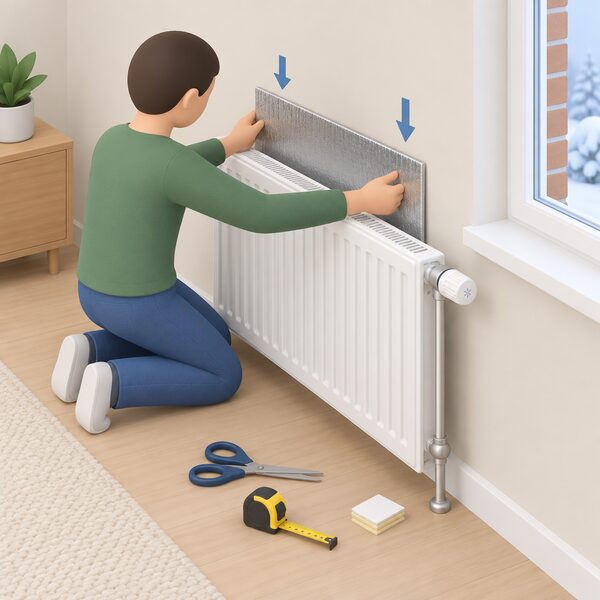
Fitting is a household job. The likely requirements are the panels, scissors, a tape measure, and double-sided tape or adhesive pads2. The method is to measure the radiators on external walls, cut the foil to size, slide the panel down the back of the radiator and press it against the wall so it sticks securely1. Some reflector panels include clips that let you mount the panels to the radiator itself, and clip-on panels are easy to install and remove, which makes them a reasonable option for a home occupied under a tenancy1.
Before starting, switch off the heating or turn off the radiators being worked on using the thermostatic radiator valve, and let the radiators cool down1. That is the safety step, and it also makes the panel easier to seat flat against the wall.
"Check if the reflector material you buy includes adhesive backing that will help it stick to your wall."
On buying, independent guidance recommends purpose-made radiator reflector panels from a DIY store rather than improvised alternatives1. Panels are also sold online, with one consumer guide quoting around £202. For rented homes, guidance is to check with the landlord first if the property is not yours2. Reflector panels are not among the alterations that need building regulations approval; adding extra radiators to a heating system is18.
In Northern Ireland, reflective radiator panels appear as a measure within the NISEP whole house solution schemes, with 10 installed under the 2024/25 programme19. That is a scheme-level figure rather than a household one, but it confirms the measure is recognised in official energy efficiency delivery.
Are they worth it for your home?
The case rests on three conditions being true at once: the radiator is on an external wall, that wall is uninsulated, and the household is willing to spend around £20 to £30 for a saving of roughly £18 to £25 a year1. Where all three hold, the measure pays back in about a year and continues to return a small amount thereafter. Where any one fails, the return falls away, and on an insulated or internal wall there is little benefit at all2.
Independent guidance describes reflector panels as a low-cost option that could reduce energy consumption, and notes they could save money on heating bills8. That is a fair summary of the evidence: a small, cheap, conditional measure rather than a transformation. It does not reduce a household's dependence on the grid or on a gas supplier, and it does nothing about the standing charges that make up a large part of a bill. What it does is reduce the heat that a radiator wastes through one specific surface, which is why it belongs near the start of a plan rather than at the end.
For a household working through measures in order, reflector panels sit alongside draught-proofing and heating controls as low-cost steps that can be done before larger work. See no-cost and low-cost ways to cut energy use first and how much can draught-proofing save on energy bills? for the measures that usually sit next to this one. For the wider sequence, the getting started guide sets out where a measure of this size fits.
Sources21 cited
- Radiator reflector panels, Energy Saving Trust, 2025-10-31
- Radiator panels, Smart Energy GB, 2026-04-22
- Draught busting, Low Carbon Hub, 2026-08-05
- How to save energy and money if you rent your home, Energy Saving Trust, 2025-11-14
- Energy efficiency, Cadent Gas, 2026-09-20
- Does radiator foil work?, Uswitch, 2025-09-11
- Four ways to lower your heating bills, EDF Energy, 2019-12-11
- Top energy savings tips, National Energy Action, 2026-07-13
- Easter DIY jobs to lower your energy bills, Chartered Institute of Plumbing and Heating Engineering, 2022-04-10
- DIY vs professional home insulation, Uswitch, 2025-11-07
- Heat pump fact check, Energy Saving Trust, 2026-07-01
- Best smart radiator valves, Which?, 2026-09
- Cold weather energy saving: your top tips, Energy Saving Trust, 2025-09-22
- Foil radiator insulation, Fuse Energy, 2026-05-29
- Solar panels, Energy Saving Trust, 2026-08-27
- Plug-in solar panels, Which?, 2026-09-15
- How does external wall insulation improve energy efficiency?, Unilin Insulation, 2026
- Building regulations approval, GOV.UK, 2026-09-17
- 2024-25 NISEP Annual Report, Utility Regulator Northern Ireland, 2026-07
- Energy grants Northern Ireland, Energy Saving Trust, 2026-09-17
- Stay warm in winter: five areas to add insulation in your home, Energy Saving Trust, 2025-02-07
 Solar Panel CostsA typical UK home pays somewhere between four and eleven thousand pounds for solar panels fitted, with most landing in the middle.
 Roof InsulationHow much heat escapes through your roof, how thick the insulation should be, what it costs and what it saves?
 Whole-House Retrofit CostsA whole-house retrofit can cost anywhere from a few thousand pounds to over fifty thousand, so what you actually pay depends on how much work your home needs.
 The Full Solar Panels GuideHow much do solar panels cost, and what could they save you each year?
 Changing Habits SavingsWhat the evidence says behavioural change saves: around £90 to £120 a year for one degree off the thermostat, £100 to £110 a year for using a full set of heating controls, and £304 to £351 a year for a bundle of small changes.
 Electric Radiators and PanelsDo electric radiators cost more to run than gas heating, and are they worth it for one room or a whole house?