
In this guide
The fastest reductions in a household energy bill come from settings and habits, not from equipment. Turning a room thermostat down by one degree is the single largest of them: the Energy Saving Trust estimates a drop from 22°C to 21°C at £120 a year in Great Britain and £80 in Northern Ireland, while official Northern Ireland guidance frames the same change as a saving of as much as 10 per cent on heating bills. Getting a full set of heating controls working properly is estimated at around £100 a year for an average semi-detached house in Great Britain and £110 in Northern Ireland. Filling a kettle only to the level needed is worth around £10 a year in Great Britain and £11 or £12 in Northern Ireland depending on the source. None of these needs a contractor, a grant or a permission.
The numbers vary between publishers, and it matters that they do. Estimates for the one-degree change alone run from around £60 to £120 a year, and one local authority describes the potential saving as up to 25 per cent of the heating bill. They rest on different assumed house types, fuel prices and starting temperatures. The percentage figures travel better than the pound figures: a fixed proportion of your own heating bill is easier to translate to your own home than an average household's cash saving.
What these measures do for energy independence is narrower than the savings suggest. Lowering demand reduces exposure to the price of imported gas and to tariff changes, and it shrinks the size of any later heat pump, solar array or battery. It does not remove the grid connection, the supplier relationship, or reliance on gas or heating oil. Saving money by lowering energy bills remains the top motivator for almost everyone seeking energy advice1. Independence, where it comes, comes later and costs more.
Start here: the actions that cost nothing
A weekend is enough for the whole list. Which? sets out six simple actions that make a home cheaper to run immediately8. The pattern across the published advice is consistent: change the temperature settings first, because they act on the largest single item in most bills; then change the timing, so heat is only produced when someone is there to feel it; then deal with the appliances that draw the most power for the longest.
It also helps to separate what is free from what is merely cheap. Thermostat settings, heating schedules, boiler flow temperature, kettle filling and dryer use cost nothing at all. Draught stopping, cylinder jackets, pipe lagging, reflective radiator panels and LED bulbs cost something, though little; in Northern Ireland several of those appear bundled as supporting measures within the Better Energy Homes Plus scheme alongside a boiler upgrade and insulation, including LED bulbs, remote smart heating controls, a low-flow shower head, a hot water tank jacket, reflective radiator panels and draught proofing where required9.
Background bill movements run alongside household action and are easily confused with it. Government reported a reduction in energy bills of an average of £150 from April 202610, and Budget measures were described in the Commons as reducing energy costs by 7 per cent from April11. A bill that falls after you change a setting has not necessarily fallen because of it, which is the case for recording a baseline before and after. Pages on working out how much energy your home uses and on measuring savings after the work cover that.
Thermostat and schedule: the one-degree rule
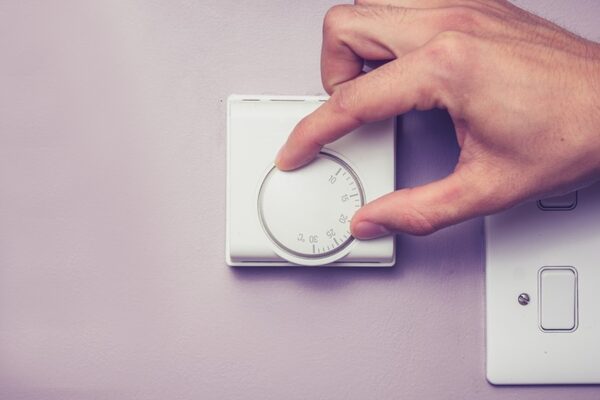
The room thermostat sets the temperature the house is heated to, and lowering the target reduces the heat lost through walls, roof and windows for every hour the heating runs. This is why the saving is expressed as a share of the heating bill rather than a flat amount.
| Source | Estimated saving from 1°C reduction |
|---|---|
| Energy Saving Trust2 | £120 a year in GB, £80 in NI (22°C to 21°C) |
| Consumer Council for Northern Ireland12 | £80 a year |
| Confused.com13 | £90 a year |
| Smart Energy GB14 | around £60 |
| nidirect3 | as much as 10 per cent of heating bills |
| British Gas Energy Trust15 | 10 per cent of the bill |
| East Herts District Council16 | up to 25 per cent of heating bills and associated carbon |
The spread is wide and the documents plainly disagree on the cash figure. The 25 per cent figure sits well outside the rest and should be treated as the outer end of a modelled range rather than a typical result. A household with a large, poorly insulated house and high heat loss will save more in cash than a small flat, because the same percentage applies to a bigger bill.
Timing matters as much as temperature. The controls turn the heating on and off, so a schedule that matches occupancy stops the house being heated for empty hours17. Official self-build guidance goes further and describes installing smart systems that control lighting, heating and cooling based on occupancy and time of day18. For an existing home, setting the programmer around the hours the house is actually used achieves much of the same without hardware. How far habit changes carry in total is covered in how much changing habits can save.
Boiler flow temperature: a separate setting from the thermostat
The flow temperature is the temperature of the water the boiler sends to the radiators, and it is set on the boiler itself, not on the room thermostat. For combi boilers, Welsh Government guidance states that reducing the flow temperature can lower bills, and Confused.com puts the figure at around £65 a year through the Money Saving Boiler Challenge13.
The order matters. The Energy Saving Trust is explicit that it is important to get heating controls right before trying to change the flow temperature20. A house with no room thermostat or no working TRVs will respond unpredictably to a lower flow temperature, because nothing is regulating the room temperature that results. There is also a control rule that applies to low-temperature domestic heating systems: where the heat generator provides hot water, controls must be installed that ensure it does not supply hot water services and space heating simultaneously21.
Heating controls: what a full set is and what it saves
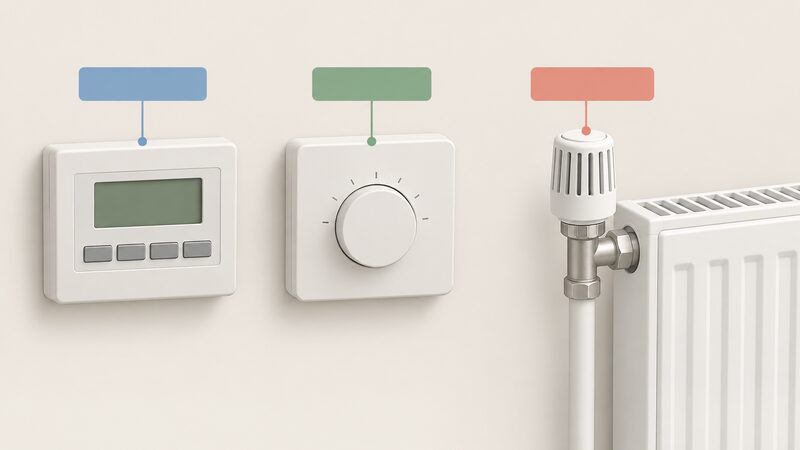
Heating controls govern when the heating system operates and the temperature reached in each room17. Home Energy Scotland describes a full set as a time-controlled programmer, at least one room thermostat, thermostatic radiator valves on radiators, and a cylinder thermostat where the system has a hot water cylinder17. The Energy Saving Trust notes that controls can be fitted to a gas, oil or liquid petroleum gas boiler to make it more efficient22.
For savings, the Energy Saving Trust gives £100 a year for an average semi-detached house in Great Britain with a full set installed, and £110 in Northern Ireland4. Confused.com puts a smart thermostat and controls at up to £110 a year19. Ofgem's load control consumer protection guidance gives a worked example for electric heating in a large house with high usage, around £300 a month, showing a 2 per cent heating bill saving of £6 a month with low control, 4 per cent and £12 a month with medium control, and 6 per cent and £18 a month with high control23. That example is useful because it makes the dependency visible: the saving scales with the bill and with how much control is added, not with a fixed product.
BEAMA's estimates of savings from heating control upgrades work from reference temperature control classes I, IV, V and VI, with the total for a full upgrade based on each measure being carried out in the order stated24. The underlying government evidence base, a rapid evidence assessment of how heating controls affect domestic energy demand, was published on 28 January 201425, so some of the research behind current figures is old.
Controls are also a large part of subsidised delivery. Ofgem's Energy Company Obligation data records 514,780 heating controls measures26, and heating controls made up 8 per cent of measures reported under the Warm Homes: Social Housing Fund27.
Controls: cost, installers and when to upgrade
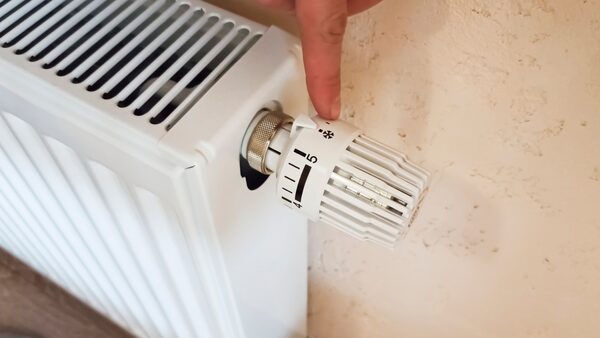
Prices for control upgrades are installer-quoted; no published price applies. The Energy Saving Trust recommends obtaining quotes from at least three different installers to be sure of value for money2. Home Energy Scotland's trigger for considering an upgrade is straightforward: think about it if the system lacks a programmer, at least one room thermostat, or TRVs on the radiators, and consult the manufacturer's manual or the installer for specific advice on using what is already fitted17.
A common misconception is that controls arrive with a new boiler. They do not have to. Home Energy Scotland states that controls can be upgraded or installed independently of the boiler17. The subsidy rules have moved in the same direction: ECO4 guidance removed the requirement for a full set of heating controls in a property following a boiler installation, a change recorded in the delivery guidance updates of 7 August 202528. Planning Portal guidance notes that where a heating or hot water system is replaced, a building control application may not be required, and where it is required it may not be necessary to apply in advance of the work29.
Free or funded advice differs across the four nations. Home Energy Scotland helps rural and off-gas households explore options such as installing a heat pump or other home energy upgrades that can reduce energy costs30. In England, local schemes such as Your Home, Better provide advice, planning and delivery to help reduce bills and the carbon emissions associated with home energy and heating31. In Northern Ireland, remote smart heating controls appear within Better Energy Homes Plus as a supporting measure9. See also free home energy advice in England, Scotland, Wales and Northern Ireland, and how much heating controls can save.
The kettle: a few pence a boil, about £10 a year to fix
A kettle typically draws 2200 to 3000 W and can pull up to 13 A, which puts it among the heaviest single-appliance loads in a kitchen6. The Centre for Sustainable Energy costs a 3000 W kettle at 13p per 10 minutes of use7. Confused.com estimates around 24 kWh a month for 15 minutes of use a day, working out at £6.85 a month on a standard variable rate tariff32. Smart Energy GB puts the per-boil cost at just a few pence, noting that the exact amount depends on the electricity tariff, the kettle's wattage and how much water is in it5.
The saving comes from the volume boiled, not from the kettle itself.
| Action | Estimated annual saving |
|---|---|
| Only boiling the water needed33 | around £10 a year in GB, £12 in NI |
| Avoiding overfilling12 | £11 a year |
| Filling to the amount needed34 | £10 a year in GB, £12 in NI |
| Buying an eco kettle that boils only what is required35 | 20 per cent less energy than a conventional electric kettle |
Limescale is the maintenance side of the same point. Smart Energy GB advises descaling whenever noticeable build-up appears, and says homes in hard water areas may need to do it more often; after descaling, the kettle should be filled with clean water and boiled once or twice before use, unless the manufacturer's instructions say otherwise5. Related comparisons sit on kettle or electric hob and eco kettle savings.
Tumble dryers: the appliance that runs longest at high power
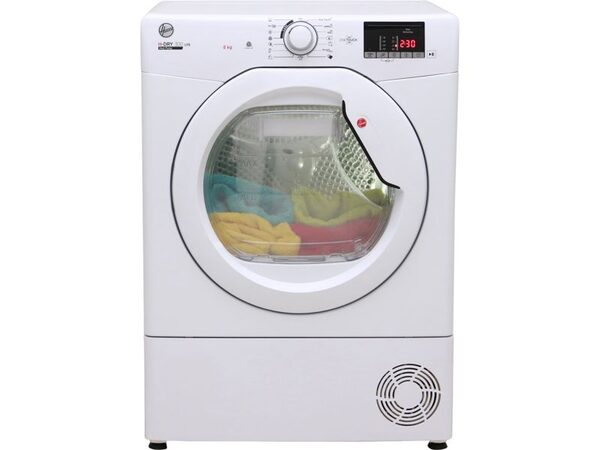
A tumble dryer rated at 2500 W costs 11p per 10 minutes of use7. The difference from the kettle is duration. A kettle runs for two or three minutes; a drying cycle runs for an hour or more, which is what puts dryers at the top of most household electricity lists.
Tumble dryers are also labelled differently from most appliances. The Energy Saving Trust notes that tumble dryers use a different energy rating scale, A+++ to D, where most white goods have moved to A to G35. That is a live area of policy: a government consultation on raising product standards for household tumble dryers proposes reforming the energy efficiency and condensation efficiency scales and introducing new acoustic airborne noise emission and repairability index scales36. Until those changes land, comparing a dryer's letter with a washing machine's letter is meaningless.
The no-cost action is to dry outdoors or on a rack whenever weather and space allow, and where the dryer is used, to spin clothes at a high speed first so less water enters it. Tumble dryer versus air drying covers the comparison, and which appliances use most electricity sets the dryer against the rest.
Appliance ratings: what the letters mean when something is replaced
Energy labels give a quick comparison, but the Energy Saving Trust is clear about what they do not do:
"The letter rating (A, G) is a quick way to compare how efficient appliances are, but it doesn't tell you exactly how much"
The scale now runs from A to G, with A the most energy efficient and G the least35. It replaced the older A+++ to E labelling32, and the Energy Saving Trust describes the same range as A, very efficient, to G, least energy efficient22. Tumble dryers remain on the A+++ to D scale for now35. The practical consequence is that an A on a 2026 label is a much harder standard than an A on a 2015 label, and a product that was once A+++ may now sit several letters lower without having changed at all.
Where the gap between letters is large, the difference in running cost is real: an electric oven with an A+++ rating uses roughly 60 per cent less energy than a B-rated oven13. That is a replacement decision rather than a quick win, and it only pays where an appliance is being bought anyway. Appliance upgrade savings goes further into that.
Knowing your numbers: supplier, MPAN and MPRN
Acting on bills requires knowing who bills you and for which meter. The Find My Supplier service identifies a gas supplier from a postcode alone, and also returns the MPRN and the gas transporter37. For electricity, the regional network operator holds the record of which supplier serves a meter; the Energy Networks Association website shows which operator covers a given area38.
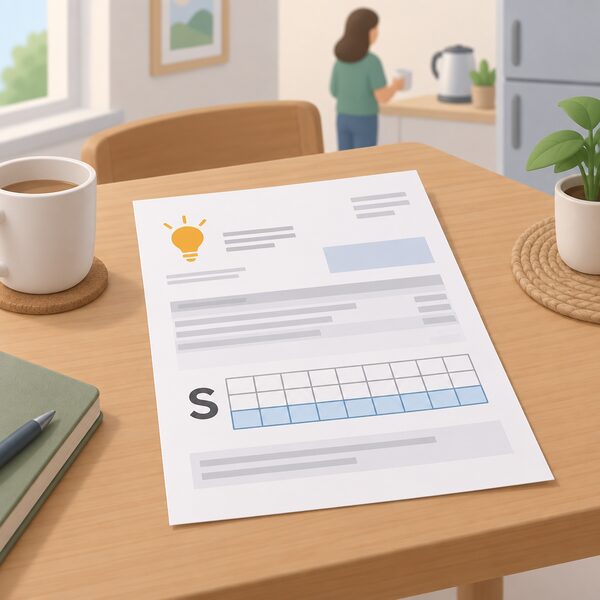
The MPAN is the reference for an electricity supply point. It is usually 13 digits long and appears on an electricity bill in a grid of numbers marked with a large letter S, the number itself being the bottom row of that grid39. The MPRN is the gas equivalent. Both belong to the property, not to the supplier, so they persist through a switch. Citizens Advice's smart meter checker needs only gas and electricity MPANs and a postcode40.
Two supplier duties are worth knowing. A supplier must tell a customer if it has a lower tariff, so the bill or online account will carry that information22. Suppliers also offer advice on more efficient use of energy that could help cut bills41. Ofgem's guidance for households struggling with costs includes reviewing current payments and debt repayments with the supplier42.
Smart meters: data first, savings second
A smart meter does not save energy on its own. What Ofgem says it does is give up-to-date information on energy use, from which a household could find ways to save money43. Smart Energy GB adds the billing point: smart meters enable accurate, not estimated, bills, so a household knows exactly what the bill should be14.
Getting one is a request to the supplier. Smart DCC states that a meter can be requested from a supplier where one has not already been offered44. Welsh Government guidance says installation typically takes about 90 minutes and is free of charge45. Renters are not excluded: the Energy Ombudsman states that private renters can choose a smart meter where the energy bills are in their name or they prepay for energy, after checking the tenancy agreement and letting the landlord know46. Where to start if you rent covers the wider position.
The dependence this creates should be stated plainly. A smart meter ties a household's consumption data, and increasingly its access to time-of-use tariffs and load control arrangements, to the supplier and the national metering network. Ofgem's load control consumer protection guidance exists precisely because control of appliances and heating can be handed to a third party in exchange for savings23. That is a trade of autonomy for cost, and it is a choice, not an obligation.
Where these measures lead next
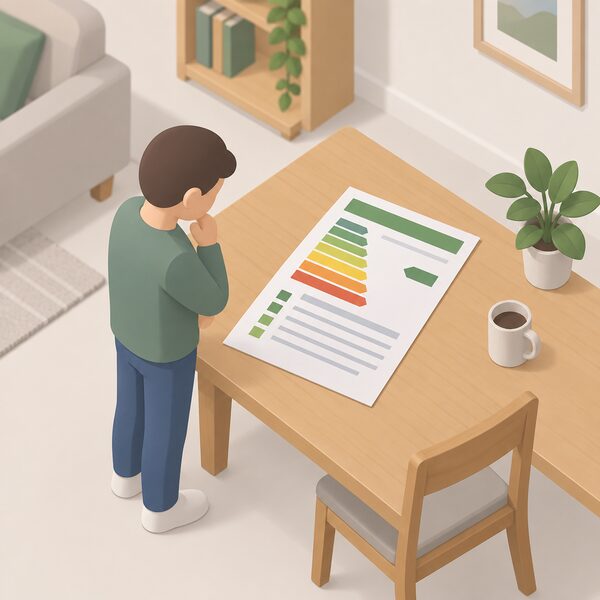
Settings and habits reach a limit set by the building. Once the thermostat, schedule, flow temperature and controls are right, the remaining losses are fabric losses, and fixing those costs money. The Energy Performance Certificate is the usual starting point for identifying them: nidirect describes looking at the EPC as a good starting point for improving a property's energy efficiency47. An advice service such as HomePlus shows how a customer can improve the EPC rating of their property and lets them discover energy saving solutions to suit their budget and understand the potential bill savings from home upgrades48.
EPCs themselves are changing. A Scottish consultation on the proposed Heat in Buildings Bill states that new certificates and ratings will help monitor progress against the Bill's heat decarbonisation target and underpin minimum energy efficiency standards49. That gives the certificate a regulatory weight it did not previously carry, particularly for landlords.
The sensible sequence from here is the fabric of the building before the heating plant, and the heating plant before generation. That is set out in what order home energy improvements should be done in and what a fabric first approach means, with using an EPC and its recommendation report to plan work for the next concrete step, and the full route mapped on the getting started guide.
Sources49 cited
- Energy advice insights, Energy Saving Trust, 2026-09-17
- Thermostats and heating controls, Energy Saving Trust, 2026-02-10
- Insulation, nidirect, 2026-09-02
- Tips to improve the EPC rating of your home, Energy Saving Trust, 2026-08-03
- Kettle running costs, Smart Energy GB, 2026-08-17
- Ratings of electrical appliances, Electrical Safety First, 2026-09-19
- How much electricity am I using?, Centre for Sustainable Energy, 2026-07
- Make your home more energy efficient in one weekend, Which?, 2026-08-28
- NISEP list of schemes 2026-27, Utility Regulator Northern Ireland, 2026-04
- DESNZ annual report and accounts 2025 to 2026: performance report, GOV.UK, 2026
- Heating oil support debate, Hansard, 2026-03-16
- Energy efficiency advice, Consumer Council for Northern Ireland, 2026-09-20
- Make your home more energy efficient, Confused.com, 2026-07-06
- The accessible in-home display, Smart Energy GB, 2026-03-16
- Best energy saving tips for UK households, British Gas Energy Trust, 2026-04-21
- Home and business grants, schemes and advice, East Herts District Council, 2026-09-17
- Thermostats and heating controls, Home Energy Scotland, 2026-09-20
- Self-build homes: sustainability, Planning Portal, 2026
- Energy saving tips for the home, Confused.com, 2025-10-14
- Should I turn my boiler's flow temperature down?, Energy Saving Trust, 2026-05-20
- Low temperature heating, NCM Product Characteristics Database, 2026-09-17
- Save money on energy bills, Energy Saving Trust, 2026-07-01
- Annex D: load control consumer protection guidance, Ofgem, 2026-08-07
- Estimated savings on fuel bills from heating control upgrades, BEAMA, 2023
- How heating controls affect domestic energy demand: a rapid evidence assessment, GOV.UK, 2014-01-28
- ECO public reports and data, Ofgem, 2026-08-11
- Warm Homes: Social Housing Fund statistics, August 2026, GOV.UK, 2026-08
- Summary of updates to ECO4 delivery guidance and measures table, Ofgem, 2025-08-07
- Boilers and heating: building regulations, Planning Portal, 2026
- Support for people in rural homes, Home Energy Scotland, 2026-09
- Grants and funding for energy saving, Tameside Council, 2026-09-17
- Appliances: how much do yours cost to run?, Confused.com, 2025-12-18
- Top five tips to save energy in the kitchen, Energy Saving Trust, 2026-05-20
- Energy mistakes to avoid, Energy Saving Trust, 2025-10-15
- Home appliances, Energy Saving Trust, 2026-05-20
- Raising product standards for household tumble dryers, GOV.UK, 2025-07-17
- Who supplies my electricity and gas?, Uswitch, 2026-06-29
- Network operators, Energy Ombudsman, 2026-09-20
- Close down or remove an MPAN, UK Power Networks, 2026-09-17
- How do you know if you have a smart meter?, Smart DCC, 2026
- Advice if you're struggling to pay your energy bills, nidirect, 2026-09-17
- Get help with your energy bills, Ofgem, 2026-09-17
- Get help with your smart meter, Ofgem, 2026-09-17
- How accurate are smart meters?, Smart DCC, 2026
- Smart meters, Welsh Government Climate Action Wales, 2026
- Smart meters, Energy Ombudsman, 2026-09-20
- Low carbon heating, nidirect, 2026-09-17
- e.surv helps customers with home energy efficiency advice, Energy Saving Trust, 2025-10-21
- Proposals for a Heat in Buildings Bill, Scottish Government, 2026-01-29
 Where to Start ImprovementsThe first steps are assessment, not purchase: read the home's EPC and its recommendation report, see actual consumption on a meter or in-home display, and take the no-cost adjustments such as turning the thermostat down one degree.
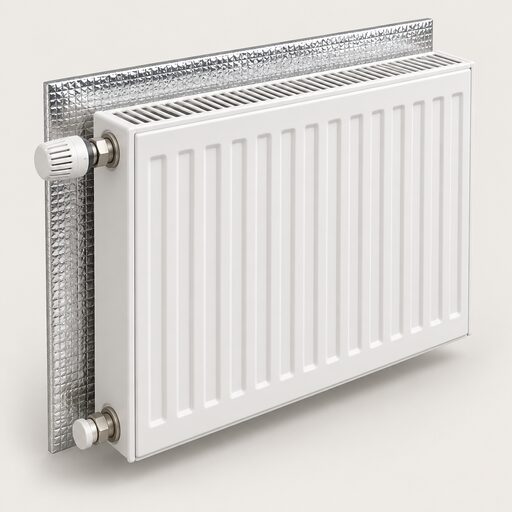 Low-Cost and DIY InsulationCovers the measures a householder can fit without a contractor: radiator reflectors, thermal curtains, chimney draught excluders, draught stripping and letterbox and floorboard sealing.
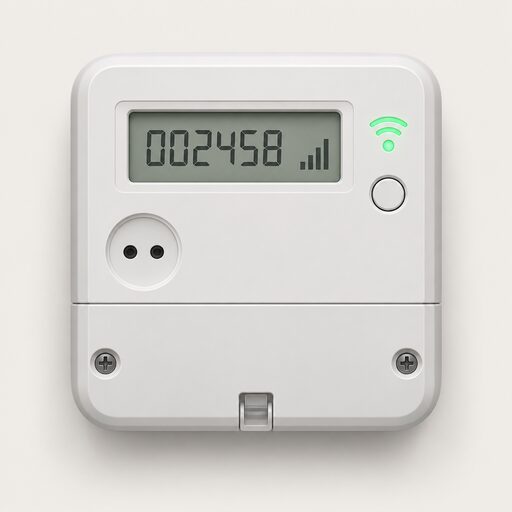 The Full Smart Meters GuideDo smart meters really save you money, and how do you use one to cut your bills?
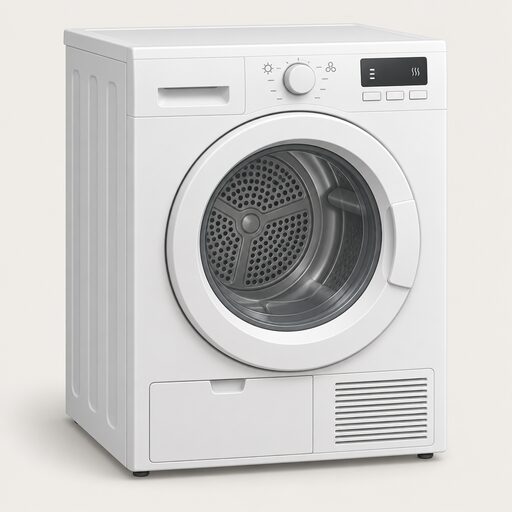 Reducing Your BillRanks household electricity and gas uses by share of the bill and sets out what each measure changes, from heating settings and insulation to appliance use and tariff choice.
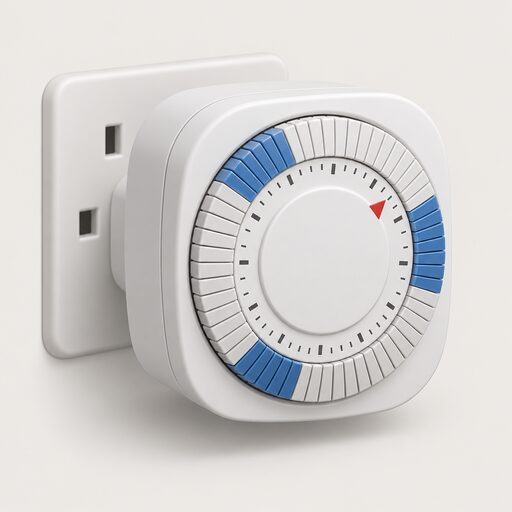 Controls and Time-of-Use TariffsCheaper electricity at night only saves money if your heating actually uses it then.
 Smart Thermostats ExplainedWhat does a smart thermostat actually do, and is it worth it?