

In this guide
Most UK households that set an energy target set it in EPC bands. Band C is the benchmark that government policy, grant schemes and the rented sector all converge on, and it is the answer to the question most people are actually asking. A home rated EPC C or above is generally regarded as having an adequate level of energy efficiency1. The score behind that band runs from 69 to 80 on a scale that typically ranges from 1 to 1002.
But band C is a policy instrument, not a physical measurement, and the Climate Change Committee has told ministers that the ratings on EPCs are an important policy tool, used to define standards and targets for reducing emissions from homes, yet poorly suited to that role3. That tension is the reason a household can chase a band, hit it, and still have a cold, expensive or high-carbon home. The alternative targets, a measured space heating demand, a bill figure, or a retrofit standard such as EnerPHit, each measure something the EPC does not.
This page sets out what each target measures, what it commits a household to, and what evidence it produces. It does not recommend one over another.
What an EPC rating actually measures
An EPC explains how energy efficient a building is and how it could be improved7. It is produced by modelling the building, not by measuring its consumption: the assessor records the fabric, the heating system, the controls and the fuel, and software generates an EPC score, typically ranging from 1 to 1002. That score is then banded.
The certificate is required when selling or letting an existing building8, which is why most homes already have one. It can only be produced by an accredited energy assessor who visits the property to carry out an assessment9, and qualified assessors can be found on the EPC register8.
Two things follow from the modelling approach. First, the rating describes the building as configured, not the household's behaviour, so a low user of energy may not achieve the estimated savings shown on the certificate. That caveat is written into the legislation: the estimated first year savings must be included in the EPC, with a statement that a low user of energy may not achieve them for domestic properties10. Second, the rating is only as good as the assumptions behind it, which is the substance of the reform argument running through every UK administration.
Each EPC also comes with a report setting out the cost effective measures that homeowners or businesses can take to improve the energy efficiency and energy rating, such as low energy bulbs or upgrading insulation9. That report, not the band, is where a plan starts.
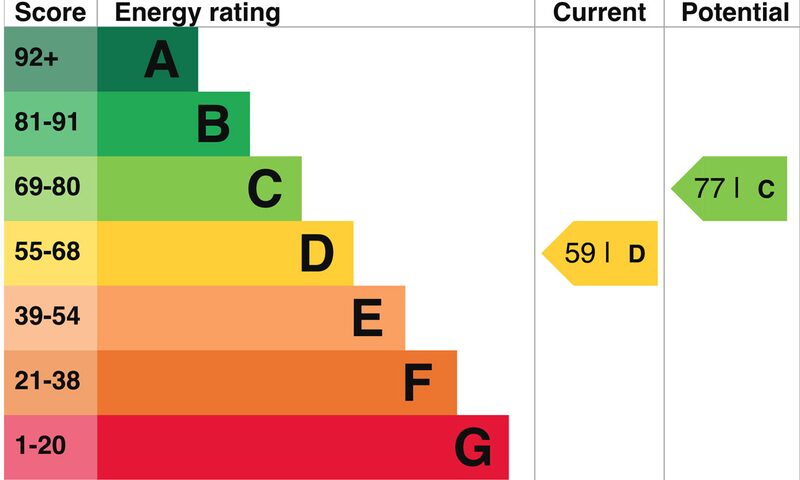
The band scale: A to G, and where the UK average sits
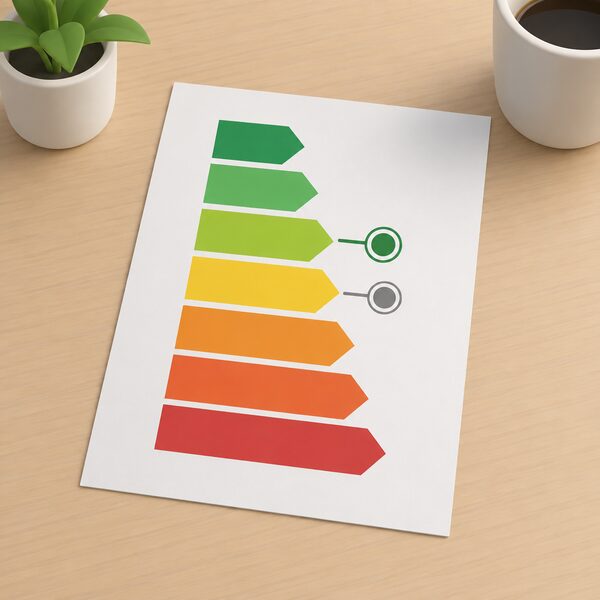
The scale runs from band A, very efficient, to band G, inefficient11. The Office for National Statistics publishes the score boundaries that sit behind each band, and they are worth knowing because a household aiming for C is aiming for a number, not a label.
| Band | Score range |
|---|---|
| A | Highest band, above C |
| B | Above C |
| C | 69 to 802 |
| D | 55 to 682 |
| E | 39 to 542 |
| F | 21 to 382 |
| G | 1 to 20 (least efficient)2 |
The national picture is uneven. Median scores for Middle-layer Super Output Areas in England ranged from 85 (band B) to 48 (band E)2, a spread of more than three bands between the best and worst areas. London, the East of England and the South East had a slightly higher median score of 70 (band C)2. That means the target a household sets is partly a function of where the home is and what the local housing stock looks like, not only of the building itself.
For a household, the practical reading is that band D is the common middle ground and band C is one or two steps above it. The distance between them is what a retrofit plan has to close, and the EPC score tells you how many points that is.
What rating should you aim for: C as the benchmark, and when to go higher
Band C is the number that appears in almost every UK policy document on domestic energy. The Heat and Buildings Strategy set out the ambition for as many homes as possible to achieve EPC band C by 2035 where cost-effective, practical and affordable4. The Commons Library records government policy on upgrading fuel poor homes in England to EPC band C where reasonably practicable11. The Social Housing Decarbonisation Fund targets homes currently below Energy Performance Certificate band C up to that standard12. The Sustainable Warmth Competition prioritised projects that upgrade homes with an EPC rating of E, F or G13.
Scotland has its own trajectory. The Heat in Buildings Strategy states that by 2030 a large majority of buildings should achieve a good level of energy efficiency, which for homes is at least equivalent to an EPC Band C14, qualified elsewhere as applying where technically and legally feasible and cost-effective15. A separate Scottish commitment sets all homes meeting at least the standard of an EPC C or equivalent by 203314.
Wales frames its long-term target differently. The Welsh Government's housing decarbonisation route sets out that retrofit must adopt the anticipated long-term decarbonisation targets, currently anticipated as EPC A in conjunction with a low carbon heat source16. That is a materially higher ambition than band C, and it is the clearest example of a target that pairs the fabric with the heating system rather than treating the band alone as the goal.
Northern Ireland operates its own EPC arrangements through building control and nidirect guidance17, and the certificate is required on sale or let there as elsewhere18.
Why the EPC score can pull against low-carbon heat

This is the most important limitation to understand before setting a target, because it means a household can be penalised for doing the right thing.
The Climate Change Committee's assessment is blunt: the current EPC rating metrics do not accurately incentivise the energy efficiency and heating solutions required to deliver Net Zero homes3. The Scottish Government reached the same conclusion in its own consultation, noting that mains gas fuel price is significantly lower than electricity, so mains gas heating may achieve a better energy efficiency rating than a zero emissions heating system in an equivalent building, making the current framework not compatible with incentivising the uptake of zero emissions heating19.
The practical consequence is recorded in evidence to a parliamentary committee: installing a heat pump can sometimes reduce a home's EPC rating20. A household that installs a heat pump, cuts its carbon and improves its comfort can watch its band fall.
The same distortion appears in the Feed-in Tariff rules, where installations had to demonstrate that the building they were wired to had achieved an energy efficiency requirement of EPC level D or above to receive the higher tariff rate21. The rating was being used as a gate on a low-carbon technology, and the gate was set by a metric that favoured gas.
Reform is under way in all three nations. Scotland's proposed domestic EPC would carry a Heat Retention Rating, a Heating System Rating and an Energy Cost Rating22, with an indicator for heating emissions that will recommend to building owners the most appropriate forms of heating system to reduce emissions to zero23, and an indicator for energy efficiency that will recommend the measures needed to reduce demand for heat23. The 2023 Scottish consultation proposed displaying an Emissions Rating and an Energy Use Indicator alongside the main rating24. The Climate Change Committee has recommended four primary metrics for domestic EPCs: total energy use intensity in kWh/m²/yr, space heating demand intensity in kWh/m²/yr, heating system type ranked from 1 to 6, and energy cost intensity in £/m²/yr25.
Until those arrive, a household setting a target on the current band is setting it on a metric that its own government advisers say is poorly suited to the job3.
Bill reduction as a target: what the estimated costs do and don't tell you
A bill target is the most intuitive target a household can set, and the least reliable as a planning instrument.
The EPC carries estimated costs, and the legislation governing them is explicit about their limits. The estimated first year savings must be included in the EPC, with a statement that a low user of energy may not achieve them for domestic properties10. The certificate also comes with cost effective recommendations to improve the energy efficiency of the building26. Both are modelled outputs, not meter readings.
The reason a bill target is nonetheless attractive is that high prices are the pressure households actually feel. The Energy Prices Bill was introduced with the purpose of addressing the negative social, economic and other impacts of the current unprecedentedly high energy prices27. That is the context in which most households start thinking about a target at all.
The weakness of a bill target is that it moves with things the household does not control: unit prices, standing charges, the weather, and the number of people in the home. A household can hit a modelled saving and see no change in the direct debit. The remedy is to measure consumption rather than cost, which is what a metered baseline does. Working out how much energy a home uses before spending anything is a separate exercise from reading the certificate, and it produces a figure the household owns.
Where a bill target does work is as a check on a fabric target. If the modelled saving does not appear on the meter, either the model was wrong or the work was not done as specified. Both are worth knowing.
Low-carbon heat and the environmental rating: a second target to weigh
The EPC has always carried two ratings, and households routinely confuse them. The energy efficiency rating is the A to G band based on the modelled running cost of the building. The environmental impact rating reflects carbon dioxide emissions instead.
Reform proposals in Scotland would make the split explicit. The new certificates and ratings will help to monitor progress in the Bill's heat decarbonisation target and to underpin minimum energy efficiency standards28. The proposed non-domestic metrics illustrate the direction: an Energy Rating from A to G based on modelled emissions relative to a reference building, a Direct Emissions figure in kg of CO2e/m²/yr, and an Energy Use figure in kWh/m²/yr24.
For a household, the two targets can point in different directions. A gas boiler can produce a good energy efficiency rating because gas is cheap per unit of heat, while producing a poor emissions figure. A heat pump can produce a poor energy efficiency rating on the current metric while producing a good emissions figure. The Scottish consultation states the problem plainly: the current EPC framework is not compatible with incentivising the uptake of zero emissions heating19.
A household weighing a low-carbon heat target therefore has to decide which rating it is optimising. If the goal is running cost, the current band is the relevant number. If the goal is carbon, the band is the wrong instrument and the household needs a different measure, whether that is the emissions figure on a reformed certificate or a metered record of what the heating system actually consumes.
"The current EPC framework is not compatible with incentivising the uptake of zero emissions heating."
Beyond EPC: the Passivhaus standard and its 15 kWh/m² space heat target
The alternative to a band target is a physical one. Passivhaus certification sets a space heating demand limit rather than a cost or carbon score, and it is expressed in the same units the Climate Change Committee wants to see on a reformed EPC.
Certified Passivhaus requires space heating of 15 kWh/m²/yr or less6. That is a demand figure, not a consumption figure, and it is measured against the treated floor area. It is a far more demanding target than band C, and it is not achievable by changing the heating system: it is a fabric standard, met by insulation, airtightness, thermal bridging detail, ventilation with heat recovery and orientation.
The gap between a Passivhaus target and a policy band target is visible in projects that started at one and settled at the other. At Marmalade Lane in Cambridge, homes moved away from Passivhaus at concept stage to targeting a space heating demand of 35 kWh/m²/yr6. That is still a demanding figure, well beyond what band C implies, and it shows how a target can be set, tested against cost, and revised.
For a household, the value of a demand target is that it is verifiable and it does not move with fuel prices. The cost is that it constrains design from the outset, which suits a new build or a deep renovation far better than a piecemeal upgrade. A household that adopts a 15 kWh/m²/yr target is committing to a whole-house approach, not a sequence of measures.
The Climate Change Committee's recommended metric of space heating demand intensity in kWh/m²/yr25 would, if adopted, put a Passivhaus-style figure on every domestic EPC. That would make the two kinds of target directly comparable for the first time.
EnerPHit: the retrofit standard for existing homes

EnerPHit is the retrofit counterpart to Passivhaus, and it exists because existing buildings cannot usually meet a new-build fabric standard without unreasonable cost. It is the standard a household with a solid-wall period property is more likely to be weighing.
The evidence from UK retrofit programmes shows what a fabric-led target looks like in practice. Edinburgh's High Rise Retrofit and Upgrade Programme Phase 1 set a target that the energy retrofit interventions will allow each home bar a few exceptions to meet a minimum energy performance rating of EPC B or SAP 81 in most cases29. That is a band above the policy benchmark, applied to a specific stock, with exceptions acknowledged in the target itself.
Scotland's proposed owner-occupier standard takes the opposite approach for hard-to-treat homes. Where it is not technically feasible or cost-effective to achieve the equivalent to EPC C rating, the proposal is a minimum fabric energy performance of walls, roof, floor and windows as recommended in the EPC14. That is a fabric target standing in for a band target, which is close in spirit to EnerPHit even though the thresholds differ.
The Scottish Government has also proposed an alternative route to meeting its standard based on the result of an EPC assessment, where an EPC demonstrated a home required less than 120 kWh/m²/year for space heating30. That is a demand-based compliance route, and it is the clearest sign that policy is moving toward the kind of target EnerPHit represents.
The lesson from these programmes is that a retrofit standard has to allow for the building. A target that cannot be met by a solid-wall terrace without internal wall insulation throughout is a target that will be waived, and a waived target produces no work.
Turning a target into a plan: using the EPC recommendations report
Whichever target a household picks, the EPC is where the plan starts, because the EPC is accompanied by a recommendations report which provides more detailed information about improvement measures7. The certificate itself gives the band and the score; the report gives the sequence.
The report's measures are described as cost effective recommendations to improve the energy efficiency of the building26, and each EPC comes with a report setting out the cost effective measures that homeowners or businesses can take to improve the energy efficiency and energy rating, such as low energy bulbs or upgrading insulation9. The measures are ordered by cost and impact, which is a reasonable first draft of a plan.
Two cautions apply. First, the report is generated from the same model as the band, so it inherits the model's blind spots, including the bias against low-carbon heating described above. A report that does not recommend a heat pump is reflecting the metric, not the building. Second, the report is a list of measures, not a sequence that accounts for the interaction between them. Doing the measures in the report's order is not the same as doing them in the right order.
The evidence on this is direct: Energy Performance Certificate ratings do not always capture the true efficiency of a retrofit, and measures like PV panels or air-source heat pumps may improve an EPC score but fail to address fundamental building issues such as poor insulation or moisture risks31. A household that treats the report as a to-do list can improve its band while leaving the building's problems in place.
The practical route is to use the report as the input to a plan, not as the plan. A whole house plan takes the report's measures and sequences them against the building's construction, the household's budget and the target it has chosen. The target determines what the plan has to deliver; the report only says what the model thinks is worth doing.
Sources31 cited
- Bristol Warm Homes Plan, Bristol City Council, 2025
- Energy efficiency of housing in England and Wales, Office for National Statistics, 2025
- Letter: Reform of domestic EPC rating metrics to Lee Rowley MP, Climate Change Committee
- Heat and Buildings Strategy, Department for Energy Security and Net Zero, 2021
- Improving the energy performance of privately rented homes: 2025 update, Department for Energy Security and Net Zero, 2025
- Building for 2050: low cost, low carbon homes, Department for Energy Security and Net Zero, 2022
- Energy Performance Certificates: a guide, Scottish Government, 2026
- When is an Energy Performance Certificate required?, Planning Portal
- Energy Performance Certificates, London Borough of Bromley
- The Green Deal Framework (Disclosure, Acknowledgment, Redress etc.) Regulations 2012, legislation.gov.uk, 2013
- Energy efficiency of housing, House of Commons Library
- Social Housing Decarbonisation Fund, Department for Energy Security and Net Zero, 2024
- Apply for the Sustainable Warmth Competition, Department for Energy Security and Net Zero, 2021
- Heat in Buildings Strategy: achieving net zero emissions in Scotland's buildings, Scottish Government, 2021
- Heat in Buildings Strategy: a fairer Scotland duty, Scottish Government, 2021
- Homes of today for tomorrow: decarbonising Welsh housing 2020 to 2050, Welsh Government, 2024
- Energy Performance Certificates leaflet, Building Control Northern Ireland
- Energy Performance Certificates, nidirect
- Domestic EPC reform consultation, Scottish Government, 2021
- Written evidence on EPC ratings and heat pumps, UK Parliament, 2023
- Feed-in Tariffs: frequently asked questions, Ofgem, 2016
- Energy Performance of Buildings (Scotland) Regulations 2025 update, Scottish Government, 2025
- Tackling fuel poverty in Scotland, Scottish Government, 2021
- Energy Performance Certificate reform consultation, Scottish Government, 2023
- Letter: Reform of domestic EPC rating metrics to Patrick Harvie MSP, Climate Change Committee
- Warm Homes: Social Housing Fund Wave 3 scheme guidance addendum, Department for Energy Security and Net Zero, 2026
- Energy Prices Bill, UK Parliament, 2022
- Proposals for a Heat in Buildings Bill, Scottish Government, 2026
- High Rise Retrofit and Upgrade Programme Phase 1, City of Edinburgh Council, 2026
- Delivering net zero for Scotland's buildings, Scottish Government, 2023
- Review of retrofit assessment in Scotland, Scottish Government, 2025
 Improve an EPC RatingWhich home improvements actually raise your EPC score, and by how much?
 Landlord Energy PermissionHow a tenant raises a request for insulation, heating, glazing or ventilation work in a rented home, what the EPC and the minimum band E rule mean, which grant schemes need landlord consent, and what happens when a landlord refuses.
 Energy in Student HousingWhat does the EPC rating mean when you are renting a student house, and can a landlord legally let one below band E?
 Policy, Targets and Coming RulesHeat pumps are central to the government's plans for greener home heating.
 Carbon Budgets and Net ZeroThe UK has promised to cut its emissions to almost nothing by the middle of the century.
 Energy Performance CertificatesAn Energy Performance Certificate rates how energy efficient your home is, from A down to G.