

In this answer
Short answer
EPC Band C is the band that covers a SAP score of 69 to 80 points. The Standard Assessment Procedure rates a dwelling's energy performance on a scale of 1 to 100 or more, and that number is then expressed as a letter band from A to G on the certificate1. Band C sits in the middle of that scale: above Band D at 55 to 68 points, and below Band B at 81 to 91 points2.
The number and the letter are the same assessment seen two ways. A householder told to "get to a C" is being asked to reach at least 69 SAP points, and a home already scoring 69 to 80 is already there. The band boundaries are published in official statistics and repeated in independent guidance, and they agree1.
Band C matters because it is the level that government schemes, social housing funding and proposed rental rules keep returning to. It is also the point at which a home's running costs and its exposure to volatile fuel prices begin to fall, which is the part that bears on a household's energy independence.
Band C in SAP points: 69 to 80
The band boundaries are consistent across the official statistics and the independent guidance that reproduces them. Band C is 69 to 80, Band D is 55 to 68, Band E is 39 to 54, Band F is 21 to 38 and Band G is 1 to 201. At the top of the scale, Band B is 81 to 91 and Band A is 92 and above1.
The EPC score itself is typically generated on a range of 1 to 1001. The underlying SAP rating is expressed on a scale of 1 to 100, and the scale is set so that SAP 100 is achieved at zero energy cost factor, meaning a dwelling that would cost nothing to run in energy terms4. That is why the practical ceiling for most existing homes sits well below 100: the assessment rewards a well-insulated, efficiently heated and well-controlled dwelling, and penalises one that leaks heat or relies on expensive fuels.
A worked example from official guidance shows how the two views line up. A pre-1919 mid-terrace case study dwelling was assessed at SAP rating 64, EPC band D as existing, and a deep retrofit without renewables brought it to SAP rating 75, EPC band C6. The 11-point gain crossed the boundary at 69 and moved the property up one band.
Why Band C matters for householders
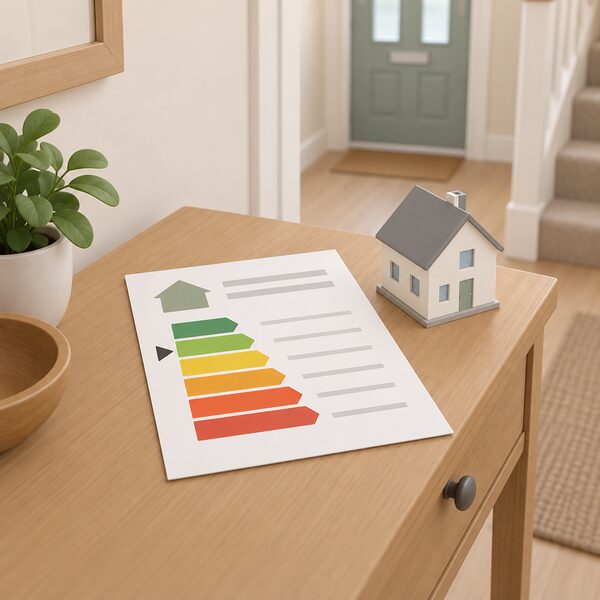
Band C has become the reference point in policy because it is treated as a good level of efficiency rather than an exceptional one. In Scotland, the government has said it intends to base the new Band C on a good level of energy efficiency equivalent to the current EER C, so that existing commitments carry across to a reformed metric7. That matters because the metric itself is changing: the Standard Assessment Procedure will be replaced with the Home Energy Model, with 2027 given as the planned methodology change8.
The scale of the gap is significant. Scottish stock modelling found 50% of homes falling into SAP band C, with 53.87% at band C or better9. That leaves a large share of homes below the band, and it is those homes that the funding schemes target.
The economic case is stated in parliamentary research: upgrading all homes to EPC Band C would deliver around £40bn in benefits to the UK economy in the period to 203011. For an individual household the benefit is narrower and more immediate: a higher band generally means a warmer home for the same spend, and less of that spend leaving the household to a supplier.
How to find your home's SAP score and band
The SAP score and band are recorded on the Energy Performance Certificate for the property. To determine the energy efficiency rating of a home, EPC assessors use the standard assessment procedure, or reduced SAP (RdSAP) for existing homes where information may not be available12. The Standard Assessment Procedure for Energy Rating of Dwellings supports the production of EPCs and covers the energy rating of dwellings13.
The practical route is the certificate itself. An existing EPC can be looked up on the register rather than commissioned again, and the certificate shows both the number and the band. Where a householder wants to understand what a score is made of, the assessment covers the fabric, the heating system, controls, ventilation and lighting, and the resulting number is a modelled projection of energy cost rather than a meter reading.
The SAP rating assigns one of seven bands to a dwelling, from A (most energy efficient) to G (least energy efficient)14. The same seven-band structure appears in the supplier guidance that governs how ratings are presented to consumers, which describes a rating band between A, or A+ for non-domestic buildings, and G15.
Can I improve my EPC rating from D to C?
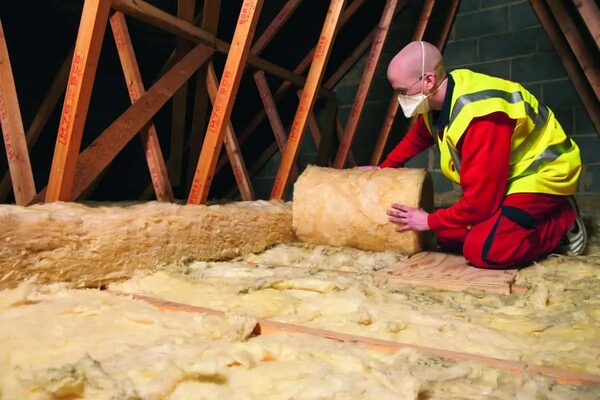
Band D runs from 55 to 68 points and Band C starts at 69, so the distance between a mid-band D and a C can be small in points terms2. Insulation is the most direct lever: loft, wall or floor insulation upgrades can raise a rating by up to two bands, from an E to a C for example16. That is a modelled outcome rather than a guarantee, and the gain depends on the starting point and what else is done.
The grant-funded retrofit programmes show what is achievable in practice. The Home Upgrade Grant Phase 2 improved the average EPC by one band, with 60% of homes upgraded to EPC C or higher17. A local authority programme in Edinburgh set a target that the energy retrofit interventions would allow each home, bar a few exceptions, to meet a minimum energy performance rating of EPC B or SAP 8118.
| Starting band | Typical route | Evidence |
|---|---|---|
| E to C | Loft, wall or floor insulation | Up to two bands16 |
| D to C | Fabric plus heating and controls | Average one band under HUG 217 |
| E, F or G | Grant-funded fabric repair | BFR increases claimable at starting SAP band E, F and G19 |
Eligibility for the main grant routes is tied to the starting band. The Warm Homes: Local Grant covers owner occupied properties with an EPC rating of Band D, E, F or G, and privately rented properties with a rating of Band D or E20. Under ECO4, qualifying actions apply to private domestic premises in valuation band A, B, C or D in England, and A, B, C, D or E in Wales and Scotland, with a pre-installation SAP band of D, E, F or G for owner-occupied and private rented premises in England or Wales, and band D or E for private rented premises in Scotland21. Building fabric repair increases can be claimed for starting SAP band E, F and G homes19.
Is Band C a legal requirement for rental properties?
Not at present. The current minimum energy efficiency standard for rented accommodation is Band E23. Landlords of domestic private rented properties, including public sector landlords, may not grant a tenancy to new or existing tenants if the property has an EPC rating of band F or G, unless an exemption applies, and must not continue letting a property already let at band F or G unless an exemption applies5. Where a certificate shows band F or G, the landlord normally has to make improvements24.
The proposal on the table is higher. The UK Government has proposed raising the minimum EPC standard for domestic private rented properties to band C by 2030, which is a proposal and not yet in force5. Government policy on long-term regulatory standards sets out upgrading privately rented homes to EPC band C by 202814. The two dates differ, and neither is in force.
The professional bodies take a different view again. The Chartered Institute of Plumbing and Heating Engineering states that the current minimum should be increased to a minimum of Band D, with landlords encouraged to improve the insulation of homes to Band C and above23. That is a recommendation, not a rule.
For social housing, the position is different again. The Warm Homes: Social Housing Fund Wave 3 requires grant recipients to improve their social homes to at least a minimum energy efficiency rating threshold of EPC band C, with homes starting at EPC band E to G that cannot reasonably reach EPC C within the cost cap exempt25. The government is also considering setting a long-term regulatory standard to improve social housing to EPC band C, subject to consultation14.
What Band C means for energy independence
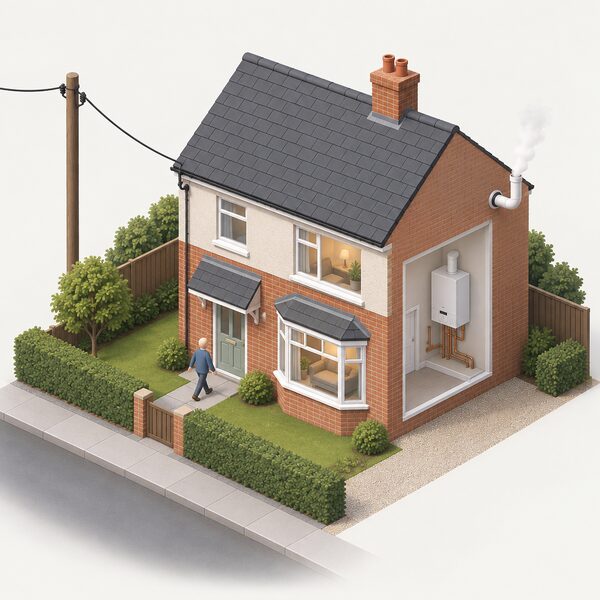
A band is a modelled rating, not a measure of self-sufficiency. EPCs rate how energy efficient a building is, with ratings from band A (very efficient) to band G (inefficient)14. Reaching Band C means the dwelling needs less delivered energy to stay warm, which reduces the volume of gas or electricity bought from a supplier and the exposure to price movements on that supply. It does not remove the supply.
The dependence that remains is straightforward. A Band C home still draws from the grid, still buys from a supplier, and in most cases still burns gas for heat. The rating measures the demand side, not the source. A deep retrofit case study reached SAP rating 75, EPC band C, without renewables6, which shows the band can be achieved on fabric and heating efficiency alone, with no generation on site and no reduction in reliance on imported fuel.
Where Band C does help is in making any later step cheaper to take. A dwelling with lower heat demand needs a smaller heat source, and the same insulation that lifts the band reduces the output a heat pump or solar array has to cover. The band is therefore a staging point rather than an endpoint: it lowers the running cost of whatever supplies the home, and it is the threshold that funding, social housing standards and proposed rental rules are built around.
"upgrading all homes to Energy Performance Certificate (EPC) Band C would deliver around £40bn in benefits to the UK economy in the period to 2030"
The limits are worth stating plainly. The rating is a modelled projection based on standard occupancy assumptions, not a measurement of a particular household's consumption. It is calculated under a methodology that is being replaced, with the Home Energy Model planned for 20278. And the band boundaries themselves are under review, with the Climate Change Committee calling for metric reform to sit alongside wider improvements to assessment quality and data use10. A householder should treat the score as the current official view of the dwelling, dated to the certificate, rather than a fixed property of the building.
Sources25 cited
- Energy efficiency of housing in England and Wales, Office for National Statistics, 2025
- Energy Performance Certificates guide, Uswitch, 2026
- SAP 10 FAQs, BRE Group, 2026
- SAP 10.3 full specification, BRE Group, 2026
- Trading standards guidance: other consumer problems, Isle of Anglesey County Council, 2026
- Homes of today for tomorrow: decarbonising Welsh housing between 2020 and 2050, Welsh Government, 2024
- Energy Performance of Buildings Scotland regulations 2025: update and government response, Scottish Government, 2025
- Energy performance of building certificates in England and Wales, January to March 2026, Ministry of Housing, Communities and Local Government, 2026
- Energy Performance of Buildings Scotland regulations 2025: stock model research, Scottish Government, 2025
- Letter on reform of domestic EPC rating metrics, Climate Change Committee, 2026
- Environmental Audit Committee report, House of Commons Environmental Audit Committee, 2026
- Energy Performance Certificates research briefing, House of Commons Library, 2026
- Standard Assessment Procedure for Energy Rating of Dwellings, NCM Product Characteristics Database, 2026
- EPCs explained, Elmhurst Energy, 2026
- Guidance for suppliers, Ofgem, 2021
- House insulation: the ultimate guide, Federation of Master Builders, 2026
- Green Homes Grant Local Authority Delivery and Home Upgrade Grant statistics, November 2025, Department for Energy Security and Net Zero, 2025
- High rise retrofit and upgrade programme phase 1, City of Edinburgh Council, 2026
- ECO4 delivery guidance version 3.2, Ofgem, 2025
- Warm Homes: Local Grant, Greater Manchester Combined Authority, 2026
- The Ecodesign for Energy-Related Products and Energy Information (Amendment) Regulations 2023, legislation.gov.uk, 2023
- ECO4 delivery guidance version 4.0, Ofgem, 2026
- Fuel poverty campaign, Chartered Institute of Plumbing and Heating Engineering, 2026
- Fuel poverty and sustainability within your home, Chartered Institute of Plumbing and Heating Engineering, 2026
- Warm Homes: Social Housing Fund Wave 3 scheme guidance addendum, Ministry of Housing, Communities and Local Government, 2026
 Setting a TargetWhat should you aim for when improving your home: a better EPC band, lower bills, or a low-carbon heating system?
 Improve an EPC RatingWhich home improvements actually raise your EPC score, and by how much?
 Energy in Student HousingWhat does the EPC rating mean when you are renting a student house, and can a landlord legally let one below band E?
 EPC StatisticsHow energy efficient are UK homes, and is it getting better?
 Energy Performance CertificatesAn Energy Performance Certificate rates how energy efficient your home is, from A down to G.
 Home Energy ModelThe energy rating on your EPC is about to be worked out differently when you buy, sell or build a home.