
In this answer
Short answer
The energy price cap is a cap on the unit rates you pay for each unit of energy you use, not the total amount1. It limits how much a supplier can charge for each unit of electricity and gas you use, not the maximum total bill2. The headline figure that accompanies each announcement, £1,723 from 1 October 2026, is an illustration for a household with typical consumption, not a ceiling on what any household can be charged.
That single distinction explains most of the gap between the number in the news and the number on the bill. The cap limits the unit rate and the daily standing charge, but it does not limit the total energy bill3. The more energy used, the higher the bill will be1. A household that heats a larger home, runs an electric shower or charges a car will pay more than the benchmark household on exactly the same tariff.
The cap also applies to a narrow set of tariffs. It covers default and standard variable tariffs, and it does not cover fixed tariffs, business energy contracts, heat networks or heating oil1. A household on a fixed deal is not protected by the cap at all, and a household on a deemed contract is protected but may still be charged rates far above what a negotiated contract would have cost.
What the price cap figure actually is: a rate, not a bill
The cap is a cap on the unit rates you pay for each unit of energy you use, not the total amount1. It limits how much a supplier can charge for each unit of electricity and gas you use, not the maximum total bill2. The National Energy Action toolkit puts it the same way: the cap limits how much companies can charge for each unit of energy and for the daily standing charge, but it does not limit the total bill3.
There are separate caps for gas and electricity, and the cap does not limit annual bills, which depend on how much energy a household uses8. Ofgem states plainly that it does not limit the cost of your total bill, and that the more energy you use, the higher your bill will be1. The cap sets a limit to the unit rate of gas and electricity a supplier can charge, to protect consumers against the loyalty penalty that out-of-contract customers otherwise face9.
The figure announced each quarter is a benchmark, not a rule. It is built from typical domestic consumption values, and those values have changed. Previous price cap figures were based on 12,000 kWh of gas and 2,900 kWh of electricity a year10. Under the previous calculation, the price cap would be announced as £1,76911. The benchmark has moved, so comparing a current headline with an older one compares two different baskets of energy as well as two different price levels.
For a household, the practical consequence is that the cap governs the price of each unit, and the household governs the number of units. Energy independence in the bill sense starts here: the tariff sets the rate, but consumption, insulation, heating system and appliance choices set the total.
Why a typical dual fuel home pays more than £1,723
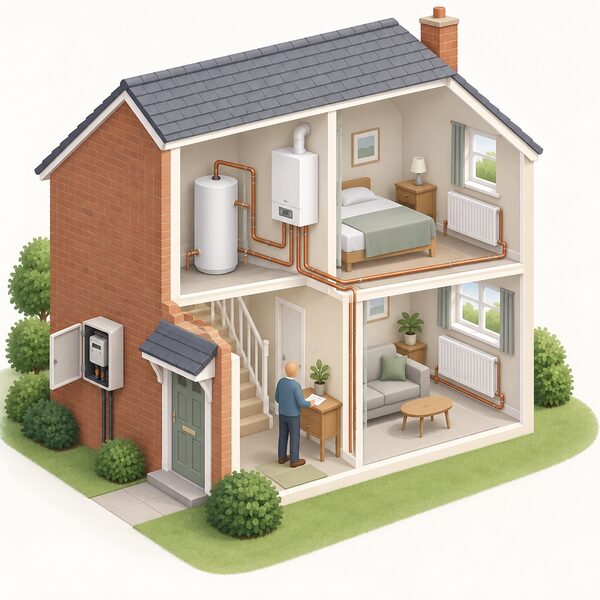
The £1,723 figure is the cap level for a typical dual fuel home on So Flex paying by Direct Debit, using both gas and electricity, from 1 October 20264. It is not a universal bill. The current price cap makes an energy bill for a dual fuel home with typical usage in Great Britain who pay by direct debit around £1,758 for 1 January to 31 March 202612. A separate official guidance figure puts the same typical bill at around £1,64112. The two documents disagree, and both are official; the difference reflects different vintages of the same benchmark rather than a change in the rules.
The benchmark itself is a modelled household, not a median. Between 1 October and 31 December 2025, the typical amount a household could pay for a dual fuel bill paid via Direct Debit was £1,755 a year13. The cap level for 1 July to 30 September 2026 varies by distribution area: in the Southern area, the benchmark maximum is £801.74 a year at 2,500 kWh single-rate electricity, with a £172.77 standing charge, and £973.28 at 3,400 kWh multi-rate, with a £172.65 standing charge5. In the Northern area the same table gives £824.03 at 2,500 kWh and £986.44 at 3,400 kWh5. In the South East it gives £824.22 and £996.635.
Those regional figures show the shape of the answer. Two households on the same national cap level, in different distribution areas and with different consumption, pay different amounts. The cap sets the maximum rate; the area sets the network and policy costs inside it; the household sets the volume.
"The price cap limits the unit cost of energy and standing charges which firms can charge, not the total bill."
The cap covers So Flex and similar tariffs only
The cap applies to default tariffs, regardless of payment method; it does not apply to fixed, green or time of use tariffs12. Ofgem lists the tariffs outside protection as fixed tariffs, business energy contracts, heat networks and heating oil1. The tariffs inside protection are standard variable tariffs1, and people on this type of tariff are protected by the energy price cap15.
Coverage also depends on how the bill is paid. A household is covered by the energy price cap if it is on a default tariff and pays for electricity and gas by standard credit, Direct Debit, prepayment meter or Economy 7 meter16. The cap on out-of-contract tariffs for pay-as-you-go customers is slightly cheaper than for direct debit customers17.
So Flex is the standard variable tariff that most households on a variable deal sit on, and it is the tariff the headline figure describes18. A household that has never switched, or whose fixed deal has ended and rolled onto the supplier's default, is likely to be on a capped tariff. A household that signed a fixed deal is not, and the price it pays is whatever the contract says.
This is where the independence question bites. A capped tariff is a protected position, but it is also a passive one: the rate moves with the quarterly review and the household has no control over it. A fixed tariff trades that protection for certainty, and can be cheaper or dearer than the cap. Neither is a route to independence from the grid or from a supplier; both are ways of buying the same units.
Deemed contracts: where 'unduly onerous' rates come in
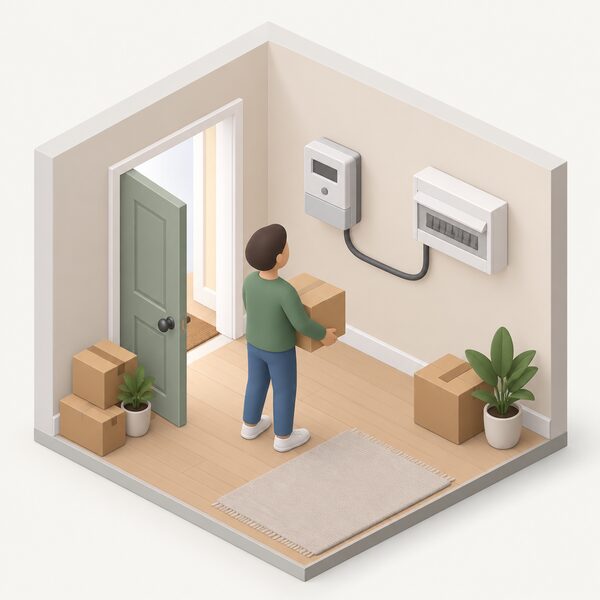
A deemed contract arises when a household occupies a property and consumes energy without having agreed a contract, for example after moving in or after a supplier failure. Ofgem's rules state that the terms of deemed rate contracts should not be "unduly onerous"7. In practice the gap can be wide: Ofgem has seen examples where deemed rate customers are charged more than double the rate of customers on contracts7. In one case study, the standing charge on the deemed contract was nearly 14 times higher than the consumer could have achieved on contract7.
The reason given is structural. Suppliers are not able to purchase gas or electricity in advance for deemed customers and instead must pay the market rate at the time energy is consumed7. That cost is passed through. The protection that remains is that a household is still covered by the energy price cap even if it is put on a deemed contract19.
Ofgem has consulted on the technical approach to market wide half hourly settlement, including if and how it accounts for differences in costs to serve customers across customer groups and suppliers when setting the energy price cap20. That work bears on how deemed and other out-of-contract customers are priced in future.
VAT on domestic electricity: what 0% changes
VAT is normally added to a domestic energy bill at 5%21. Ofgem's own bill guidance shows VAT (5%) as a line on the bill22, and the same 5% appears in the standard breakdown of what makes up an energy bill23. The lower 5% level applies to domestic energy, including home charging of an electric vehicle24.
From 1 October 2026 to 31 March 2027, a temporary zero rate of VAT applies to qualifying supplies of domestic electricity in Great Britain6. The measure introduces a temporary zero rate for qualifying supplies, and it sits alongside the cap change on the same date. It applies to Great Britain, so households in Northern Ireland are not covered by it.
The VAT position on energy-saving products is separate and unchanged: a rate of either 5% or 0% applies when certain energy-saving products are installed in a home, if the household is eligible25. That is a different relief from the temporary electricity measure, and it applies to installation rather than to consumption.
For a household, the temporary zero rate reduces the tax on the electricity portion of the bill for six months. It does not change the unit rate, the standing charge or the cap level, and it does not apply to gas. A bill that is higher than the headline figure can still be higher after the VAT change, because the change affects the tax line, not the volume of energy used.
What Ofgem does and does not do about a high bill

Ofgem does not control the price of gas and electricity beyond setting the energy price cap level23. It sets the cap, and the cap limits the unit cost of energy and standing charges which firms can charge, not the total bill14. Ofgem will be closely monitoring supplier compliance and will continue to take firm action against suppliers who fall short of their requirements26.
What Ofgem does not do is resolve an individual bill. A household with a problem relating to late, incorrect or missing bills, back billing, being overcharged, a faulty meter, poor customer service or a supplier refusing to refund credit from an account should contact the supplier first27. If that does not resolve it, the Energy Ombudsman is approved by Ofgem to deal with consumer complaints about energy bills, mis-selling, problems with energy supply and problems with switching supplier28.
Where a supplier fails, the household is not left without a supply: Ofgem's guidance covers what happens if an energy supplier goes out of business, and customers are moved to a new supplier19. A household that is struggling to pay can ask its supplier to agree a payment plan, a payment break or a reduction, review payments and debt repayments, and give access to hardship funds29. The price cap limits the maximum amount suppliers can charge for each unit of energy used4, and that limit applies whatever the payment arrangement.
The dependence that remains is straightforward. The cap is set by a regulator, the units are bought on a market, the standing charge is set by the network and policy costs, and the household pays both. A lower bill comes from using fewer units or from a tariff that prices them lower, not from the cap itself.
Sources29 cited
- Energy price cap, Ofgem, 2026-09-17
- How to estimate your energy use, Which?, 2026-08-03
- Struggling with energy bills, National Energy Action, 2026-06-25
- Price cap, Smart Energy GB, 2026-10-01
- Energy price cap levels 1 July to 30 September 2026, Ofgem, 2026
- Temporary zero rate of VAT for domestic electricity in Great Britain, GOV.UK, 2026-10-01
- Deemed contracts and rates, Energy Ombudsman, 2026-09-20
- Energy price cap research briefing, House of Commons Library, 2026-09-20
- What is the energy price cap, Energy Saving Trust, 2026-09-07
- Fuel poverty scenario modelling, Scottish Government, 2026-09-02
- Ofgem debt and affordability call for input, National Energy Action, 2024-03-28
- Energy price cap explained, Welsh Government, 2026
- Energy statistics, Uswitch, 2025-10-01
- Ofgem price cap, End Fuel Poverty Coalition, 2026-08-26
- How your electricity or gas bill is calculated, Ofgem, 2026
- Changes to the energy price cap 1 October to 31 December 2025, Ofgem, 2025-08-27
- What changes are coming for energy bills in 2026, Which?, 2026-08-19
- Green energy, Uswitch, 2026-09-04
- What happens if your energy supplier goes out of business, Ofgem, 2026
- Energy price cap technical approach to market wide half hourly settlement, Ofgem, 2026-03-25
- Check if you are owed money on your energy bill, Ofgem, 2026
- Understand your electricity and gas bills, Ofgem, 2026
- Ofgem guide, Uswitch, 2026-09-20
- EV charging VAT, Zapmap, 2026-08-24
- Energy-saving products VAT, GOV.UK, 2026-09-17
- Summary of changes to energy price cap 1 October to 31 December 2025, Ofgem, 2025-08-27
- Complain about your energy supplier or network operator, Ofgem, 2026
- Problems with services, Isle of Anglesey County Council, 2025-10
- Get help with your home or business energy bills, Ofgem, 2026
 Typical Household FigureThe energy price cap limits unit rates and daily standing charges, not the total bill.
 The Full Energy Bills and the Price Cap GuideWondering why your bill went up even when you used less power?
 Energy Price CapThe price cap sets the most you pay for each unit of gas and electricity, plus the daily standing charge, but not your total bill.
 Typical Consumption ValuesOfgem's typical usage figures are what the price cap and most bill comparisons are based on.
 Standing ChargesWhy is there a daily charge on a gas or electricity bill even when nothing is used, and what does it actually pay for?
 Fixed and Variable TariffsCompares capped standard variable tariffs with fixed deals, including exit fees, contract end and rollover.