

In this answer
Short answer
A typical household using oil for central heating might spend between £600 and £1,200 per year, according to independent guidance1. That wide band is the honest answer: heating oil has no price cap, no standing charge and no annual statement, so the annual figure depends almost entirely on how many litres a home burns and what those litres cost when they were bought.
On volume, the published estimates cluster tightly. Independent price trackers put typical UK homes at 1,500 to 2,000 litres a year2. Maker guidance sits inside that band: around 1,800 litres, or between two and three tanks3; 1,700 to 1,800 litres4; and 1,900 litres for the average oil-powered household5. Around 1.5 million UK homes rely on heating oil because they are not connected to the national gas grid6.
Annual usage: 1,700 to 2,000 litres for a typical oil-heated home
The volume figures come from several directions and agree closely enough to be useful. Independent trackers give 1,500 to 2,000 litres a year for typical UK homes2. One supplier states that a typical household uses around 1,800 litres of oil, or between two and three tanks3. Another puts the total at 1,700 to 1,800 litres a year, or three 500 litre tanks4. A third cites 1,900 litres as the average for an oil-powered household5.
The same supplier translates 1,800 litres into around 27,000 kWh of energy per year3. That is a useful bridge, because it allows comparison with metered fuels. Independent guidance puts the gas used for heating and hot water in a typical home at 11,212.5 kWh a year, after deducting cooking gas9. The gap between roughly 27,000 kWh of oil and roughly 11,212.5 kWh of gas reflects both the larger, older, off-grid housing stock and the lower efficiency of oil as a fuel.
Households do not buy in annual increments. Kerosene buyers tend to order two or three times a year, depending on tank size and energy use, buying between 1,000 and 2,000 litres per order10. A 1,000 litre delivery could last six months or more, but that depends on the size of the home, the number of radiators, how much heating is used and boiler efficiency11.
How litres turn into pounds: working out the annual bill
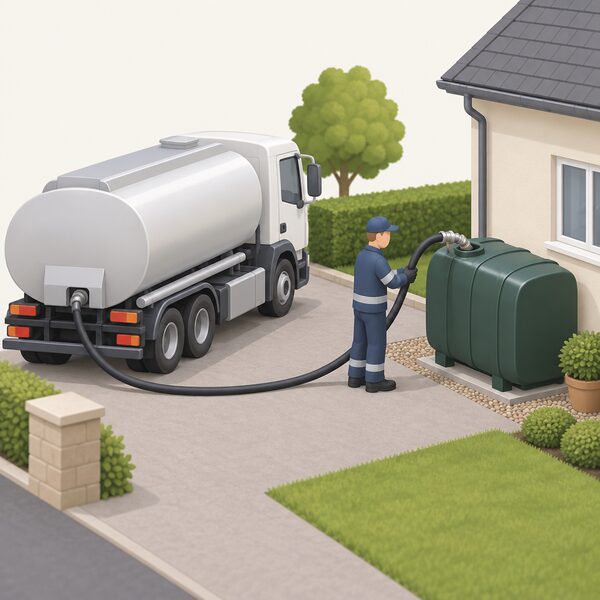
The arithmetic is simple once two numbers are known: annual litres and the price paid per litre. One supplier used a 12-month average cost of £0.97 per litre to model running costs5. Another modelled 1,176 litres at 65 to 85 pence per litre with 85% boiler efficiency and 10 kWh per litre, giving about £765 to £1,00012. Independent guidance puts a medium energy-use home on kerosene at around £789 per year13.
Because oil is bought in batches, the price paid on each delivery is the only figure that matters for an individual bill. A household buying 1,800 litres at 65 pence per litre pays £1,170; the same volume at 85 pence per litre pays £1,530. Both sit above the £600 to £1,200 range that independent guidance gives for a typical oil-heated home1, which shows how quickly a price move overwhelms a usage estimate.
| Input | Figure | Source basis |
|---|---|---|
| Annual usage | 1,500 to 2,000 litres | Independent tracker2 |
| Annual usage | around 1,800 litres | Maker guidance3 |
| Annual usage | 1,700 to 1,800 litres | Maker guidance4 |
| Annual usage | 1,900 litres | Maker guidance5 |
| Price per litre | £0.97, 12-month average | Maker guidance5 |
| Price per litre | 65 to 85 pence | Maker guidance12 |
| Modelled annual cost | about £765 to £1,000 | Maker guidance12 |
| Modelled annual cost | around £789 | Independent guidance13 |
Heating and hot water accounts for over 50% of average domestic fuel bills14, and over half of a typical home's energy bill goes on heating and hot water15. For an off-grid household, that share is concentrated in a single fuel bought in lump sums rather than spread across monthly direct debits.
What makes one household's oil spend differ from another's
Property size and fabric come first. A larger, older or poorly insulated house burns more litres for the same comfort level, which is why the published range runs from 1,500 to 2,000 litres rather than settling on one number2. Boiler efficiency, radiator count and hot water demand all move the total, and the same 1,000 litres can last six months or considerably less depending on those factors11.
Fuel quality matters too. Heating oil is less efficient than gas as a fuel and often costs more per unit of energy16. That is a property of the fuel, not of the household, and it means an oil home needs more energy input for the same heat output.
Geography is the sharpest divider. In Northern Ireland, 49.5% of households used heating oil as their sole source of heating, according to the 2021 and 2022 censuses17. In Scotland, approximately 142,000 households use heating oil18, and oil is the primary heating fuel in 6% of Scottish dwellings, or 142,000 households, compared with 7% of owner-occupied and 6% of private rented dwellings19. Urban locations use electricity in 8% of dwellings and oil in 1%19.
Affordability follows the same lines. Households in Scotland that use heating oil or electricity as their main energy source for heating are more likely to find keeping up difficult, with 36% reporting difficulty20. Around 8% of Scottish homes that use oil group with fewer options to offset fuel cost increases21.
Does household heating oil spending change much from year to year?
It changes more than almost any other domestic fuel cost. Heating oil costs can be affected by sudden price fluctuations, though longer-term comparisons show it has comparable annual running costs to mains gas22. The volatility is the defining feature: a household can face a doubling of its fuel price inside a single month.
That is not hypothetical. The average price of home heating oil in the UK increased by over 100%, from approximately 60 pence per litre to over 120 pence per litre, between the end of February and mid-March 202617. In Northern Ireland, Consumer Council data showed the average price of home heating oil rising by approximately 85 to 95% over the same weeks17.
The direction can reverse just as fast. One independent report noted heating oil prices hitting a five-year low, with 800 litres costing £400 at 50 pence per litre in the May to July 2019 period23. A household that filled its tank at that point and again at the 2026 peak would have seen its per-litre cost more than double.
This is the core of what oil means for household energy independence. An oil-heated home is not dependent on the gas grid or on a single licensed supplier, and it can choose when and from whom to buy. But it is fully exposed to a global commodity price with no cap, no regulated tariff and no smoothing mechanism, and it must hold enough capital to buy in bulk at whatever the price happens to be on delivery day.
Oil compared with other heating fuels on household cost
The UK average cost of heating a typical three bedroom house is around 50% higher with heating oil than with mains gas7. Independent guidance is blunter: heating oil tends to be pricier than heating a home through gas, because it is less efficient as a fuel and often costs more per unit of energy16.
Against other off-grid options the picture is less clear-cut. A medium use household on LPG, requiring around 11,500 kWh a year for heating and hot water, faces an estimated annual heating cost of around £92324. That is above the £789 modelled for a medium energy-use home on kerosene13, though the two figures rest on different demand assumptions and are not directly comparable.
Electric heating carries its own cost structure. A typical heat pump consumer faces £398 in total levy costs added to the annual electricity bill, across heating (£218) and non-heating uses (£180)25. Those levies are a policy cost added to electricity, not a fuel price, and they sit alongside whatever the underlying unit rate happens to be.
| Fuel | Annual cost figure | Basis |
|---|---|---|
| Heating oil | £600 to £1,200 | Typical household, central heating1 |
| Kerosene | around £789 | Medium energy-use home13 |
| Heating oil | about £765 to £1,000 | 1,176 litres at 65 to 85 ppl12 |
| LPG | around £923 | Medium use, 11,500 kWh24 |
| Mains gas | approx. £750 | Heating and hot water, excluding cooking9 |
The comparison that matters most for independence is not the headline number but the exposure. Mains gas is capped and paid monthly. Oil is uncapped, bought in advance, and priced by a market the household cannot influence. LPG and electricity each carry their own dependencies: a supplier, a contract, or a levy.
Where the money goes, and where to find your own figure
Heating and hot water takes over half of a typical home's energy bill15, and over 50% of average domestic fuel bills14. For an oil household, that spending is invisible between deliveries: there is no meter reading, no monthly statement and no annual summary from a supplier.
Support exists but is targeted. The £100 Home Heating Oil Support Scheme in Northern Ireland used a digital pre-paid card and was designed to support around 340,000 households who use oil as their main source of heating26. In Scotland, help for households using heating oil has been directed at approximately 142,000 households18. Fuel-poor households in receipt of energy efficiency improvements would achieve average annual bill savings of £23027.
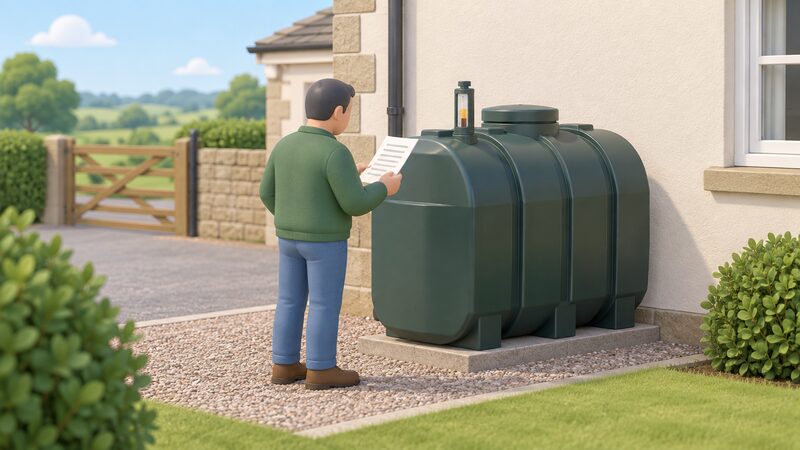
For an individual household, the only reliable record is its own paperwork. Delivery notes show litres and price per litre; a tank gauge shows what remains. Multiplying annual litres by the average price paid gives a real figure rather than a modelled one. The published averages are a benchmark for comparison, not a prediction of any particular bill.
"Heating oil costs can be affected by sudden price fluctuations, but longer-term comparisons show it has comparable annual running costs to mains gas"
Sources27 cited
- Average UK energy bill, Energy Saving Trust, 2026-01-30
- Heating oil prices in England, BoilerJuice, 2026-09-20
- A house buyer's guide to oil for central heating, Certas Energy, 2026-06-22
- When should you fill your heating oil tank?, Certas Energy, 2026-04-13
- How much do oil boilers cost to run?, Good Energy, 2026-04-29
- Heating fuel guide, Uswitch, 2026-01-27
- The cost of heating a home with heating oil, House of Commons Library, 2026-09-17
- Government warns suppliers over heating oil prices, End Fuel Poverty Coalition, 2026-03-16
- Ground source heat pump costs and savings, Which?, 2026-05-08
- Getting the best heating oil prices, Which?, 2026-07-07
- Heating oil tanks, Which?, 2026-06-01
- Average heating bill UK, Bluetti Power, 2026-09-17
- Oil central heating, Which?, 2026-06-01
- How to save money on energy bills, CIBSE, 2026-09-17
- Reduce your heating bill tips, IVIE, 2026-09-20
- What is heating oil?, Which?, 2026-05-18
- Home heating oil prices and support, House of Commons Library, 2026
- Help for households using heating oil, Scottish Government, 2026-03-17
- Key attributes of the Scottish housing stock, Scottish Government, 2024
- Energy tracker: insights from latest survey, Consumer Scotland, 2023-10
- Heat in buildings strategy: business and regulatory impact assessment, Scottish Government, 2021-11-11
- What heating options are available off the grid?, OFTEC, 2026-09-20
- Heating oil prices hit a five-year low, Which?, 2020-08-26
- LPG central heating, Which?, 2025-09-22
- Domestic interim heat pump tariff: background paper, Heat Pump Association, 2024-01
- £100 Home Heating Oil Support Scheme goes live, Department for Communities, 2026-09-08
- Help to Heat: a solution to the affordability crisis in energy, IPPR, 2026-09-20
 Household Energy ConsumptionHow much gas and electricity does a typical UK home use in a year?
 Running Costs by FuelHow the cost of heat compares across mains gas, heating oil, LPG, electricity, solid fuel and heat pumps once efficiency and the price cap are applied.
 Home HeatingWhy do so many homes in Northern Ireland run on heating oil, and will that ever change?
 Heat Pump Running CostsWhat does a heat pump cost to run each year, and is it cheaper than a gas boiler?
 The Full Statistics GuideHow many homes in the UK have solar panels, heat pumps or batteries?
 Energy IndependenceA heat pump runs your heating on electricity instead of gas or oil, so how much does that really cut what you pay and how exposed you are when fuel prices jump?