In this guide
An oil boiler is a wet central heating boiler that burns heating oil, usually kerosene, instead of mains gas. Boilers in UK homes are usually fuelled by gas or oil, with LPG and biomass less common1. The oil version works in much the same way as a gas condensing boiler, except that it is fed from an on-site external storage tank rather than a pipe from the street2. That single difference shapes everything else about living with one: the tank, the deliveries, the unregulated fuel price and the OFTEC registered engineer who services it.
Oil boilers provide an estimated four million homes in the UK with no access to mains gas with an alternative form of fuel3. Official counts of the off-gas-grid population sit in the same range: four million UK households, about 15 per cent of the total, are off the mains gas grid, and an estimated 4.8 million households across Great Britain were not connected to the gas grid in 20244. The number actually heating with oil is smaller: around 1.5 million UK households use heating oil, including many in Northern Ireland6.
On performance and cost, the headline numbers are these. Building regulations set a minimum efficiency of 85 per cent for a new oil boiler in England and in Wales8, while modern liquid fuel-fired condensing boilers have efficiency ratings of over 90 per cent, on a par with gas boilers10. Installation is quoted at around £3,300 to £4,000 by one comparison guide and around £2,500 to £4,500 by an oil supplier, depending on size, quality and model3. Running costs are reported at around £1,100 a year on average, with a range of £960 to over £2,000 for a typical three-bedroom home12. And heating oil prices are not regulated by Ofgem and are not covered by the energy price cap13.
What an oil boiler is and how it works
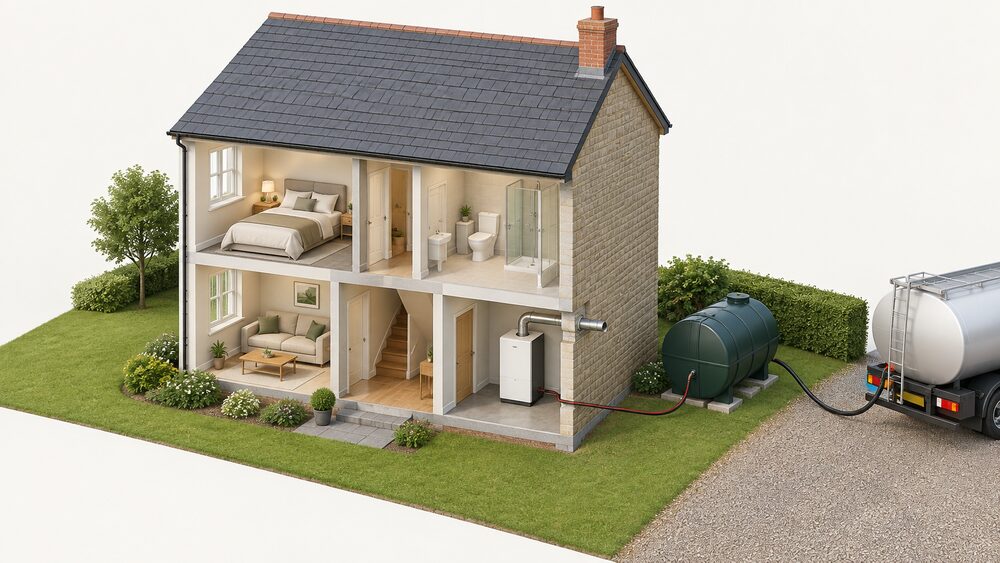
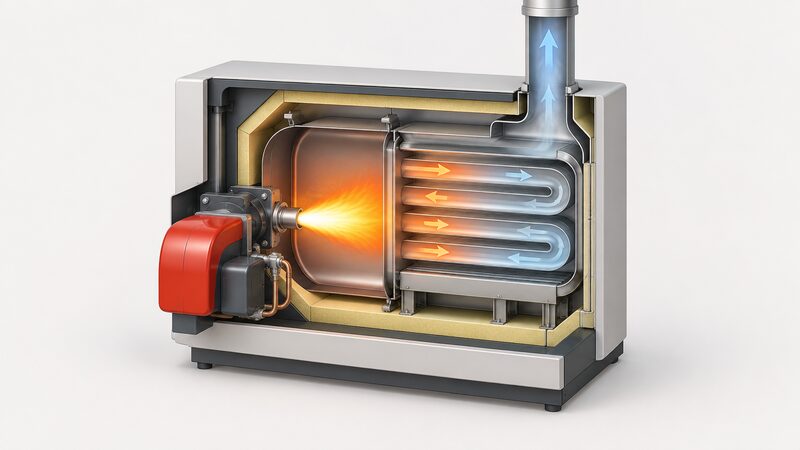
An oil boiler burns kerosene delivered by tanker and stored on the property14. Oil condensing boilers work in a very similar way to gas boilers, but are fed from an on-site external oil storage tank2. Fuel is drawn from the tank along a buried or surface-run fuel line to a pressure-jet burner, where it is atomised through a nozzle and ignited. Regular boilers are designed to heat water within a heat exchanger by absorbing the heat contained in the flue gases created by the burner15. A condensing model takes that further by recovering latent heat from the flue gases before they leave through the flue.
The heated water then goes where any wet system sends it: to radiators, to underfloor heating, or through a coil into a hot water cylinder. A combi boiler usually has two heat exchangers, one for central heating and one for hot water16. Oil combis exist alongside system and regular models, so the same three-way choice described on combi boilers, system boilers and regular boilers applies to oil as it does to gas.
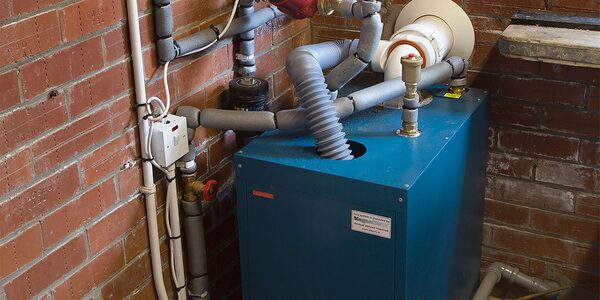
The practical difference from gas is space. An oil boiler needs more space for things like an oil storage tank17. The boiler itself may be internal or in an outbuilding; the tank must sit somewhere outside with tanker access. Controls are not optional: all gas and oil boilers require time and temperature controls to be installed at the same time, if not already present and working18. That requirement is covered in more detail under Boiler Plus and heating controls and thermostats.
Who uses oil boilers: the off-gas-grid households

Oil heating is a rural and off-grid technology. Four million UK households, 15 per cent of the total, are off the mains gas grid4, and an estimated 4.8 million households across Great Britain were not connected to the gas grid in 20245. Not all of those burn oil: some use LPG, some direct electric heating, some solid fuel. Estimates of the oil-heated population differ by source and by date.
| Estimate | Figure | Source type |
|---|---|---|
| UK households using heating oil (March 2026) | 1.5 million6 | Official, Commons debate |
| UK homes using oil for heating, including many in Northern Ireland | around 1.5 million7 | Independent consumer body |
| UK households relying on heating oil rather than the gas grid | over one million19 | Fuel supplier |
| Homes served by oil boilers with no mains gas access | an estimated four million3 | Independent comparison guide |
The four million figure describes homes without mains gas rather than homes burning oil specifically, which is why it sits so far above the others. The distribution is uneven across the four nations. Northern Ireland is the extreme case: it has no widespread gas network outside the main towns, and heating oil is the default domestic fuel there, which is why Northern Ireland runs its own oil-specific support scheme. In Scotland, around 87 per cent of households use a gas or oil-fuelled boiler20. For households weighing the alternatives, heating a home off the gas grid and LPG boilers cover the neighbouring options.
Efficiency: 85% minimum, over 90% in a modern condensing model
The regulatory floor and the market reality are different numbers. Building regulations guidance for England states that each boiler must have a minimum efficiency of 86 per cent for gas and 85 per cent for oil8, and the Welsh Government guidance uses the same 85 per cent figure for oil9. That is the legal minimum for a replacement, not what a current appliance achieves.
What is actually sold does considerably better. Modern liquid fuel-fired condensing boilers have efficiency ratings of over 90 per cent, on a par with gas boilers10, and OFTEC's own consumer guidance states that modern condensing appliances can exceed 90 per cent efficiency and are available as regular, system and combination boilers15.
Scotland and Wales set a higher bar in their compliance documents. The Scottish domestic building services compliance guide requires that an oil-fired regular boiler should be of the condensing type with an efficiency not less than 91 per cent ErP, with non-condensing regular boilers at 84 per cent and non-condensing combination boilers at 82 per cent where they are permitted at all21. The Welsh consultation version of Approved Document L sets 91 per cent for a wet heating regular boiler, dropping to 82 per cent only in exceptional circumstances in existing buildings22. An oil-fired range cooker with an integral central heating boiler is treated separately at 80 per cent in existing dwellings23.
The gap between 85 per cent and 91 per cent matters over a heating season, because oil is bought by the litre and every percentage point is fuel that stays in the tank. Condensing performance also depends on return water temperature, which is why boiler flow temperature and boiler efficiency and ErP ratings are worth reading alongside the headline rating.
Costs: installation, fuel and what the year looks like
Installed prices for a new oil boiler are quoted at £3,300 to £4,000 by one comparison guide, and at around £2,500 to £4,500 by an oil supplier depending on size, quality and model3. Oil boilers can be more expensive than electric ones because of higher installation costs14. Prices are installer-quoted: the final figure depends on whether the tank, fuel line and flue are being replaced at the same time. The wider picture is in new boiler cost.
Running costs are reported at around £1,100 a year on average, with a stated range of £960 to over £2,000 for a typical three-bedroom home12. An oil boiler usually costs hundreds of pounds a year more to run than its gas equivalent3. Those are modelled or reported averages, not a tariff: the actual bill depends on how much oil is bought and at what price on the day.
| Cost item | Figure | As of |
|---|---|---|
| New oil boiler, installed | £3,300 to £4,0003 | September 2026 |
| New oil boiler installation | around £2,500 to £4,50011 | April 2026 |
| Average annual running cost | around £1,10012 | June 2026 |
| Annual running cost, three-bedroom home | £960 to £2,000+12 | June 2026 |
| Annual service | around £90 to £9524 | September 2026 |
| Repairs found during a service | £120 to £75024 | September 2026 |
Several factors influence how much heat a property needs, including property size, the number of external walls, wall thickness, insulation levels, glazing type, the number of people in the home and daily habits. Fabric improvements therefore change the fuel bill more reliably than the appliance does. See also home heating running costs and gas vs oil boiler running costs.
Heating oil sits outside the price cap
This is the single most important thing about oil for a household budget. Heating oil prices are not regulated by Ofgem and are not covered by the energy price cap13. Trading Standards put it plainly:
"heating oil is not covered by Ofgem's energy price cap, leaving consumers fully exposed to sudden market increases"
Manufacturer guidance makes the same point about volatility: prices can rise sharply during periods of high oil costs since heating oil is not covered by the energy price cap12. There is no standing charge and no supplier contract in the mains-gas sense, and no automatic protection when the wholesale market moves. In practice oil is bought in bulk, at the price quoted on the day of ordering, from whichever distributor a household chooses, so the timing and size of an order changes the effective unit cost. A household with a large tank and the cash to fill it in summer is in a materially different position from one buying small emergency loads in January.
The independence trade-off is genuine but partial. There is no exposure to a gas network, a gas supplier or a capped unit rate. There is exposure to a global commodity price, a road tanker, and a distributor's delivery schedule. The boiler also needs mains electricity to run.
Northern Ireland: the Home Heating Oil Support Scheme
Northern Ireland has a dedicated oil scheme because oil heating is the norm there. The Home Heating Oil Support Scheme opened for applications on 9 September 2026 and closes on 31 March 202726.
It is open to households who use oil as their primary source of heating, are resident in Northern Ireland, and in either of the qualifying months either receive a qualifying benefit, or are a single person or couple, including pensioners, with an annual income of less than £30,000 net of allowable deductions26. Once activated, the voucher can then be used to purchase home heating oil with any Northern Ireland oil supplier26.
Support elsewhere works differently: eligibility for financial support to improve home energy efficiency depends on where a household lives in the UK. The national routes are set out in boiler and heating grants in England, Scotland, Wales and Northern Ireland.
The oil storage tank: siting, deliveries and inspection
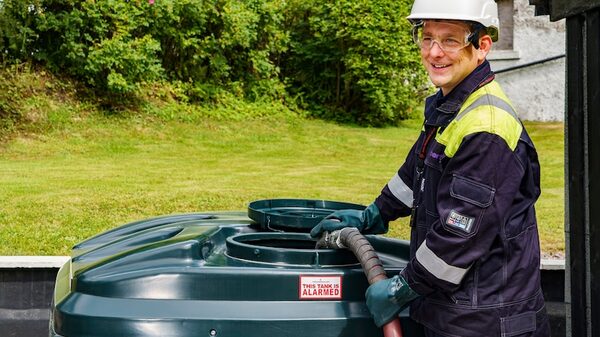
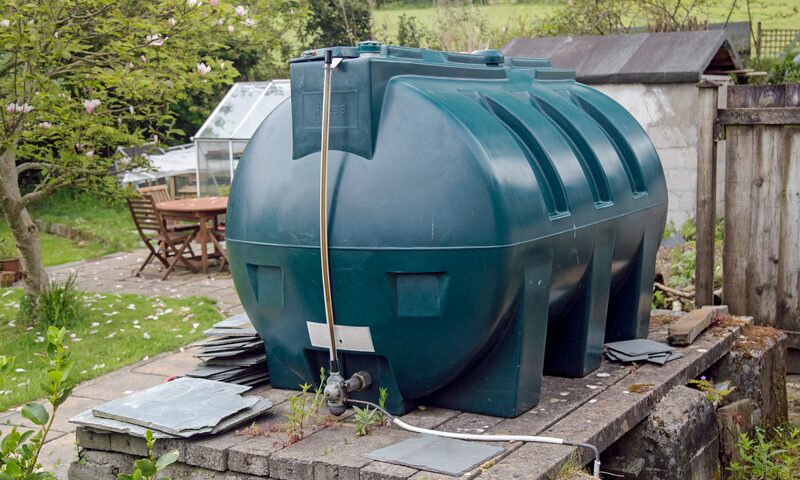
An oil boiler has a storage tank that needs refilling every few months27. That interval depends on tank size, house heat demand and the weather, and it is the part of oil heating that most changes daily life: the household, not a supplier, is responsible for not running out.
An OFTEC registered tank installer will advise on the best place to locate a heating oil tank so that it meets safety standards and building regulations28. Siting rules cover distance from buildings and boundaries, bunding requirements and tanker access, and are covered in full on domestic heating oil tanks.
Inspection guidance is layered:
- Monthly: inspect tanks, pipes and other equipment for leaks, damage and interference once a month, and fix any problems as soon as possible through an OFTEC technician29.
- Every six months: carry out a thorough check of the oil tank, looking for cracks, leaks or signs of rust, and clear overgrown areas so delivery access routes stay safe28.
- Annually: the fuel tank should be inspected every year as part of the annual heating system service15, with the technician advising on its condition.
- Every 10 to 15 years: oil tanks need replacing30.
Citizens Advice guidance on alternative fuels suggests keeping at least a quarter of a tank while waiting for deliveries31. Deliveries should be supervised, the tank should never be overfilled, and no more oil should be ordered than can be safely stored29.
Manufacturer guidance is that the boiler should be turned off while the tank is being filled, and left off for a short period afterwards of up to 30 minutes32. The reason is sediment: a fresh delivery disturbs whatever has settled at the bottom of the tank, and drawing that straight into the burner invites a blocked nozzle or filter.
Servicing: annual checks by an OFTEC registered engineer
Most oil boilers require an annual service by a qualified engineer to check the burner, flue, fuel supply and overall efficiency12. The registration scheme for oil is OFTEC, not Gas Safe: OFTEC maintains a register of trained and assessed technicians who are qualified to work safely with oil-fired appliances33. Official Northern Ireland guidance is to arrange for the boiler and tank to be serviced at least once a year by an OFTEC technician, including any underground pipe work29, and fuel suppliers make the same annual recommendation19.
An oil boiler service typically takes one to two hours, compared with about an hour for a system boiler24. A service is also the moment when latent problems surface: if issues are found, an additional bill averaging £120 to £750 can follow24. Work carried out by an OFTEC registered competent person can be covered by the OFTEC workmanship warranty, which covers liquid fuel-fired boiler, cooker, storage and supply installations34.
Annual servicing matters more for oil than for gas because the combustion side has consumable parts. A nozzle wears, a fuel filter clogs, and combustion drifts off its commissioned settings, at which point efficiency and soot production both move the wrong way. Cleaning parts of the boiler and checking the boiler flame form part of a normal service, and nothing behind the casing is householder work. More on what a service includes is on boiler servicing and maintenance and OFTEC registration.
Troubleshooting and restarting after running out of oil
Where a gas boiler simply fails to ignite, an oil boiler locks out. A burner lockout can occur as a result of no oil or a leak in the pipeline35. If an oil boiler will not start, a heating engineer can check the electrical supply at the burner terminal block, and if none is present, check the boiler and overheat thermostat36.
Common symptom patterns reported by manufacturers include:
- Boiler runs but water temperature is low: check whether the nozzle is undersized or the fuel pressure is low.
- Boiler operating on the overheat thermostat: check for a faulty boiler thermostat.
- Fumes or odours: check all fuel line connections and remake as necessary.
- Visible smoke or a high smoke number: check whether there is insufficient air supply.
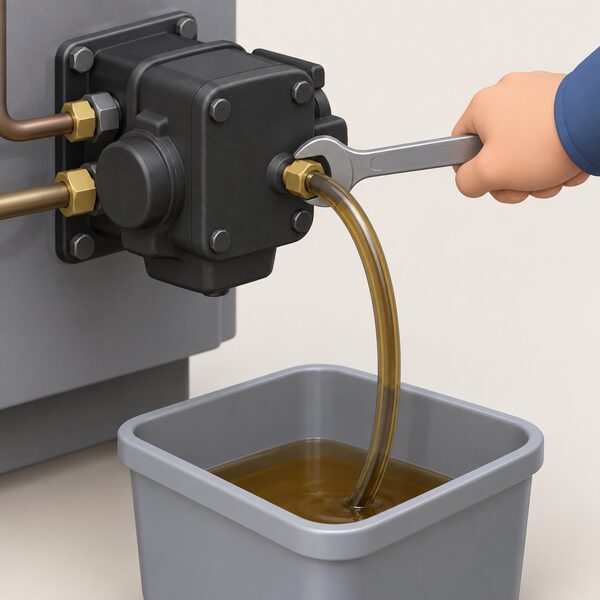
Resetting is not a fix in itself. The fault that caused the lockout should be addressed before resetting, otherwise serious damage may follow, and if the boiler does not come on again an engineer should be called37. Running dry adds a step: if the appliance is run without oil, air may be drawn into the system, so a standard reset will not restore it and the fuel line must be bled37.
The procedure described by the manufacturer runs as follows37:
- Switch the appliance off.
- Locate the bleeder valve on the fuel pump, identifiable by its hex nut.
- Attach rubber tubing to the valve with the other end in a container.
- Loosen the nut with a wrench until it is finger tight.
- Press the reset button on the unit controller.
- Open the valve until oil and air come out, probably turning the nut less than once.
- Keep draining until there is a solid flow of oil and the burner is running again, then tighten the valve and wipe away spilled oil.
An oil supplier can also assist with cleaning the tank and flushing through the oil lines35. Fault codes and symptom diagnosis in general are covered on common boiler faults and fault codes.
Lifespan and the signs of replacement
Reported lifespans converge on the same band. An oil boiler lifespan is given as 10 to 15 years12, most modern oil boilers are designed to last between 10 and 15 years although this varies between manufacturers19, and general guidance suggests considering a replacement if a boiler is 10 to 15 years old, frequently has issues or breaks down a lot14.
Indicators of a boiler nearing the end of its useful life include frequent breakdowns, failing to meet the heating and hot water needs of the home, an unexplained rise in energy bills, difficulty finding replacement parts for repairs, and no support for smart technology. Oil tanks follow a similar clock, needing replacement every 10 to 15 years30, so a boiler replacement and a tank replacement often arrive within a few years of each other and are worth planning together. See how long do boilers last for the wider picture, and Grant oil boilers, Warmflow oil boilers and Mistral oil boilers for the ranges sold in the UK.
Where oil heating sits in the move to low-carbon heat
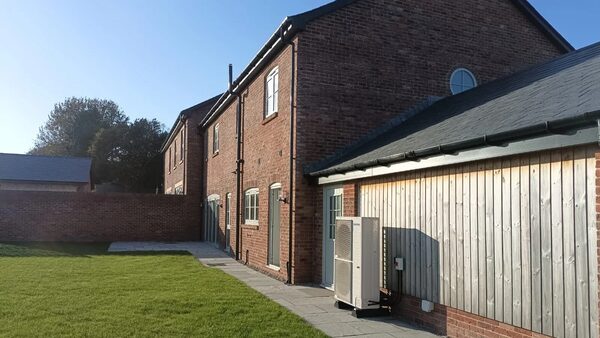
Policy direction is clear even where dates are not yet law. Manufacturer guidance on the transition states that from the mid-2030s it will not be possible to replace a gas or oil boiler with anything other than a low-carbon heating system, or an appliance that can be converted to use a clean fuel38. Government-commissioned research also notes that households moving to a heat pump from a working gas or oil boiler were more equivocal about the change and more likely to report an increase in bills or lower satisfaction than their previous system39. That finding is about people replacing a functioning appliance, not a failed one.
For an oil household specifically, two routes are under discussion: electrification, and renewable liquid fuels that an existing appliance could be converted to burn. The industry body for liquid fuel distributors points to future liquid fuels as the continuity route, while efficiency measures such as switching to a condensing boiler increase efficiency and cut emissions in the meantime10. Neither is settled, and nothing here should be read as a fixed date for oil heating.
What is firm is the dependence that remains. An oil boiler removes the gas network and the capped unit rate from a household's list of dependencies, and replaces them with an unregulated commodity price, a tanker delivery, a storage tank that must be maintained and eventually replaced, and a mains electricity supply without which the burner will not fire. Compare it against the alternatives on heat pumps compared with boilers and home heating and energy independence, or return to the full guide at boilers and home heating.
Sources39 cited
- Heating your home, Energy Saving Trust, 2026-05-19
- How a boiler works and the different boiler types, Viessmann, 2023-03-06
- Different boiler types explained, Uswitch, 2026-09-18
- Off-gas grid households, House of Commons Library, 2026-09-17
- Households not connected to the gas grid, House of Commons Library, 2024
- Heating Oil Support debate, Hansard, 2026-03-16
- LPG central heating, Which?, 2025-09-22
- Boilers and heating: building regulations, Planning Portal, 2026
- Building regulations: boilers and heating, Welsh Government, 2026-09-17
- Future liquid fuels, UKIFDA, 2026-01-27
- Heating oil price guide, Certas Energy, 2026-04-27
- Air source heat pumps vs oil boilers, EDF, 2026-06-16
- Heating oil and off-grid fuels, House of Commons Library, 2026-09-20
- New boiler cost, Uswitch, 2024-11-06
- Your home guide to liquid fuel heating, OFTEC, 2026-09-20
- What is a heat exchanger, Vaillant, 2026-09-17
- What size boiler do I need, E.ON Next, 2026-09-17
- Boiler Plus, Ideal Heating, 2026-09-17
- Boiler care, Certas Energy, 2026-09-01
- Scottish House Condition Survey 2024 key findings, Scottish Government, 2026-02
- Domestic Building Services Compliance Guide 2022, Scottish Government, 2022-06
- Approved Document L Volume 1, consultation version, Welsh Government, 2026-09-17
- Approved Document L, Conservation of fuel and power, Volume 1, GOV.UK, 2023
- How much does a boiler service cost, Uswitch, 2026-09-03
- Cost of living pressures and soaring prices expose gaps in bulk fuel checks, Chartered Trading Standards Institute, 2026-03-16
- Home Heating Oil Support Scheme, Department for Communities, 2026-09-17
- Boilers, Energy Saving Trust, 2026-05-20
- Tank care and security, UKIFDA, 2026-02-18
- Check your oil tank, nidirect, 2026-09-17
- New to LPG, Liquid Gas UK, 2026-09-20
- Help with bills if you use alternative fuels, Citizens Advice, 2023-02-24
- Should I turn my oil boiler off when my oil tank is being filled, Worcester Bosch, 2026-09-17
- Domestic oil installation and boiler servicing, nidirect, 2024-08-27
- Workmanship warranty, OFTEC, 2026-09-20
- What can cause an oil boiler burner to lockout, Grant UK, 2026-09-20
- What to check if a boiler will not start, Grant UK, 2026-09-17
- How to reset a boiler, Viessmann, 2022-03-24
- Hydrogen and the future of home heating, Intergas, 2026-09-17
- Report on the heat pump transition, GOV.UK, 2026-05
 New Boiler Cost in the UKWhat a replacement boiler costs in the UK by type and fuel, and what drives the installation element: conversions, relocations, flue work and system upgrades.
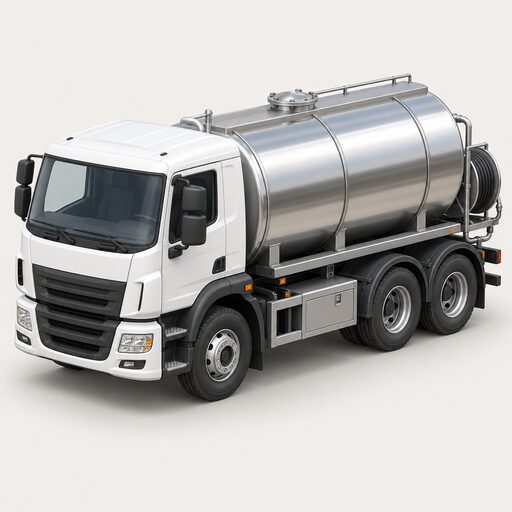 Heating Oil and LPG SupplyHow heating oil and bulk LPG reach off-grid homes, who owns the tank, what the fuels cost, why neither is covered by the price cap, and what supply risk looks like in winter.
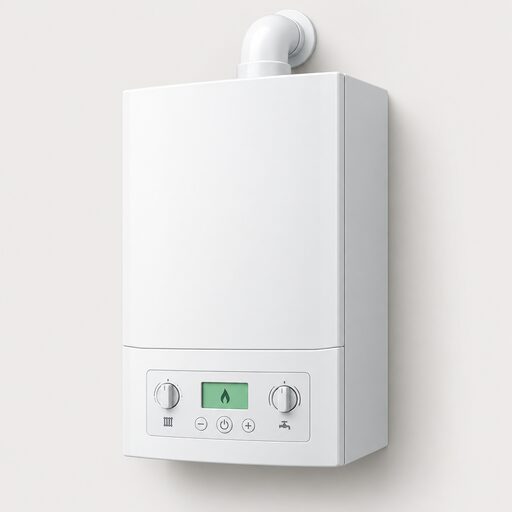 Boiler Manufacturers in the UKCovers the manufacturers supplying gas, oil, LPG and electric boilers to UK homes, their main ranges and where they are made.
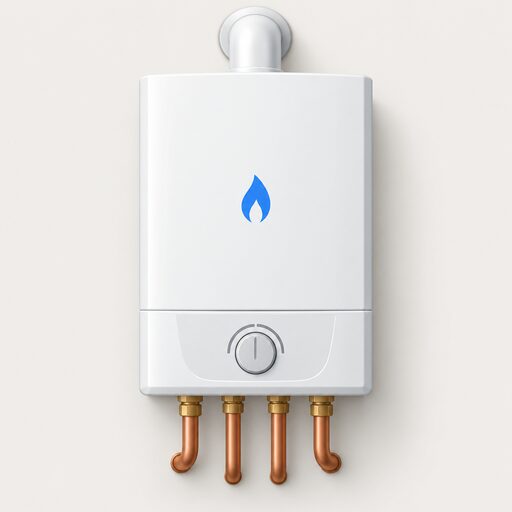 The Full Boilers and Heating GuideWhich boiler suits your home, and when is it worth swapping the old one?
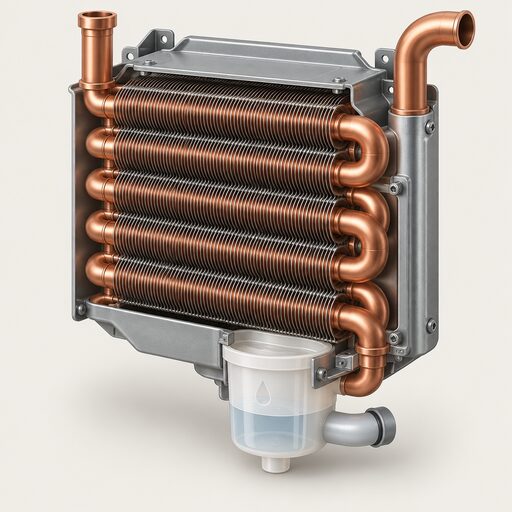 Gas Boilers GuideMains gas boilers heat around 23 million UK homes.
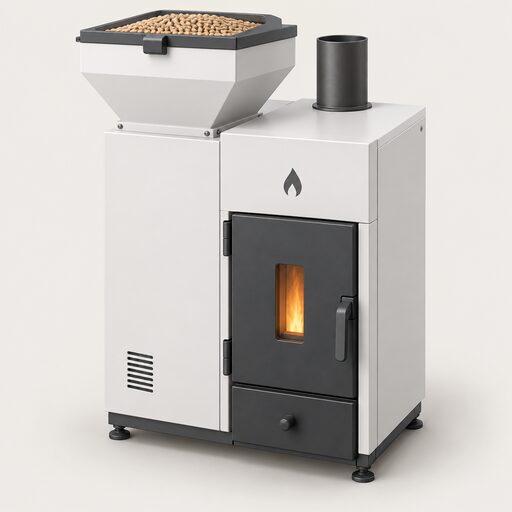 Biomass Boilers and StovesHow pellet and log biomass boilers and room stoves work in UK homes: the £5,000 Boiler Upgrade Scheme grant and its rural, off-gas-grid conditions, emissions limits, smoke control area law, fuel sourcing and the practical demands of storage and maintenance.