

In this answer
Short answer
Yes. Northern Ireland has two price checkers for home heating oil, and they work on different rhythms. The Consumer Council runs a Home Heating Oil Price Checker that surveys suppliers across Northern Ireland every week, with a daily checker operating Monday to Friday1. BoilerJuice runs a comparison that checks the 1,000 litre price for heating oil (Kerosene 28) across its network of suppliers in Northern Ireland every day3.
The two are not the same instrument. The Consumer Council's is a benchmark: it gathers oil prices from across Northern Ireland so that a household can check whether it is getting a competitive price for an order1. BoilerJuice's is a supplier comparison: it takes each supplier's lowest price for every postcode district and averages them, excluding VAT at 5%3. One tells a household what the market looks like; the other shows what individual suppliers are quoting.
The reason a checker matters in Northern Ireland more than in most places is the pace of movement. Consumer Council data showed the average price of home heating oil in Northern Ireland rising by approximately 85 to 95% between the end of February and mid-March 20264, and the Northern Ireland Executive described recent price increases of nearly 100% in just a few weeks5. A quote that was competitive in February was not competitive in March.
The Consumer Council checker: weekly survey, daily display
The Consumer Council's Home Heating Oil Price Checker is the official Northern Ireland benchmark. Every week it surveys suppliers across Northern Ireland to benchmark prices on the cost of home heating oil, and the daily oil price checker operates Monday to Friday2. During office closures on bank or public holidays, the previous working day's prices are displayed2. All prices surveyed include 5% VAT2.
The Council's stated purpose is narrow and practical: it gathers oil prices from across Northern Ireland so that households can check if they are getting a competitive price for their order1. It is not a forecasting service. The tracker does not forecast future prices, and the figures are correct at the time of the survey2. That distinction matters for anyone trying to time a purchase: the checker tells a household where the market stands now, not where it is heading.
The Council's wider consumer work sits behind the tool. It gives free advice and can investigate complaints about natural gas and electricity6, and it offers an energy price comparison tool for electricity and gas tariffs from all suppliers in Northern Ireland6. The Consumer Council and Northern Ireland Energy Advice give free, independent and impartial energy advice to all domestic householders in Northern Ireland6.
For a household off the gas grid, the checker is the closest thing to a published reference price. It is free to use, it is independent of the suppliers it surveys, and it covers the whole of Northern Ireland rather than a single distribution area. The Home Energy Index, which tracks changes in household gas, electricity and home heating oil prices in Northern Ireland, extends the same monitoring to the wider energy bill7.

BoilerJuice: a daily comparison on the 1,000-litre kerosene price
BoilerJuice publishes a Northern Ireland heating oil price comparison that works differently from the Consumer Council's. Every day it compares the 1,000 litre price for heating oil (Kerosene 28) across its network of suppliers in Northern Ireland3. The methodology is explicit: it compares heating oil suppliers and takes their lowest price, does this for every postcode district, and uses that information to calculate an average UK heating oil price, excluding VAT at 5%3.
That basis has two consequences a household should understand before comparing it with a quote. First, the headline figure is a 1,000-litre price, so it reflects the per-litre rate available on a full delivery rather than a part load. Second, it is an average of the lowest prices found across postcode districts, not the price any single supplier will offer at a given address.
Coverage is broad. BoilerJuice reports hundreds of participating suppliers across Northern Ireland, including Antrim, Armagh and Down3. Minimum order sizes vary: 150L of heating oil can be bought in some parts of Northern Ireland, which allows smaller top-ups at a higher per-litre rate3.
VAT treatment differs between the two published figures, and the difference is worth noting. The Consumer Council's surveyed prices include 5% VAT2. BoilerJuice's average is calculated excluding VAT at 5%3. On the ordering side, the reduced rate of 5% VAT still applies to commercial orders up to 2,300 litres, and domestic customers ordering more than 2,300 litres are required to confirm that they are domestic heating oil users to keep the reduced rate3.
How to test whether a quoted price is competitive
The checkers are only useful if the comparison is like for like. Three variables decide whether a quote sits above or below the published benchmark: volume, VAT treatment and delivery timing.
Volume is the largest. The Consumer Council publishes averages for smaller orders as well as the 1,000-litre basis, and these are the closest published benchmarks for a part load:
| Order size | Northern Ireland average | VAT position | Date |
|---|---|---|---|
| 300 litres | £353.16 | Includes 5% VAT | 17 September 20262 |
| 500 litres | £570.40 | Includes 5% VAT | 17 September 20262 |
A household ordering 300 or 500 litres is therefore comparing against a different figure from the 1,000-litre price BoilerJuice uses3. Per-litre rates generally fall as volume rises, so a part-load quote that looks expensive against the 1,000-litre benchmark may simply reflect the smaller delivery.
VAT is the second variable. The Consumer Council's surveyed prices include 5% VAT2; BoilerJuice's average excludes it3. Comparing one against the other without adjusting for VAT will misstate the gap.
Timing is the third. Prices for heating oil fluctuate throughout the year, and UKIFDA advises staying in touch with a local UKIFDA distributor to keep track of current prices8. BoilerJuice reports that prices usually fall in summer months when demand is much lower and increase when it gets colder during winter3. A quote taken in July and a quote taken in December are not measuring the same market.
For households that want collective buying rather than individual comparison, the Northern Ireland Oil Buying Network negotiates discount prices with suppliers on behalf of its members on a weekly basis1. That is a different mechanism from a checker: it pools demand instead of publishing a benchmark.

Why Northern Ireland prices move sharply in weeks
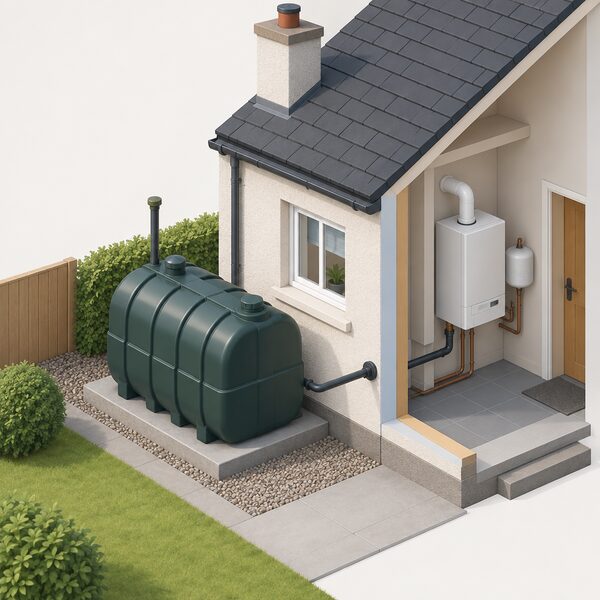
Northern Ireland's exposure to oil is structural. The Energy Saving Trust notes high dependence on oil heating in the region9, which means movements in the global oil market pass almost directly into household heating costs. OFTEC's guidance is blunt about the consequence: heating oil costs can be affected by sudden price fluctuations, though longer-term comparisons show it has comparable annual running costs to mains gas10.
The 2026 spike shows how fast that transmission works. The Northern Ireland Executive referred to recent price increases of nearly 100% in just a few weeks5. Consumer Council data showed the average price of home heating oil in Northern Ireland increasing by approximately 85 to 95% between the end of February and mid-March 20264. UK figures show prices almost doubled in one month in March 2026, with the spike linked to supply disruption following the start of the Israel/US-Iran conflict12. UKIFDA described the pattern from the household side: many oil-heated households across the UK and Ireland have seen heating oil prices rise unexpectedly and quickly4.
The drivers are a long list rather than a single cause. BoilerJuice attributes price movement to increase in demand, OPEC, conflict in oil producing countries, VAT rates, distribution and delivery costs, refining costs, exchange rates, weather and crude oil prices3. Several of those are outside any household's control, which is why the checker matters: it cannot prevent a spike, but it shows whether a given quote has already absorbed one.
The policy response has been direct financial support rather than price control. On 16 April 2026, the Northern Ireland Executive agreed proposals for a Home Heating Oil Support Scheme to provide financial assistance to households impacted by rising home heating oil costs13. The scheme is open to people living in Northern Ireland, who may be eligible to apply online14. Separately, eligible households can apply for a £100 voucher that can be used for heating oil15.
What the checkers do for a household's energy independence
A price checker does not reduce a household's dependence on heating oil, and it does not change the fact that the fuel is bought from a distributor and priced in a global market. What it does is remove one layer of asymmetry. Before the Consumer Council began surveying suppliers weekly, a household had only the quotes it was given; now there is an independent benchmark for the whole of Northern Ireland1.
The dependence that remains is substantial. Northern Ireland has high dependence on oil heating9, and the region's housing stock is the subject of ongoing official work on energy efficiency, with a consultation on the Northern Ireland energy efficiency of housing16. The Energy Saving Trust's work on a Northern Ireland fuel poverty strategy sets out the wider context in which oil-heated households sit16.
For households considering a move away from oil, the alternatives carry their own dependencies. Air source heat pumps are covered in the Energy Saving Trust's advice17, and OFTEC sets out the off-gas-grid heating options10. Northern Ireland has no standing charge for mains gas, and smart time-of-use tariffs are not available there17, which shapes how any electrified heating would be priced. The Consumer Council publishes broader guidance on saving energy and money19.
The practical position is that a checker is a tool for the purchase a household is about to make, not a route out of oil. It tells a household whether the quote in front of it is competitive against the Northern Ireland market on the day it was given. The rest of the bill, from tank insulation to boiler servicing, sits outside what any price checker can show.
Sources19 cited
- Home heating oil, Consumer Council, 2026
- Home Heating Oil Price Checker, Consumer Council, 2026
- Heating oil prices Northern Ireland, BoilerJuice, 2026
- Why are heating oil prices going up?, UKIFDA, 2026
- Heating oil market, House of Commons Library, 2026
- Get help with your complaint, Consumer Council, 2026
- Home Energy Index, Consumer Council, 2026
- Heating oil buying guide, UKIFDA, 2026
- Decarbonisation in Northern Ireland, Energy Saving Trust, 2025
- What heating options are available off the grid?, OFTEC, 2026
- Heating cost comparison, OFTEC, 2026
- Written statement: rising energy costs response, Welsh Government, 2026
- Home heating oil support scheme, Department for Communities, 2026
- Home heating oil support scheme FAQs, Department for Communities, 2026
- Home heating oil support, nidirect, 2026
- NI fuel poverty strategy, Energy Saving Trust, 2026
- Air source heat pumps, Energy Saving Trust, 2026
- Off-gas-grid heating guides, OFTEC, 2026
- Save energy and money, Consumer Council, 2026
 Energy Bills in Northern IrelandNorthern Ireland has no price cap.
 Utility Regulator NIWho sets your energy prices in Northern Ireland and who can you complain to?
 Home HeatingWhy do so many homes in Northern Ireland run on heating oil, and will that ever change?
 Heating Oil and LPG PricesHeating oil and LPG prices change fast, so what is a fair price today and why did it jump so sharply this year?
 Fuel PovertyWhy does Northern Ireland have such a high rate of fuel poverty, and how many households are affected?
 Oil Boilers and Heating OilHow oil-fired boilers work, the kerosene they burn, and the tanks, burners and servicing they need.