
In this guide
Northern Ireland runs its own domestic energy market. There is no price cap of the kind that applies in Great Britain: the Energy Price Guarantee guidance states that "Energy prices were not capped in Northern Ireland and energy suppliers have the flexibility to set their tariffs independently to reflect their costs of operating"1. Instead, the Utility Regulator for Northern Ireland approves supplier tariffs, and the market has "a different regulator, no price cap and an entirely different set of suppliers from Great Britain"2.
That single structural difference explains most of what a Northern Ireland household sees on a bill. The crisis-era Energy Price Guarantee was delivered in Northern Ireland as a per-unit discount rather than a cap, and the Energy Bills Support Scheme arrived as a single £600 payment rather than the monthly £66 and £67 credits paid in Great Britain3. Households here also heat with a wider mix of fuels, including oil and solid fuel, which no cap has ever covered.
Why Northern Ireland has a separate energy market
The regulatory boundary is the starting point. The Energy Prices (Domestic Supply) (Northern Ireland) Regulations 2022 were debated on the basis that Northern Ireland has "a different regulator, the Utility Regulator for Northern Ireland, no price cap and an entirely different set of suppliers from Great Britain"2. The Energy Prices Act 2022 then set out that the Energy Price Guarantee schemes in Northern Ireland were to apply to those with "domestic electricity supply" and "domestic gas supply", with the schemes intended for customers on domestic tariffs, including some non-domestic premises with similar metering and tariff arrangements such as places of worship, some farms and small businesses operating from former dwelling-houses2.
Because there is no cap, the mechanism is tariff approval. The Energy Price Guarantee directions for domestic energy consumers in Northern Ireland were made to "allow domestic electricity and gas suppliers in Northern Ireland to make tariff changes on days other than the first day of a quarter"10. That matters more than it sounds: it removed the old quarterly rhythm in which Northern Ireland tariffs moved on set dates, and it means a household's rate can change at a point the supplier chooses, subject to the regulatory process and to notice.
The wider policy backdrop is different too. The Climate Change Act (Northern Ireland) 2022 commits Northern Ireland to cutting carbon emissions, and the guidance on low carbon heating links changing market prices and that Act directly11. Support for generation has followed its own path: rather than the Great Britain Feed-in Tariff route, "a change to the Northern Ireland Renewables Obligation (NIRO) Order put additional incentives into place for generating stations of certain technologies and installed capacities"12.
For a household, the independence question is blunt. A Northern Ireland home is not shielded by a cap, so it carries more wholesale price risk than a Great Britain home on a standard variable tariff, and it has no cap-based backstop when wholesale prices spike. What it does have is a regulator that scrutinises and approves the tariffs suppliers propose, and a supplier set that is largely regional.
What a typical energy bill costs: £1,093 to £1,121 for electricity, £1,060 for gas
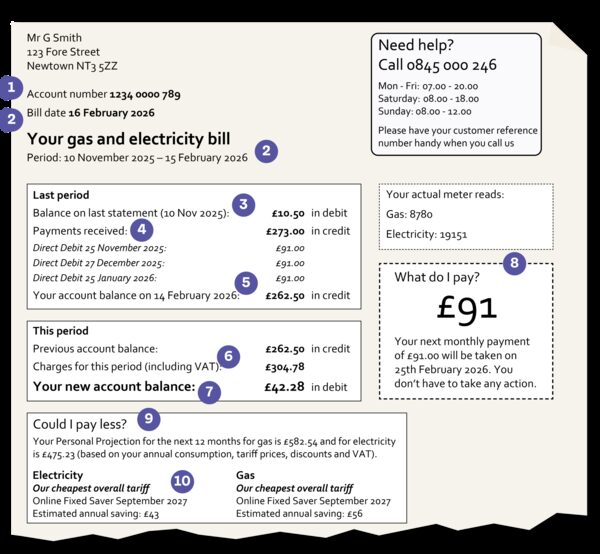
The most recent official benchmark figures for Northern Ireland come from the price cap tables published for 1 July to 30 September 2026, which include a Northern region column. At 2,500 kWh single-rate consumption, the annual bill benchmark is £824.03 with a £223.48 standing charge; at 3,400 kWh multi-rate consumption, it is £986.44 with a £220.70 standing charge13. For comparison, the Northern Scotland column in the same table shows £829.05 at 2,500 kWh with a £200.04 standing charge, and £1,002.90 at 3,400 kWh with a £202.30 standing charge13.
The crisis-era figures show how far the market moved. The Energy Price Guarantee guidance records that "a typical household using electricity and mains gas would have seen their energy bill increase from £1,952 to £2,109" on an annual equivalent basis, and describes the Northern Ireland figure as "around £2,109 per year"1. That £2,109 is a dual fuel figure for a household using electricity and mains gas, and it is the number most often quoted for Northern Ireland at the height of the crisis.
Two cautions apply to any headline figure. First, the £2,109 relates to a household on mains gas, and a large share of Northern Ireland homes are not on mains gas at all, so their bill composition is different: electricity plus oil, or electricity plus solid fuel. Second, the benchmark consumption levels behind these figures are assumptions, not measurements, and a household using more or less will see a different total. The standing charge is a fixed daily cost that applies whatever is used, and in Northern Ireland it is a substantial part of the total: £223.48 a year at the single-rate benchmark13.
Unit rates compared: electricity at 30.8p, gas at 9.0p and solid fuel at 6.5p per kWh
Unit rates are where the fuel mix becomes visible. Under the Energy Price Guarantee, the discount applied to Northern Ireland unit rates was up to 19.9p/kWh for electricity and 4.8p/kWh for gas from October to December 2022; up to 13.6p/kWh for electricity and 3.9p/kWh for gas from January to March 2023; and up to 3.8p/kWh for electricity and 2.6p/kWh for gas from April to June 20231. To three decimal places, the April to June 2023 discounts were 3.770p/kWh for electricity and 2.603p/kWh for gas1.
Those are discounts off a reference rate, not the rates themselves, and the two sets of figures in circulation for the same quarter do not agree. One official statistics release gives the Q2 2023 discount as up to 3.8p/kWh for electricity and 2.6p/kWh for gas, while another gives up to 19.9p/kWh for electricity and 4.8p/kWh for gas1.
For current Power NI pricing, the published price list gives a Monthly Direct Debit with online billing unit rate of 32.100p per kWh and a standing charge of 0.000p per day, against a Quarterly Direct Debit with online billing unit rate of 32.610p per kWh, dated 18 September 202615. The zero standing charge on the Monthly Direct Debit product is notable: it means the fixed daily cost is carried in the unit rate instead, so a low-usage household pays less in fixed terms and a high-usage household pays more per unit.
Solid fuel and oil sit outside all of this. Northern Ireland's heating guidance covers a range of technologies suited to different homes, and the low carbon heating guidance sets out the alternatives to oil and gas11. The practical consequence is that a household heating with oil or solid fuel has no unit rate set or approved by any regulator, no standing charge, and no cap or discount mechanism: it buys fuel at whatever the local market charges, when it needs it.
Power NI payment options: Monthly Direct Debit, Keypad and quarterly billing
Power NI's three main domestic routes differ in how the money moves and what discount attaches.
| Payment method | Unit rate | Standing charge | Discount | Notes |
|---|---|---|---|---|
| Monthly Direct Debit with online billing | 32.100p/kWh | 0.000p/day | Up to 6% or £60 a year15 | No fixed term contract; available to new and existing customers15 |
| Quarterly Direct Debit with online billing | 32.610p/kWh | Not stated in the price list | Not stated | Payment date fixed 14 days after the bill date6 |
| Keypad (pay as you go) | Standard rate less 2.5% | Not stated | 2.5% off the standard rate, ongoing7 | No rental fee, no security deposit, free installation7 |
The Monthly Direct Debit product carries no fixed term contract and is available to new and existing customers15. Its discount is capped: a maximum of £40 savings per year on Monthly Direct Debit, or a maximum of £60 savings per year with online billing, equivalent to 4% and 6% off the standard rate respectively15. Power NI's own guidance describes the saving as "up to 6% or £60 per year"6.
Keypad customers do not receive a quarterly bill, and the meter carries no rental fee, no security deposit and free installation7. The discount is 2.5% off the standard rate and is described as ongoing7. For a household that wants to avoid a fixed daily charge and to pay in advance of use, the Keypad route is the one designed for that, at the cost of managing top-ups and of the meter's own rules on arrears recovery.
"Keypad customers can avail of Keypad Reward by topping up online or via the Power NI App (buy £50, get £1 free)."
Monthly Direct Debit: how the amount is set and what discount you get
The Monthly Direct Debit amount is a forecast, not a meter reading. Power NI states that for a current customer it looks at historical energy use to forecast costs for the next 12 months, and for a new customer it uses property details6. The amount is reviewed annually, and six monthly if it falls within certain parameters6. Customers choose a payment date between the 1st and 28th of each month, and eight working days' notice is needed for a change to take effect6. Power NI gives at least 10 working days' notice of any change it makes to the amount6.
Billing and payment run on different clocks. A Monthly Direct Debit customer receives a bill as usual each quarter, but the Direct Debit is taken each month6. That is why a credit balance can build up without anything being wrong: the monthly payments are levelled across the year while the billed consumption is seasonal. Power NI advises sending quarterly readings to keep the amount accurate6. It also states that it is not possible to suspend Direct Debit payments6.
Refunds are not automatic. Power NI states that a refund can be requested by contacting the company6. Independent guidance on energy credit sets out grounds on which a supplier may decline: that Direct Debit payments "won't cover your future bills without a credit balance in place", or that no recent meter reading has been supplied or a smart meter is not working correctly17. A household in credit therefore has a request to make rather than an entitlement that pays out on its own.
Quarterly Direct Debit works differently again: the payment date cannot be changed, because it is automatically made 14 days after the date on the bill6. For a household that wants control over timing, that is a real constraint, and it is the reason the Monthly Direct Debit route exists.
The Keypad meter: discounts, top-ups and friendly credit
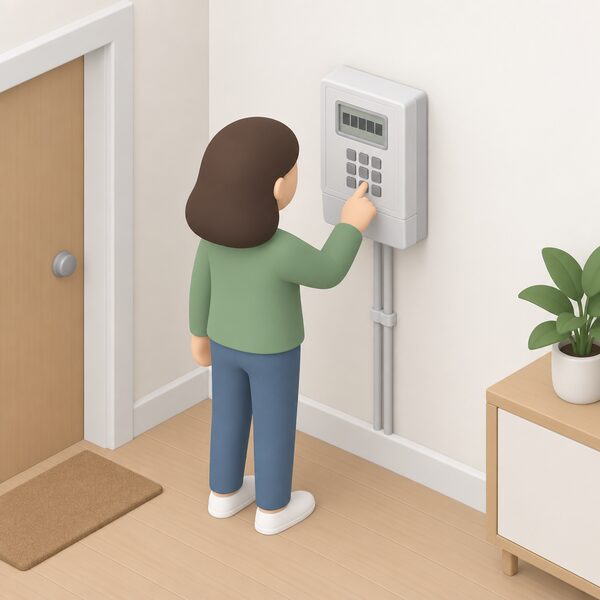
A Keypad meter is a prepayment meter operated by a numeric code rather than a card. When a top-up is bought, the customer is given a Powercode, usually a 20-digit number, and after a change in electricity prices a special 40 or 60-digit Powercode is issued7. Top-ups can be bought online at powerni.co.uk, by Customer Helpline 24 hours a day, at any Post Office or PayPoint, or through the Power NI app for iPhone and Android7. Replacement cards carry no charge7.
The meter has its own protections. When the low-credit warning sound is turned off, the customer automatically gets £3 emergency credit7. Friendly Credit keeps supply on past the point where credit would otherwise run out: if emergency credit runs out after 4pm on a Friday, supply stays on until 8am the following Monday, and if it runs out after 4pm Monday to Thursday, supply stays on until 8am the following day7. Friendly Credit also does not run out on 1 January, 17 March, 12 July and 25 December, with supply staying on until 8am the following working day7. With Economy 7 the cut-off is 11am, and other tariffs can request the same7. All stated times are GMT, with one hour added during Summertime7.
Arrears recovery is capped. Where a meter is set to recover arrears, it will not take more than 20% of each top-up; at a 20% recovery rate, a £10 top-up gives £8 credit and £2 off the outstanding balance7. Customers with arrears receive an annual account statement7. Installation of a prepayment meter without express agreement is stated to be used only as a last resort in the debt recovery process7. A Keypad meter is not suitable in a household where a life support system or critical care medical equipment is required7.
Two operational points matter in practice. Most meters store up to 13 months' data, and meter replacement work is completed by Northern Ireland Electricity Networks within 10 working days7. The "wrong tar" message means the most recent tariff change code has not been entered; once it is entered, the last top-up code bought can be entered18. An "incorrect" message means the wrong top-up code was keyed in: wait until the message clears, press the star button and re-enter the number18.
Energy bill support schemes in Northern Ireland: the £600 payment and £30 reduction
Northern Ireland's crisis support was delivered as lump sums rather than monthly credits. All households in Northern Ireland received a single, one-off £600 payment to help with their bills3. That £600 combined the £400 Energy Bills Support Scheme with the £200 Alternative Fuel Payment, and the National Audit Office records that "In NI, the government made a one-off £600 payment combining both the EBSS and AFP domestic schemes"4. The Energy Bills Support Scheme element was a £400 discount on energy bills for households in Northern Ireland, with the cost of the scheme estimated at approximately £332 million based on estimates of eligible households19.
The delivery mechanism was designed around Northern Ireland's payment landscape. The Energy Prices Act 2022 provided for reducing the amount that would otherwise be charged for NI domestic electricity supply by licensed electricity suppliers who are parties to the scheme, and a parallel provision covered non-domestic supply20. The scheme was open to those with a domestic electricity meter point paying by standard credit, payment card and direct debit, and Direct Debit customers were to receive the discount automatically as a deduction to the monthly Direct Debit amount or as a refund to the bank account following collection21. Voucher support for households without a direct supplier relationship began in January22.
A separate, smaller scheme has been announced to cut energy bills in Northern Ireland by £30 a year per household14. That is a standing reduction rather than a crisis payment, and it is distinct from the £600.
Alongside the payments, the Northern Ireland Sustainable Energy Programme funds energy efficiency schemes available for domestic and business customers, with the list of schemes published by the Utility Regulator23. For households in difficulty, suppliers are expected to refer customers who are struggling to pay bills to organisations like Advice NI, which offers free, independent debt advice8. In December 2022 the government urged suppliers to suspend all debt recovery and enforcement activity until the end of January, and to provide payment holidays until the end of January where customers were struggling to pay3.
The Consumer Council: free help with complaints and price comparison

The Consumer Council for Northern Ireland is the main free source of help. It gives free advice and can investigate complaints about natural gas and electricity8. It also offers an energy price comparison tool to compare electricity and gas tariffs for all suppliers in Northern Ireland8. That tool matters more here than in Great Britain, because with no cap and a regional supplier set, comparing tariffs is the only route to a lower rate.
Alongside it, NI Energy Advice offers free, independent and impartial energy advice to domestic householders in Northern Ireland, plus referrals to energy grants and other sources of help11. Its remit includes free advice on saving energy in the home, energy efficiency grants and oil buying clubs25. The Consumer Council NI and Northern Ireland Energy Advice together give free, independent and impartial energy advice to all domestic householders in Northern Ireland11.
The advice function is not the same as the complaint function, and it is worth keeping them apart. NI Energy Advice is where a household goes for practical guidance on reducing consumption, grants and oil buying. The Consumer Council is where a household goes when a supplier dispute needs investigating. For households in England or Wales, the equivalent free consumer service is Citizens Advice, which can help with problems with energy bills or supply9. That service does not cover Northern Ireland, which is why the Consumer Council route exists.
For a household thinking about independence, this is the practical infrastructure. There is no cap to fall back on, so the comparison tool and the free advice service are the mechanisms that substitute for it, and they are free to use.
Where to go when a complaint is not resolved
The escalation path runs from supplier to ombudsman. A household can contact the Energy Ombudsman if it is not happy with the way the energy supplier has handled the complaint26. The Ombudsman can be used where a reported problem is not fixed within 8 weeks, where the household and the energy company cannot agree on a fix, where a deadlock letter is received, or where the decision received is not satisfactory28. The same escalation route applies to bill complaints28.
There is a separate statutory route for network disputes. Under Article 27, any dispute between the distributor and the consumer, or another distributor or owner of the street electrical fixture, over disconnection or refusal to connect may be referred by any party to the Department29. That is a different forum from the Ombudsman and applies to the network rather than the supply relationship.
Heat network disputes have their own conditions. Unresolved heat network disputes may be reviewed by the Energy Ombudsman after a complaint to the supplier, a deadlock letter or 8 weeks, and with sufficient evidence including the complaint date30.
For households in payment difficulty, the first step is the supplier, and the guidance on overdue utility bills sets out what to expect31. Suppliers are expected to refer customers who are struggling to pay bills to organisations like Advice NI for free, independent debt advice8. The Energy Price Guarantee directions allowing tariff changes on days other than the first day of a quarter also mean that a rate change can arrive at an unusual point in the year, which is one reason a bill can look wrong when it is not10.
What this means for a household's energy independence
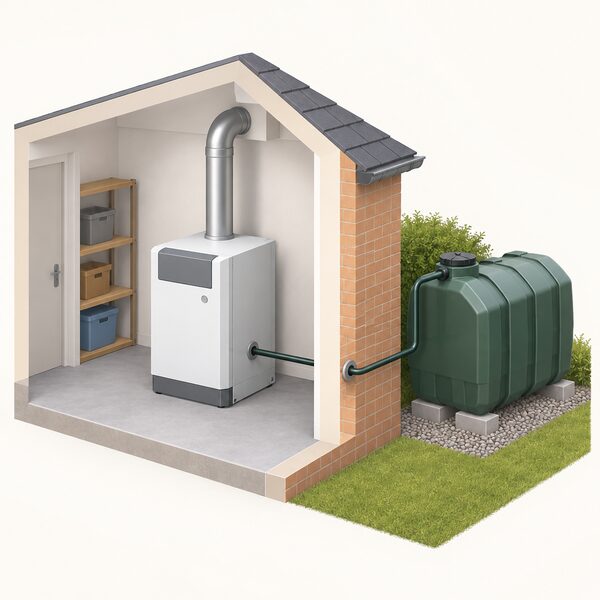
Northern Ireland households carry more direct exposure to energy costs than households in Great Britain, and the structure of the market is the reason. There is no cap, so the tariff a supplier sets is the tariff a household pays, subject to the Utility Regulator's approval process1. The crisis support that did exist arrived as lump sums, a single £600 payment in winter 2022/23, rather than as a continuing shield3.
What remains in the household's hands is the payment method and the fuel choice. The Monthly Direct Debit discount is capped at £40 a year, or £60 with online billing, equivalent to 4% and 6% off the standard rate15. The Keypad discount is 2.5% off the standard rate, ongoing, with no rental fee, no security deposit and free installation7. Those are real but modest sums against a bill in the region of £2,109 for a dual fuel household at the crisis peak1.
The larger lever is the fuel itself. A household on mains gas has a unit rate that has been subject to the Energy Price Guarantee discount mechanism; a household on oil or solid fuel has no such mechanism at all1. That is the sharpest independence divide in the Northern Ireland market, and it is not one a payment method can close.
The dependence that remains is structural: on a supplier for the tariff, on the Utility Regulator for approval, on the network for connection, and on imported fuel for the wholesale price behind all of it. The Consumer Council's comparison tool and NI Energy Advice's free guidance are the practical substitutes for a cap, and they are the two things a household can use without cost8.
Sources31 cited
- Energy Price Guarantee up until 30 June 2023, GOV.UK, 2026-09-17
- Energy Prices (Domestic Supply) (Northern Ireland) Regulations 2022(NorthernIreland)Regulations2022), Hansard, 2022-11-16
- Vital help with energy bills on the way for millions more homes across Great Britain and Northern Ireland, GOV.UK, 2022-12-19
- Energy bills support, House of Commons Library, 2026-08-28
- Energy bills support: an update, National Audit Office, 2024-11-14
- Monthly Direct Debit, Power NI, 2026-09-20
- Services for prepayment meter customers, Power NI, 2026-09-20
- Advice if you're struggling to pay your energy bills, nidirect, 2026-09-17
- Complain about your energy supplier or network operator, Ofgem, 2026
- Energy Price Guarantee for domestic energy consumers in Northern Ireland: ministerial directions, GOV.UK, 2023-01-04
- Low carbon heating, nidirect, 2026-09-17
- Guidance for FIT generators V18, Ofgem, 2026-04-01
- Energy price cap levels 1 July to 30 September 2026, Ofgem, 2026
- Energy bills support, House of Commons Library, 2026-08-06
- Electricity price comparison table, Consumer Council, 2026-09-18
- Heating technologies to suit your home, nidirect, 2026-09-17
- Energy credit, Confused.com, 2026-07-03
- I've got a message on my Keypad, what does it mean?, Power NI, 2026-09-20
- Northern Ireland Energy Bills Support Scheme, UK Parliament, 2022-10-18
- Energy Prices Act 2022, legislation.gov.uk, 2022-10-25
- £400 energy bills discount to support households this winter, GOV.UK, 2022-07-29
- Northern Ireland households to receive voucher support for energy bills starting in January, GOV.UK
- List of schemes published 2023/2024 Northern Ireland Sustainable Energy Programme, Utility Regulator, 2023-05-09
- Energy efficiency tips, nidirect, 2026-09-17
- Cost of living and winter support, Belfast City Council, 2026-09-20
- Understand your electricity and gas bills, Ofgem, 2026
- How your electricity or gas bill is calculated, Ofgem, 2026
- Complain about your energy supplier or network operator, Ofgem, 2026
- Article 27, Electricity (Northern Ireland) Order 2012, legislation.gov.uk, 2026-09-17
- Cardiff Community Housing Association Limited, Energy Ombudsman, 2026-09-19
- Overdue utility bills, nidirect, 2026-09-17
 Suppliers in Northern IrelandNorthern Ireland runs its own energy market, with its own regulator, its own suppliers and no price cap.
 Utility Regulator NIWho sets your energy prices in Northern Ireland and who can you complain to?
 Tariffs in Northern IrelandWhy does Northern Ireland have its own energy tariffs instead of the Ofgem price cap?
 Devolved vs Reserved PowersWho decides what you pay for gas and electricity, and who decides how your home is insulated or improved?
 Power Cuts in Northern IrelandNorthern Ireland has a single electricity distribution network, run by NIE Networks, and its own reporting number, registers and compensation arrangements.
 NI Gas Tariffs and NetworksHow gas tariffs in Northern Ireland are set by network area, why the Ten Towns area differs from Greater Belfast, when approved changes take effect, and what the Consumer Council comparison tool covers.