

In this guide
A Direct Debit is the payment method most UK households use for gas and electricity, and it is the method the price cap is built around. The monthly amount is not a meter reading turned into a bill: it is a fixed sum, usually based on an estimate of the energy a household will use over a year, spread evenly across twelve payments1. That is why the figure stays the same in July and January even though consumption does not.
The financial case for it is set by the cap itself. For the period 1 April to 30 June 2025 the cap stood at £1,849 a year for a typical dual fuel household paying by Direct Debit, £129 (7%) below the standard credit equivalent3. Ofgem's August 2025 press release put the saving available to the 8 million customers then paying by standard credit at £135.60 from switching payment method alone4. The gap is not a discount in the marketing sense; it reflects the lower cost to a supplier of predictable, automated payments.
The trade-off is that a fixed monthly payment is an average, not a measurement. Credit builds in the low-use months and is drawn down in the high-use months, and the supplier reviews the amount periodically against actual consumption. The rules on notice, on refunds and on the Direct Debit Guarantee are what stand between a household and an amount that drifts away from reality.
What a Direct Debit is and how the monthly amount is worked out
A Direct Debit is an instruction to your bank authorising a named supplier to collect varying amounts from your account. For energy, the amount is normally fixed rather than variable: the supplier estimates annual consumption, applies the tariff, and divides the total into equal monthly instalments1. The estimate is the pivot. It is built from the property's history, the tariff's unit rates and standing charge, and any meter readings the supplier holds.
Two versions of the method exist. A fixed monthly Direct Debit takes the same amount every month, which is the common arrangement and the one the price cap figures assume. A variable Direct Debit takes the actual billed amount each month, so the payment moves with consumption. The second is only available where a supplier offers it, and where it is not offered the alternative is to change supplier2. Variable Direct Debit carries its own condition: without a smart meter, monthly meter readings have to be sent, because there is no averaging left to absorb an estimate2.
The cap figures are quoted for a household on Direct Debit because that is the reference payment method. Ofgem's cap for 1 April to 30 June 2025 was £1,849 a year for a typical dual fuel Direct Debit customer, against £1,720 for the same household on prepayment, a difference of £1293. Policy costs within the Direct Debit cap were £198 a year in the 1 July to 30 September 2025 period, unchanged from the previous period3.
For a household's energy independence, Direct Debit changes little about where the energy comes from. It is a billing mechanism, not a supply one: the household remains connected to the grid and to a licensed supplier, and the payment method does not alter the fuel mix or the standing charge. What it does affect is control over cash flow, and that is where the rules matter.
Why Direct Debit is usually the cheapest way to pay
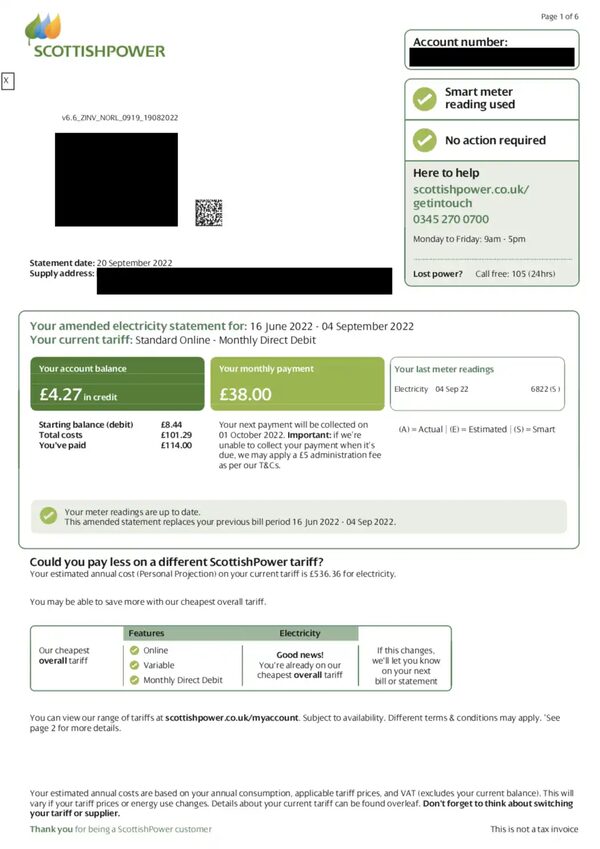
The price cap is published as a set of figures by payment method, and the ordering is consistent. Direct Debit sits at the bottom, standard credit above it, and prepayment in a separate column that varies by fuel and meter type. For the 1 April to 30 June 2025 cap period the Direct Debit figure was £1,849 and the standard credit figure £1,720 for prepayment, with the £129 gap representing 7%3.
The gap has narrowed and widened with the cap. In cap period 12a, announced in February 2024, customers paying by standard credit paid an additional £106 compared with Direct Debit customers6. Ofgem's August 2025 press release, published alongside the October cap announcement, stated that 8 million customers were then paying by standard credit and could be making savings of £135.60 with one simple switch4. The two figures are not directly comparable: one is a cap differential, the other a saving calculated for a particular group of customers at a particular time.
Economy 7 households see the same pattern with a different shape, because the differential applies to electricity only. In the 1 July to 30 September 2025 period, Economy 7 customers on standard credit paid an additional £82 compared with Direct Debit, while Economy 7 customers on a prepayment meter paid £30 less than the Direct Debit equivalent3.
Nearly all suppliers offer a discounted price for paying by Direct Debit, on the reasoning that it ensures prompt, regular payments7. That is the mechanism behind the cap differential: the discount is priced into the tariff rather than applied as a separate credit. A household moving from cash or cheque to Direct Debit contacts the supplier, asks about the discount on offer, and sees the change on the next bill, unless it has a prepayment meter7.
How the Direct Debit Guarantee protects every payment
The Direct Debit Guarantee is the scheme rule that sits behind every instruction, and it does three things that matter for energy billing. It requires advance notice of a change to the amount or date, it gives a right to an immediate refund where an error occurs, and it gives a route to the bank where a payment is disputed.
On notice, the consumer guidance is not uniform. One source states that a supplier has to let you know about a payment increase before it happens, and puts the period at between 3 and 10 days depending on the supplier2. Another states that under the Direct Debit Guarantee a supplier is obliged to let you know a minimum of ten days in advance where a payment increases or decreases8. A third states that a supplier must notify you of a change in the Direct Debit payment amount or payment date in advance, without fixing a number7.
On errors, the position is clearer. If there is an error in a Direct Debit payment, you are entitled to a refund under the Direct Debit Guarantee7. If a bill changes and you are not told, you can contact your bank to dispute the charge and seek compensation8. Separately, all energy suppliers must follow the Erroneous Transfer Customer Charter, and compensation may be available where a transfer happens in error9.
"if there is an error in your Direct Debit payment, you are entitled to a refund under the Direct Debit Guarantee"
A failed payment is a different matter from an erroneous one. If there are not enough funds in the account to pay a Direct Debit, it may be returned unpaid and could result in a charge from the bank to cover additional administration10. Energy debt on a live account is treated as a priority debt in official guidance for advisers11.
When and why your supplier can change your payment amount
A supplier can change the monthly amount, and the most common reason given is consumption rather than price. Payments have probably gone up because you are using more energy than the supplier expected, and the price of energy and the daily fee have stayed the same12. That distinction matters: on a fixed tariff, a rising Direct Debit is not a price rise, and a fixed tariff does not protect you from the Direct Debit amount increasing or decreasing14.
Suppliers may also increase the amount over the winter months to cover additional usage, while the unit rates charged do not change10. The change is a cash-flow adjustment, not a tariff change, and it should reverse when consumption falls if the account is in balance.
The licence conditions constrain how the amount is set. Standard Licence Condition 27 requires suppliers to take all reasonable steps to ensure the fixed amount of a domestic customer's regular Direct Debit payment is based on the best and most current information available15. Ofgem's March 2024 explanatory note on customer credit balances states that suppliers must ensure fixed Direct Debit amounts are based on accurate and up to date information so that credit balances are not excessive16. Those two requirements are the basis for challenging an amount that has drifted.
Where a change is made, the supplier should give reasonable notice of changes to Direct Debit payments and explain why the change is necessary12. The same expectation applies in Wales, where the equivalent guidance states that a supplier should tell you in a reasonable amount of time before a price increase takes place12. Where the change is a price rise rather than a payment adjustment, suppliers are expected to give at least 30 days' notice8.
Credit balances and overpayments: why they build up and what to do
A credit balance arises when you pay for more energy than you have used, for example because you pay a set amount by Direct Debit every month17. The pattern is seasonal and predictable: credit typically builds over the summer months when less energy is used, and can then help reduce bills in the winter months1. A balance in September is not evidence of an error; a balance in September that keeps growing is.
The regulatory position is that suppliers must ensure fixed Direct Debit amounts are based on accurate and up to date information so that credit balances are not excessive16. Where a balance has built up because the amount was set too high, the remedy is a review of the amount. Where it has built up because a Direct Debit was previously set too low to cover what was owed, the position is different, and Ofgem's guidance on back billing sets out that condition explicitly18.
Refusing to refund credit from an account is one of the issues a supplier's complaints process covers, alongside late, incorrect or missing bills, back billing, being overcharged, a faulty meter and poor customer service19. Where a supplier has not followed the back billing rules, it will refund any money taken in error21. The route is the supplier first, then the energy ombudsman if the complaint is not resolved.
For a household's independence, a credit balance is money sitting with a supplier rather than in the household's account. It is not lost, and it is not interest-bearing in any way the rules require. The practical control is the review: an amount based on current information is the mechanism the licence conditions provide, and it is the one to invoke when a balance grows beyond the seasonal pattern.
Fixed monthly payments and budgeting: the drawbacks to weigh

The case for fixed monthly payments is predictability. The case against is that predictability is achieved by averaging, and averaging can hide a drift. A household that uses more than the estimate builds a debit rather than a credit, and the correction arrives as a larger monthly amount or a catch-up bill.
The evidence on how this lands is mixed. In the Energy Satisfaction Survey wave covering July 2024, 7% of domestic energy consumers had fallen behind on Direct Debit22. That is a minority, but it is a large minority in absolute terms, and it sits alongside the debt picture that official guidance treats as a priority: energy debt on live accounts is a priority debt11.
The other drawback is that the amount is not the bill. A fixed tariff does not protect the Direct Debit amount from moving14, and a supplier may raise the amount over winter to cover additional usage while unit rates stay the same10. A household budgeting on the monthly figure alone can be surprised by a review it did not anticipate.
There is a structural point too. The Direct Debit discount is priced into the tariff, so a household that cannot or does not use Direct Debit pays the standard credit rate, which was £106 more in cap period 12a6 and £129 more in the 1 April to 30 June 2025 period3. The saving is real, but it is a saving on a higher baseline, and it is contingent on the payment method remaining available.
Dual fuel tariffs: one supplier, one bill, and the discounts on offer
A dual fuel tariff covers both gas and electricity with the same supplier, with one point of contact and one monthly or quarterly invoice covering both fuels5. Pretty much all energy suppliers offer dual fuel tariffs, on the reasoning that they are cheaper and easier to manage for both the supplier and the customer5. Whether a particular supplier offers one is up to them, and availability can differ from supplier to supplier25.
The discount structure is where the detail sits. Some suppliers offer a discount for having both fuels with them, and in some cases separate suppliers could be cheaper18. That is the honest position: the dual fuel discount is a real feature of many tariffs, but it is not a guarantee of the lowest price, and the comparison has to be made against the best single-fuel offers available.
The Direct Debit discount and the dual fuel discount are separate. Nearly all suppliers offer a discounted price for paying by Direct Debit7, and some offer a further discount for taking both fuels18. A household on dual fuel and Direct Debit is therefore typically on the cheapest combination of the two dimensions the cap recognises, which is why the headline cap figures are quoted on that basis.
| Arrangement | What it covers | Billing | Discount basis |
|---|---|---|---|
| Dual fuel, Direct Debit | Gas and electricity, one supplier | One monthly or quarterly invoice5 | Direct Debit discount plus any dual fuel discount7 |
| Dual fuel, standard credit | Gas and electricity, one supplier | One invoice, paid on receipt | No Direct Debit discount; £129 higher in the 1 April to 30 June 2025 cap period3 |
| Single fuel, two suppliers | One fuel each | Two invoices, two points of contact | No dual fuel discount; separate tariffs may still be cheaper18 |
Is dual fuel actually cheaper than separate tariffs?
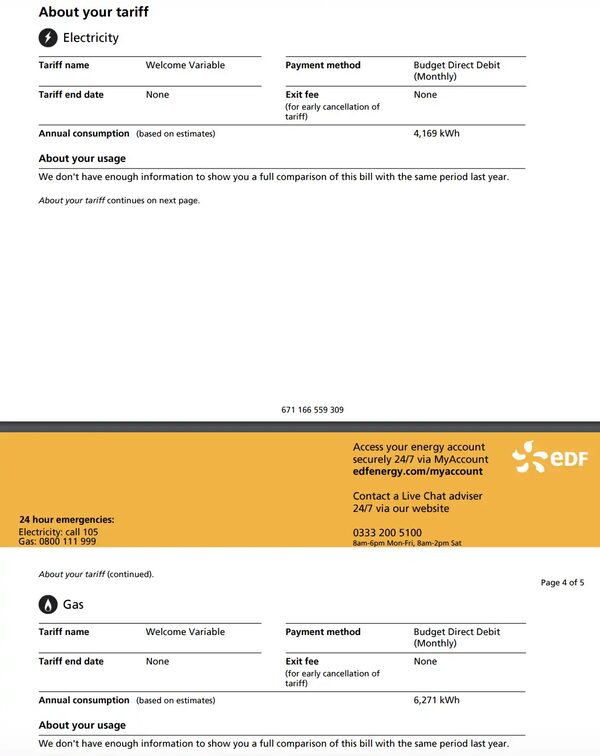
There is no guarantee that a dual energy deal is cheaper than separate gas and electricity tariffs, though suppliers tend to pass on some savings5. That is the clearest statement of the position, and it should govern how the question is approached: dual fuel is a convenience and a discount structure, not a price promise.
The historical evidence on the Direct Debit differential is more concrete than the evidence on dual fuel. Ofgem's retail market review, published in 2010, put the average saving for Big 6 standard dual fuel customers switching to the cheapest supplier on Direct Debit at £176 on a 2010 bill26. The same document recorded that as of January 2011 the ScottishPower dual fuel standard credit versus Direct Debit differential stood at £114 per annum, excluding any prompt pay discount26. Those figures are old and describe a different market, but they establish that the payment method differential has been a persistent feature of the retail market for well over a decade.
The current cap figures are the ones to use. The 1 April to 30 June 2025 cap was £1,849 for a typical dual fuel Direct Debit household, £129 (7%) below the standard credit equivalent3. Ofgem's August 2025 press release framed the same gap as a £135.60 saving for the 8 million customers then on standard credit4. The two numbers differ because they are calculated on different bases, and both are official.
For a household's independence, the dual fuel question is about concentration rather than self-sufficiency. One supplier means one point of contact and one bill, and it also means one relationship to manage, one complaints route and one set of terms. It does not reduce dependence on the gas grid or on imported gas, and it does not change the standing charge or the unit rates beyond the discounts the tariff carries.
Who can and cannot switch to a dual fuel tariff
The eligibility rule is straightforward. If you are on two separate single-fuel tariffs for gas and electricity, you can switch to a dual fuel one with no problem25. The constraint is physical rather than administrative: a dual fuel tariff requires both a gas supply and an electricity supply, so a household with no gas connection cannot take one.
That rules out all-electric homes, and it also rules out households in areas without a gas network. For those properties the relevant comparison is between electricity tariffs, not between dual and single fuel. The price cap still applies: households are covered if they are on a default tariff and pay by standard credit, Direct Debit, prepayment meter or Economy 7 meter27.
There is a separate eligibility question about who can switch supplier at all. If you pay a supplier directly for the electricity or gas you use at home, you can choose to switch to a different supplier or tariff at any time9. Households on prepayment meters, in debt under an agreed repayment plan, or in some park home arrangements face different conditions, and those are dealt with elsewhere.
Smart meters change the tariff options rather than the eligibility. A smart meter allows access to more flexible tariffs, including dual-rate tariffs28. That is a tariff benefit rather than a dual fuel condition, and it applies to electricity supply regardless of whether gas is also taken from the same supplier.
Switching, exit fees and the 50-day window

Switching to a dual fuel tariff is a supplier switch, and the process follows the standard switching rules. There is no downtime between the old contract ending and the new one beginning, and no supplier visit is needed unless a smart meter is installed5. The household sets up the Direct Debit with the new supplier ahead of the takeover date and cancels the old Direct Debit after paying the final bills10.
Exit fees are the main cost risk. Ofgem research published in July 2025 found that 70% of consumers who thought they had an exit fee on their current contract would still switch to a deal with a £300 exit fee29. That is a finding about consumer behaviour rather than a rule, and it illustrates how weakly exit fees deter switching in practice. The terms of the individual tariff govern whether a fee applies and how much it is.
A fixed rate dual fuel tariff usually locks the household in for a set period, commonly 12 months at a fixed amount per unit of energy5. The end of that period is the natural review point, and it is also when the tariff reverts to a standard variable or default rate unless a new deal is taken.
For a household's energy independence, the switching rules are the main lever available. The payment method, the fuel combination and the supplier are all choices within a market that is regulated but not self-directed: the gas still arrives through the network, the electricity through the grid, and the billing through a licensed supplier. What the rules provide is a set of protections on the money side, from the notice requirement on a payment change to the refund right under the Direct Debit Guarantee, and those are the parts a household can actually use.
Sources30 cited
- Understand your electricity and gas bills, Ofgem, 2026
- Energy supplier has increased your Direct Debit, Citizens Advice, 2026
- Summary of changes to energy price cap 1 July to 30 September 2025, Ofgem, 2025
- Energy price cap will rise 2 per cent in October, Ofgem, 2025
- How to compare dual fuel tariffs, Confused.com, 2025
- Default Tariff Cap Letter, 1 April 2024, Ofgem, 2024
- Paying for energy by cash, Uswitch, 2025
- Energy consumer rights, Uswitch, 2025
- Switch your home energy supplier, Ofgem, 2026
- Direct Debit guide, Uswitch, 2025
- Guide for energy suppliers and debt advice providers, Ofgem, 2026
- Your gas or electricity supplier has put up its prices, Citizens Advice, 2026
- Your gas or electricity supplier has put up its prices (Wales), Citizens Advice, 2026
- Energy tariffs explained, Uswitch, 2026
- Open letter on expectations for energy suppliers undertaking charge recovery action, Ofgem, 2020
- Customer credit balance explanatory note, Ofgem, 2024
- Check if you are owed money on your energy bill, Ofgem, 2026
- What to do if you get a back bill (households), Ofgem, 2026
- Energy terms explained, Ofgem, 2026
- Complain about your energy supplier or network operator, Ofgem, 2026
- What to do if you get a back bill, Ofgem, 2026
- Energy Satisfaction Survey, Wave 19, Ofgem, 2024
- Bills and benefits, GOV.UK, 2026
- Water, gas and electricity bills, GOV.UK, 2026
- Dual fuel or single fuel tariffs: what suits your home, Energy Helpline, 2026
- Retail market review, Ofgem, 2011
- Changes to energy price cap between 1 January and 31 March 2026, Ofgem, 2025
- Getting a smart meter, Ofgem, 2026
- Understanding consumers' energy tariff choices, Ofgem, 2025
- Energy price caps explained, Ofgem, 2020
 Price Cap RatesPaying by direct debit, prepayment or standard credit changes what you pay under the price cap, so which method is cheapest?
 Fixed and Variable TariffsCompares capped standard variable tariffs with fixed deals, including exit fees, contract end and rollover.
 Reading an Energy BillA line-by-line walk through a domestic gas and electricity bill: unit rate, standing charge, kWh consumption, meter readings, tariff name and balance, plus the 12-month back billing limit and the guaranteed standards payments that apply when a supplier or network operator gets it wrong.
 Prepayment Meter DebtHow debt repayment is set on a prepayment meter, the limits on the share of a top-up that can be taken, and how to have a rate reviewed.
 Ways to Pay an Energy SupplierHow you pay for gas and electricity changes what you are charged, and by how much.
 V2G Earnings and TariffsExplains how households are paid under vehicle-to-grid arrangements, whether through export payments, a flat monthly credit or a time-of-use tariff.