

In this comparison
Under the price cap, prepayment is the cheaper way to pay, not the dearer one. For cap period 15a, running from 1 October to 31 December 2025, Ofgem set the prepayment cap at £1,707 a year for a typical household and the direct debit cap at £1,7551. That is £48 in prepayment's favour. Standard credit, where a household pays on receipt of the bill by cash or cheque, sits above both: £136 a year more than direct debit in the same period1.
The gap is deliberate. Ofgem has acted to make standing charges for prepayment customers the same as those paid by direct debit customers, a process known as levelisation that opened in April 20242. Before that, prepayment standing charges were higher, and the unit rate discount had to work harder to offset them.
What the cap does not do is cap a household's bill. It caps the unit rates and standing charges a supplier can charge on a default tariff, for a household with typical usage. A home that uses more pays more, whatever method it uses. The figures below are the cap levels, not a promise about any individual bill.
The price cap: £1,723 a year from 1 October, up 4%
The cap level that matters most to a household reading this in late 2026 is the one taking effect on 1 October 2026: £1,723 a year for a typical dual fuel household paying by direct debit, a rise of around £60 and 4% from £1,6634. That is the headline figure most suppliers and advice bodies quote, and it applies to a household on a standard variable tariff using typical amounts of gas and electricity.
The prepayment level moves with it, and the relationship between the two has been stable across recent periods. In cap period 15a the prepayment cap was £48 below direct debit1. In the period before, 1 July to 30 September 2025, it was £47 lower5. In 1 April to 30 June 2025 it was £46 lower6. The pattern is consistent: prepayment sits a little below direct debit, and the exact gap is reset at each quarterly review.
For Economy 7 households, which use a cheaper overnight rate and a dearer daytime one, the numbers are smaller because the bill covers electricity only. The Economy 7 prepayment cap was £30 less than the Economy 7 direct debit cap in period 15a1, and £30 less in the July to September 2025 period5. Economy 7 standard credit was £74 more than Economy 7 direct debit in April to June 20256.
The direction of travel matters for independence. A prepayment household is buying the same units from the same grid as its neighbour on direct debit, and the cap does not change that dependence. What it changes is the price of the payment mechanism, and the mechanism is the one part of the bill a household can actually choose.
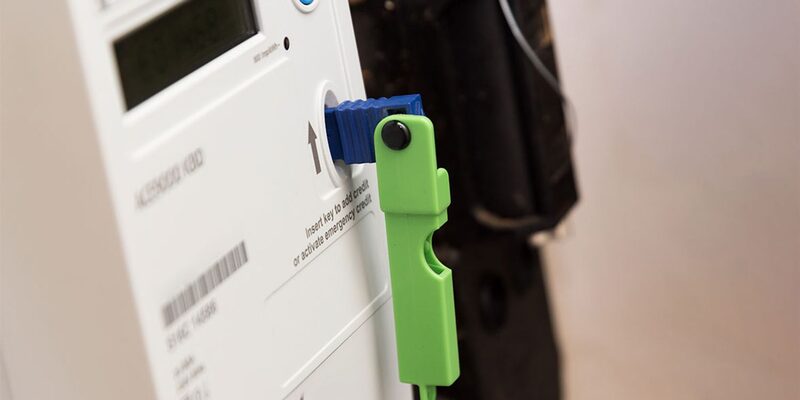
Prepayment pays £48 less under the cap: what the difference covers
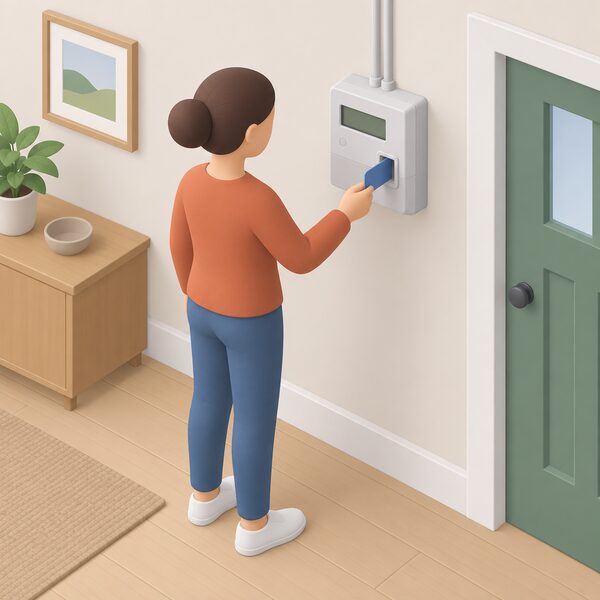
The £48 gap is not a discount for paying early. It reflects a real difference in what it costs a supplier to serve a prepayment customer versus a direct debit one, and the cap methodology is built to reflect those costs rather than to reward one group.
The core operating cost allowance in the cap is set using 2017 supplier cost data, and it reflects the operational costs of serving a direct debit consumer2. Prepayment customers carry different costs: the meter itself, the top-up network, and the fact that the supplier holds no credit balance and carries no bad debt risk on that account. The cap level for prepayment is set below direct debit because those costs, netted out, come in lower.
Standard credit goes the other way. A household paying on receipt of a bill costs the supplier more to serve, because the supplier is extending credit and absorbing the risk of non-payment. That is why standard credit carries a premium: £136 a year above direct debit in period 15a1, and £106 above direct debit in cap period 12a7. The principle was set out when the cap was designed, when Ofgem consulted on two separate caps for direct debit and standard credit consumers and proposed setting the standard credit cap £22 higher than the direct debit cap8.
The gap between prepayment and direct debit has narrowed and widened slightly across periods, from £46 to £48, as wholesale costs and the allowances inside the cap have moved. A household should treat the current figure as the current figure, not a permanent entitlement.
Prepayment, direct debit or standard credit: which cap level applies to you
Three payment methods, three cap levels, and the one that applies to a household depends on how it actually pays. The cap applies to customers on a standard variable tariff paying by standard credit, direct debit, prepayment meter or Economy 7 meter9. A capped tariff depends on how you pay, where you live, and what type of meter you have10.
| Payment method | Cap level, 1 Oct to 31 Dec 2025 | Difference vs direct debit |
|---|---|---|
| Direct debit | £1,755 a year | Baseline1 |
| Prepayment meter | £1,707 a year | £48 lower1 |
| Standard credit (cash or cheque) | Direct debit plus £136 | £136 higher1 |
| Economy 7 direct debit | £1,179 a year | Electricity only1 |
| Economy 7 prepayment | £30 less than Economy 7 direct debit | Electricity only1 |
The variation does not stop at payment method. The cap level also varies by where you live, by fuel type, and by meter type2. That is why two households on the same supplier and the same payment method can see different unit rates: the regional distribution costs differ, and the cap is set to reflect them.
One thing does not vary. Ofgem must set one cap level for all suppliers, with no different provisions for different holders of supply licences11. The cap is set to cover a notional efficient supplier, and there is no bespoke cap for any individual company12. A household cannot shop around for a better cap level, because there is only one.
What suppliers can and cannot do when you owe money
Debt is where the two payment methods diverge most sharply, and where the rules do the most work.
A supplier must notify a customer of a change in the direct debit payment amount or payment date in advance13. That is a protection direct debit customers have and prepayment customers do not need, because a prepayment customer is not building up a balance the supplier can adjust. Suppliers must also ensure that fixed direct debit amounts are based on accurate and up to date information, so that credit balances are not excessive14. Standard Licence Condition 27 requires suppliers to take all reasonable steps to ensure the fixed amount of a domestic customer's regular direct debit payment is based on the best and most current information available15.
For prepayment customers in debt, the position is different. A household with a prepayment meter that owes its supplier up to £500 can generally switch supplier16. That matters, because it means a prepayment debt does not lock a household into a supplier it wants to leave.
The prepayment price cap itself sits in the licence as SLC28.A, a condition setting supplier obligations18. Where a supplier fails, Ofgem can open investigations, make orders and impose penalties19. Ofgem does not get involved in individual complaints about suppliers and does not investigate individual disputes20; those go to the Energy Ombudsman.
Standing charges and why payment method affects what you pay
Standing charges are the fixed daily amount a household pays whatever it uses, and they were once the main reason prepayment looked expensive. That changed.
Ofgem acted to make standing charges for prepayment meter customers the same as those paid by direct debit customers2. The decision on levelising standing charges for prepayment and direct debit consumers was announced in February 2024 and took effect from April 20242. The effect is that prepayment meter and direct debit consumers pay the same level of standing charges, whereas before April 2024 they did not2.
That levelisation is now built into the cap as an allowance, described by Ofgem as making sure prepayment and direct debit customers pay the same standing charge4. It is the reason the prepayment cap can sit below the direct debit cap on unit rates while the standing charge is identical: the discount is doing all the work, rather than being partly eaten by a higher fixed charge.
The practical consequence for a household is that a low-usage prepayment home is no longer penalised twice. Under the old arrangement, a high standing charge hurt a household that used little energy most, because the fixed cost was spread over fewer units. Levelisation removed that specific penalty.
"we have already acted to make standing charges for prepayment meter customers the same as those paid by direct debit customers"

When the next cap change lands and how to track it

Ofgem updates the price cap every three months3. Each level is announced roughly five weeks before it takes effect, and the review dates for the periods ahead are published in advance.
The next period begins on 1 January 2027, following an announcement in late November 20264. After that, the review for April to June 2027 is due on 23 February 2027, and the review for July to September 2027 is due on 26 May 20274. A household wanting to know what it will pay in the new year needs the late November announcement, not the current figure.
The quarterly rhythm is not the original design. The prepayment cap was introduced in April 2017, following the Competition and Markets Authority's remedy, and it was set to move every six months in line with a range of cost indices21. The default tariff cap that followed extended protection to customers on standard variable tariffs more broadly, and the frequency moved to quarterly.
For a household, the practical point is that the gap between prepayment and direct debit is reset four times a year. A household weighing the two methods should look at the current period's figures and expect the relationship to hold, but the exact pound figure to change.
What the cap does not cover: tariffs outside the cap and supplier choice
The cap applies to default tariffs, and it does not matter how a household pays, whether by direct debit or with a prepayment meter3. What it does not cover is everything else. Fixed tariffs, green tariffs and time of use tariffs sit outside the cap3.
That is the single most important limit on the protection. A household on a fixed deal is not covered by the cap level at all, and a household on a tracker or time of use tariff is exposed to wholesale prices directly. The cap is a backstop for households that have not chosen a fixed product, not a universal price ceiling.
The cap's purpose is to protect default tariff customers by limiting the amount they can be charged for their gas and electricity22. It is set to cover a notional efficient supplier, and Ofgem can only set one cap across the market12. There is no route to a bespoke cap for a household that thinks its own costs are higher.
Where a supplier fails, the household does not lose supply. Customers move to a new supplier under a deemed contract, and the rules state that the terms of deemed rate contracts should not be unduly onerous23. Suppliers can ensure contracts are not unduly onerous by making sure the profit derived from deemed rate customers is not significantly higher than the profit derived from contracted customers23. Prepayment protections continue through that transfer.
For a household thinking about independence, the honest position is this: the payment method changes the price of the mechanism, and the cap level follows it, but neither method changes where the energy comes from. Both are buying from the same grid, through the same supplier, at a price set by the same regulator. The choice between prepayment and direct debit is a choice about cash flow and control, not about sovereignty.
Sources23 cited
- Summary of changes to the energy price cap, 1 October to 31 December 2025, Ofgem, 2025
- Standing charges: domestic retail options, Ofgem, 2024
- Energy price cap explained, Welsh Government, 2026
- Energy price cap, Ofgem, 2026
- Summary of changes to the energy price cap, 1 July to 30 September 2025, Ofgem, 2025
- Summary of changes to the energy price cap, 1 April to 30 June 2025, Ofgem, 2025
- Default Tariff Cap Letter, 1 April 2024, Ofgem, 2024
- Default tariff cap: policy consultation overview, Ofgem, 2018
- Energy price caps explained, Ofgem, 2020
- Energy price cap wholesale adjustment decision, Ofgem, 2024
- Review of additional wholesale costs in the default tariff cap, Ofgem, 2023
- Price cap: decision on the process for updating the Default Tariff Cap methodology, Ofgem, 2022
- Paying for energy by cash, Uswitch, 2025
- Customer credit balance explanatory note, Ofgem, 2024
- Open letter on expectations for energy suppliers undertaking charge recovery action, Ofgem, 2020
- Switch your home energy supplier, Ofgem, 2026
- Response to Ofgem policy consultation for protecting energy consumers with prepayment meters, National Energy Action, 2020
- TDCVs 2019 open letter, Ofgem, 2019
- Supplier Performance Report, July to December 2023, Ofgem, 2024
- Complain about your energy supplier, Ofgem, 2026
- Retail energy markets in 2016, Ofgem, 2016
- Consultation on the wholesale additional risk allowance index, Ofgem, 2022
- Deemed contracts and rates, Energy Ombudsman, 2026
 Price Cap RatesPaying by direct debit, prepayment or standard credit changes what you pay under the price cap, so which method is cheapest?
 Ways to Pay an Energy SupplierHow you pay for gas and electricity changes what you are charged, and by how much.
 The Full Energy Bills and the Price Cap GuideWondering why your bill went up even when you used less power?
 Prepayment and Pay As You GoHow prepayment and pay as you go energy tariffs work in the UK: meter types, top-ups, emergency credit, debt repayment through the meter, price cap treatment and how households move to a credit meter.
 Typical Household FigureThe energy price cap limits unit rates and daily standing charges, not the total bill.
 Energy Price CapThe price cap sets the most you pay for each unit of gas and electricity, plus the daily standing charge, but not your total bill.