

In this answer
Short answer
A prepayment meter does not stop a household switching supplier. What stops it is the size of the debt attached to the meter. The rule used across the market is £500 per fuel: a household can switch if it owes the current supplier less than £500 for gas or £500 for electricity, and the debt transfers to the new supplier to be repaid through top-ups1. Owe more than that on either fuel and the switch is blocked until the balance falls3.
The debt does not disappear when the supplier changes. It follows the account, and the household stays on a prepayment meter with the new supplier until the arrears are cleared5. That is the trade-off at the centre of this page: switching is a route to a cheaper tariff or better service, not a route out of debt.
The £500 rule: switching with prepayment debt under the threshold
The threshold is the single most useful number here. Independent guidance is consistent that a prepayment customer can switch as long as the debt to the current provider is less than £5001, and that the same £500 applies for each meter, with the debt repaid to the new supplier rather than written off2. One comparison site puts it plainly: a prepayment customer can switch as long as they owe less than £50011. Another states that a switch is only possible if the debt to the current provider is under £500, and that the debt transfers with the household12.
The regulator's own consumer guidance uses the same figure from the other direction: a household can switch where it has a prepayment meter and owes the supplier up to £5003. Debt charities and consumer bodies repeat it, with one adding that arrears above £500 on a prepayment meter are what block the move5.
What this means in practice is that a household carrying a modest arrears balance has real choice. It can compare tariffs, switch, and keep repaying at the same rate through the new supplier's top-up mechanism. The debt is not a barrier at that level; it is a condition of the switch. Above £500 on either fuel, the household's options narrow to reducing the balance first, and the routes for that sit with the supplier and the support schemes rather than the switching market.
"you pay by topping up a prepayment meter and you have less than £500 debt for each meter (you'll repay this debt to your new supplier)"

When you cannot switch: debt over £500 per meter
Above the threshold the switch is refused. Independent guidance is explicit that a prepayment customer cannot switch if they owe more than £500 in gas or electricity4, and that owing more than £500 for gas and £500 for electricity prevents a switch13. The Welsh-language version of the same advice says a prepayment meter does not prevent switching unless more than £500 is owed to the current supplier for gas or £500 for electricity14. A debt advice service states the block at more than £50015.
The comparison with credit meters is worth setting out, because the two regimes work differently. For a household on a credit meter, the trigger is time rather than amount: owing money to the supplier for more than 28 days means the household cannot switch until what is owed is repaid16. On prepayment, the trigger is the size of the balance. A prepayment household can therefore be in arrears for far longer than 28 days and still switch, provided the total stays under £500 per fuel.
There is a second, separate restriction that catches some households. If any bill is over 28 days old, or a high balance is outstanding on a prepayment meter, the existing supplier may prevent the switch until the outstanding amount is paid17. That sits alongside the £500 rule rather than replacing it, and it means an old unpaid bill can block a move even where the meter balance itself looks manageable.
Tenants with prepayment meters: your right to switch
Renting does not remove the right to switch. Independent guidance is clear that a prepayment meter and a tenancy together still allow a switch2, and that being on a prepayment meter does not prevent a customer switching tariff or supplier, with tenants who are responsible for paying the bills holding the right to switch provider18. The same right applies where the tenant pays the supplier directly for gas or electricity, including with a prepayment meter19.
The distinction that matters is between switching supplier and changing the meter. A tenant has the right to change a meter from prepayment to credit, or the reverse, but may be obliged to change it back at the end of the tenancy20. Where the meter itself is to be altered, the landlord's permission is needed21. Switching supplier alone does not touch the meter, so it does not raise the same question.
For a tenant in arrears, the practical position is the same as for an owner occupier: under £500 per fuel, the switch can proceed and the debt transfers; over it, the switch is blocked. The prepayment meter stays in place with the new supplier until the arrears are paid off5. A template letter exists for tenants and others who want to put a switching request in writing to a supplier while on a prepayment meter22.
Moving from prepayment to a credit meter
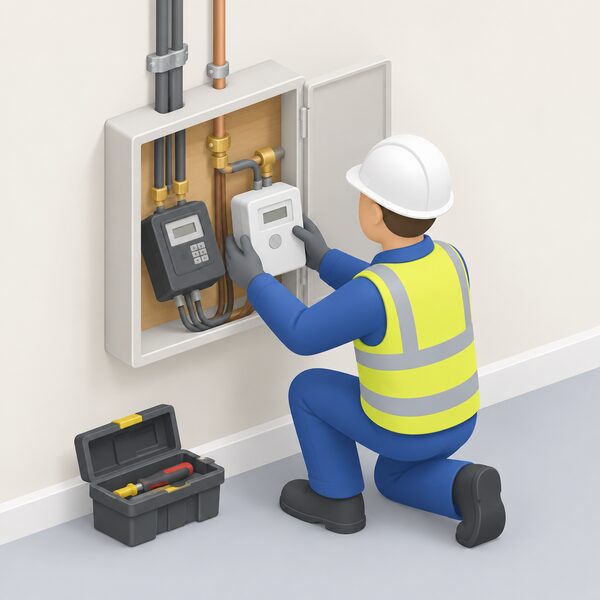
The route off prepayment runs through the debt. Once the debt on the account is settled, the supplier may be able to change the prepayment meter to a credit meter7. Cost is not usually the obstacle: none of the bigger suppliers charge to change prepayment meters over to credit meters8. The supplier may require proof of address, a credit check, or both23.
There is a separate obligation that does not depend on the debt being cleared. If it is not safe and practical for a household to be on prepayment, the supplier should move it to paying by credit, meaning payment for energy after use rather than before24. That is a safety and practicality test, not an affordability one, and it sits alongside the debt-cleared route rather than behind it.
One caution applies to non-smart credit meters. A supplier might charge if a household switches to a new supplier within 12 months of the meter being fitted, even where it was fitted for free12. That is a meter-specific charge, distinct from the debt rules, and it is worth knowing before arranging a change and then moving supplier soon afterwards.
Debt built up on a credit meter can also be moved onto a prepayment meter by the energy company, with automatic repayments taken each time the household tops up25. That is how many prepayment arrears balances arise in the first place, and it explains why the repayment element is built into the top-up rather than billed separately.
Smart meters: switching between prepay and credit mode without a new meter
A smart meter changes the mechanics of all of this. Suppliers can switch consumers from credit to prepayment mode without the cost of a new meter being added to existing debt9. The same source confirms that a household with a smart meter can switch from prepayment to credit without a new meter being installed9. Smart Energy GB states that a supplier can change between credit and prepay without a whole new meter10, and that smart prepay customers can switch between payment modes without physically changing the meter27.
In prepayment mode, a smart meter can add credit automatically or without a visit to a shop28. Switching from an existing gas or electricity prepay meter to a smart credit meter is described as straightforward for customers who meet the conditions30.
The consent question follows from the same technology. A supplier can install a prepayment meter without permission where a household is building up energy debt and other ways of recovering it have not worked31. It can also get a warrant to enter the property and install a prepayment meter, or remotely switch an existing smart meter to prepayment mode31. For tenants, a supplier might install a smart meter in prepayment mode, or switch an existing smart meter to prepayment mode19. Where a supplier switches an existing supply meter to prepayment mode without consent, official guidance for heat networks requires it to ensure the consumer receives prepayment meter credit, unless that is technically infeasible or outside the supplier's control35.
Compensation may be available for households moved onto prepayment in the past. Independent guidance flags customers moved onto a prepayment meter between 1 January 2022 and 31 January 2023 as potentially owed compensation where a meter was installed or they were switched over remotely21. Official guidance frames the window as being forced onto prepayment between 1 January 2022 and 21 January 2023 where the supplier did not follow the rules properly31.
What happens once the debt is paid off

While arrears remain, each top-up does two jobs. As well as paying the unit rate for the energy used, a little extra goes towards what is owed21. Suppliers often recommend prepayment meters for customers already in fuel debt, set up to repay a specific amount each week based on affordability18. That is why the balance falls steadily rather than in one payment.
Once the debt is cleared, the repayment element stops and the top-up buys energy alone. At that point the supplier may be able to move the household to a credit meter7, and none of the bigger suppliers charge for the change8. Until then, the household remains on prepayment with whichever supplier holds the account, and the debt stays with it5.
For energy independence, the picture is mixed. A prepayment household under the £500 threshold can shop across the market, which is real leverage over price and service, and a smart meter removes the need for a new meter when moving between prepay and credit9. What remains is dependence on the supplier holding the debt, on the top-up mechanism, and on the meter mode the supplier controls. Clearing the balance is what converts that into a free choice of payment method. Households weighing the wider steps can start from the full UK guide to home energy, and the mechanics of topping up and emergency credit are set out in how to top up a prepayment meter.
Sources35 cited
- Gas and electricity switching, Uswitch, 17 September 2026
- How to switch energy supplier, Which?, 15 May 2026
- Switch your home energy supplier, Ofgem, 2026
- How to switch energy supplier, Confused.com, 15 December 2025
- Switching utility providers, StepChange, 20 September 2026
- You can't afford to top up your prepayment meter, Citizens Advice, 17 September 2026
- Energy tariffs explained, Uswitch, 17 February 2026
- Prepayment meter change to credit meter, Uswitch, 23 April 2026
- Can a smart meter cut off power, Smart Energy GB, 24 April 2026
- How to use a smart meter in prepay mode to save money, Smart Energy GB, 17 August 2026
- Gas only energy tariffs, Confused.com, 2026
- Change prepayment meter to credit meter, Confused.com, 20 April 2026
- A step by step guide to setting up gas and electricity in a new home, Energy Helpline, 20 September 2026
- You can't afford to top up your prepayment meter (Welsh), Citizens Advice, 17 September 2026
- Energy debt, Uswitch, 9 June 2026
- Tackling fuel poverty in Scotland, Scottish Government, 23 December 2021
- Energy questions answered, Confused.com, 3 July 2026
- Prepayment meters, Centre for Sustainable Energy, August 2025
- Switching energy supplier if you're a tenant, Citizens Advice, 17 September 2026
- Dealing with your energy supplier, Centre for Sustainable Energy, January 2026
- Prepayment meters guide, Uswitch, 26 August 2026
- Letter to switch energy supplier if you have a prepayment meter, Citizens Advice, 20 September 2026
- Moving house gas and electricity guide, Uswitch, 26 August 2026
- Problems getting to or topping up your prepayment meter, Citizens Advice, 17 September 2026
- Energy debt on prepayment meters, Centre for Sustainable Energy, August 2026
- Benefits for prepay customers, Smart Energy GB, 19 August 2026
- Switching supplier, tariffs and bills, Smart Energy GB, 16 March 2026
- Get help with your smart meter, Ofgem, 2026
- Getting a smart meter, Ofgem, 2026
- How to get a smart meter, Smart DCC, 2026
- Check if energy suppliers can install prepayment meters without permission, Ofgem, 2026
- Prepayment meters consumer guidance, Ofgem, 2026
- Installing a prepayment meter without your permission, Ofgem, 2026
- Installing a prepayment meter without your permission, Ofgem, 2026
- Heat networks consumer protection guidance, Ofgem, 5 September 2025
 Prepayment Meters and DebtCan your energy supplier force you onto a prepayment meter because you owe them money?
 Prepayment Meter DebtHow debt repayment is set on a prepayment meter, the limits on the share of a top-up that can be taken, and how to have a rate reviewed.
 Disconnection and WarrantsCan your energy supplier force you onto prepayment or cut you off for debt?
 Prepayment and Vulnerable RulesThe licence obligations on energy suppliers when a household falls into debt: when a prepayment meter may be installed without consent, the warrant process, the ban covering highly vulnerable households, remote switching of smart meters, and the free help available.
 Energy Debt Repayment PlansOwe money to your energy supplier?
 Switching SupplierHow long does switching energy supplier actually take, and what happens if you owe money?