

In this answer
Short answer
Yes, a park home resident can switch energy supplier, but only where the household holds its own domestic contract with the supplier. Ofgem's switching guidance is unconditional on that point: "If you have to pay your energy bills, you can choose to switch your supplier or tariff at any time"1. That covers park homes where the resident is billed directly by an energy company.
The complication is the supply arrangement. Many park homes are supplied through a business contract held by the site owner, or through the owner's own meter, and Ofgem publishes separate guidance for people who live in a home supplied through a business contract2. Where that applies, the resident is not the contract holder and the ordinary domestic switching route does not exist. Ofgem's guidance for alternative homes sets out the position for residents who pay a landlord or site owner by meter readings or estimates3.
So the answer turns on one question: who holds the contract with the energy supplier? If it is the household, switching is a normal domestic process. If it is the site owner, the household's route to a different supplier runs through the owner, not through a comparison site.
Where Citizens Advice fits in when you switch
Citizens Advice occupies two distinct roles in the energy market, and park home residents meet both. The first is as a consumer advice body. It offers information and support on a range of topics, including struggling to pay bills, problems with an energy supplier or energy supply, saving energy at home, and getting a better energy deal7. Its consumer service covers England and Wales5.
The second role is as a comparison and information tool. Energy UK points households to accredited energy comparison websites or the Citizens Advice comparison tool when comparing the market8. That matters for park home residents because the comparison tool is not a sales channel: it exists to give consumers accessible information about supplier performance and to enable more informed switching decisions9. Citizens Advice also runs a supplier star rating built on customer service metrics, which it describes as providing consumers with accessible information about energy supplier performance9.
Citizens Advice has been a persistent critic of supplier conduct. Its frontline advisers have consistently seen evidence of people in vulnerable circumstances being moved onto prepayment meters, in breach of energy supplier regulations, according to its own policy work10. That finding sits behind much of the current protection regime, including the rules on involuntary prepayment installation11.
For a park home household, the practical value is this: the consumer service can explain the switching process, check whether a complaint has been handled properly, and, where the case meets the criteria, refer it onward. It cannot switch a supply held under someone else's business contract, and it does not act as an energy supplier or an ombudsman.
Help with struggling to pay your bill
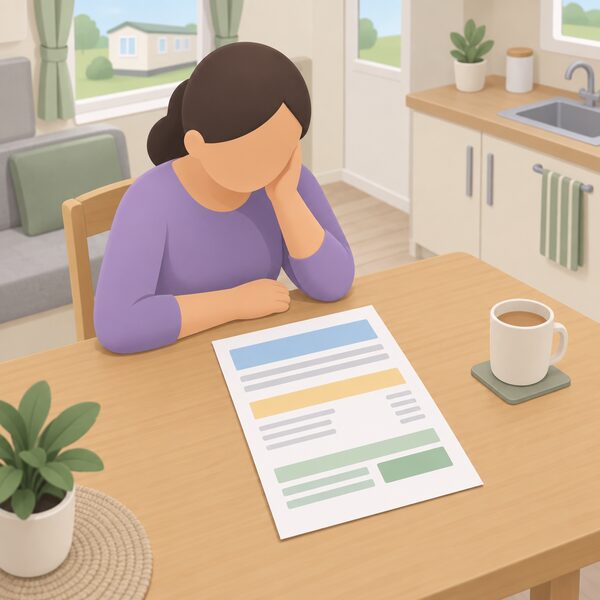
Where a household is struggling to pay for energy, or thinks it may get into difficulty, Ofgem's guidance is that the supplier can be asked to agree a payment plan, a payment break or a reduction, to review current payments and debt repayments, and to give access to hardship funds13. The same three options, a payment plan, payment break or reduction, appear in Ofgem's separate help pages7.
Suppliers are also expected to offer advice on more efficient use of energy that could help cut bills, according to nidirect's guidance for Northern Ireland consumers15. That is a support measure rather than a tariff change, and it applies alongside the payment options rather than instead of them.
For park home residents the sticking point is often who the supplier recognises as its customer. Where the household pays the site owner rather than an energy company, the supplier's payment-plan machinery is not directly available, because there is no account in the household's name. Ofgem's guidance for people supplied through a business contract sets out the checks to make before moving to such a home: who holds the energy contract, how energy charges are calculated, how much residents typically pay, whether charges are metered or estimated, whether the resident can choose a supplier or tariff, and whether it is possible to switch to a domestic contract2.
Where the household does hold its own account, the support route is straightforward. Ofgem's guidance on getting help with energy bills covers supplier schemes and grants, and the Welsh government's own cost-of-living pages sit alongside it for households in Wales14. In Northern Ireland, nidirect publishes separate advice for people struggling to pay energy bills15.
Complaining to your supplier or the Energy Ombudsman
The complaint route has a fixed order. The Energy Ombudsman's own instruction is to speak to the energy supplier first to raise a complaint, and if they cannot help, the Ombudsman will aim to fairly and impartially resolve the dispute17. Ofgem's guidance repeats the escalation point: a consumer can contact the Energy Ombudsman if they are not happy with the way the supplier has handled the complaint18.
The Ombudsman has real powers once a case is accepted. Where a mistake has been made or a consumer has been treated unfairly, it can require the supplier to put things right20. The outcomes available include practical action, such as crediting or cancelling an account or changing a tariff, an apology, a financial award, or a combination of these, and the Ombudsman may also make recommendations to prevent the issue happening again21.
Ofgem lists the kinds of problem that belong with the supplier in the first instance: late, incorrect or missing bills, back billing, being overcharged, a faulty meter, poor customer service, and refusing to refund credit from an account18. Where a household has its own contract with an energy supplier, it can follow the supplier's complaints procedure, with details on the bill or the supplier's website3.
Park home residents on a site owner's supply face a different position. Ofgem's alternative homes guidance states that residents who pay a landlord or site owner by meter readings or estimates cannot make a complaint directly to the energy supplier if they do not have a contract with them3. The complaint in that case is with the party that holds the contract, which is the site owner or landlord, not the energy company.
"Speak to your energy supplier first to raise a complaint, and if they can't help, we'll aim to fairly and impartially resolve your dispute"
Extra Help Unit: when Citizens Advice can take on your case
The Extra Help Unit is the part of the Citizens Advice service that steps into an individual case. It exists for consumers in vulnerable circumstances, by referral6. Its role is to support vulnerable consumers by raising complaints with energy suppliers on their behalf, particularly where there is a risk of disconnection or complex personal circumstances22.
The referral criteria are specific. The consumer service may refer a case to the Extra Help Unit where someone needs support with a difficult or urgent complaint, cannot deal with their energy supplier on their own because of personal circumstances, is considered vulnerable, or is at risk of being disconnected from an energy supply23. Where a case is referred, the consumer service adviser may be able to pass it to the Extra Help Unit, which can negotiate with the supplier on the consumer's behalf23.
There is a second, quieter route into support. Under the ECO4 flexible eligibility rules, one of the proxies for referral to a local authority is that a person in the household has been referred for support by their energy supplier or Citizens Advice because they are struggling to pay their electricity or gas bills24. That connects the advice service to energy efficiency funding as well as to complaint handling.
For a park home household, the Extra Help Unit matters most where the supply is at risk. A disconnection threat against a household that does not hold the contract is a harder case, because the unit negotiates with suppliers and the supplier's customer is the site owner. Where the household does hold the account, the referral route is open on the same terms as any other domestic consumer.
Checking supplier customer service before you switch
Supplier performance is published, and it is worth reading before a switch rather than after. Citizens Advice's star rating exists precisely to give consumers accessible information about supplier performance and to enable more informed switching decisions9. Energy UK directs households to accredited comparison sites or the Citizens Advice comparison tool for the same purpose8.
The mechanics of a switch are handled by the incoming supplier. The new supplier contacts the existing supplier, arranges the switch date and asks for a final meter reading25. Where a household stays with the same supplier but changes tariff, the switch can be done through the online account or via customer services25. Ofgem's switching guidance adds a compensation term: if the switch is not completed on time, the new supplier must pay the household £401.
For anyone moving into a park home, the checks come before the switch. Ofgem's list of pre-move questions covers who holds the energy contract, how energy charges are calculated, how much residents typically pay, whether charges are metered or estimated, whether the resident can choose a supplier or tariff, and whether switching to a domestic contract is possible2. Those answers determine whether a comparison site is any use at all.
What independence a park home household actually has

The energy independence of a park home household is set by the contract, not by the meter. Where the resident holds a domestic account, the position is the same as any other home: the household can switch supplier or tariff at any time, can ask for a payment plan, payment break or reduction, can escalate an unresolved complaint to the Energy Ombudsman, and can be referred to the Extra Help Unit where circumstances warrant it1.
Where the site owner holds the contract, the household depends on the owner for the price it pays, the tariff it sits on, and the route for any complaint. Ofgem's alternative homes guidance is explicit that a resident without a contract cannot complain directly to the supplier3. The dependence in that arrangement is not the grid, which serves the home either way, but the intermediary: the site owner sets or passes through the charge, and the household has no direct relationship with the company generating the bill.
The wider policy context points the same way. Citizens Advice has argued that upgrading 13 million inefficient homes to EPC C could save consumers £24 billion on energy bills, a figure about the housing stock rather than about switching26. The government's consultation on a Home Energy Advice service describes a single-entry point for consumer home energy advice on GOV.UK, helping homeowners, landlords and tenants find tailored, impartial and trusted advice on how to heat their homes and make them more energy efficient27. Both are about reducing the size of the bill rather than changing who sends it.
For a park home resident, the practical sequence is to establish who holds the contract, then use the routes that follow from that answer. Where the household holds it, switching, complaint escalation and hardship support are all available. Where the site owner holds it, the household's leverage runs through the owner, and the advice services can explain the position but cannot transfer a supply they do not control.
Sources27 cited
- Switch your home energy supplier, Ofgem, 2026
- If you live in a home with a business energy contract, Ofgem, 2026
- Alternative homes energy guidance, Ofgem, 2026
- Energy terms explained, Ofgem, 2026
- Consumer protection rights, GOV.UK, 2026-09-17
- Heat networks regulation: consumer protection guidance decision, Ofgem, 2026-01-13
- Getting help if you can't afford your energy bills, Ofgem, 2026-09-17
- Switching supplier, Energy UK, 2023-03-12
- Energy supplier rating decision document, Citizens Advice, 2020-01-31
- Kept in the dark: the urgent need for action on prepayment meters, Citizens Advice, 2023-01-11
- Check energy suppliers can install prepayment meters without household permission, Ofgem, 2026
- Installing a prepayment meter without your permission, Ofgem, 2026
- Get help for your home or business energy bills, Ofgem, 2026
- Get help with your energy bills, Ofgem, 2026-09-17
- Advice if you're struggling to pay your energy bills, nidirect, 2026
- Help with household costs, Isle of Anglesey County Council, 2026-09-20
- Facilitated complaints resolution, Energy Ombudsman, 2026-09-20
- Complain about your energy supplier or network operator, Ofgem, 2026
- Understand your electricity and gas bills, Ofgem, 2026
- Understanding your rights, Energy Ombudsman, 2026-09-20
- What to expect, Energy Ombudsman, 2026-09-19
- Worried about your energy bills, Energy Ombudsman, 2026-03-24
- If you've been told your energy supply will be disconnected, Citizens Advice, 2026-09-17
- ECO flexibility funding, Ceredigion County Council, 2026-09-17
- How to check your energy tariff and switch if you find a better deal, British Gas Energy Trust, 2026-07-30
- Impacts of the gas crisis on households and businesses: response, Energy Saving Trust, 2026-04-22
- Reforming consumer protection for home upgrade schemes, GOV.UK, 2026-06-17
 Rented Homes and Landlord MetersWho is responsible for the energy in your rented home?
 Switching SupplierHow long does switching energy supplier actually take, and what happens if you owe money?
 Suppliers and IndependenceCan you really cut your energy bills by making your own power, and how much of your supplier do you still need?
 Back Billing RulesCan a supplier really charge you for energy you used years ago?
 Moving Home Energy AccountsMoving home means you get a new energy supplier whether you choose one or not, so who supplies your new place and what happens to your old account?
 Prepayment Meters and DebtCan your energy supplier force you onto a prepayment meter because you owe them money?