

In this guide
Anyone who pays a supplier directly for the gas or electricity used at home can choose to switch to a different supplier or tariff at any time1. The switch itself is a paperwork exercise: the new supplier manages the transfer, contacts the outgoing supplier, agrees a switch date and asks for a closing meter reading. Suppliers must move an electricity or gas supply from the old supplier to the new one within five working days1. Nothing physical changes. Switching supplier does not change the energy arriving at the property, only who is paid for it, so no pipes or cables are altered and the supply is not interrupted2.
To start, a household needs very little: postcode, the name of the current supplier, the name of the current tariff, the unit price paid per kilowatt hour and the amount of energy used each year1. Most of that sits on a recent bill or in an online account4. The question worth answering before anything else is which tariff the household is on now, because that determines whether an exit fee applies and how much room there is to move.
The limit of the exercise should be stated plainly. Switching changes the commercial relationship, not the household's dependence. The gas and electricity still come through the same network, the same meter and the same supply licence system, and the price on a variable tariff still moves with the price cap. What switching buys is control over which rates apply and for how long.
What switching changes, and what it leaves untouched
The supply is unaffected on both fuels when a switch takes place3. The transfer is handled entirely by the supplier being moved to, under the Energy Switch Guarantee, which also describes switching to a new tariff within five working days whether the change is to a new supplier or a new tariff with the existing one7. There is technically no limit to how many times a household can switch3.
What does not change is the physical apparatus and the household's reliance on it. Only the current supplier can move a meter: to have another supplier do it, the supply must be switched to them first8. A smart meter cannot normally be swapped back for a traditional one either.
Regulator research found considerably more consumers claiming to be on fixed tariffs (38%) than the official data suggests (11%). Among those who say they are on a fixed electricity tariff, 55% report being "very confident" this is the case, while 38% say they are only "somewhat" confident9.
If a supplier fails, no action is required from the customer: the regulator moves the account to a new supplier automatically and the supply is not interrupted1. A household on a Green Deal loan can change electricity supplier only where the new supplier takes part in the Green Deal scheme10.

Fixed or variable: which tariff you are on now, and how to tell
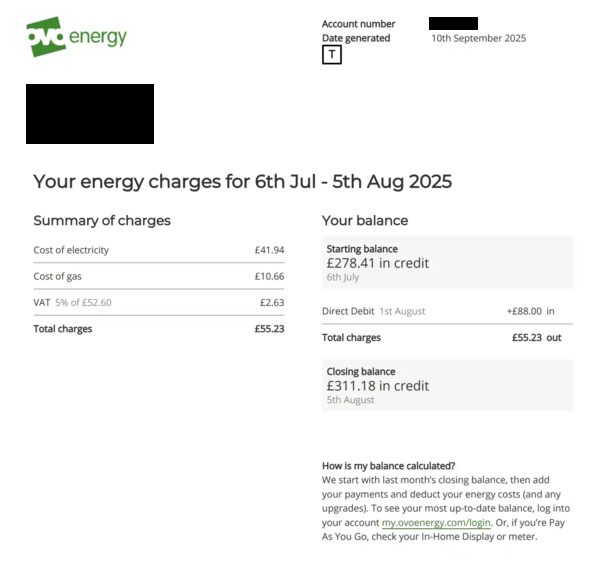
The tariff name and details appear on the latest bill or statement, or in a supplier app or online account11. A household is probably on a standard variable tariff if it has never switched supplier, has not switched for a year or more, has had a fixed deal end, or if the tariff name contains words such as "Simpler", "Flex", "Basic", "Standard" or "Variable"12.
On a variable tariff the unit rate can change at points in the year, influenced by the price cap13, and the default variable rate is determined by the energy price cap and changes every three months14. More bluntly, suppliers "can change prices whenever they like for any reason"15, though a supplier increasing prices should tell customers in a reasonable amount of time before the change takes effect5. A variable rate is simply what the supplier decides to charge per unit16.
Households are frequently wrong about which they are on. Regulator research found considerably more consumers claiming to be on fixed tariffs (38%) than official data suggested (11%); among those saying they were on a fixed electricity tariff, 55% were "very confident" and 38% only "somewhat" confident9. That gap between belief and record is wide enough that confidence alone is no guide. Checking the latest bill, which carries the tariff name and the annual usage, is the only reliable answer.
Fixed tariffs: what is locked in and what still varies
On a fixed tariff the unit cost of energy and the daily standing charge are fixed; the amount charged still depends on how much energy is used, multiplied by that unit cost, plus the daily fee5. A fix locks in unit rates and standing charges, not the total bill, which changes with consumption17. Fixed and standard variable tariffs share one feature: energy costs the same at any time of day13, unlike time-varying tariffs.
Fixed deals normally run a minimum of 12 months, and are commonly 12 to 24 months14. The trade-off is flexibility: a fixed deal usually ties the household in for a set period18. Most fixed tariffs include exit fees for each fuel, payable on leaving early19. Consumer understanding here is patchy: only 57% could identify that exit fees may still apply when moving to another deal with the same supplier9.
If a fixed tariff has already ended, switching supplier or tariff remains open at any time5.
What a fixed deal costs against the price cap
No single published saving figure exists, because fixed prices are quoted deal by deal by each supplier. What the evidence supports is a direction of travel: standard variable tariffs are described as the most expensive tariff an energy consumer can be on, with fixed rates usually the cheapest20, and a supplier moving a household onto its standard variable tariff at the end of a fix moves it onto a rate that is typically higher than fixed rates21.
Comparisons should weigh unit rates and standing charges, whether prices are fixed or can change, the length of any fixed term, the payment methods available, customer service and support, and any additional benefits or incentives11. A fixed rate is only worth taking where it is no more than 40% more expensive than the current price cap, on one independent assessment20.
Separately, and for households willing to shift their usage rather than simply change rates, regulator modelling estimates that those who do not generally use electricity at peak times of 4pm to 7pm could save over £200 a year by moving from the price cap to a tariff whose price changes through the day22. That is a different proposition from a fixed deal and depends on being able to move consumption.
Exit fees and the 49-day penalty-free window
An exit fee may be payable to a previous supplier where a fixed rate tariff was left before it ended1. The exception is the run-up to the end date.
| Situation | Exit fee position |
|---|---|
| Final 49 days of a fixed contract | No exit fee; free to switch23 |
| First 14 days of a new contract (cooling-off) | No exit fee3 |
| Standard variable tariff | No exit fee, free to switch24 |
| Supplier has failed | Switch without exit fees, even from a fixed contract25 |
| Mid-term on a fixed deal with fees | Fee payable per fuel19 |
The 49-day rule is consistent across the sources: a provider cannot charge exit fees if a switch happens within 49 days of the current deal ending26, described elsewhere as 49 days or seven weeks23, and customers are entitled to switch from 49 days before the end of their contract27. Suppliers should not charge any exit fees from 49 days before the plan end date28.
Fees change behaviour. In regulator research, 93% of consumers who thought they had an exit fee said they would take a deal with no exit fee, against 70% for a deal carrying a £300 exit fee9. A supplier also cannot charge an exit fee to switch after it has said a switch may go ahead5.
When a fixed deal ends, the rollover is automatic

Nothing needs to be done for a fixed deal to end badly. The supplier automatically moves the account onto its standard variable tariff when the fixed deal ends5, and that tariff is generally more expensive12. Customers who do not sign a new deal are rolled onto the supplier's standard variable tariff27; some suppliers may instead offer the chance of another fixed deal17.
The warning is built into the rules. A supplier is required to contact a fixed-term customer 42 to 49 days before the end date, saying the tariff is ending6, and that obligation is described elsewhere as notice 49 to 42 days before23. A supplier should also remind customers when a contract is about to end5. Treating the switch as a habit every 12 to 18 months keeps the account off the default rate27.
Moving home: the tariff you inherit and the opening reading
On moving in, the household is automatically put onto a deemed contract with the property's existing supplier, on that supplier's default or standard variable tariff29. The move itself is an automatic switch to the new property's supplier, and the tariff will probably change30.
For a household already on a fixed deal at the old address, a supplier might allow the same contract and tariff to continue at the new home without a fee; if the contract is broken, the household goes onto a standard variable tariff at the new property29. The right to switch begins as soon as responsibility for the property begins, which when buying is after exchange of contracts31.
The practical sequence on moving day is short: identify the supplier, tell them the household has moved in, and submit meter readings, keeping photographs as evidence31. A meter reading is needed when switching suppliers, when moving, and where a supplier cannot take automated reads26. That opening reading is what separates the previous occupier's consumption from the new household's. Guidance on meter readings when moving home and on taking a meter reading covers the mechanics.
Where the home is supplied through a business contract, checks before moving in should cover who holds the energy contract, how charges are calculated, how much residents typically pay, whether charges are metered or estimated, whether the supplier or tariff can be chosen, and whether it is possible to switch to a domestic contract32. Moving into a home with a prepayment meter warrants contacting the supplier at least three days before moving in, to ask whether the meter needs resetting or a new key or card is required33.
Switching step by step, from quote to final bill
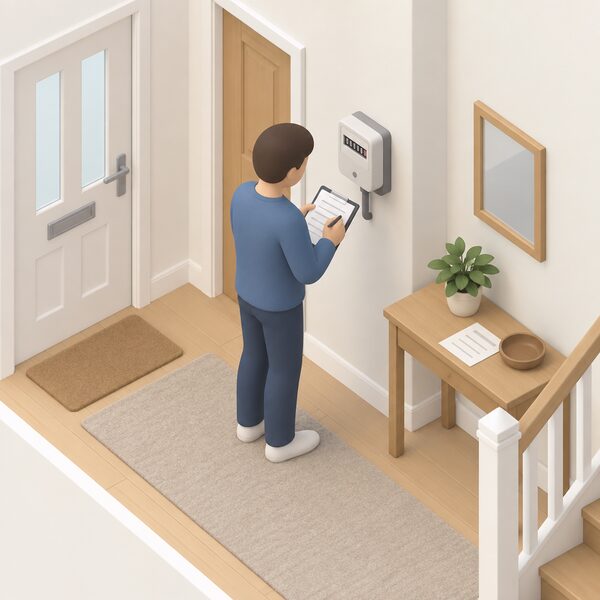
- Gather the details. Postcode, current supplier, tariff name, unit price per kWh and annual consumption1. Some comparison routes ask only for an address and a recent bill34, or postcode, plan name and a recent bill35.
- Check the exit fee position. Note the tariff end date and whether the account is inside the final 49 days23.
- Compare on rates, not headline claims. Unit rates, standing charges, contract length, payment methods and any incentives11.
- Confirm the switch with the new supplier. The new supplier manages the transfer36, contacts the existing supplier, arranges the switch date and asks for a final meter reading11.
- The cooling-off period runs. No exit fee can be charged for switching tariff during the 14-day cooling-off period at the start of the contract3.
- Take a reading on the switch date. A reading on the day of the switch is part of the process37.
- Settle the closing account. Any amount owed is added to the final bill from the old supplier, which should arrive within six weeks3. Credit on the account is refunded by the old supplier in the final bill, with possible compensation if it is not38; credit should be claimed back on switching2.
The whole transfer between tariffs or suppliers is handled by the supplier being moved to36, and the process should be completed within five days once the switch is confirmed35. Since April 2024, suppliers have five working days to move a household from the old supplier to the new14.
Who cannot switch, or cannot reach every tariff
Switching is straightforward for a household on a variable rate tariff, or one whose fixed contract is ending shortly4. Several groups face limits.
- Tenants whose landlord pays the supplier. They cannot switch supplier or tariff themselves; the landlord chooses the supplier and can be asked to change, but does not have to41. Tenants who pay the supplier directly can switch, including with a prepayment meter41. See switching supplier if renting.
- Residents on a landlord's business contract. They may not have the right to choose their own supplier or switch themselves32.
- Prepayment customers in debt. Switching is blocked above £500 owed for gas or £500 for electricity40; below that, the debt can be repaid to the new supplier [10 words apply: see below]42.
- Economy 10 households. At least one comparison service does not support Economy 10 switching, directing customers to approach suppliers directly19.
On prepayment debt, Ofgem puts the threshold at up to £500 owed per meter1, and independent guidance agrees that switching is possible while debt to the current provider is under £50043. Being on a prepayment meter does not in itself prevent switching tariff or supplier, and tenants responsible for the bills keep the right to switch33. Where the account debt is settled, a supplier may be able to change a prepayment meter to a credit meter19; some suppliers install a new meter free, but in most cases a credit check or a refundable deposit is required, and private tenants who are the bill payer have the right to change payment method33. Further detail sits on switching supplier with a prepayment meter and debt.
Smart meters are not an obstacle. People with a smart meter can switch supplier and tariff in exactly the same way as anyone with a traditional meter13, and many prepay customers can switch supplier while keeping their smart meter, with the supplier able to change between credit and prepay modes without a whole new meter44.
Incentives, and what a switch will not do

Extra rewards for switching are unusual: a small cashback sum may occasionally be offered for moving to a specific supplier37. Some comparison services require only a postcode and tariff name to start30. Suppliers also offer advice on using energy more efficiently as a way of cutting bills45, which is a different lever from the tariff itself.
It is worth being clear about the ceiling. Aside from switching, a household does not control the tariff its supplier sets; what it can change is how much energy it uses. Rates, standing charges, cap movements and end-of-contract rollovers all remain in the supplier's and the regulator's hands. Reducing demand, and where possible shifting it, is the part of the bill a household actually owns. The wider sequence is set out in taking more control of your home's energy and in the home energy how-to guide.
Northern Ireland works to different tariff rules
Northern Ireland's domestic electricity market is governed separately. Under a 2022 ministerial direction, each licensed electricity supplier "shall not set a new Tariff or revise an existing Tariff for any Consumer to take effect on a day other than a quarter day" without the written consent of the Secretary of State46. The effect is that tariff changes there are pinned to fixed points in the calendar rather than being made at any time. Support for households struggling to pay in Northern Ireland includes suppliers offering advice on more efficient energy use to help cut bills45. The switching process described above reflects Great Britain's arrangements, and households in Northern Ireland should expect their supplier's tariff timetable to differ.
Sources46 cited
- Switch your home energy supplier, Ofgem, 2026
- Getting the best energy deal, Age UK, 2026-09-10
- How to switch energy supplier, Confused.com, 2025-12-15
- How to read your energy bill, Confused.com, 2025-12-15
- Your gas or electricity supplier has put up its prices, Citizens Advice, 2026-09-17
- How to complain about your energy bill, Which?, 2026-07-30
- Energy Switch Guarantee, Energy UK, 2026-07-08
- Move your gas or electricity meter, Citizens Advice, 2026-09-20
- Understanding consumers' energy tariff choices: research report, Ofgem, 2025-07
- Green Deal: energy saving measures, GOV.UK, 2026-09-17
- How to check your energy tariff and switch, British Gas Energy Trust, 2026-07-30
- Standard rate tariffs explained, Uswitch, 2026-08-26
- Energy flexibility, Smart Energy GB, 2026-03-16
- How to switch energy supplier, Which?, 2026-05-15
- Fixed and variable tariffs: what's the difference, Energy Helpline, 2026-09-20
- Fixed rate tariffs and switching, Home Energy Scotland, 2024-02
- Fixed energy tariffs, Uswitch, 2026-09-07
- Switching your energy supplier, Energy Saving Trust, 2026-06-26
- Energy tariffs explained, Uswitch, 2026-02-17
- Average gas and electric bills in the UK, Energy Helpline, 2026-09-20
- How to understand your electricity and gas bills, Energy Ombudsman, 2025-04-24
- Smart Meter Guaranteed Standards of Performance draft impact assessment, Ofgem, 2025-08
- How do I avoid exit fees when switching energy, Energy Helpline, 2026-09-20
- Great Energy Savings Switch FAQs, Uswitch, 2026-09-19
- Electricity-only tariffs, Confused.com, 2026
- Understanding energy bills, StepChange, 2026-09-20
- When is the best time to switch my energy deal, Uswitch, 2026-08-26
- How do I read my OVO Energy bill, Uswitch, 2025-09-10
- Moving home: dealing with your energy supply, Citizens Advice, 2026-09-20
- Who supplies my electricity and gas, Uswitch, 2026-06-29
- A step-by-step guide to setting up gas and electricity in a new home, Energy Helpline, 2026-09-20
- If you live in a home on a business energy contract, Ofgem, 2026
- Prepayment meters, Centre for Sustainable Energy, 2025-08
- Gas and electricity comparison, Confused.com, 2026
- Types of energy tariff, Confused.com, 2025-11-03
- Switching supplier with a smart meter, Smart Energy GB, 2026-03-16
- What happens to credit if I switch, Uswitch, 2026-05-29
- How your electricity or gas bill is calculated, Ofgem, 2026
- You've been switched to a new energy supplier without your agreement, Citizens Advice, 2026-09-17
- If you can't afford to top up your prepayment meter, Citizens Advice, 2026-09-17
- Switching energy supplier if you're a tenant, Citizens Advice, 2026-09-17
- What happens if your energy supplier goes out of business, Ofgem, 2026
- Gas and electricity switching, Uswitch, 2026-09-17
- How to use a smart meter in prepay mode to save money, Smart Energy GB, 2026-08-17
- Advice if you're struggling to pay your energy bills, nidirect, 2026-09-17
- Energy Price Guarantee for domestic electricity consumers in Northern Ireland: direction, GOV.UK, 2022-12-19
 Switching SupplierHow long does switching energy supplier actually take, and what happens if you owe money?
 The Full How To GuideSwitching supplier, sending meter readings, sorting an EPC, claiming a grant, complaining when something goes wrong, coping in a power cut: where do you start with any of it?
 What Makes Up a BillBreaks a domestic energy bill into wholesale costs, network charges, policy levies, operating costs, supplier margin and VAT, with the share each takes and how those shares have moved since the energy crisis.
 Comparison Sites and BrokersWhich energy comparison sites can you trust, and what happens if a switch goes wrong?
 Moving Home Energy AccountsMoving home means you get a new energy supplier whether you choose one or not, so who supplies your new place and what happens to your old account?
 Final Bills and Credit RefundsHow final bills and credit refunds work when you leave an energy supplier: the six-week deadline for the final bill, the ten-working-day deadline for refunding credit, the twelve-month back billing limit, and the automatic compensation that applies when suppliers miss these standards.