

In this answer
Short answer
Switching energy supplier gives a household a 14-day cooling-off period, a window in which the new contract can be cancelled without penalty. Ofgem states plainly that if you change your mind, you can cancel your switch within 14 days1. The same 14 days appears across consumer guidance: the period runs from sign-up, and cancelling inside it carries no exit fee2.
The cooling-off period is not a pause before the switch happens. The new supplier takes over the account while the 14 days run, and cancelling inside the window returns the supply to the old supplier. Under the Energy Switch Guarantee, signed by most suppliers, the switch itself is completed within five working days from the end of the cooling-off period4. One consumer guide puts the whole process at up to three weeks including the two-week window5.
What the cooling-off period does for a household is limited but real: it is a right to reverse a decision, not a route to independence. The supply still comes through the same wires and pipes, from whichever supplier holds the account, and the gas still arrives through the same network. What changes is the contract, the price and the terms.
The cooling off period: 14 days to cancel without penalty
The 14-day cooling-off period is a statutory right, not a courtesy. It came in with the Consumer Contracts (Information, Cancellation and Additional Charges) Regulations, which came into force on 13 June 2014 and brought a 14 calendar day cooling-off period for gas and electricity consumers8. Consumer guidance describes it as the 14 days after signing up for a new energy deal within which cancellation is allowed9, and as a two-week window giving 14 days to cancel a contract without giving a reason3.
The right applies to switches made online, by phone or at the doorstep, and cancellation inside the window carries no penalty7. Where the agreement was made at home or in a public space such as a shopping centre, the same 14 days applies and no reason need be given10. The period is not confined to domestic doorstep sales: it attaches to the switch itself.
One procedural point matters if a household leaves cancellation late. A notice of cancellation sent at any time during the cooling-off period is valid even if it is actually received by the trader after the 14 days have expired8. The act of sending inside the window is what counts, not the moment it lands.
"By law you have a 14 day cooling-off period to change your mind without incurring a penalty."
What the window does not do is cancel the energy used. One supplier states that a customer who chooses to start being supplied during the cooling-off period is responsible for all costs of energy used and other services during that period12. The supply continues; only the contract is reversible.

When the 14 days begins, and the one-day disagreement

The start date is where the guidance is not perfectly aligned. Several sources describe the period as running from sign-up or from the moment the switch is confirmed. One consumer guide calls it the standard 14-day cooling-off period from sign-up13, and another says the period begins once the switch has been confirmed online or by phone3. A maker's guidance puts it as running from when the switch request is submitted, described as the day the contract is agreed14.
Other sources put the start a day later. Guidance on the 14-day window a supplier must allow describes it as running from the day after the contract is agreed15, and a consumer body says the period starts the day after a contract is set up with the new supplier2. Guidance on cancellation rights for work done in the home uses the same construction: the cooling-off period begins the day after the go-ahead is given16.
The practical difference is one day. A household counting 14 days from the confirmation message and a household counting from the following morning will disagree by a single day, which matters only at the very edge of the window. Both figures stand: the period is 14 days, and its start is described as either the day of confirmation or the day after.
Cooling off and fixed deals: does the tariff type matter
The tariff type does not change the cooling-off right. A fixed energy deal carries a two-week cooling-off period with free cancellation17, and a fixed deal inside its first 14 days is inside the cooling-off period and can be cancelled18. No exit fee can be charged if a tariff is switched during the 14-day cooling-off period at the start of the contract6. A dual fuel tariff carries the same protection: there is still a cooling-off period when it is free to cancel19.
What differs is what happens after the window closes. A fixed rate tariff locks in prices for a set time, normally a minimum of 12 months20, with fixed deals typically running 12 months21 and fixed energy tariffs usually 12 to 24 months15. One guide describes a switching habit of every 12 to 18 months9. Once the cooling-off period has passed, leaving a fixed deal early can mean an exit fee; a fixed dual fuel deal switched after the 14-day window may carry one19.
| Tariff type | Cooling-off period | Exit fee inside the window | Typical term |
|---|---|---|---|
| Fixed | 14 days, free cancellation17 | None6 | 12 months21, 12 to 24 months15 |
| Dual fuel | 14 days, free to cancel19 | None6 | Set by the tariff |
| Fixed, cancelled late | Window has closed | May apply19 | 12 to 24 months15 |
Two things sit outside the tariff question. Switching supplier does not change a Feed-in Tariff payment rate22, and switching to any energy tariff is described as simple, without power outages, and typically taking just a few days23. Neither affects the cooling-off right, but both bear on what a household is weighing up when it decides whether to cancel.
How long the whole switch takes, cooling off included
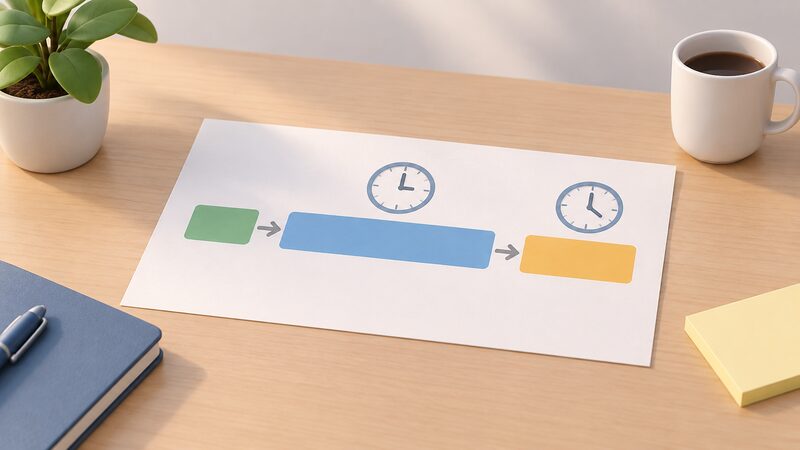
The switch has two clocks. The first is the cooling-off period, 14 days. The second is the transfer itself. Ofgem states that suppliers must switch electricity or gas supply from the old supplier to the new one within five working days1, and Welsh trading standards guidance gives the same figure, with the new supplier providing a date16.
Under the Energy Switch Guarantee, the switch occurs within five working days from the end of the cooling-off period24. The guarantee promises no interruption to supply, and a return to the old supplier if the customer changes their mind within 14 days4. It also covers the money: the old supplier refunds any credit due within 14 days of the final bill7. Previously, the switching process took 21 days4.
Put together, the sequence runs: confirm the switch, 14 days of cooling-off, then up to five working days for the transfer. One consumer guide describes the whole thing as taking up to three weeks including the two-week cooling-off period5. A switching service gives a total of 17 days for the account to be switched over, including a two-week cooling-off period25. A news report describes switching as taking a few minutes to arrange and only five working days to complete26, and a 2021 report attributed to Ofgem gave an average switching time that did not include the 14-day cooling-off period27.
Ofgem's own research on cooling off found that respondents tended to be satisfied when switching took four weeks or less, as this is generally what they expected25. That is a useful benchmark: a switch that runs to three weeks is inside the range households regard as normal.
What the Energy Switch Guarantee adds
The Energy Switch Guarantee is an industry commitment, and most suppliers are signed up to it9. Its terms are specific. The switch should take no longer than five working days4, and most suppliers that comparison services work with adhere to it, promising to complete switches within five days5. It also makes it possible to switch to a new tariff within just five working days19.
The guarantee's protections extend beyond speed. There will be no interruption to the energy supply, and a customer who changes their mind within 14 days can return to the old supplier4. The credit position is covered too: the old supplier refunds any credit due within 14 days of the final bill7. One supplier states its own version of the promise directly: a 14-day cooling-off period to cancel the contract if the customer changes their mind, and a switch occurring within five working days from the end of that period24.
For a household, the guarantee is what turns the cooling-off right into something usable. Without it, a cancellation inside 14 days would still leave the question of how quickly the supply returns and what happens to any credit balance. With it, the return route and the refund window are both defined. The guarantee does not remove the dependence on a supplier, a network and a meter; it sets the terms on which the account moves between them.
Where the cooling-off right ends
The right is bounded. After 14 days the contract stands, and cancelling means switching again rather than reversing. On a fixed tariff that second switch can carry an exit fee, which is why the window matters most at the start of a fixed term19. The cooling-off period is a one-time reversal right attached to the agreement, not an ongoing right to leave.
It also does not touch the physical supply. The gas and electricity continue to arrive through the same network regardless of which supplier holds the account, and the meter does not change because of a cancellation. What a household controls through the cooling-off period is the contract and the price, not the infrastructure. The Energy Switch Guarantee sets the switching terms; the exit fees rules govern what leaving costs after the window closes; and the wider question of cancelling a switch without penalty sits alongside this page. For the full picture of who supplies UK homes and how the market is structured, the energy suppliers guide is the starting point.
Sources27 cited
- Switch your home energy supplier, Ofgem, 2026
- Getting the best energy deal, Age UK, 2026-09-10
- The Great Energy Savings Switch: FAQs, Uswitch, 2026-09-19
- Gas only energy, Uswitch, 2026-09-07
- Switch energy supplier, EDF, 2026
- How do I avoid exit fees when switching energy, Energy Helpline, 2026-09-20
- Best deal energy, Home Energy Scotland, 2026-09-20
- Cooling off report, Ofgem, 2016-12
- When is the best time to switch my energy deal, Uswitch, 2026-08-26
- Dealing with your energy supplier, Centre for Sustainable Energy, 2026-01
- Energy Switch Guarantee, Uswitch, 2026-09-20
- Cooling off background paper, Ofgem, 2014-10
- How to compare dual fuel tariffs, Confused.com, 2025-11-03
- OVO faster switching policy, OVO Energy, 2026-09-19
- How to switch energy supplier, Which?, 2026-05-15
- Cancelling building or decorating work, Citizens Advice, 2026-09-17
- Fixed energy deal, Fuse Energy, 2026-05-12
- Fixed energy, Uswitch, 2026-09-07
- Dual fuel, Uswitch, 2026-09-18
- Gas and electricity, Confused.com, 2026
- How to switch energy supplier, Confused.com, 2025-12-15
- Feed-in Tariff, Uswitch, 2026-07-13
- EV energy tariffs, Uswitch, 2025-09-17
- Energy: your questions answered, Confused.com, 2026-07-03
- Energy bills rise today: here's what to do, Uswitch, 2026-07-01
- Three weeks to switch energy supplier to avoid record price rises, Which?, 2021-09-17
- Problems with services, Isle of Anglesey County Council, 2025-10
 Switching SupplierHow long does switching energy supplier actually take, and what happens if you owe money?
 Switch Energy SupplierThe practical sequence of a domestic energy switch: the details and readings needed, the five working day transfer, cooling-off periods, exit fees and the final bill.
 Final Bills and Credit RefundsHow final bills and credit refunds work when you leave an energy supplier: the six-week deadline for the final bill, the ten-working-day deadline for refunding credit, the twelve-month back billing limit, and the automatic compensation that applies when suppliers miss these standards.
 Installation ContractsCan you cancel a solar panel or boiler contract after signing?
 Fixed-Rate Energy TariffsWhat a fixed energy tariff fixes and what it does not, the contract lengths sold in the UK, exit fees and the 49-day window, how fixed rates compare with the price cap, and what happens when the term ends.
 Supplier Licensing and FailureWhat happens when your energy supplier goes bust?