

In this answer
Short answer
An exit fee is the amount charged by an energy supplier when a household leaves a contract early. It applies to fixed tariffs, and it is payable if the switch happens before the deal reaches its final 49 days1. Leave inside that window and nothing is charged; leave before it and the fee stands.
The charge is per fuel, not per household. A dual fuel customer on a fixed deal can be charged for both gas and electricity, so a tariff listing £50 per fuel becomes £100 across the account2. Reported levels run from around £25 to £30 per fuel at the lower end up to £100 per fuel, with some fixed tariffs carrying fees as high as £250 per fuel1.
The 49-day rule is the single most useful thing to know. It is set by the regulator rather than by the supplier, so it applies whatever the tariff's own small print says about early termination4. Everything else, the amount, whether it is charged once or twice, and what happens on a house move, follows from that window.
What an exit fee is and when it applies
An exit fee is the amount charged by a supplier if a household wants to leave its contract early1. It exists because a fixed tariff is a forward purchase: the supplier buys energy ahead at a set price for a set period, and breaking that arrangement early leaves the supplier holding a position it priced on the assumption the customer would stay. The fee recovers part of that.
The charge is payable if the fixed deal is left before it reaches its final 49 days6. Fixed deals vary in whether they carry one at all. Some come with exit fees payable on early departure, and the terms are worth checking before signing rather than after8. One supplier's Simply Fixed product states plainly that exit fees apply9, while the Energy Switch Guarantee, a switching standard, notes that a fee may apply where a customer on a fixed tariff leaves before the contract ends10.
The scale of the charge matters to behaviour. Ofgem's research on tariff choices found that a £50 exit fee reduced the share of consumers choosing an otherwise optimal deal to 81%, and that a £300 fee cut it to 61%6. The fee is not a trivial line for most households.
What the fee does for energy independence is limited but real: it is the price of the flexibility to move. A household that fixes gains price certainty for a term and gives up the right to leave cheaply during that term. The dependence that remains is on the contract itself, and on the supplier's willingness to apply the waiver correctly when the window opens.
The 49-day rule: when you can switch without paying

The rule is simple and it is the one to remember. A supplier cannot charge exit fees if the switch happens within 49 days of the current deal ending4. The same window is described across the guidance as the last 49 days, or seven weeks, of the contract1. Inside it, a fixed deal can be left without paying any exit fees11.
The window is not a supplier concession. It is a regulatory floor, so it applies even where the tariff's own terms describe an early termination charge3. Guidance from a consumer body puts it as a right: in the last 49 days of a fixed-term contract, no exit fee is payable and the household has the right to switch freely without being charged8.
Timing the switch is therefore the whole exercise. If a fixed deal is left before the final 49 days, an exit fee will probably be payable12. If the switch is not inside the last 49 days, exit fees are likely to apply13. The practical consequence is that a household wanting to move without charge waits until the window opens, then starts the switch.
"Your provider cannot charge exit fees if you switch within 49 days of your current deal ending."
The window also shapes what a household should expect from the switching process itself. A switch begun inside the final 49 days proceeds on the normal timescale, and the new supplier's own onboarding runs from there. There is no separate notice period to serve on the old supplier to escape the fee; the 49-day clock is the only one that matters.
Typical exit fee amounts: £25 to £100 per fuel
Reported exit fees vary widely, and the range across the guidance is wide enough that a household should read its own tariff rather than assume a figure. At the lower end, exit fees generally tend to cost around £25 to £30 per fuel, depending on the supplier1. One consumer body reports fees from £0 to £50 per type of fuel14.
At the upper end, many exit fees are still as much as £100 per fuel, so a dual fuel deal could cost considerably more than a single-fuel one6. Fixed energy tariffs often carry exit fees of £100 per fuel for leaving before the end of the contract, and exit fees are typically £100 or more5. One independent source reports fees of at least £50 per fuel and sometimes as much as £2503, while another reports a range of £50 to £400 on affected fixed tariffs15.
One source gives £250 per fuel as the upper figure and another gives £200 per fuel, and that conflict is unresolved. Both are reported here rather than reconciled.
| Reported exit fee | Per fuel | Source type |
|---|---|---|
| £25 to £30 | per fuel | independent guidance1 |
| £0 to £50 | per type of fuel | independent guidance14 |
| £100 or more | per fuel | independent guidance5 |
| £50 to £250 | per fuel | independent guidance3 |
| £50 to £400 | per fuel | independent news15 |
The spread reflects genuine differences between tariffs rather than disagreement about a single market rate. A supplier pricing a long fixed term with a large forward purchase behind it has more to recover than one pricing a short term. For a household, the fee is a known number printed in the tariff terms, and it should be read alongside the term length and the unit rate rather than in isolation.
Dual fuel: one fee or two?

A dual fuel tariff supplies gas and electricity from the same supplier on one account, and the exit fee is charged per fuel rather than per account. A household on a dual fuel tariff that leaves early might have to pay an exit fee for both gas and electricity1. On a fixed term dual fuel tariff, an exit fee is payable for both types of energy if the deal is left early16.
The arithmetic is straightforward once the per-fuel figure is known. One supplier's Flexi Price tariff lists an exit fee of £50 per fuel7. A sample bill for another supplier's fixed plan shows exit fees of £50 per fuel for electricity and gas, charged if the customer switches before the final 49 days of the contract2. A tariff quoted at £50 per fuel therefore costs £100 to leave across a dual fuel account.
Some dual fuel deals carry much larger figures. Exit fees on dual fuel deals can be hundreds of pounds per fuel, which is why the small print is worth reading before signing17. The maker of one dual fuel product notes that switching before the current deal is up may attract an early exit fee18.
The per-fuel structure is the point to carry away. A household comparing a dual fuel tariff with two separate single-fuel contracts should compare the total exit exposure, not the headline figure, because a dual fuel deal doubles it. The dual fuel tariffs page sets out how the combined supply arrangement works more broadly.
Moving home with a fixed tariff
Moving house is the case where the fee most often does not apply, provided the tariff moves with the household. Guidance states that households usually do not pay an exit fee when they move house6. Where the tariff is transferred to the new property, exit fees do not apply19.
Supplier terms reflect the same position. One supplier's fixed tariff rules state that where a household moves house during the fixed term, no exit fees apply provided the tariff is transferred to the new property; the rates may change depending on the location of the new property, but the term remains the same20. An earlier version of the same supplier's terms adds a condition: a new fixed tariff taken at the new property may incur an exit fee for ending the previous fixed tariff early21.
That condition is the trap. The fee is avoided by transferring the existing contract, not by ending it and starting a new one. Where the old contract is ended instead, an early termination charge can still be raised, and guidance for households moving home notes that breaking a contract early can attract an exit fee22.
The practical sequence is to tell the supplier about the move before the supply is switched over, and to ask explicitly for the tariff to be transferred rather than closed. The take a fixed tariff when moving page covers the transfer mechanics, and the tariff when moving into a new home page covers what applies when the property is new to the household.
How to check whether your tariff charges one
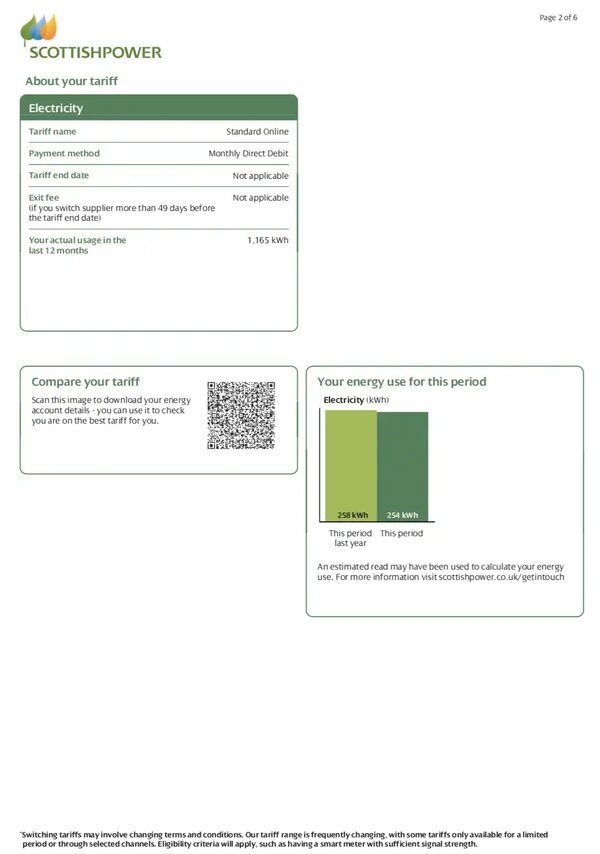
The tariff terms are the authority, and they are printed on the bill. A bill shows the tariff name, whether it is fixed or variable, the exit fees, and the unit rates and standing charges23. That single section answers the question without a call to the supplier.
Before changing anything, the exit fees, fixed-term conditions and any other charges that might apply should be understood24. Where a fee exists, it is worth comparing it with the savings the switch would produce, since moving to a cheaper tariff could still save money overall even after the fee is paid25.
The 49-day window is the other thing to check. A household can establish how many days remain by counting from the contract end date shown on the bill. If fewer than 50 days remain, no early exit fee can be charged26. The same exception is described in moving-house guidance: the fee usually does not apply if fewer than 50 days are left on the contract19.
That right sits alongside the 49-day rule rather than replacing it, and it turns on what was disclosed at the point of signing up. For households on a fixed deal generally, the exit fees and tariff contract terms page sets out how the charge sits within the wider contract, and the fixed-rate energy tariffs page explains what a fixed term does and does not fix. The switch supplier free on a fixed tariff page deals with the switching mechanics once the window is open.
Sources27 cited
- How do I avoid exit fees when switching energy, Energy Helpline, 2025
- Dual fuel tariffs, Uswitch, 18 September 2026
- Electricity only tariffs, Confused.com, 2026
- Understanding energy bills, StepChange, 20 September 2026
- Dealing with your energy supplier, Centre for Sustainable Energy, January 2026
- Understanding consumers' energy tariff choices, Ofgem, July 2025
- Which? energy survey results, Which?, 19 January 2026
- How to switch energy supplier, Which?, 15 May 2026
- Exit fees guide, Uswitch, 17 July 2026
- Energy Switch Guarantee, E.ON Next, 17 September 2026
- Gas and electricity switching, Uswitch, 17 September 2026
- Green energy tariffs, Confused.com, 3 November 2025
- Scottish Power price per kWh, Jackery UK, 29 April 2026
- How do I read my OVO Energy bill, Uswitch, 10 September 2025
- Avoiding the price cap, Act on Energy, 2026
- Dual fuel tariffs guide, E.ON Next, 17 September 2026
- How to compare dual fuel tariffs, Confused.com, 3 November 2025
- Moving house energy checklist, Energy Saving Trust, 1 May 2026
- Domestic EcoLoyalty 1 year Fixed Tariff July 2026 principal terms, Ecotricity, 2026
- Domestic EcoLoyalty 1 Year Fixed Tariff May 2026 principal terms, Ecotricity, 2026
- Energy bills support, British Gas Energy Trust, 11 August 2026
- Moving home: dealing with your energy supply, Citizens Advice, 20 September 2026
- Tariff watch, End Fuel Poverty Coalition, 20 September 2026
- How to check your energy tariff and switch, British Gas Energy Trust, 30 July 2026
- How do I read my E.ON Energy bill, Uswitch, 10 September 2025
- Switching your energy supplier, Energy Saving Trust, 26 June 2026
- Tenants' energy rights explained, Ofgem, 12 September 2013
 Exit Fees and Contract TermsExplains exit fees on fixed energy contracts, how they are charged per fuel, and the Ofgem switching window in which a supplier cannot apply them.
 Fixed-Rate Energy TariffsWhat a fixed energy tariff fixes and what it does not, the contract lengths sold in the UK, exit fees and the 49-day window, how fixed rates compare with the price cap, and what happens when the term ends.
 The Full Tariffs GuideWhich energy tariff suits how you live, and will switching really save you money?
 Final Bills and Credit RefundsHow final bills and credit refunds work when you leave an energy supplier: the six-week deadline for the final bill, the ten-working-day deadline for refunding credit, the twelve-month back billing limit, and the automatic compensation that applies when suppliers miss these standards.
 Dual Fuel TariffsExplains what a dual fuel tariff is, how discounts and single billing work, and where separate gas and electricity contracts remain available.
 Time-of-Use Tariffs ExplainedCan you pay less for electricity by using it at different times of day?