

In this answer
Short answer
Switching energy supplier does not interrupt your gas or electricity supply. Both should be unaffected when you move from one supplier to another, and there should be no interruption at any point in the process1. What changes is who bills you for the energy you use, not the pipes and cables that deliver it. There is no need to change any pipe or cable, and no break in supply3.
The switch itself is an administrative and billing event. Your new supplier manages it, contacts your existing supplier on your behalf, arranges the switch date and asks for a final meter reading4. Suppliers must complete a domestic electricity or gas switch within five working days5. Independent guidance gives the same maximum, and notes that a customer can ask to delay the date if a later start suits better1.
The reassurance holds for almost every household, including tenants who pay their own bills, prepayment customers on smart meters, and customers whose supplier has gone out of business. The exceptions are narrow and specific: physical work on the network, and the separate programme to replace meters that depend on the Radio Teleswitch Service.
What actually changes when you switch: billing and tariff, not pipes or wires
The physical network is untouched by a supplier switch. The same gas and electricity arrive at the same meter through the same connection. Switching supplier does not change the energy you receive at all, only who you pay for it, so there is no need to change any pipes or cables and no interruption to supply3. The wires and pipes belong to the distribution networks, which are regional monopolies and are not chosen by the household.
What does change is the commercial relationship. If you pay a supplier directly for the electricity or gas you use at home, you can choose to switch to a different supplier or tariff at any time5. That right applies equally to rented properties where the tenant pays the bills: if you have to pay your energy bills, you can choose to switch your supplier or tariff at any time5. Where a landlord or site owner bills residents by meter readings or estimates, the resident cannot switch suppliers themselves9.
Switching is simplest on a variable rate tariff, or where a current fixed rate contract is ending shortly10. To complete a switch, a supplier needs the name of your current supplier, the name of your current tariff, your energy use in kilowatt hours, how you pay now and how you would like to pay, and your postcode3.
The dependence that remains after a switch is real but unchanged by it: the household still relies on the same regional network, the same physical supply, and a supplier that must remain solvent and competent. Switching changes the counterparty, not the infrastructure.
The switch process step by step, and where delays can occur
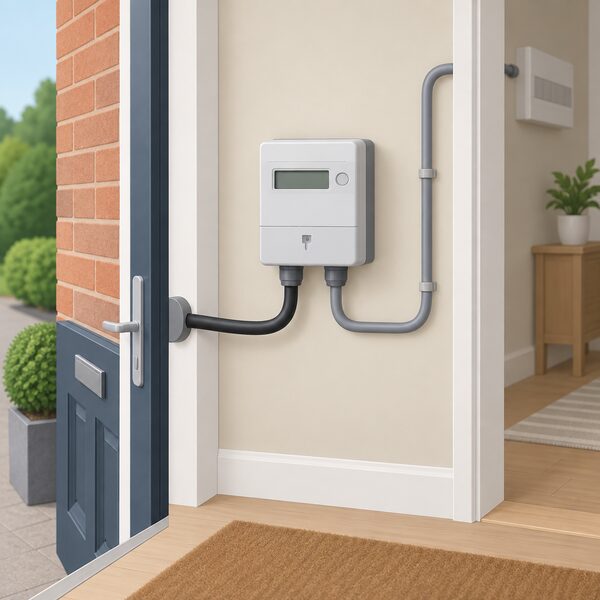
The process is short and largely invisible to the household. Your new supplier manages the switch, contacts your existing supplier, arranges the switch date and asks for a final meter reading4. The switch usually takes place within five working days8, and suppliers are required to complete it within that window5.
- Choose a tariff and supplier, and provide your current supplier, tariff, usage, payment method and postcode3.
- The new supplier contacts the old one, agrees a switch date and requests a final meter reading4.
- The supply transfer completes within five working days5.
- The old supplier issues a final bill; any credit is refunded and any balance is collected.
Delays are the exception rather than the rule, but they exist. One consumer body notes that the process of moving can take up to 21 days, and advises contacting the new supplier if it appears to be running long11. For context on how far the process has come, a 2014 consultation recorded that switching then took around five weeks, which it described as slow and a source of frustration and confusion for customers12. The five working day standard is the current position.
Where a switch involves a physical change rather than a change of billing, the timescale is different. Moving an electricity supply position requires the supply to be made dead first: a jointer disconnects, moves the supply and reconnects, usually taking an hour or two, with a morning or afternoon appointment agreed in advance13. That is network work, not a supplier switch.
Meter readings at the switch: avoiding estimated-bill disputes
The final meter reading is the hinge on which the whole switch turns financially. It closes the old account at a known point and opens the new one from the same figure. Your new supplier asks the old one for that reading as part of arranging the switch4.
Estimated readings are where disputes begin. Estimated readings can lead to large unexpected bills, so regularly submitting accurate readings matters14. The Energy Ombudsman has published a case study in which a supplier rebilled a disputed electricity bill of more than £2,200 down to £93.02 using actual meter readings, removed the balance and offered a £100 goodwill payment15. That case shows both how far an estimated bill can drift and how far it can be corrected with real readings.
Smart meters change the picture. With a SMETS2 meter, a household can switch energy suppliers without any interruption to its energy readings, bill payments or gas and electricity supply6. First generation SMETS1 meters behave differently: they could temporarily go dumb and lose their ability to send automatic meter readings after a switch17, and may have experienced some loss of smart functionality when switching18. A SMETS1 meter might lose some functionality for a short time on changing supplier19.
When a switch does involve work: smart meters and the Radio Teleswitch Service
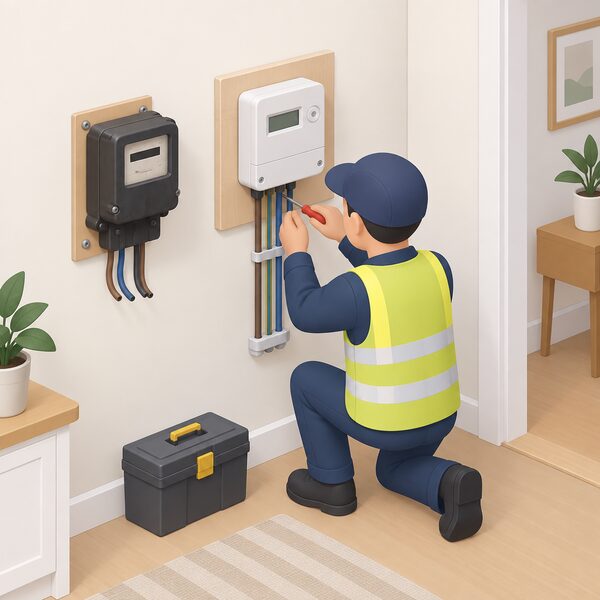
Most switches involve no visit and no work. Two situations do.
The first is the smart meter itself. A smart meter is not required to switch, but the meter's capabilities may not travel intact. You can switch suppliers if you have a smart meter, but your new supplier might not offer all the smart meter services, such as remote meter readings, and the meter may need replacing20. Where smart metering equipment does not work, Citizens Advice has recommended that suppliers be held accountable, closing the accountability gap between energy suppliers and the Data Communications Company, including changes to DCC contracts if required21.
The second is the Radio Teleswitch Service. RTS produces the radio signal to household meters that have off peak tariffs but are not smart meters. It sends signals by radio wave to switch between peak and off peak electricity rates and controls when heating and hot water systems turn on7. It is provided by your electricity supplier7. It is being decommissioned, and suppliers are required to proactively contact customers who use RTS meters to inform them about the upcoming switch-off date and the need to upgrade to a smart meter to avoid disruptions7.
Not every affected customer can be booked in immediately. There are situations where an electricity supplier will not be able to offer an appointment for a smart meter upgrade yet, and will get in touch when ready22. Households on RTS meters therefore face a genuine, dated dependence: the meter must be replaced, and the timing is partly in the supplier's hands.
Smart meters also carry a capability that cuts the other way. Suppliers are able to remotely switch off energy supply with smart meters, but only under very strict circumstances23. That is a power of last resort, not a routine tool of the switching process.
Will I be cut off if I have a debt with my current supplier?
Debt does not automatically block a switch, but it can. On a credit meter, you can switch energy supplier if you have been in debt for fewer than 28 days, because the money you owe will be added to your final bill8. Beyond that window, a supplier may object to the transfer, and the debt becomes a barrier until it is addressed.
Where a household is struggling, suppliers have obligations that run alongside the switching rules. Suppliers should review your current payments and debt repayments24. Prepayment debt is handled through a separate route, the Debt Assignment Protocol, which allows a prepayment customer to move supplier while carrying debt across.
The conduct of suppliers on prepayment has been the subject of sustained criticism. Moving a customer to prepayment required a court warrant, but courts were overwhelmed with applications and, according to the government, huge batches of disconnections were approved in minutes25. Regulators have since told firms to stop forcing energy customers onto prepayment meters25.
For prepayment customers who want to switch, the position is more workable than it once was. Many customers can switch supplier while keeping their smart meter26. The practical dependence for a prepayment household is the meter itself: a smart prepay meter can move with the customer, an older prepayment meter may not.
If something goes wrong: complaints and the Energy Ombudsman
Most switches complete without incident. Where one does not, the escalation route is well defined. The Energy Ombudsman provides an independent service, separate to Ofgem, for problems with an energy supplier, an energy broker, a network operator or a heat network supplier27. Consumers can complain to the Energy Ombudsman if the issue is not resolved to their satisfaction28.
The Ombudsman has real powers. If a mistake has been made or you have been treated unfairly, it can require the supplier to put things right29. It can tell suppliers to take practical action, such as crediting or cancelling an account or changing your tariff, to make an apology, or to offer a financial award, or a combination of these, and it may make recommendations to prevent the issue happening again30.
Switching disputes are within its scope. The Ombudsman will consider whether it was appropriate for a supplier to place a customer on a deemed rate contract, or whether supplier error or omission left the customer on high deemed contract prices for longer than necessary31. That matters where a switch has gone wrong and a household has been left paying default rates.
"If a mistake has been made or you have been treated unfairly, we can require the supplier to put things right."
The dependence that remains at this stage is procedural: the household relies on the Ombudsman scheme, on the supplier's cooperation with any award, and on the record of meter readings and correspondence it kept. For the wider picture of how suppliers are held to account, see complaining about an energy supplier and the Energy Ombudsman.
Sources31 cited
- How to switch energy supplier, Confused.com, 2025-12-15
- Energy: your questions answered, Confused.com, 2026-07-03
- Switching your energy supplier, Energy Saving Trust, 2026-09-10
- How to check your energy tariff and switch, British Gas Energy Trust, 2026-07-30
- Switch your home energy supplier, Ofgem, 2026
- Smart meters for landlords, Smart Energy GB, 2026-03-16
- Radio Teleswitch Service, Electricity North West, 2026-09-19
- Gas and electricity, Confused.com, 2026
- Alternative homes energy guidance, Ofgem, 2026
- How to read your energy bill, Confused.com, 2025-12-15
- Dealing with your energy supplier, Centre for Sustainable Energy, 2026-01
- Fast and reliable switching consultation, Ofgem, 2014-06-16
- Service alteration: what's involved, Electricity North West, 2026-09-20
- Struggling with energy bills, National Energy Action, 2026-05-06
- Estimated meter readings case study, Energy Ombudsman, 2026-07-29
- What is a smart meter, Smart Energy GB, 2026-08-10
- How do you know if you have a smart meter, Smart DCC, 2026
- Troubleshooting smart meter issues, Smart Energy GB, 2026-04-01
- Switching supplier with a smart meter, Smart Energy GB, 2026-03-16
- Problems with services, Isle of Anglesey County Council, 2025-10
- The state of smart consumer experiences of smart meters, Citizens Advice, 2026-02-03
- RTS meters, National Energy Action, 2026-07-08
- Can a smart meter cut off power, Smart Energy GB, 2026-04-24
- Get help with your energy bills, Ofgem, 2026-09-17
- Energy firms must stop forcing customers onto prepayment meters, Which?, 2023-01-23
- How to use a smart meter in prepay mode, Smart Energy GB, 2026-08-17
- Complain about your energy supplier or network operator, Ofgem, 2026
- Smart meters: your rights and expectations, GOV.UK, 2025-08-08
- Understanding your rights, Energy Ombudsman, 2026-09-20
- What to expect, Energy Ombudsman, 2026-09-19
- Deemed contracts and rates, Energy Ombudsman, 2026-09-20
 Switching SupplierHow long does switching energy supplier actually take, and what happens if you owe money?
 Switch Energy SupplierThe practical sequence of a domestic energy switch: the details and readings needed, the five working day transfer, cooling-off periods, exit fees and the final bill.
 Suppliers and IndependenceCan you really cut your energy bills by making your own power, and how much of your supplier do you still need?
 Moving Home Energy AccountsMoving home means you get a new energy supplier whether you choose one or not, so who supplies your new place and what happens to your old account?
 Supplier Licensing and FailureWhat happens when your energy supplier goes bust?
 Erroneous TransfersSomeone else has switched your gas or electricity without asking you.