
In this guide
Moving home does not create a gap in your energy supply, but it does create a new contract whether you ask for one or not. When you move in, whoever supplied energy to the previous owners automatically becomes your supplier, and you are on what is called a deemed contract until you choose something else1. The same rule applies in reverse when you leave: your existing account is either transferred to the new address, if the supplier offers that, or closed with a final bill1.
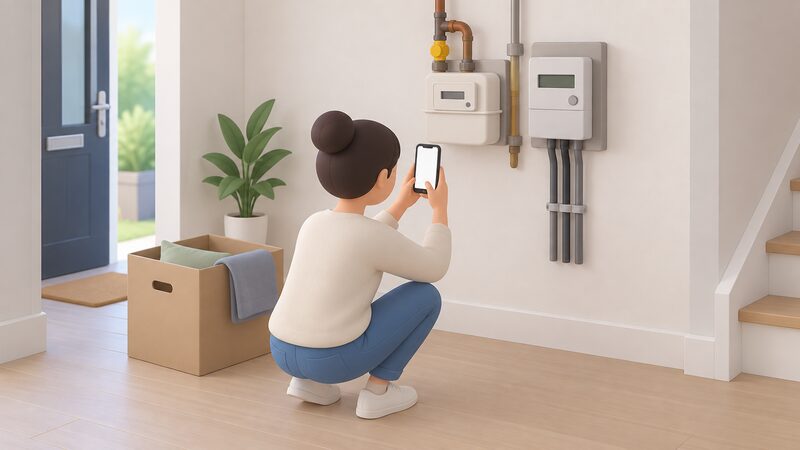
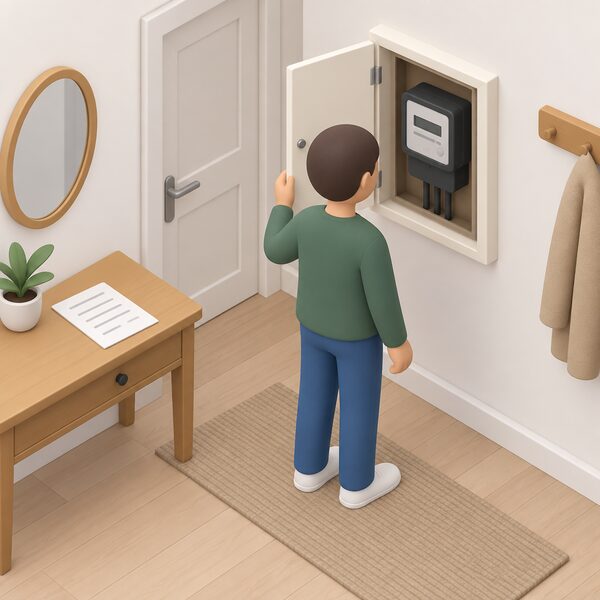
The practical steps are short. Give your supplier at least 48 hours' notice before you move out, so it has time to act1. Take a meter reading on the day you move in and give it to the supplier, so the previous occupier's usage is not billed to you1. If you are moving into a home with a prepayment meter, speak to the supplier before topping up, because money paid onto a meter still registered to someone else may cover their energy rather than yours1.
Around eight million people in the UK have a prepayment energy meter, according to Ofgem figures cited by Uswitch, so a meter of that kind is a realistic thing to inherit2. Prepayment tariffs sit under the same price cap as standard variable credit tariffs, and the cap levels for July to September 2026 vary by region and by payment method2.
What happens to your energy account when you move house
The account you leave behind has two possible endings. Your supplier can transfer it to your new house if it offers that service, or it can close the account and issue a final bill1. Either way, the supplier needs time, which is why the 48 hour notice figure exists. Notice is not a licence condition with a fixed statutory period; it is consumer guidance, and the terms you agreed with your supplier govern what happens if you give less.
If you pay a supplier directly for the electricity or gas you use at home, you can choose to switch to a different supplier or tariff at any time, and that right does not disappear because you are moving4. Once you have chosen, suppliers must switch your electricity or gas supply from your old supplier to your new supplier within 5 working days4. That deadline matters most in the gap between moving in and choosing a tariff, because a deemed contract is usually a standard variable rate rather than the cheapest thing on offer.
If your supplier goes out of business during all of this, no action is required. Ofgem moves customers automatically to a new supplier and makes sure the energy supply is not interrupted4. The same protection applies whether you are mid-move or settled. A credit balance does not follow automatically; that is a separate process handled through the final bills and credit refunds route.
To compare tariffs after a move you need your postcode, the name of your current supplier, the name of your current tariff, the amount you pay per unit in kilowatt hours, and the amount of energy you use each year4. Without the last two, any comparison is guesswork.
Taking over the supply at your new home
The first job at a new address is finding out who supplies it. The previous owner's supplier becomes yours automatically on move-in, so the answer is usually whoever the last occupier used1. Once you know, speak to that supplier and give the initial meter reading from the day you moved in1. That reading is the dividing line between the previous occupier's usage and yours, and it is the single most useful piece of evidence if a bill later looks wrong.
Some homes are not on a domestic contract at all. If you move into a property supplied through a business contract, Ofgem advises checking who holds the energy contract, how energy charges are calculated, how much residents typically pay, whether charges are metered or estimated, whether you can choose your supplier or tariff, and whether it is possible to switch to a domestic contract6. Residents on a landlord's business contract may not have the right to choose their own energy supplier or switch suppliers themselves6. Where a resident does hold their own contract with an energy supplier, they may be able to switch their business energy supplier7.
Communal and heat network homes sit outside the standard domestic framework too, and Ofgem publishes separate guidance for alternative homes7. The practical consequence is the same in every case: establish the contract type before assuming you can shop around.
Meter types you may inherit: credit, smart and prepayment
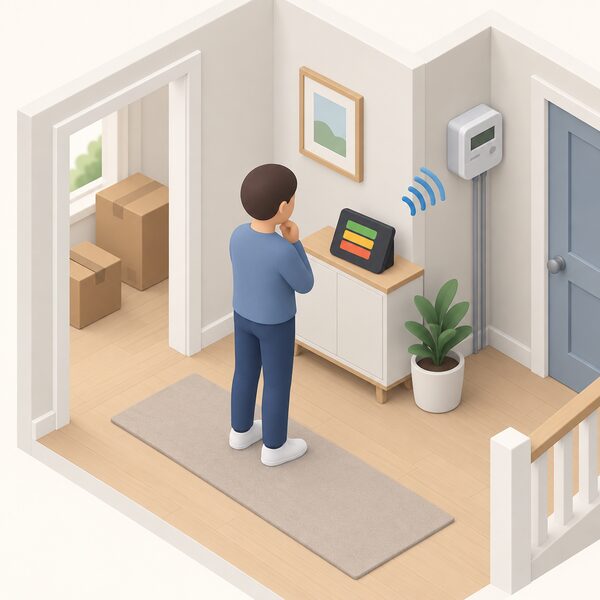
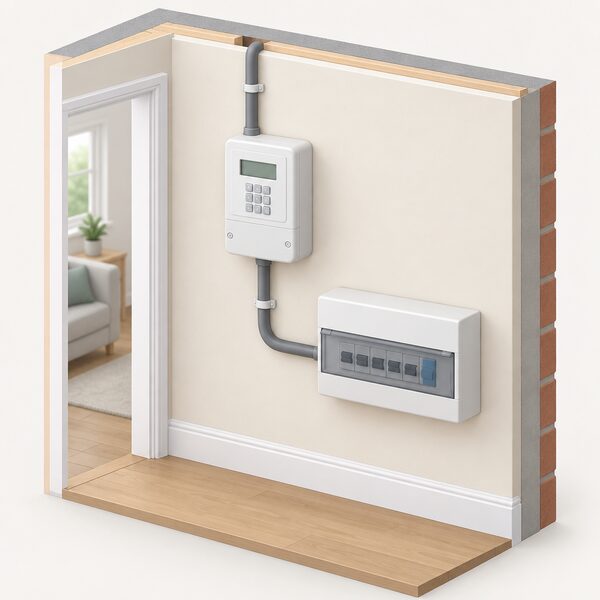
Three meter arrangements turn up in a home you have just bought or rented. A credit meter bills you after use. A smart meter records and reports consumption remotely. A prepayment meter requires payment in advance8. Prepayment itself comes in three main forms: key meters, smart card meters and smart prepayment meters2.
Smart meters are available to almost everyone. Whether you are on a pre-payment plan or renting, you can benefit from a smart meter, according to the Welsh Government's energy advice9. Private renters can choose a smart meter if the energy bills are in their name or they prepay for energy, after checking the tenancy agreement and letting the landlord know10. If you rent your home, the advice is to discuss any changes with your landlord, as each meter may form part of your tenancy agreement11.
Ofgem has been running home-move trials looking at proposals to switch existing smart meters into prepayment mode in situations of domestic customers moving homes12. That is a live policy area rather than a settled rule, and it matters to anyone inheriting a smart meter, because the meter's mode can in principle be changed remotely.
| Meter type | How you pay | What to check on move-in |
|---|---|---|
| Credit | After use, usually by Direct Debit or on receipt of bill | Opening reading, tariff name, whether a fixed term is running |
| Smart | After use or in advance, depending on mode | Whether the in-home display is present and the meter is communicating |
| Prepayment | In advance, by key, card, token or app | Which shops or apps accept top-ups, and any debt loaded on the meter |
Prepayment meters: how pay-as-you-go works
A prepayment meter lets you pay for electricity or gas in advance rather than after you have used it8. In Northern Ireland the same principle applies through a smart card, key or token, or sometimes coins, used to pay for gas or electricity as you use it13. The meter releases energy up to the value you have loaded, which makes budgeting predictable and removes the risk of a large quarterly bill arriving unannounced.
The trade-off is that the meter, not the supplier's billing system, is the gatekeeper. If the credit runs out and emergency credit is exhausted, supply stops. That is why the top-up network matters as much as the tariff. Electricity and gas meters can be topped up at recognised PayPoint or Payzone shops, or at the Post Office2. Smart prepayment meters can also be topped up through a supplier's app or online account, and the Welsh Government's advice notes that prepayment customers and renters can benefit from a smart meter for exactly this reason9.
If you lose a key or card, contact your supplier to get a new one sent out, and in the meantime the supplier should be able to authorise a temporary card from your nearest PayPoint, PayZone or Post Office2. Where the supplier has changed, the new supplier will give you information on how to get new key cards and tokens14. A replacement card or key can be sent by the supplier, which will also advise on what to do next1.
What a prepayment tariff costs: standing charges and the price cap
Prepayment tariffs are subject to the price cap in the same way standard variable credit tariffs are2. The cap does not set a single national price; it sets a maximum for standing charges and unit rates that varies by region and by how you pay. For gas, the benchmark maximum charges for 1 July to 30 September 2026 include a £101.33 standing charge and a £739.84 annual bill at 9,500 kWh in the Northern region, £99.53 and £745.22 in the South East, £99.16 and £761.19 in the Southern region, £99.68 and £757.41 in the Southern Western region, £102.62 and £760.20 in London, and £100.04 and £725.94 in the East Midlands3.
For electricity on prepayment, the standing charge was 57.19p per day in the July to September 2026 period2. The Welsh Government's price cap explainer gives a typical annual figure of around £1,711 for a pre-payment meter for 1 January to 31 March 202615. Older cap levels show how far the numbers move: for 1 April to 30 June 2024, the gas cap at 12,000 kWh per annum on prepayment was £783.60 in the Southern region and £767.79 in the Eastern region16.
The regional spread is not arbitrary. Standing charges recover the fixed cost of connecting a property and maintaining the network, and those costs differ by area. A household moving from one region to another can therefore see the same usage produce a different annual figure. Tariffs offered by energy suppliers may include a standard variable tariff, a renewable energy tariff, an electric vehicle tariff, a fixed price, and prepayment energy tariffs17.
| Region (gas, prepayment) | Standing charge | Annual bill at 9,500 kWh |
|---|---|---|
| Northern | £101.33 | £739.84 |
| South East | £99.53 | £745.22 |
| Southern | £99.16 | £761.19 |
| Southern Western | £99.68 | £757.41 |
| London | £102.62 | £760.20 |
| East Midlands | £100.04 | £725.94 |
All figures cover 1 July to 30 September 20263.
Emergency credit and self-disconnection
Most prepayment meters have an emergency credit budget you can use, like an overdraft, but it is limited2. The amount is set by the supplier and the meter type rather than by a single national figure, so a household moving into a prepayment property should establish the emergency credit limit and how it is repaid before relying on it. Debt can build on a prepayment meter if you have used some or all of your emergency credit, missed a standing charge payment, or are on a repayment plan2.
Where a supplier installs a prepayment meter without permission, it must give you £30 credit once it has installed the meter or remotely switched your existing meter to prepayment mode5. That credit is a consumer protection rather than a discretionary gesture.
Self-disconnection is treated seriously in the rules. Authorised heat network suppliers are obliged to offer a reasonable amount of additional support credit in a timely manner where a prepayment consumer has self-disconnected or self-rationed in circumstances in which any occupant of the household is in a vulnerable situation19. Suppliers can provide temporary extra credit if needed, while councils can supply fuel vouchers2. For households in debt, supplier schemes and grants can cover energy costs, paying off energy debt, and making energy-saving improvements to the home20.
Debt on the meter: how repayments are taken and how to negotiate
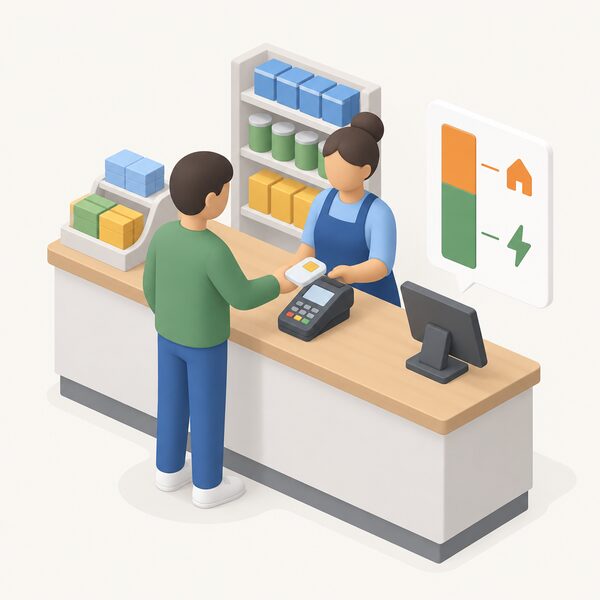
A prepayment meter recovers debt through the meter itself. As well as paying the unit rate for the energy you use, you pay a little extra to go towards what you owe2. That structure means the debt is cleared gradually and automatically, but it also means the meter absorbs part of every top-up before any energy is released.
The legal basis for recovering certain sums through a prepayment meter is set out in the Electricity (Prepayment Meter) Regulations 2006. A prepayment meter may be used to recover a sum owed to a gas or electricity supplier by a customer for gas supply, electricity supply, gas meter provision or electricity meter provision at premises previously owned or occupied by the customer, and for gas meter provision or gas supply at the premises where the meter is installed22. That is a narrow, defined power rather than a general right to load a new occupier with someone else's bill.
Two other mechanisms attach costs to a property rather than a person. Under the Green Deal, payments in instalments are made by the person liable to pay the energy bills, to the relevant energy supplier through the energy bills, recoverable as a debt, and held by the supplier as agent and trustee for the person who made the improvements23. The charge stays on the energy meter, so if the person moves, the charge stays with the house, and the next occupant picks up the payments24. A buyer or renter should therefore ask directly whether a Green Deal or similar charge sits on the meter.
Switching while in debt has limits. If you have a prepayment meter and you owe your supplier up to £500, you can still switch4. If a household using a credit meter has owed money to their supplier for more than 28 days, it cannot switch supplier until it has repaid what it owes25. Where the debt is under 28 days old, any money owed to the old supplier should be added to the final bill4. Suppliers are expected to review current payments and debt repayments as circumstances change20.
Switching from prepayment to a credit meter
Switching from an existing gas or electricity prepay meter to a smart credit meter is straightforward for customers who want it, according to Ofgem11. The conditions are financial rather than technical. Uswitch reports that suppliers will likely require that your account is debt-free and, in some cases, that the account holder passes a credit check2. Tenants on prepayment can move to paying by credit if they do not owe money to the energy supplier26.
Renters face one extra step: you will need the landlord's permission to change the meter2. That is because the meter may form part of the tenancy agreement11. Where a supplier switches an existing supply meter to prepayment mode without the consumer's consent, it must ensure the consumer receives prepayment meter credit, unless that is technically infeasible or otherwise outside the supplier's control19.
The direction of travel matters for a household's independence. A credit meter with a smart meter attached gives a household the widest choice of tariffs and payment methods, and it removes the physical top-up trip. A prepayment meter keeps budgeting tight but narrows the tariff market and puts the supply at the mercy of a top-up. Neither arrangement changes the underlying dependence on a supplier and a network; both simply change how the relationship is administered.
Renters: what you can and cannot change
If you have to pay your energy bills, you can choose to switch your supplier or tariff at any time4. That right applies to tenants who pay the supplier directly, and it includes switching with a prepayment meter26. You cannot switch energy supplier or tariff yourself if your landlord pays the energy supplier for you26. In that situation your landlord might agree to switch, but does not have to26.
Where a supplier wants to install a prepayment meter, it might install a smart meter in prepayment mode, or switch an existing smart meter to prepayment mode26. That is a change to the meter rather than the tariff, and it is governed by the same vulnerability and suitability rules that apply to any involuntary installation.
For anyone in a rented home, the supplying rented homes and landlord meters page sets out the wider framework of tenant rights and landlord meters. The short version for a move is that the name on the account determines who can switch, and the tenancy agreement determines what can be done to the meter itself.
When a prepayment meter is not safe or practical
A supplier must not install a prepayment meter if there are any vulnerable people in the household5. The prohibited circumstances include terminal illness or severe health condition, dependence on a continuous energy supply for medical equipment, everyone in the household being 75 or over with no support, a child under 2, no one able to top up due to a physical or mental health condition, or temporary circumstances such as pregnancy or bereavement that make a prepayment meter unsafe or unsuitable5.
Before any involuntary installation, the supplier must visit the home to understand the circumstances and check whether a prepayment meter is safe and suitable for the household5. The supplier must not proceed with the installation or the switch unless it has made the necessary arrangements to ensure it would be safe and reasonably practicable for a relevant consumer to use a prepayment meter19.
If a meter cannot be moved, the supplier must replace it with a different type of meter8. That obligation matters for anyone who inherits a prepayment meter in a position that makes topping up impractical, for example a meter box that is inaccessible or a property where the occupant cannot physically reach it.
If a problem with a meter is not resolved, the complaint route is defined. Contact your energy supplier about late, incorrect or missing bills, back billing, being overcharged, a faulty meter, poor customer service, or refusing to refund credit from your account28. If you suspect an issue with your smart meter, or your energy supplier identifies an issue, the supplier should promptly investigate it, resolve it themselves or with third parties, and keep the consumer informed29. Beyond the supplier, the complaining about an energy supplier page covers the escalation path and the Energy Ombudsman.
Sources29 cited
- Moving house energy checklist, Energy Saving Trust, 2026
- Prepayment meters guide, Uswitch, 2026
- Energy price cap levels, 1 July to 30 September 2026, Ofgem, 2026
- Switch your home energy supplier, Ofgem, 2026
- Installing a prepayment meter without your permission, Ofgem, 2026
- If you live in a home or business on an energy contract, Ofgem, 2026
- Alternative homes energy guidance, Ofgem, 2026
- Get help with your prepayment meter, Ofgem, 2026
- Smart meters, Welsh Government, 2026
- Smart meters, Energy Ombudsman, 2026
- How to get a smart meter, Smart DCC, 2026
- Debt strategy update: supporting reduction in energy debt, Ofgem, 2025
- Overdue utility bills, nidirect, 2026
- What happens if your energy supplier goes out of business, Ofgem, 2026
- Energy price cap explained, Welsh Government, 2026
- Default tariff cap level, 1 April 2024 to 30 June 2024, Ofgem, 2024
- Problems with services, Isle of Anglesey County Council, 2026
- Check energy suppliers can install prepayment meters without household permission, Ofgem, 2026
- Heat networks consumer protections draft guidance, Ofgem, 2025
- Getting help if you can't afford your energy bills, Ofgem, 2026
- The Electricity and Gas (Energy Company Obligation) Regulations 2020, legislation.gov.uk, 2020
- The Electricity (Prepayment Meter) Regulations 2006, legislation.gov.uk, 2006
- Energy Act 2011, legislation.gov.uk, 2011
- Minor consequential improvements, Part L Building Regulations, Parliament, 2012
- Tackling fuel poverty in Scotland, Scottish Government, 2021
- Switching energy supplier if you're a tenant, Citizens Advice, 2026
- Prepayment meters consumer guidance, Ofgem, 2026
- Complain about your energy supplier or network operator, Ofgem, 2026
- Smart meters: your rights and expectations, GOV.UK, 2025
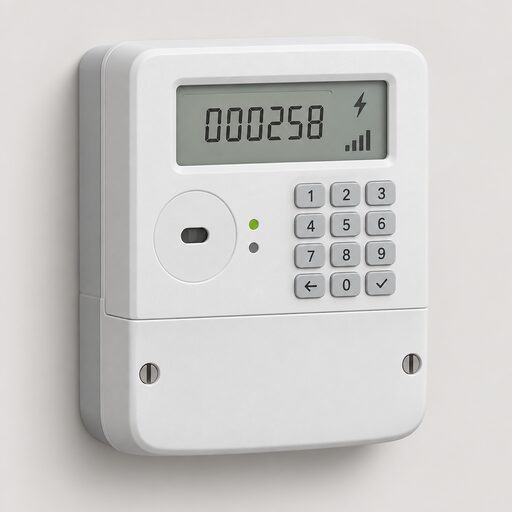 Moving Home Energy ChecklistThe immediate energy tasks on moving in: finding the supplier and meters, taking opening readings, checking whether the meters are smart, setting up billing, prepayment top-ups, the Priority Services Register, and your rights as a buyer or renter.
 Switching SupplierHow long does switching energy supplier actually take, and what happens if you owe money?
 Supplier Apps and AccountsWhat can you actually do in your supplier's app?
 Rented Homes and Landlord MetersWho is responsible for the energy in your rented home?
 Prepayment Meters and DebtCan your energy supplier force you onto a prepayment meter because you owe them money?
 Where to Start If You RentRenting means you can switch supplier or get a smart meter yourself, but insulation, glazing and heating need your landlord's agreement.